


Editors and agents will tell you: dialogue is the fastest way they decide whether to keep reading. Strong dialogue makes a chapter feel alive in three lines. Weak dialogue makes even an exciting plot feel cardboard. The good news—dialogue is one of the most learnable parts of fiction craft, because the rules are concrete and the fixes are mechanical.
The Three Jobs of Every Dialogue Line
Every line of dialogue should do at least two of these three jobs at once: reveal character, advance the plot, and create or release tension. If a line does only one, cut or rewrite it. If it does all three, you've written a great line.
What Dialogue Is Actually For
Before fixing dialogue mechanics, get clear on what dialogue must accomplish in fiction. Click each function to see how it works.
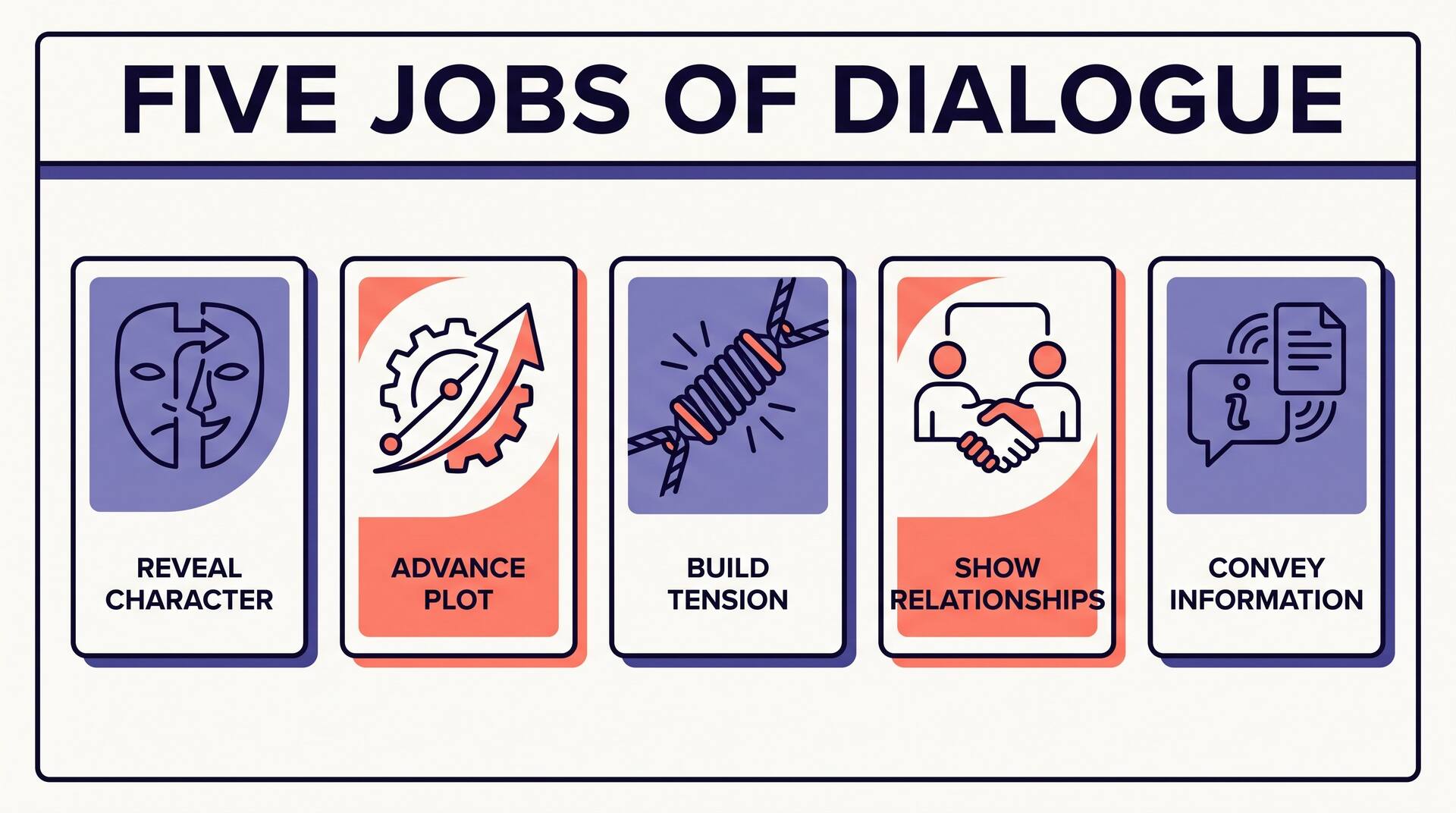
Character Voice
Dialogue is the fastest, most economical way to communicate personality. Word choice, sentence length, rhythm, and what a character refuses to say all expose interior life faster than a paragraph of description.
Dialogue Tags and Attribution
The mechanics of attribution are simple, but they trip up most first drafts. Get these right and your dialogue stops feeling amateur on contact.
Said Is Invisible. Use It.
'Said' and 'asked' read as transparent—readers process them as punctuation, not as words. Substituting 'opined,' 'expostulated,' 'chortled,' or 'ejaculated' draws attention to the tag instead of the line. Reserve fancy tags for rare, deliberate effect.
"I'm not coming," she said.
"I'm not coming," she expostulated emphatically.
Use Action Beats Instead of Tags
An action beat replaces a tag and does double duty—identifying the speaker while also showing what they're doing, which often reveals what they're feeling. Aim for action beats over tags whenever the action adds meaning.
She closed the laptop. "I'm not coming."
"I'm not coming," she said sadly.
Avoid Adverbs on Dialogue Tags
'She said angrily,' 'he whispered nervously.' If the line itself doesn't communicate the emotion, the line is the problem—not the tag. Adverb-on-tag is almost always a place to rewrite the dialogue or replace the tag with an action beat.
His voice dropped. "Get out."
"Get out," he said angrily.
Drop the Tag When the Speaker Is Obvious
In a two-person scene, you usually need a tag every three to four lines, not on every line. Once readers know who's speaking, they keep tracking automatically. Excess tags make a scene feel slow and over-explained.
"Don't lie to me." "I'm not." "Then look at me."
"Don't lie to me," she said. "I'm not," he said. "Then look at me," she said.
Building Distinct Character Voices
If you can cover the dialogue tags and still tell who's speaking, you've nailed character voice. Five reliable techniques.
Vocabulary and Education
A surgeon, a teenager, and a retired sergeant choose different words for the same idea. Build a small vocabulary signature for each major character—five to ten word patterns they reach for, and a few they would never use.
Sentence Rhythm
Some characters speak in fragments. Some build long, looping sentences. Some never finish a thought. Rhythm is more identifying than accent—and far less risky to write.
What They Avoid
Voice is partly defined by topics a character will not discuss, words they refuse to use, and questions they deflect. The pattern of avoidance reveals as much as anything they say outright.
Tics and Verbal Habits
A nervous laugh after every serious sentence. The repeated 'look,' that opens an argument. A character who answers questions with questions. Use one or two tics per major character—more than that becomes parody.
Status and Power
Characters who hold power talk in shorter sentences and ask fewer questions. Characters seeking approval explain more, hedge more, and end statements with implicit upspeak. Status shifts during a scene should change how characters talk.
Subtext: Saying Less, Meaning More
Subtext is the invisible layer underneath the words. It is also the difference between dialogue that sounds like a script and dialogue that sounds like life.
Step 1: Decide What Each Character Actually Wants
Before drafting a scene, write one sentence per character: what they want from this conversation right now. Not their life goal—their goal in this exchange. Subtext lives in the gap between the want and the words.
Step 2: Have Them Want Different Things
If both characters want the same thing from the conversation, you have an interview, not a scene. Misaligned wants generate friction even when the surface conversation is polite.
Step 3: Write the Surface Conversation About Something Else
Two parents arguing about their child's grades are usually arguing about whose fault it is. A couple discussing dinner plans on a bad day is rarely discussing dinner. Pick a surface topic that allows the real conflict to leak through.
Step 4: Use Body Language and Silence
Beats of silence, broken eye contact, and small physical actions carry the unsaid. A character who turns away mid-sentence has just given you half the scene's emotion for free.
Step 5: Resist the Urge to Translate
First-draft writers tend to clarify the subtext on the page ("What I mean is, I'm scared"). In revision, cut those lines. Trust readers to feel the gap—that's where the emotional payoff is.
Using AI to Strengthen Dialogue
AI is unusually good at dialogue because the patterns are explicit and improvements are mechanical. Use it as an editor on demand.
Paste a flat exchange and ask AI to rewrite each line with subtext, given each character's goal in the scene.
Generate three voice variants for the same line so you can hear which sounds most like your character.
Have AI flag every adverb-on-tag and every on-the-nose line in a scene, with suggested rewrites.
Use AI to draft alternate openings for a stalled dialogue scene—often the line you need is the third option, not the first.
Generate believable interruptions and reactions to break up overly long speeches.
AI excels at dialogue mechanics but cannot invent the deep specificity of your characters' real lives. Use AI to stress-test and tighten—then bring the lived detail only you know.
Seven Common Dialogue Mistakes
On-the-Nose Dialogue▾
Characters announcing exactly what they feel and exactly why. Real people deflect, joke, redirect, and lie. On-the-nose dialogue is the single biggest tell of an early draft.
Fix: For each emotional line, ask: what would this person say if they were trying not to say this? Use that line instead.
Maid-and-Butler Dialogue▾
Two characters explaining things to each other that they would both already know, only because the reader doesn't know yet. 'As we discussed last Tuesday at the council meeting...'
Fix: Drop the information into action, observation, or partial dialogue from a character who genuinely doesn't know it. Let the reader catch up.
Phonetic Accents and Dialect▾
Spelling out accents ('I dinnae ken what ye mean') reads as caricature on the page and often borders on offensive. Dialect should come from word choice, rhythm, and idiom—not from misspelling.
Fix: Pick three or four authentic phrases or grammar patterns per dialect character. Drop the phonetic spelling entirely.
Speeches Instead of Conversations▾
One character delivers a paragraph-long monologue while the other nods. In real conversations, listeners interrupt, redirect, push back, and react in real time.
Fix: Break long speeches with reactions, interruptions, questions, or physical beats. If the speech genuinely needs to stand whole, justify it with a strong reason in the moment.
Identical Voices▾
Every character sounds like the author. The same vocabulary, the same rhythm, the same jokes. Once a reader notices it, the cast collapses into one voice.
Fix: Read a chapter aloud, covering tags. If you can't tell who is speaking, give two characters opposing voice signatures (one terse, one loquacious; one literal, one ironic) and rewrite.
Naming the Person You're Talking To▾
'Listen, Jennifer, I think we should...' Real people almost never use the name of the person they're addressing. It's a screenwriting hack to remind the audience who's on screen, and it reads as artificial in fiction.
Fix: Cut every name address unless it's emotionally loaded—a parent angry at a child, or a name said softly during a confession.
Dialogue Without Setting▾
Two heads in white space, talking for pages. Without grounding in physical setting, even great dialogue starts to feel disembodied.
Fix: Anchor dialogue scenes in environment. Have characters interact with objects, weather, and movement. The setting should react to the conversation.
Dialogue Formatting Rules
Standard manuscript formatting in English fiction. Get these right—editors notice immediately when they're wrong.
- Each new speaker starts a new paragraph, even if their line is only one word.
- Use double quotation marks for spoken dialogue (US) or single quotes (UK)—pick one and stay consistent.
- Place commas and periods inside the closing quotation mark in US style.
- If a tag follows the dialogue, end the dialogue with a comma, not a period: "I'm leaving," she said.
- If an action beat follows, end the dialogue with a period: "I'm leaving." She picked up her coat.
- Use em dashes for interrupted speech: "But I—" / "Don't."
- Use ellipses for trailing speech: "I just... I don't know."
- When one character speaks across multiple paragraphs, open every paragraph with a quotation mark but only close it at the very end of the speech.
Dialogue Revision Checklist
Run every dialogue scene through this checklist before declaring it done.
Write the Conversation Only Your Characters Could Have
Strong dialogue is built, not born. Almost every great-sounding line in published fiction is the result of revision—first drafts are full of explanation, mismatched voices, and floating heads. The writers you admire revise dialogue the same way you do; they just do it more often.
Pick one scene from your current manuscript today. Run it through the checklist above. Cut every adverb tag, replace half your tags with action beats, and find the line where someone says exactly what they feel—then rewrite it as the line they would actually say. That single pass will lift the chapter further than any plot fix.