

Why email beats social media for authors
A social post reaches whoever the algorithm decides to show it to, which is often a small fraction of your followers. An email lands in the inbox of every subscriber who has not unsubscribed. When a book launches, that difference decides whether your first week of sales comes from people who already like your work or from strangers you are paying ads to reach.
Early sales matter more than later ones because retailers rank books by recent velocity. A list of a few hundred engaged readers who buy in the first days can push a new release into category charts, where strangers start finding it. That is why experienced indie authors often say the list is the business.
You own it
No algorithm change can take your subscribers away.
It compounds
Every book you publish grows the list, and the list sells every next book.
It is direct
You can ask readers questions and get real answers.
Social media still has a job: it introduces you to new readers. The goal of most social activity should be to move those readers onto your list. For the full channel mix, see our guide to book marketing for self-published authors.
Start with a reader magnet
Nobody wants to 'join a newsletter'. Readers will happily trade an email address for something they want. That something is called a reader magnet: a free piece of your writing given in exchange for signing up.
A prequel novella
Fiction seriesA short story set before book one. It introduces the world and characters and ends with readers wanting the series.
Bonus scenes
Romance and fantasyAn extra epilogue, a scene from the other character's point of view, or a deleted chapter for readers who finished the book.
The first chapters
Any new releaseA free preview of the opening chapters. Readers who like the start are your warmest buyers.
A practical toolkit
Non-fictionA checklist, workbook or template that applies the book's method. It proves your expertise in five minutes.
The best magnet is closely tied to the book you want people to buy next. A generic freebie attracts freebie collectors; a prequel attracts readers of that exact series.
If you write in AIWriteBook, a short prequel or bonus story can be drafted from the characters and world of your existing book with the chapter generator, so it keeps the same voice and continuity.
Where readers sign up
A magnet only works when readers see it. Put the offer in the places where people who already like your writing are standing.
- The back of every book
- The highest-converting spot. A reader who just finished your book is at peak interest. Add a short invitation and a link right after the last chapter.
- The front matter
- A one-line offer before chapter one catches readers who sample the book in the store preview.
- Your author page
- A single page with your books, your bio and a signup form, linked from every social profile.
- Social bios and posts
- One link in every bio, and an occasional post that offers the magnet directly.
- Group promotions
- Newsletter swaps and shared giveaways with authors in your genre bring in readers who already buy similar books.
AIWriteBook's author page is built for this: it shows your books, captures reader emails, and can gate a free chapter preview behind signup, so the magnet and the form live in one place you control.
The welcome sequence: your most important emails
A new subscriber is never more interested than in the minutes after signing up. A welcome sequence is a short series of automatic emails that delivers the gift, introduces you and turns a stranger into a reader who opens your emails. Most email platforms let you set it up once and let it run for every new subscriber.
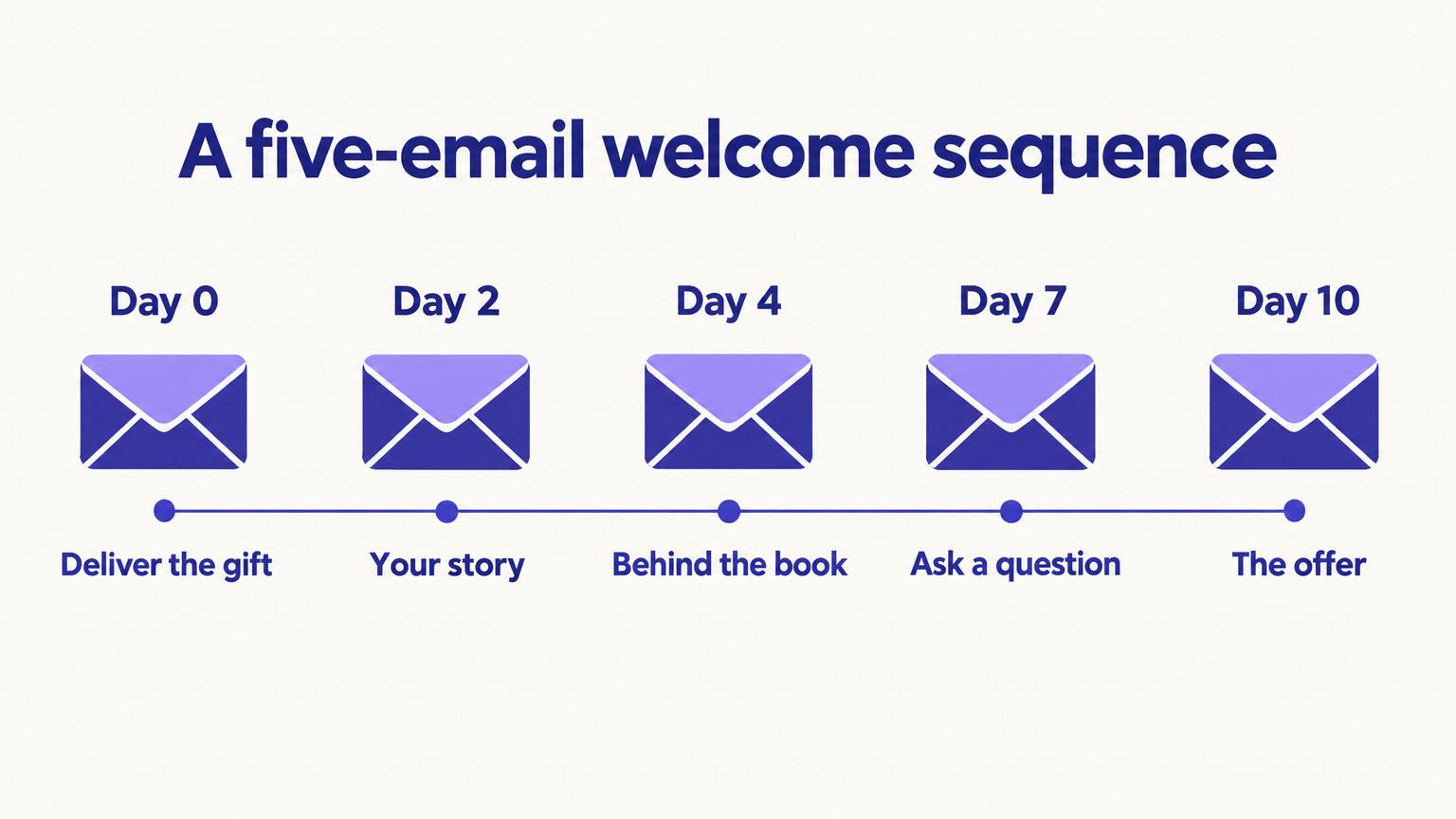
Here is a simple five-email structure that works for fiction and non-fiction alike:
- Day 0
Deliver the gift
Send the magnet immediately with a warm two-line hello. Tell them what kind of emails to expect and how often.
- Day 2
Your story
Why you write what you write. Keep it short, personal and specific.
- Day 4
Behind the book
An inspiration, a research detail or a character secret. Readers love feeling like insiders.
- Day 7
Ask a question
Ask what they read or what they struggle with. Replies teach you about your readers and help deliverability.
- Day 10
The offer
Recommend the book they should read next, with a direct link to buy it.
You can draft all five emails in minutes with the free email sequence generator, then rewrite them in your own voice. Short and human beats polished and long.
What to send every month
Between launches, the job of your newsletter is to keep readers glad they subscribed. Once or twice a month is enough for most authors. Consistency matters more than frequency: a list that hears from you every few weeks remembers you when the next book lands.
Keep each email about one main thing, with one clear link. Readers skim inboxes on phones; a single idea and a single action are easier to act on than a crowded digest.
Some authors turn their most engaged subscribers into paying supporters with early chapters and bonus content. If that interests you, our guide to Patreon for writers shows how that works alongside a free list.
Launch emails that sell
A launch is where your list pays off. Plan a short campaign instead of a single 'it is out' message, because not everyone opens every email.
| 4 weeks before | Cover reveal and release date. Invite readers to join an advance reader team for early copies in exchange for honest reviews. |
| 2 weeks before | Share the first chapter and the preorder link if you have one. |
| Launch day | The main announcement: the hook, the cover, the buy link. Nothing else in the email. |
| 3 days after | A reminder for people who missed it, with a line from an early review. |
| 1 week after | A thank-you, a gentle request to leave a review, and a last call on any launch price. |
For the bigger picture of a release, including ads, advance readers and pricing, read our book launch strategy guide. AIWriteBook's author page can also send launch broadcasts to the readers it has collected.
Numbers worth watching
Email platforms show dozens of numbers. A handful tell you whether the list is healthy.
Signup rate
How many readers who see your offer join
If it is low, improve the magnet or move the offer higher in the back matter.
Click rate
How many subscribers click a link
The best signal of real interest, and a closer proxy for sales than opens.
Unsubscribe rate
How many leave after each email
A small steady trickle is normal. A spike means an email missed the mark.
Sales after a send
Changes in sales in the days after an email
The number that matters most. Compare launch emails to each other over time.
Open rates have become less reliable because some email apps load images automatically, so treat them as a rough trend rather than an exact figure. Clicks and sales tell the truth.
Consent, unsubscribes and the rules
Only email people who asked to hear from you. Never add readers from a contest list, a conference badge scan or a purchased list without clear permission. Besides being against the law in many countries, it hurts deliverability for everyone else on your list.
Every email needs a working one-click unsubscribe link and your contact details in the footer. Reputable email platforms add both automatically. Say clearly on the signup form what readers will receive, and keep that promise.
Clean your list once or twice a year by removing subscribers who have not opened or clicked in many months, after a final 'still want to hear from me?' email. A smaller list of real readers sells more than a large list of ghosts.
Author email list questions
Before the first book is out, ideally. Even a few dozen subscribers who signed up from early chapters or a magnet give your launch a starting crowd. If you already have books out, start today and add a signup link to the back of each one.
Once or twice a month works for most authors, with more frequent emails during a launch. The most important thing is to stay regular, so readers recognize your name when the next book arrives.
A prequel story or bonus scene from the series you want readers to buy. It should be short, satisfying and connected to the next book, so it attracts readers of your genre rather than collectors of freebies.
Most email platforms have a free tier that is enough for a small list, with paid plans as the list grows. Choose one that supports an automated welcome sequence, a signup form and a one-click unsubscribe.
Put the offer in the back of every book, use a magnet tied to your next release, and join newsletter swaps or group promotions with authors in your genre. Readers who already buy similar books convert best.
Every book should grow the list
Treat each book as a front door to your list, and each email as a way to keep readers glad they came in. Start small: one magnet, one signup page, five welcome emails. Then let every new release add readers who are waiting for the next one.
For the channels that bring new readers to that front door, see the full Book Marketing guide.