


What's in this guide
Why enemies to lovers dominates romance
Hate is not the opposite of love. Indifference is. Two characters who despise each other are already doing the one thing romance requires: paying obsessive attention to each other. They track each other's moods, memorize each other's weaknesses, and think about each other constantly. The trope works because it front-loads intimacy and lets attraction arrive later, disguised as hostility.
It also solves a mechanical problem most romance drafts have: flat middle scenes. In an enemies to lovers story, every scene carries two currents at once — the surface conflict the characters admit to, and the attraction they don't. A budget meeting, a shared cab, a sword-training session: all of it crackles, because the reader is decoding subtext the characters are suppressing.
Finally, the payoff scales with resistance. Romance readers rate the kiss by how much it cost, and when two people with every reason to walk away choose each other anyway, the intimacy is earned — which is what readers reread. It's also why this trope punishes shortcuts harder than any other: skip a beat and the arc reads as whiplash. So don't skip beats. Here they are.
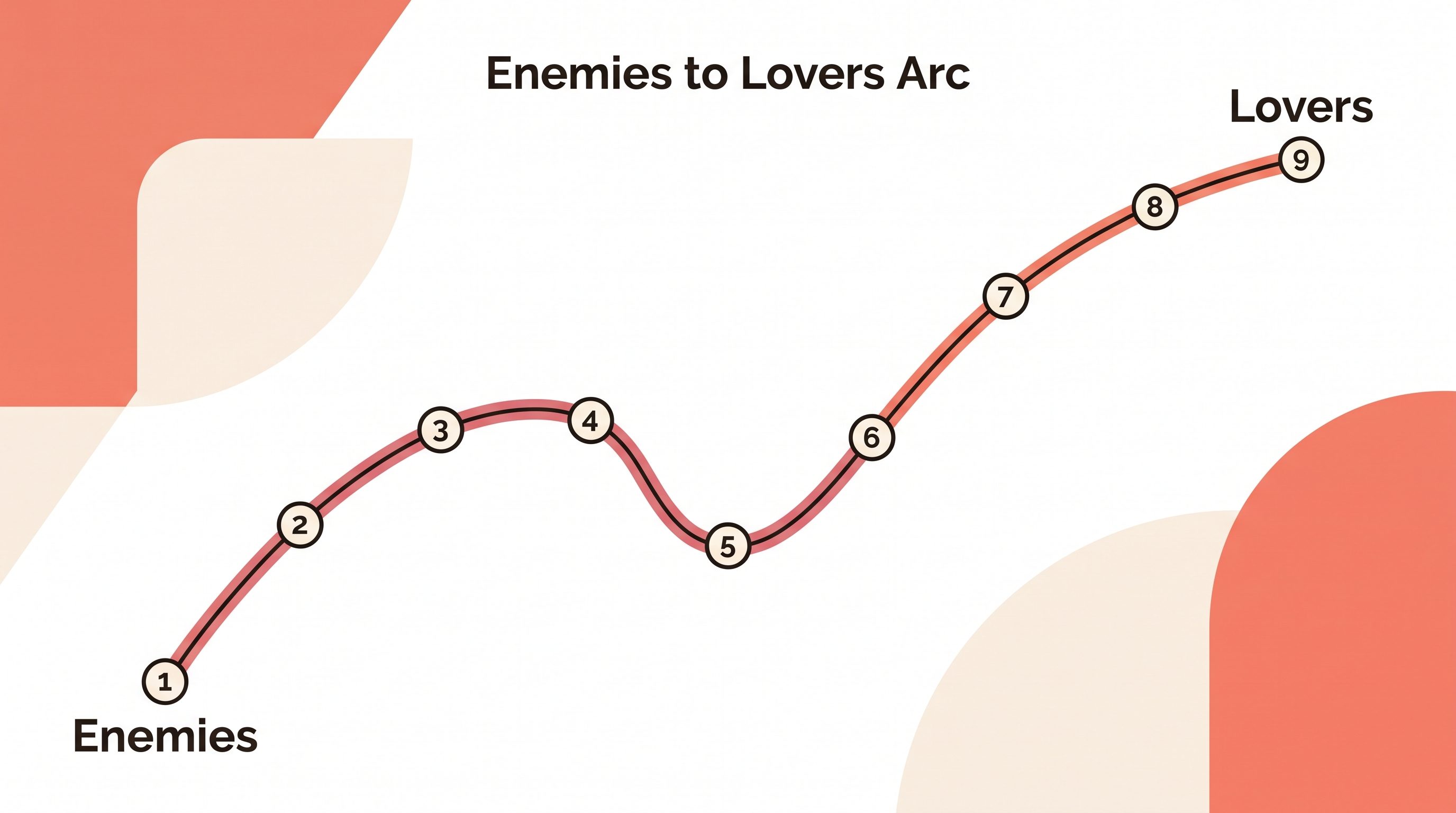
The 9-beat enemies to lovers beat sheet
Spread these across your structure however your genre demands — a 70,000-word contemporary romance usually lands beat 5 near the midpoint and beat 6 around 75%. What matters is that every beat gets at least one full scene. Each one below tells you what must happen, what the reader should feel, and one craft move that makes it land.
The collision
The leads meet — or re-meet — in a way that costs at least one of them something concrete: a promotion, a court case, a family's honor, a territory. The opposition is established as fact, not attitude.
What the reader should feel
Sparks, plus the delicious certainty that this specific person is going to be a problem.
Craft tip
Give both leads a legitimate grievance in the very first encounter. If only one of them is wronged, you've written a bully and a victim, not two enemies.
Forced proximity
An external structure locks them together: the same office, a binding contract, a quest, a wedding party, a war council. Neither can walk away without losing the thing they want most.
What the reader should feel
Dread and anticipation in equal measure — the reader knows exactly what this pressure cooker is for.
Craft tip
The proximity engine must be load-bearing. Ask: could either lead quit tomorrow at no real cost? If yes, the reader stops believing every scene they share.
Grudging respect
One lead catches the other being genuinely competent or unexpectedly decent — off-script, when they don't know they're being watched. The mental category 'enemy' develops its first inconsistency.
What the reader should feel
That quiet, gleeful 'oh no' — the reader spots the turn before the character does.
Craft tip
Respect must arrive through witnessed behavior, never through dialogue. One observed act of skill or kindness outweighs a page of a character telling us their enemy is impressive.
The crack in the armor
A moment of real vulnerability — exhaustion, grief, fear — makes the wound behind the hostility visible. The enemy becomes a person with a reason.
What the reader should feel
Sympathy re-sorting itself. The reader starts arguing the enemy's side.
Craft tip
Keep the hostility alive in the dialogue while the attraction leaks out through action. The gap between what they say and what they do is the tension — close it too early and the scene goes soft.
The almost-moment
A near-kiss, a near-confession, a touch that lasts a beat too long — interrupted, or deliberately broken by the more frightened of the two.
What the reader should feel
Kinetic frustration. If the reader doesn't mutter at the page here, the beat failed.
Craft tip
Let the interruption come from the original conflict itself — the rival firm calls, the rival court summons — not a random knock at the door. The plot should block the kiss, so the reader blames the conflict, not coincidence.
The betrayal
The original opposition detonates. A secret is exposed, a loyalty test is failed, one wins the case or the crown at the other's direct expense. Everything soft that was built gets weaponized or lost.
What the reader should feel
Gutted — while understanding exactly why both of them did what they did.
Craft tip
The betrayal lands hardest when it is the correct move inside the betrayer's stated loyalty. Right by their code, devastating anyway. A betrayal born of stupidity earns anger at the author; a betrayal born of principle earns heartbreak.
The dark night
Apart, each lead confronts two truths: what they actually lost, and where they were actually wrong. Not one truth. Both.
What the reader should feel
Grief with a pilot light of hope under it.
Craft tip
Force each lead to defend the other to a third party. The moment a character argues their enemy's side out loud is the precise moment the reader believes the love is real.
The choice
One lead sacrifices the very thing the conflict was about — the case, the claim, the promotion, the family's approval — and grovels in proportion to the harm done in beat 6.
What the reader should feel
Catharsis. The debt from the betrayal is paid on the page, in full.
Craft tip
The grand gesture must cost the exact currency of the original conflict. The ruthless lawyer throws the case; the rival heir renounces the claim. A bouquet and a speech cannot pay a debt that was denominated in ambition.
New equilibrium
Together — with the structural conflict resolved, not suppressed. The world that forced them apart has actually changed, and the sparring survives as play.
What the reader should feel
Earned warmth, and the sense that these two will be bickering happily in forty years.
Craft tip
Keep the banter in the final chapter. Readers came for the dynamic, not its removal — only the stakes of the sparring should change, never the voltage.
The #1 rule: the enmity must be structural
Here is where most enemies to lovers drafts die: the 'enmity' is a misunderstanding. He thinks she snubbed him at a party; she misheard what he said about her sister. Run one test on your premise — could a single honest conversation dissolve the conflict? If yes, you don't have enemies. You have two people avoiding a conversation for 300 pages, and readers smell it by chapter three.
Structural enmity means opposing goals, loyalties, or values: two lawyers on opposite sides of the same case, two heirs to one throne, two officers sworn to nations at war, two managers competing for the only promotion. One's win is, by the rules of their world, the other's loss — so no conversation can fix it. Only sacrifice can.
Structural opposition is built at the character level, before you draft a single scene. Both leads need an explicit goal, an explicit loyalty, and a wound that explains why they can't just let it go — and the goals have to genuinely collide. The fastest way to stress-test this is to write both profiles side by side; the free character creator lets you generate each lead's goals, flaws, and backstory and check that the collision is real before you commit to the premise.
One more layer separates good from great: map the external opposition onto internal wounds. The rival who fights dirty because she grew up with nothing versus the heir who follows rules because rules are all that ever protected him — now the conflict argues two worldviews, not two schedules. If you want a deeper toolkit for building leads whose natures clash productively, our guide to character archetypes and how to subvert them covers the pairings that generate friction on their own.
Five mistakes that sink enemies to lovers
These come up constantly in reader reviews of the trope — which means they are the exact things your readers are primed to punish.
The hate is flirting from page one
If the chapter-one banter is already charged and fun, there's no distance left to travel and the 'enemies' label is false advertising. Early scenes need teeth: something real at stake, words that actually wound, at least one exchange the leads will later have to apologize for.
Redemption without groveling
The betrayer gets forgiven off-page, or with a single 'I'm sorry.' Readers keep a ledger, and the apology must be witnessed, specific about the harm, and expensive. If you're unsure what visible change looks like on the page, study how published authors handle it — we break down the mechanics in our guide to dynamic characters and how their change is shown, not told.
The conflict evaporates at the midpoint
The leads kiss at 50% and the back half becomes established-couple fluff. The original opposition needs a second act — that is beat 6's entire job. If your conflict can't survive the first kiss, it was never structural.
A power gap played as romance without being addressed
Boss and report, captor and captive, prince and servant: the trope loves power imbalance, but the imbalance must be acknowledged in the text and leveled before the ending — the boss steps back from the review, the captive gains real leverage. Otherwise you've written coercion with a bow on it, and reviewers will say so.
Rushing the turn
Hate to love in a single scene reads as whiplash, no matter how good the scene is. Readers accept the flip only after respect (beat 3), vulnerability (beat 4), and an almost-moment (beat 5) have each had at least one full scene of their own. Three separate scenes is the minimum toll.
What the best-known examples nail
Four books, four beats executed at the highest level. Read each with the beat sheet open and the architecture becomes visible.
Pride and Prejudice — Jane Austen
The blueprint, and still the best beat 6 and 7 in the business: Darcy's first proposal doubles as an insult, and his letter afterward forces Elizabeth into a genuine dark night — rereading every scene of the book, and herself, in a new light.
The Hating Game — Sally Thorne
A masterclass in forced proximity and the almost-moment: desks facing each other, one promotion between two people, and escalating 'games' that let hostility and flirtation share every line of dialogue.
Red, White & Royal Blue — Casey McQuiston
Nails the collision and the structural stakes: a public cake disaster forces a PR 'friendship' between a First Son and a British prince, and the opposition is genuinely institutional — careers, crowns, and an election ride on the secret.
The Cruel Prince — Holly Black
Shows the trope working on hard mode: the power imbalance between a mortal girl and a faerie prince is explicit text, not subtext, and the grudging respect builds through political scheming rather than banter — proof the beats survive outside contemporary romance.
Drafting the arc with AI — without losing the tension
The beat sheet above is a spine, and a spine is exactly what AI is good at fleshing out — if you keep control of the turns. In AIWriteBook, start by generating your two leads with explicit opposing goals, then feed the nine beats into the outline builder so every chapter knows which beat it serves. You get a full chapter plan where the almost-moment and the betrayal land where you placed them, not where a model drifted.
The real leverage is in revision. Enemies to lovers scenes fail in inches — a line that's too warm too early, a glance that gives the game away in chapter four. AIWriteBook's chapter AI chat works on one chapter at a time and shows every suggested change as a diff you accept or reject: ask it to sharpen the hostility in an exchange while keeping the attraction in subtext, keep the three lines that crackle, reject the rest. Your voice stays; the voltage goes up.
And when a sparring exchange feels flat, test alternatives fast: the free dialogue generator will produce a version of the same confrontation you can mine for rhythms and comebacks before you rewrite the scene properly.
Put the beat sheet to work
Create both leads, map the nine beats onto a chapter outline, and revise every scene with accept/reject diffs — starting with your actual premise, today.
Your fill-in beat sheet template
Copy this into your notes and fill in the blanks for your premise. If any line resists being filled, that beat is where your outline is weakest — fix it before drafting.
- 1
Collision: ____ costs ____ something concrete when they first clash, because both believe ____.
- 2
Forced proximity: they cannot walk away from each other because ____, and leaving would cost ____.
- 3
Grudging respect: ____ witnesses ____ doing ____ when they think no one is watching.
- 4
Crack in the armor: the wound behind ____'s hostility is ____, and it shows when ____.
- 5
Almost-moment: they nearly ____, interrupted by ____ (which comes from the original conflict).
- 6
Betrayal: ____ chooses ____ over the relationship, because their code demands it.
- 7
Dark night: apart, ____ realizes they were wrong about ____, and defends the other to ____.
- 8
The choice: ____ sacrifices ____ — the exact thing the conflict was about — and grovels by ____.
- 9
New equilibrium: the world changed because ____, and their sparring now sounds like ____.
Pressure-test your draft
Tick each check you can honestly pass. Anything unticked is your revision list.
Enemies to lovers FAQ
The turn is earned one beat at a time
Enemies to lovers rewards writers who respect its machinery. Make the opposition structural, give every turn its own scene, let the betrayal be principled and the gesture expensive — and the trope does what no other setup can: it makes attention look like hate until the exact moment it can't anymore.
Print the template, run the nine checks against your outline, and start with beat 1. The collision scene is the promise your whole book keeps.
Explore the full Genre Fiction guide for more trope-level craft →