

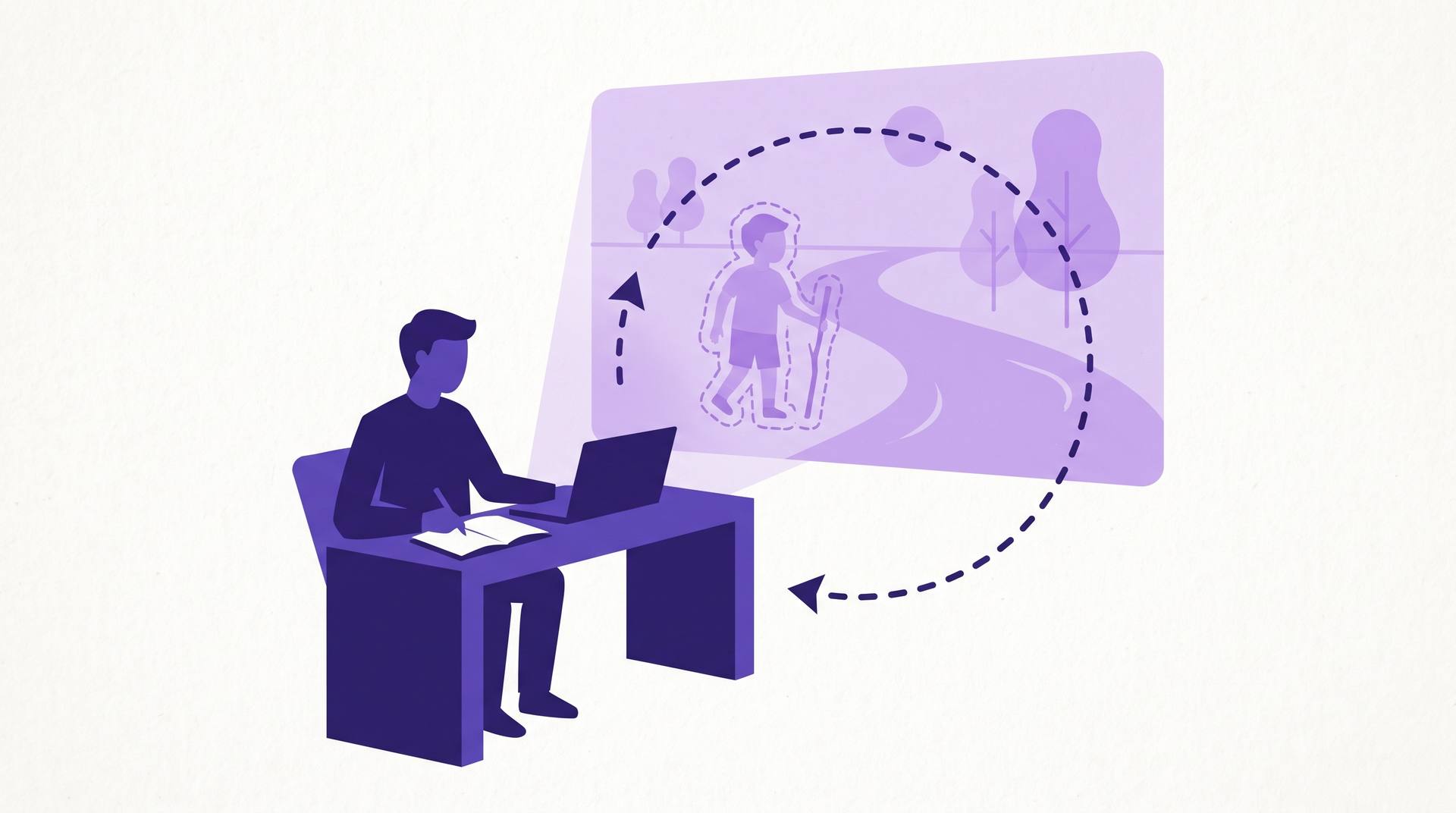
A flashback is the easiest device in fiction to attempt and one of the hardest to land. The attempt is easy because you already know the backstory — it is sitting in your head, fully formed, demanding to be told. The landing is hard because the reader does not want it yet. They want to know what happens next, and you have just pressed pause on next.
Everything below is about closing that gap: making the reader want the past before you hand it to them, then getting back to the present without a bump.
What a flashback actually is
Definition
A flashback is a scene set earlier than the story's present that interrupts the forward narrative, is dramatised rather than summarised, and returns the reader to the present when it ends.
The three conditions matter. If it does not interrupt, it is just chronological order. If it is not dramatised, it is backstory summary — a paragraph of exposition, which is often the better choice. If it never returns, it is not a flashback, it is the story.
That third condition is worth dwelling on, because it separates a flashback from a structure that merely starts late. A novel that opens at a funeral and then spends three hundred pages on the years before it is not flashing back — it has simply chosen a non-chronological shape, which is the territory covered in our piece on starting a story in medias res. A flashback is a round trip. You leave the present and you come back to it, usually within a chapter, sometimes within a paragraph.
The distinction has practical consequences. Round trips need a departure gate and an arrival gate. A one-way structural choice does not.
Four ways in, one way out
There are only four transitions worth using, and they differ in how much reader attention they cost. Pick by how deep the flashback goes and how long it lasts.
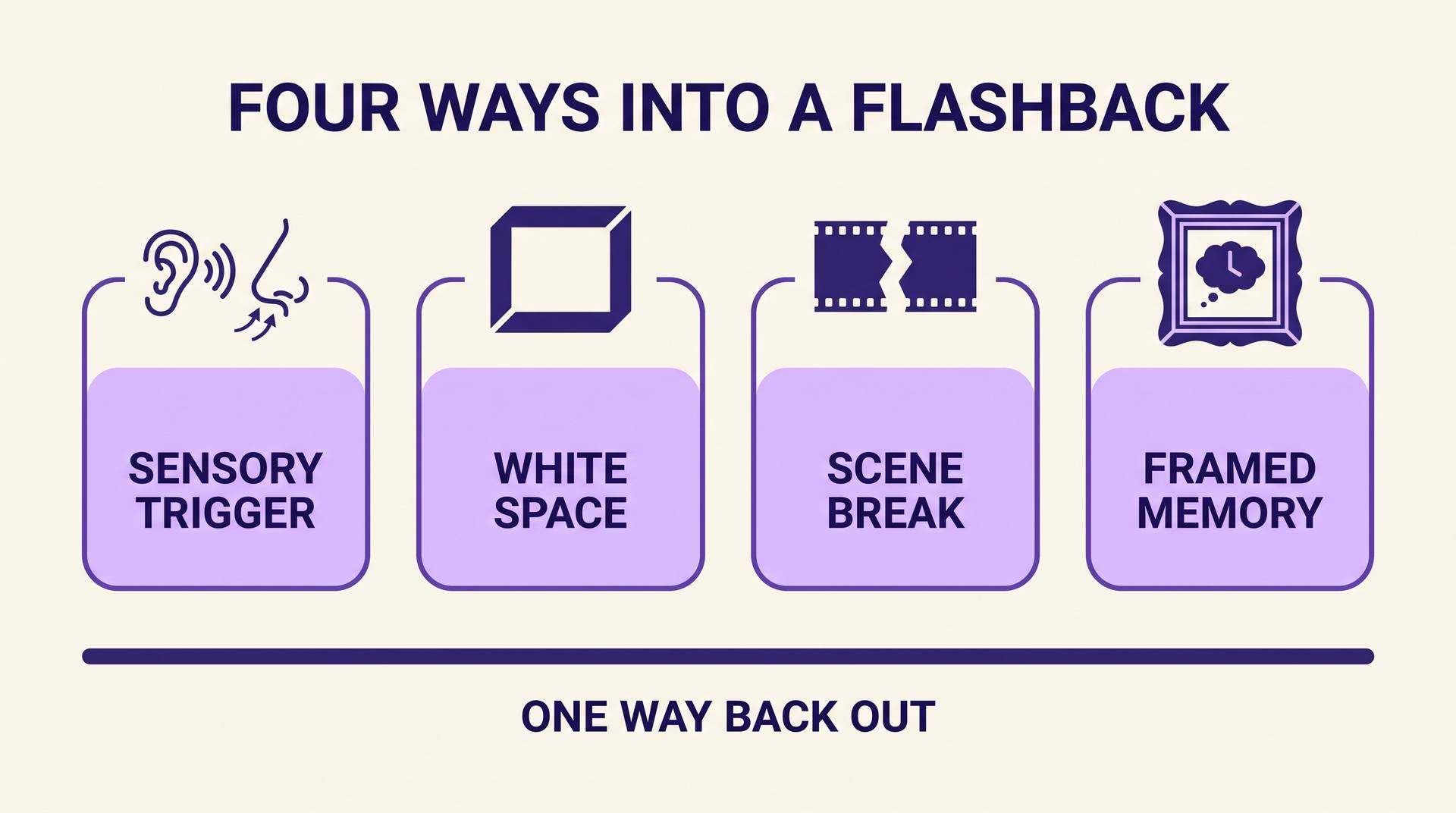
The sensory trigger
A smell, a sound, a phrase someone repeats. The present-day detail collides with a stored one and the character goes under. This is the most invisible entry and the most overused: burnt toast and dead mothers have done enough service. It works when the trigger is specific to this character and this past, not to memory in general.
White space
End a present-day paragraph, leave a line break, open the next paragraph in the past. No transitional sentence at all. Readers are far better at this than writers expect, provided the first line of the new paragraph anchors the time immediately — a date, an age, a season, a name that only existed back then.
The scene break
A hard break with a marker: a chapter heading, a dateline, a numbered section. This is the honest choice for a flashback longer than about a thousand words, because it tells the reader up front that they are being moved, and readers forgive a move they were warned about.
The framed memory
A character tells the past to another character, and the telling is itself a present-day scene with its own tension. Emily Bronte built Wuthering Heights (1847) this way: Nelly Dean narrates decades of Earnshaw and Linton history to a lodger who keeps interrupting, and her partiality is part of the story.
The exit is where most flashbacks fail, and there is really only one technique: return to the exact present-day detail you left from, changed. The cup of coffee is cold now. The other person in the room has stopped waiting for an answer. Readers navigate by object, not by tense — give them the same object on the way back and the seam disappears.
What does not work is the summary exit, the sentence that says She shook off the memory and returned to the present. It announces that the writer, not the character, has finished with the past.
The verb problem
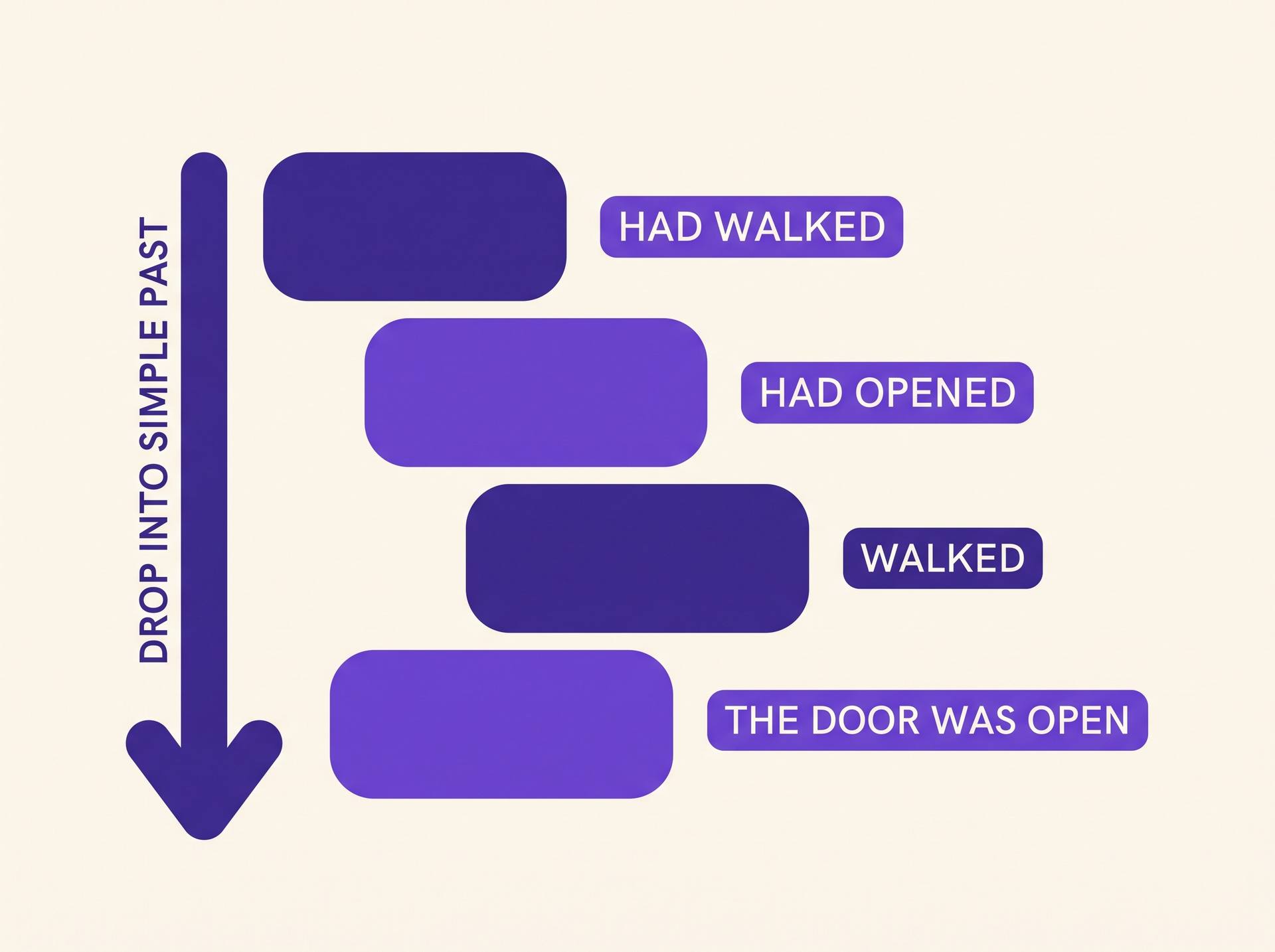
This is the mechanical question nobody answers clearly, so here it is. In a novel written in the simple past, a flashback technically belongs in the past perfect — had walked, had opened. But sustained past perfect is exhausting. Every sentence carries a spare auxiliary verb, and after half a page the prose reads like a deposition.
The professional solution is a ladder. Use past perfect for the first two or three verbs to establish that you have moved backwards, then drop into simple past for the body of the scene, then use one or two past-perfect verbs again at the exit to climb back. The reader registers the shift at the edges and stops noticing it in the middle, which is exactly what you want: they should be inside the earlier scene, not tracking its grammar.
Worked example
Heavy: She had driven to the house. She had parked under the elm. She had waited until the light in the upstairs window had gone out, and then she had walked to the door.
Laddered: She had driven to the house and parked under the elm. She waited until the light in the upstairs window went out. Then she walked to the door.
Two past-perfect verbs at the top, simple past from the second sentence on. The tense does the signalling once and then gets out of the way.
If your novel is in the present tense, the same ladder applies one step down: enter in simple past, run the scene in simple past, return to present. And if the flashback is a single sentence rather than a scene, leave it in past perfect entirely — a ladder needs somewhere to go, and one rung is not a ladder.
Flashbacks that earn their place
Four books that use the device differently, and what each one is actually doing with it.
The Odyssey — Homer
The oldest famous long flashback in Western literature. Odysseus, a guest at the Phaeacian court, is asked who he is, and answers with four books of narrative covering the cyclops, Circe and the underworld. The frame is doing real work: he is a stranger performing his own identity to hosts who can help or destroy him, so the telling has stakes independent of the events told.
Wuthering Heights — Emily Bronte (1847)
Almost the entire novel is a flashback nested inside a frame, delivered by a housekeeper to a tenant. Bronte gets two things from the structure: a narrator with a stake in how the past looks, and a present-day listener whose reactions guide ours.
Rebecca — Daphne du Maurier (1938)
"Last night I dreamt I went to Manderley again." The opening establishes a narrator looking back from a later, quieter life, which puts a shadow over every happy scene that follows. The retrospection is not a scene break; it is a permanent tint on the whole book.
The Kite Runner — Khaled Hosseini (2003)
Opens in San Francisco in December 2001 with a phone call, then goes to Kabul in 1975 for the bulk of the novel. This is the cleanest commercial model of the device: a short present-day frame poses one unanswered question, the past answers it at length, and the present returns to act on the answer.
Billy Pilgrim has come unstuck in time.
Worth knowing as the boundary case. Vonnegut's novel is not built from flashbacks — Billy genuinely moves through his own timeline, so there is no stable present to return to. If your narrator can leave and come back, you are writing flashbacks. If time itself is broken, you are writing something else, and the rules below do not apply.
What the four have in common is that the past arrives after the reader has a reason to want it. Homer waits until Odysseus is asked. Hosseini waits until a phone call makes the past urgent. Nobody opens with the childhood.
How to know it should be cut
Run the flashback through these five questions. Two failures and it is probably a paragraph of summary in disguise; three and it should go entirely.
- 1Does the reader already have a question this scene answers? If they have not wondered about it yet, you are answering into silence.
- 2Does something change inside the flashback? A memory with no turn is a photograph. Scenes need a before and an after, even scenes set thirty years ago.
- 3Would three sentences of summary do the same job? If yes, write the three sentences. Dramatisation is expensive — it costs momentum — and you should only pay when the moment needs to be lived rather than known.
- 4Does the present-day scene survive the interruption? Read the present scene straight through with the flashback removed. If it reads better, the flashback was defusing tension you had worked to build.
- 5Is this the earliest point the information is genuinely needed? Backstory has a shelf life. Delivered too early it is noise; delivered at the moment it explains a decision, it is revelation.
The fourth question catches the most flashbacks, because writers tend to place them at the point of maximum tension — the reader is finally leaning in, and that seems like the moment they will accept a detour. It is the opposite. Interrupting the tightest scene in the chapter is how you teach a reader to skim. Place the flashback in a trough, not on a peak.
Cutting a flashback rarely means losing the information. It usually means the same facts return later as a line of dialogue or an object with a history, which is the technique our guide to showing rather than telling covers at sentence level.
Five ways writers break them
| The mistake | The fix |
|---|---|
| The prologue flashback | Opening a novel with the past means the reader forms an attachment to a timeline you are about to abandon. Start in the present, earn twenty pages of trust, then go back. |
| Stacked flashbacks | A flashback inside a flashback almost always confuses more than it reveals. Flatten them: pick the more dramatic of the two and turn the other into a line of reported speech. |
| The information dump wearing a costume | If the scene exists only to deliver facts, the characters will start explaining things to each other that they both already know. Give the scene its own conflict or convert it to summary. |
| No time anchor | Readers should know within one sentence how far back they are. An age, a season, a job the character no longer has — anything concrete beats "years earlier". |
| The unmarked return | Coming back with a new scene the reader has never seen leaves them unsure which decade they are in. Return through the object or the sentence you departed from. |
The first one is the most common and the most costly. A flashback in chapter one asks a reader to invest in a character before they have a reason to, and the standard result is a book that gets put down on page four. The related trap of over-signalling the past before you show it is covered in our piece on how foreshadowing actually works — hints and flashbacks pull in opposite directions, and using both on the same information wastes one of them.
Drafting them without losing the present
The practical difficulty with flashbacks in a long manuscript is bookkeeping. Chapter nine goes back eleven years; chapter fourteen goes back six; by chapter twenty you cannot remember whether the reader has met the sister yet in either timeline. Two things help.
Before drafting, sketch both timelines separately, then interleave them. Our free outline generator will turn a premise into a chapter-by-chapter structure you can edit in the browser, and it is useful here because you can mark each chapter with the year it sits in and see at a glance whether the past is arriving in a sensible order rather than whenever you felt like writing it.
For the individual scene, our free scene builder is a quick way to pressure-test whether a remembered moment has a genuine turn in it — the second question in the cut list above. If you cannot state what changes between the start and the end of the memory, the scene is a photograph and you have your answer before you write three thousand words of it.
If you are drafting the book on AIWriteBook, the chapter generator works from an outline you approve first, so a flashback chapter is planned as a chapter — with its own year, its own turn, and its own return to the present — rather than appearing mid-draft because the model decided some backstory was due. And when a flashback needs its tense laddered or its exit rewritten, the chapter AI chat edits the passage in place and shows the change as a diff you accept or reject line by line, which is a far cheaper way to test two versions of a transition than regenerating the chapter.
Neither replaces the judgement call. The tools handle the tracking; deciding that the reader is finally ready for the past is still yours.
Questions writers ask
Either under about three hundred words or long enough to be its own chapter. The dangerous middle is the two-page flashback: too long to feel like a beat, too short to feel like a scene, and it usually leaves the present-day chapter with a hole in the middle of it.
There is no number, but there is a pattern. If they are regular and structural — every second chapter, or one per act — readers settle into the rhythm and will accept many. If they are irregular and reactive, three or four across a novel is about the limit before the forward story stops feeling forward.
Only if it is very short. Italics across a full scene are tiring to read and many editors dislike them for exactly that reason. For anything longer than a paragraph, use a scene break and a time anchor instead — typography is a weaker signal than a clear first sentence.
Backstory is everything that happened before page one; a flashback is one way of delivering some of it. Most backstory should never become a flashback. It belongs in summary, in dialogue, or in the way a character behaves in the present.
It can, and it usually should not. The reader has nobody to care about yet, so the past has no context to land in. The exception is a very short frame — a page or less — that raises a question the past then answers, which is the structure The Kite Runner uses.
Not unless the dream faithfully replays a real earlier event. A distorted or symbolic dream is a different device with different rules, and readers apply a heavy discount to anything they suspect will turn out not to have happened.
The short version
Enter through a trigger, a break, or white space; run the tense as a ladder rather than a wall of past perfect; exit through the object you left from. Place the past in a trough of tension, never on a peak, and only after the reader has formed the question it answers.
And keep the cut list handy. The best editorial decision available on most flashbacks is to delete the scene and keep two sentences of it, which is a much easier decision to make before you have spent a week writing the whole thing.
Where flashbacks sit in the larger sequence of decisions — premise, structure, outline, draft — is laid out in our guide to writing a book, which is the right place to settle timeline questions before the drafting starts.