

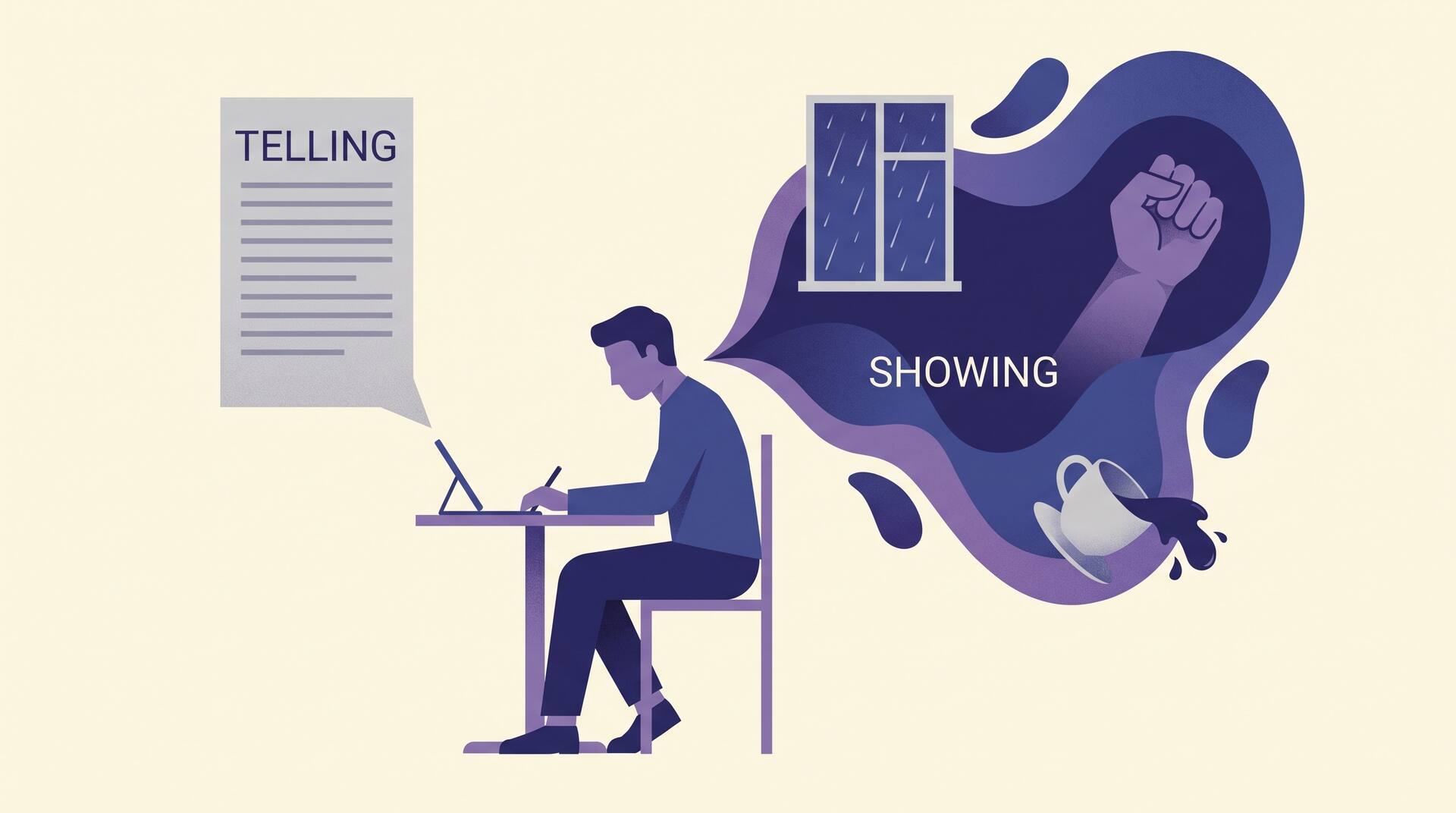
The advice is half wrong. Not the good half — the half that got flattened by repetition until it became a reflex instead of a decision.
"Show, don't tell" is really a claim about where a reader's belief comes from. Readers believe what they work out for themselves and stay suspicious of what they are handed. Say a man is dangerous and the reader files it. Let the reader watch him fold his newspaper into perfect quarters before he answers a question, and the reader decides he is dangerous — and then defends that conclusion, because it is now theirs.
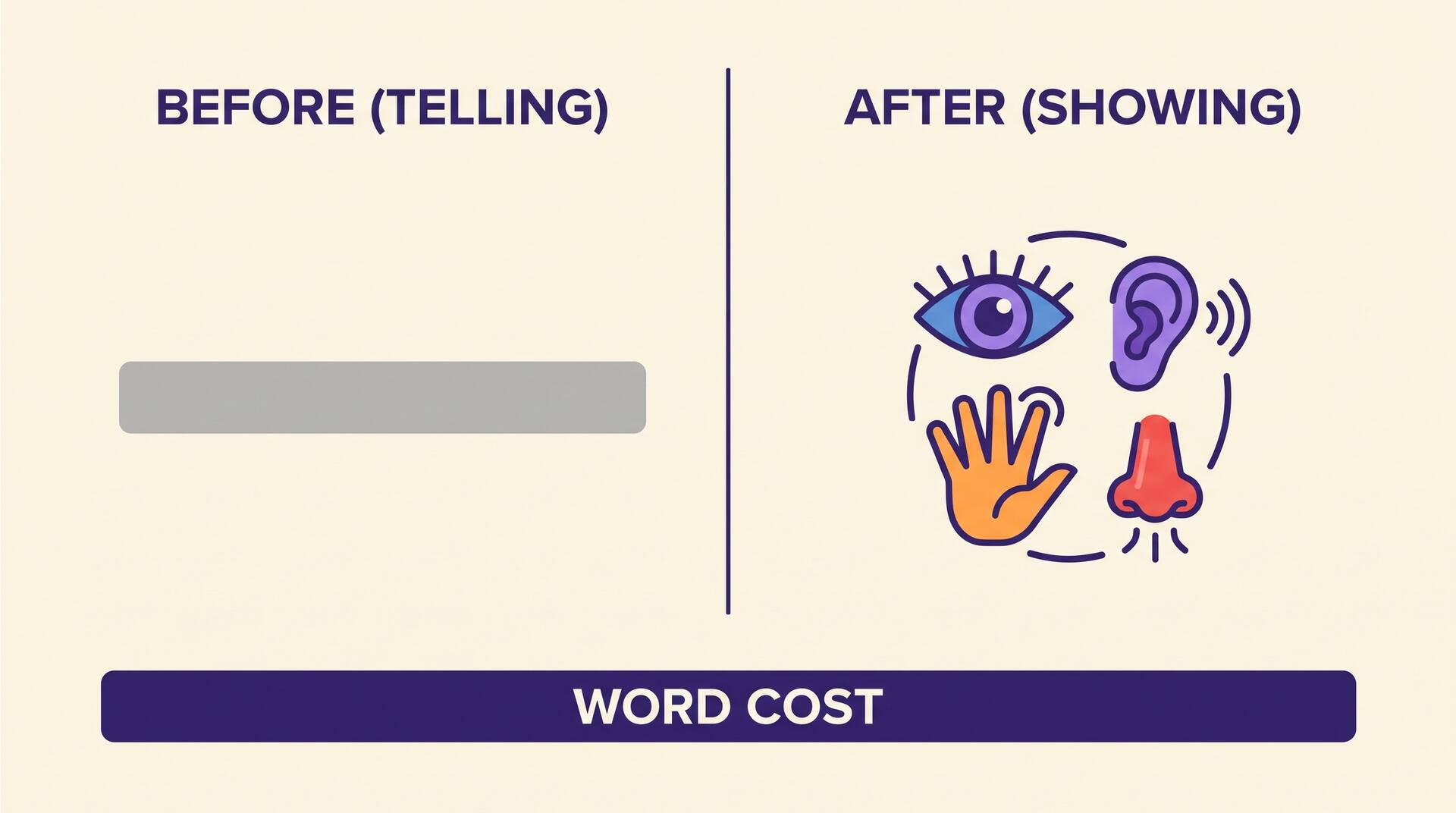
What nobody teaches is the price. Showing costs words, and the currency is pace. Every one of the six rewrites below gets better and gets longer, most of them by four to six times. A novelist who shows everything writes a bloated, exhausting book in which nothing is emphasised, because emphasis only exists relative to something quieter.
So this guide runs in an order most don't: first what showing mechanically is, then the five situations where telling is the correct professional choice, then six before-and-after pairs with the word cost printed next to each one, then the filter-word audit you can run over your own draft this afternoon.
What "showing" actually is, mechanically
Showing is not "use vivid adjectives." Swapping sad for desolate is still telling, just with a thesaurus open. Showing works through exactly three channels, and it helps to know which one you are reaching for.
Sensory detail
Something a camera or a microphone could have caught. The chipped rim of the mug, the smell of the hallway, the particular hum of a fridge in a room where nobody is speaking. Concrete, external, verifiable.
Behaviour
What the character does, especially the small unnecessary things. People under pressure straighten objects, over-explain, check their phone with the screen already on. Behaviour is the most reliable channel because readers read behaviour for a living.
Subtext
What is said around the thing, or the thing conspicuously not done. Two people discussing a train timetable while one of them is deciding to leave. This is the channel most "show don't tell" advice forgets, and it is the one that separates competent prose from good prose.
One useful test: could a stranger sitting at the next table have observed this? If yes, you are showing. If it required access to the narrator's summary of the character's inner life, you are telling — which may still be the right move.
In descriptions of nature one must seize upon small details, grouping them so that when the reader closes his eyes he gets a picture. For instance, you will get a moonlit night if you write that on the mill dam a piece of broken bottle flashed like a bright little star.
The famous one-liner about the glint of light on broken glass is a later paraphrase. Chekhov's own sentence is more useful, because it names the mechanism: a small detail, chosen and placed, does the work an abstraction cannot.
Five situations where telling is the correct choice
This is the section the rule usually swallows. Professional novelists tell constantly. They tell on purpose, and they tell in five recognisable places.
1. Compressing time
"The next three weeks went the same way." You cannot dramatise three weeks of sameness without boring everyone, and the sameness is the point. Told summary is how a book moves between the moments that deserve a scene.
2. Information the reader needs but does not care about
How the inheritance was structured, which cousin owns the lease, what the character does for a living. Give it in a clean told sentence and get back to the story. Dramatising logistics is how you produce a scene nobody remembers.
3. Habitual behaviour
This one is a trap. If you show a character locking the door three times, the reader reads a single evening. If you tell them she locks the door three times every night, the reader reads a life. Scene implies singularity; summary implies pattern. Choosing the wrong one changes the meaning of the sentence.
4. Deliberate de-emphasis
Attention is a signal. Anything you slow down for, the reader assumes matters. If a detail must be present for later but must not glow now, tell it — quickly, flatly, in a subordinate clause — and the reader will register it without flagging it.
5. Pace and contrast
Showing only lands against a quieter background. Three dramatised scenes in a row flatten each other. A page of told summary before the confrontation is what makes the confrontation feel like an arrival. Telling is not the absence of craft; it is the rest between the notes.
The working rule is not "show, don't tell." It is closer to: show what the book is about, tell what the book needs. If a moment carries the emotional or structural weight of the chapter, dramatise it. If it is connective tissue, say it and move.
Six before-and-after rewrites
All original, all deliberately unglamorous, because the sentences that need this treatment in your draft are unglamorous too. Word counts are printed so you can see the trade you are making. Notice that the sixth pair runs backwards.
Emotion: fear
Telling
She was terrified of the basement.
Showing
She left the basement light burning all night, and in the morning the pull chain was still wound around her fist.
The label became a consequence that outlasted the moment. Six words to twenty-one.
Character trait: meanness
Telling
Martin was cheap.
Showing
Martin split the bill to the cent, then asked for a copy of the receipt in case anyone went back and adjusted the tip line.
The judgement moved from the narrator to the reader, which is why it sticks. Three words to twenty-four.
Setting: neglect
Telling
The apartment was neglected.
Showing
Three of the four burner knobs were gone, and someone had left a pair of pliers on the stovetop for whoever cooked next.
"Neglected" is a verdict; the pliers are evidence, and they imply a person who gave up in stages. Four words to twenty-two.
Relationship: distance
Telling
They had grown apart.
Showing
He asked how her mother was. She said fine, and did not ask about his.
Pure subtext — no sensory detail at all. Showing is not always description; sometimes it is an omission the reader hears. Four words to fifteen.
Physical state: exhaustion
Telling
He was exhausted.
Showing
He read the same line four times and still could not have said what it was about.
Avoids the physiology cliché file — no heavy eyelids, no aching bones. The failure of attention does more work than the body would. Three words to seventeen.
Running it backwards: over-shown
Telling
Her chest tightened. Her palms went slick. A cold thread ran down her spine and her breath came shallow and quick.
Showing
She was afraid.
Twenty-one words to three, and the page got better. This fear was a transition into the next beat, not the beat itself. Dramatising every emotion is how a ninety-thousand-word manuscript becomes a hundred and thirty thousand with no new story in it.
The filter-word audit
There is a category of verb that quietly reinstalls the narrator between the reader and the scene. They are called filter words, and they are the fastest structural edit available to a drafting writer, because you can find them with a search box.
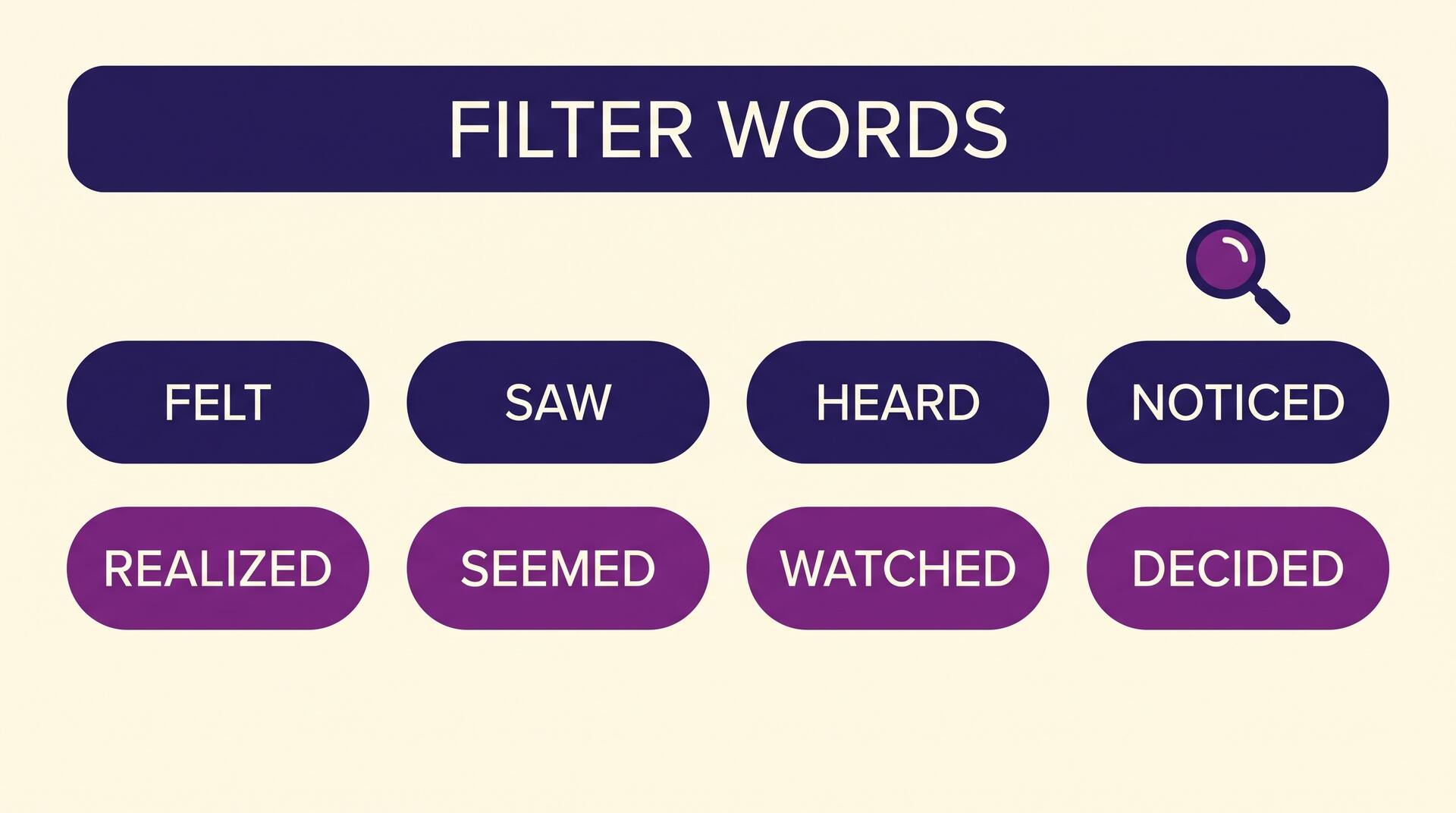
"She heard the gate scrape open" puts a reporter in the room. "The gate scraped open" puts the reader there. Same information, one less layer of glass. Not every instance should go — occasionally the act of noticing is the point, and in deep close third the filter can mark a shift in attention — but in most drafts eighty per cent of them are habit.
Run the list below over one chapter. Search each word, look at every hit, and ask whether the sentence survives without it. Tick them off as you go; the list remembers where you stopped.
The audit has a second benefit nobody mentions: the sentences left standing after a filter sweep tend to be shorter, and shorter sentences make weak verbs visible. A line-level pass with a grammar checker right after the sweep catches the tense drift and dangling modifiers that a heavy rewrite always introduces.
If a rewritten line reads correct but stiff, that is usually rhythm rather than grammar, and reading it aloud beats any tool. When a whole paragraph refuses to come apart, a paraphrasing pass can shake loose an alternative phrasing to react against — you rarely keep it, but seeing the sentence rearranged tells you which part you were actually protecting.
How much showing can one scene carry?
Look back at the rewrite pairs. The average expansion was roughly five to one. That number is the whole pacing argument in miniature.
A ninety-thousand-word novel has room for something like thirty to forty fully dramatised scenes once you account for the connective summary between them. That is a budget, and budgets force ranking. Before you dramatise a moment, it is worth asking whether it is one of the forty — because if you spend three pages showing a character's commute, you have taken those pages from the confrontation in chapter nineteen.
Within a scene, the practical ceiling is lower than writers expect. Three or four consecutive shown beats without a told sentence to orient the reader and most people start skimming, because sustained concrete detail with no summary reads as texture rather than story. The fix is a rhythm, not a rule: dramatise the beat, summarise the bridge, dramatise the next beat.
Description-heavy passages have their own version of this problem, and it is worth reading our piece on imagery in writing alongside this one — showing and describing are related but not the same job, and confusing them is how scenes turn into inventory.
Five ways showing goes wrong
Upgrading the adjective and calling it done
"He was furious" becoming "he was incandescent with rage" is not showing. It is the same sentence in a better coat. If the verb of the sentence is still a form of to be plus a feeling word, nothing has changed.
The body-part inventory
Pounding hearts, dropping stomachs, prickling necks. Physiology is the first thing every writer reaches for and therefore the first thing every reader has read a thousand times. It is technically sensory and functionally invisible.
Showing, then telling the same thing anyway
"She slammed the drawer shut. She was angry." The second sentence tells the reader they cannot be trusted with the first. This double-signal is the single most common finding in first drafts. Delete the explanation and trust the drawer.
Showing the wrong detail
A vivid detail that carries no meaning is worse than a flat one, because vividness is a promise. If you spend a sentence on the pattern of the wallpaper, the reader will look for the wallpaper to matter.
Narrator judgement smuggled into a gesture
"He smiled cruelly" is telling with a verb in front of it. The reader should reach cruel on their own from what the smile follows. Adverbs on gestures are where telling hides after you have swept out the obvious cases.
Where a drafting tool actually helps here
None of this is work AI does for you. Choosing which moment deserves a scene is a judgement about your book, and no model has read your book the way you have.
What it does help with is the mechanical half. In AIWriteBook's chapter editor, the AI chat sits alongside the draft and proposes edits as a diff — you see the suggested rewrite against your original line and accept or reject each change individually rather than having a paragraph silently replaced. For a filter-word sweep or an over-told passage, that shape matters: you keep the sentences where the telling was deliberate and take only the rewrites that earn it. The chapter generator page walks through how the drafting and editing loop fits together.
If the problem is upstream — the scene is flat because there is nothing to show, not because it is worded badly — a quick pass through the scene builder is the more honest fix. It forces you to name what physically happens in a beat, and a beat with no physical events is usually a beat that should have been a told sentence in the first place.
Character-level flatness has the same tell. If every rewrite you attempt produces generic behaviour, the character is underspecified rather than under-shown; our guide to dynamic characters covers how to give someone enough specific interior contradiction that their behaviour writes itself.
Common questions
The short version
Showing is sensory detail, behaviour and subtext — not better adjectives. Telling is a professional tool with five real uses, not a failure. The ratio between them is a budget you spend on the moments that carry your book, and filter words are the cheapest sweep available to find where you have been standing between the reader and the page.
Do the audit on one chapter. Not the whole manuscript — one chapter, this week. The pattern you find will repeat everywhere else, and knowing your own two or three habits is worth more than any rule.
This is one piece of a longer process; the full guide to writing a book covers where line-level revision sits relative to outlining, drafting and the structural edit that should come before any of this.