

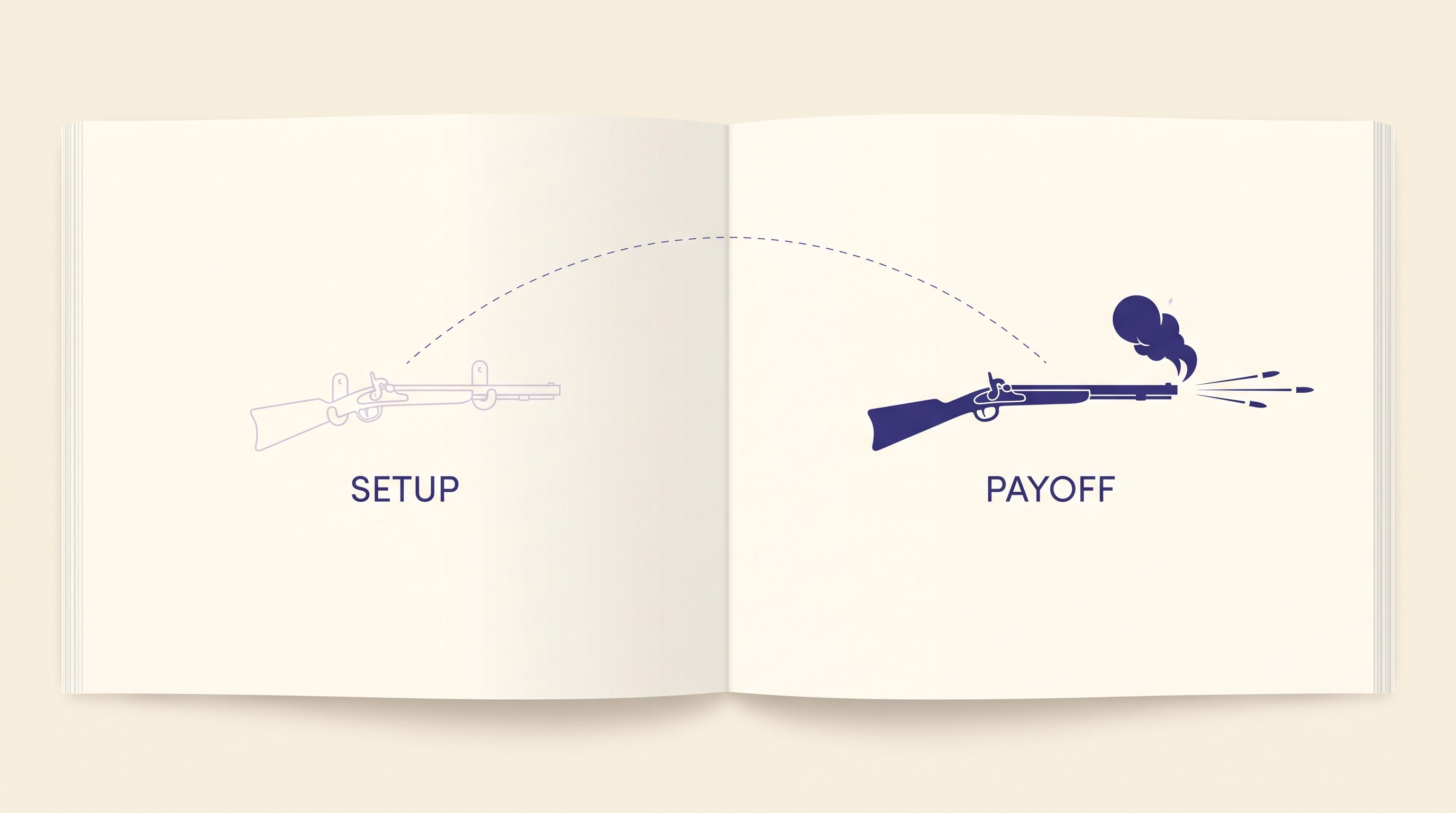
Every reader has had the experience: the twist lands, and something in the back of the mind says of course. Not "I guessed it" — that is failure — but "that was always true." That feeling is manufactured. Somebody put an object, a line of dialogue, or a weather pattern in front of you two hundred pages earlier and let you walk past it.
This guide takes the mechanism apart: what foreshadowing is, how it differs from the two devices people constantly confuse it with, the five distinct types, seven real examples with the actual machinery exposed, and a working method for planting and paying off in a draft you are writing right now.
What foreshadowing actually is
Definition
Foreshadowing is the deliberate placement of information early in a narrative that acquires its real significance later, so that a future event arrives as a surprise and as a confirmation at the same time.
The double demand is the whole difficulty. Information that only surprises is a cheat; information that only confirms is a spoiler. Foreshadowing has to do both, which is why it is usually the last thing a first draft gets right.
Foreshadowing vs red herring vs Chekhov's gun
These three get treated as synonyms in comment sections and they are not even the same category of thing. One is a promise, one is a lie, and one is a rule about tidiness.
| Term | What it is | What it does to the reader |
|---|---|---|
| Foreshadowing | A true signal, planted early, whose meaning is withheld | Rewards them on reread; makes the ending feel earned |
| Red herring | A false signal, planted deliberately to mislead | Sends them confidently in the wrong direction |
| Chekhov's gun | A principle of economy: anything conspicuous must be used | Trains them to trust that nothing on the page is idle |
Chekhov put it in a letter to the writer Aleksandr Lazarev in 1889: if you say in the first chapter that there is a rifle hanging on the wall, in the second or third it absolutely must go off. It is a prescription against clutter, not a technique for suspense — but it is the reason planted objects read as promises at all. We break it down further in our piece on Chekhov's gun.
A red herring is the inverse move, and it only works when it is a real clue that points somewhere real. If it is obviously a decoy, it insults the reader. Agatha Christie's method in The Murder of Roger Ackroyd is the gold standard: her narrator writes "I did what little had to be done" about the minutes he was alone with the body, and every reader reads past it as modesty. It is a confession, in plain sight, doing the work of a red herring and a piece of foreshadowing at once.
The five types, and what each one costs
Most craft books list two — direct and indirect — which is not enough to be useful. Five distinctions actually change how you write the scene.
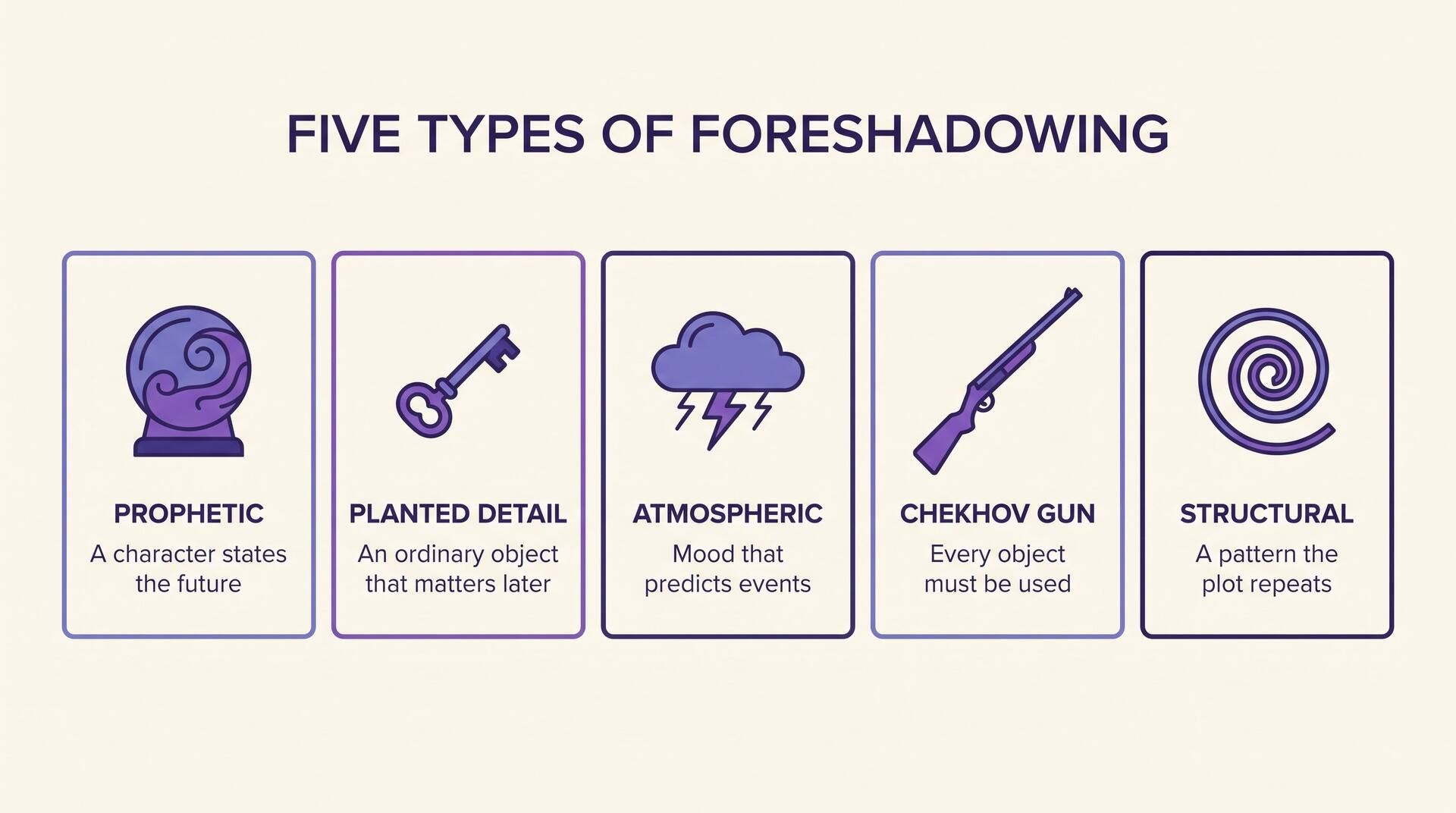
1. Prophetic (direct)
Someone states the future outright: a prologue, a prophecy, a character's flat prediction. Shakespeare opens Romeo and Juliet by telling you the lovers will die — "a pair of star-cross'd lovers take their life" — before a single scene has run. Cost: you forfeit the what and have to make the how carry everything. Benefit: dramatic irony from page one, and every hopeful moment now hurts.
2. Planted detail
An ordinary object, skill, or fact introduced with no emphasis, retrieved later at full weight. This is the workhorse. It needs the reader to register it and not to underline it, which is a narrow gap to thread — usually by giving the detail a job in the present scene so it is not just sitting there.
3. Atmospheric
Weather, setting, and mood that condition the reader for what is coming: the gathering storm, the empty road, the dinner that goes too quietly. It is the cheapest to write and the easiest to overdo. Used well it primes without predicting; used badly it becomes a soundtrack telling you how to feel.
4. Chekhov's gun
The strict subtype of planted detail: a conspicuously introduced object whose later use is structurally required. The difference from an ordinary plant is emphasis. If a character notices a thing, the reader files it. If a character explains it, the reader files it and expects it back.
5. Structural
A pattern rather than a detail — a repeated situation, an echoed line, a scene rhymed at two points in the book — where the earlier instance teaches the reader how to read the later one. Least discussed, hardest to fake, and the type that survives literary scrutiny best.
Seven examples, decoded
Each one below is followed by the mechanism, not just the observation. Expand any of them.
Of Mice and Men — Candy's dog
Carlson argues that Candy's old dog is suffering and should be shot; Candy gives in, and afterwards says his regret is that he let a stranger do it instead of doing it himself. Mechanism: Steinbeck stages the entire ending in miniature and hands you its moral in advance, so that when George takes the pistol to Lennie the reader already knows exactly what the alternative was. Structural foreshadowing at its most ruthless — the earlier scene teaches you how to read the later one.
Macbeth — the second set of prophecies
The apparitions tell Macbeth that no man of woman born shall harm him and that he is safe until Birnam Wood comes to Dunsinane. Both are true and both are traps: Macduff was delivered by caesarean, and the army cuts branches for camouflage. Mechanism: prophetic foreshadowing weaponised. Shakespeare gives the audience the information and the wrong interpretation simultaneously, so the reveal is a re-reading rather than new data.
Harry Potter — the Vanishing Cabinet
In Chamber of Secrets, Harry hides inside a cabinet in Borgin and Burkes; in Order of the Phoenix, Fred and George shove Montague into its broken twin at Hogwarts and nobody gives it a second thought. In Half-Blood Prince, Draco repairs it and walks the Death Eaters into the castle. Mechanism: a plant with four years of decay time between setup and payoff, kept alive by two low-emphasis appearances. The reason it works is that both earlier appearances have a job in their own scene.
Jaws — the compressed air tanks
Hooper brings scuba tanks aboard the Orca, and when Brody clumsily knocks them about, Hooper snaps at him that they can blow up; the exchange plays as characterisation and comic friction. In the final minutes Brody jams one into the shark's mouth and shoots it. Mechanism: a textbook Chekhov's gun, disguised by giving it an emotional function first. The audience remembers the argument, not the object.
The Sixth Sense — the rule of the red door
Shyamalan has said the film uses red to mark anything touched by the other world, and Malcolm never once physically interacts with a living person other than Cole. Mechanism: visual and behavioural foreshadowing that cannot be consciously parsed on a first viewing but is completely fair on a second. The film hides the clue by making it a stylistic tic rather than an event.
Breaking Bad — the pink teddy bear
Four episodes across season two open with a monochrome flash-forward of a charred pink bear floating in a swimming pool, with no context. The season ends with two aircraft colliding over the house. Mechanism: prophetic foreshadowing stripped of meaning — the audience is handed the image but not the sentence it belongs to, so anticipation runs for ten hours without any risk of the reveal being guessed.
Romeo and Juliet — "I have a soul of lead"
Beyond the prologue, Romeo tells his friends on the way to the Capulet ball that his mind misgives some consequence yet hanging in the stars, and that the night's revels will begin a forfeit of untimely death. Mechanism: the character voices the dread the plot will confirm. This only lands because Shakespeare has already spent the prologue buying the audience's belief that the warning is not paranoia.
Notice what the strong examples have in common: the setup is doing a second job at the moment it appears. The dog scene is about Candy's dignity. The tank scene is about Brody being out of his depth on another man's boat. Nothing is standing on the page waiting to be useful.
How to plant and pay off in your own draft
Foreshadowing is almost always added in revision, and that is not cheating — it is the normal order of operations. You cannot foreshadow an ending you have not written. What follows is the sequence that works.
Write the payoff first, then reverse-engineer
Finish the scene the twist lives in. Then ask a mechanical question: what would have had to be true, present, or known earlier for this to be possible? Those answers are your plants. This is why retro-fitting is fine and pantsing is fine — the crime is not planting late, it is not planting at all.
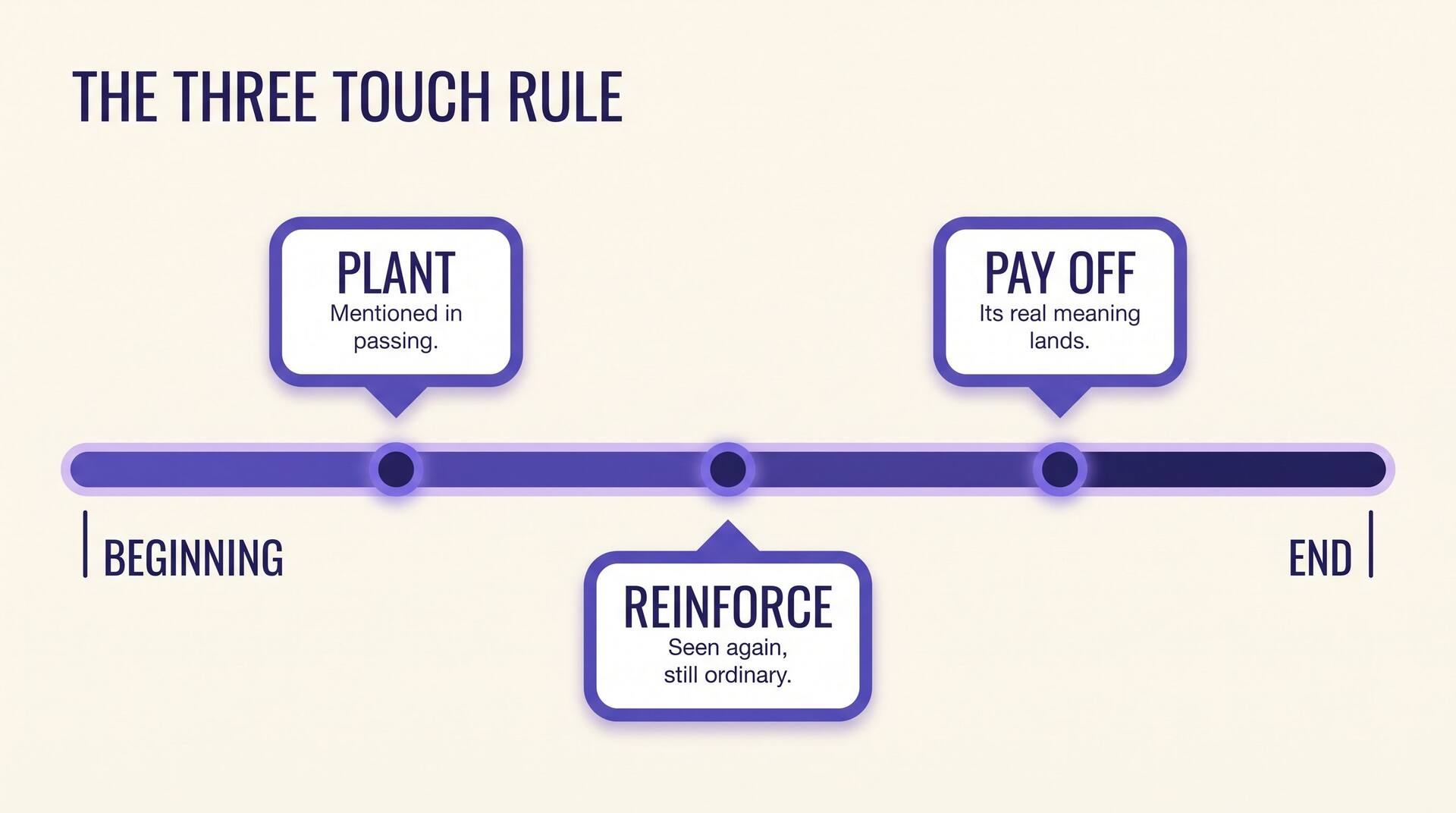
Use three touches, not one
One mention is usually too faint to register; two feels like emphasis; three spaced across the book reads as texture. Plant it early with a job in its own scene, let it reappear once in the middle doing something unrelated, then pay it off. The middle touch is the one most drafts skip, and it is the one that converts a payoff from convenient to inevitable.
Bury it under something louder
Put the plant in the same paragraph as a bigger emotional event — an argument, a joke, an embarrassment. The reader's attention goes to the loud thing and the quiet thing goes in sideways. This is the single most reliable technique on this page and it is why the Jaws tanks work.
Test the distance
Too close and the reader connects it before you want them to; too far and they have genuinely forgotten. As a rough working rule, a plant needs at least two chapters of separation to stop feeling like setup, and a reminder if more than about ten chapters pass. Both numbers are instincts, not laws — but if your beta readers say "that came out of nowhere," your gap is too wide, and if they say "I saw it coming," it is too narrow or too loud.
If you are drafting inside AIWriteBook, the fastest way to do the reverse-engineering pass is the chapter AI chat: open the early chapter, describe the ending you now need it to support, and ask for the plant to be worked into an existing paragraph. Every suggestion comes back as an accept-or-reject diff, so you can see exactly what changed in a chapter you already like instead of regenerating it and losing the prose you were happy with.
For the standalone version of this problem — you have a setup and no idea what to do with it — our free plot twist generator will propose payoffs for a premise you paste in, and the scene builder is useful for drafting the middle-touch scene where the plant reappears doing something unrelated.
Four mistakes that kill it
- Telegraphing. The plant is written with more emphasis than it can justify — a paragraph of description for a letter opener, a character staring meaningfully at a locked drawer. The reader knows a novel's economy better than you think. If nothing else in the chapter gets that much room, the object is wearing a sign.
- Unpaid setups. A promise made and never kept is worse than no promise. Every conspicuous object, unexplained scar, and ominous phone call is a debt on the reader's ledger, and readers do keep the ledger. Cut the setup or write the payoff; there is no third option.
- Foreshadowing that explains itself later. The reveal arrives and a character says "the knife — of course, it was there the whole time." You have just converted the reader's private pleasure into a lecture. Trust them to make the connection; the ones who miss it were never going to be persuaded by being told.
- Atmosphere doing the work of plot. Three storms, two crows, and a broken mirror do not constitute foreshadowing. Mood can prepare a reader emotionally but it cannot make an event feel earned — only concrete, specific, verifiable information does that.
The second mistake is by far the most common in first novels, and it is the one that generates the review phrase every author dreads: "felt unfinished." It is rarely about plot holes. It is about setups the writer forgot they had opened.
When not to foreshadow
There are three situations where reaching for it makes the book worse.
- 1When the point is the arbitrariness. Some events are meant to feel like the world refusing to make sense — an accident, a random death, an indifference. Foreshadow it and you have told the reader the universe has a plan after all, which is the opposite of what you meant.
- 2When you are writing comedy that depends on the swerve. A joke's payoff usually needs to be genuinely unprepared. Prime it and you have written a callback, which is a different and slower kind of funny.
- 3When the story is short. In a 3,000-word story there is often no room for a plant to cool off. It sits too close to its payoff and reads as machinery. Short fiction more often uses a single resonant image than a setup-and-return structure.
Keeping track of it across a whole book
The practical reason foreshadowing fails in long projects is bookkeeping. At 80,000 words nobody remembers that the neighbour's dog was mentioned in chapter four, including the author. Two habits fix this.
The first is a plant-and-payoff ledger: a two-column list where every setup gets a chapter number on the left and its payoff chapter on the right. Anything with an empty right column at the end of the draft is either a cut or an assignment. It is unglamorous and it catches more problems than any amount of rereading.
The second is doing the plotting before the prose. Working from a chapter-by-chapter outline you can actually edit means you can walk the whole book in an afternoon and place setups where they belong, rather than discovering at chapter thirty that the object you need was never introduced. Our free outline generator produces that structure from a premise, and if you are writing the book in AIWriteBook, the outline builder keeps the plan attached to the draft — you approve or rewrite each chapter's plan before any prose is generated, which is exactly the moment a missing plant is cheap to add.
For a longer treatment of how setups map onto the shape of a story, our guides to three-act structure and rising action cover where in the arc plants typically want to sit.
Questions writers ask
What is foreshadowing in simple terms?
It is a hint planted early in a story about something that happens later. The hint has to be true, and it has to be quiet enough that the reader passes over it the first time — so that when the event arrives it feels both surprising and inevitable.
What is the difference between foreshadowing and a red herring?
Foreshadowing points at what will actually happen. A red herring points at something that will not. Both are planted deliberately and both must look equally plausible at the time, which is why they are so often used in the same chapter of a mystery.
Is Chekhov's gun the same as foreshadowing?
No. Chekhov's gun is a rule about narrative economy — do not introduce something conspicuous unless you intend to use it. Foreshadowing is a technique for shaping a reader's expectations. A Chekhov's gun usually functions as foreshadowing, but plenty of foreshadowing involves no object at all.
Can you add foreshadowing after the first draft?
That is the usual way it is done. You cannot reliably foreshadow an ending you have not written yet. Most novelists finish the draft, list what the ending needed to be possible, and then go back and plant those things into scenes that already exist.
How obvious should foreshadowing be?
Aim for a detail a reader notices and does not weigh. The practical test is a beta reader: if they say the ending came out of nowhere, the plant was too faint or too far back; if they guessed the twist early, it carried too much emphasis.
How many times should you foreshadow one event?
Usually about three light touches for a major payoff — an initial plant, one mid-book reappearance doing unrelated work, and the payoff itself. Minor payoffs often need only one. More than three and the pattern starts to announce itself.
The short version
Foreshadowing in writing is a debt structure. You open an account early, quietly, in a scene that has other business; you touch it once more so it stays alive; you settle it at the end. Do that and the ending reads as the only thing that could have happened. Skip the middle touch and it reads as convenient. Skip the payoff and the book reads as unfinished.
Since almost all of this is decided by where things sit relative to each other, it is a planning problem more than a prose problem. Our guide to writing a book covers how outlining, drafting, and revision fit together, and where the plant-and-payoff pass belongs in that order.