

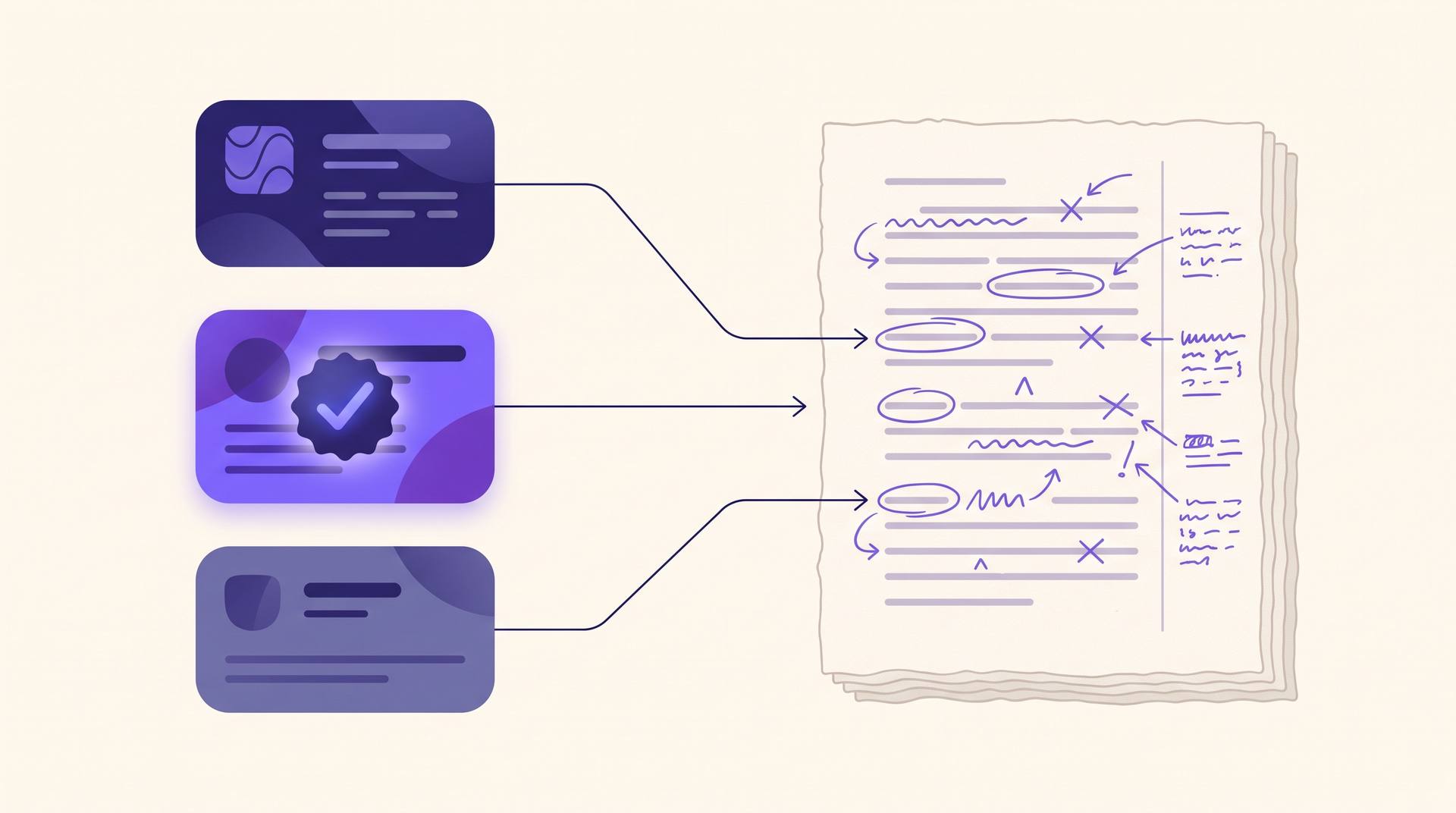
What you are actually buying
Most bad hires are not bad editors. They are the right editor doing the wrong job, because the author asked for editing without saying which kind. There are four, they run in order, and paying for a later one before an earlier one is how authors waste money.
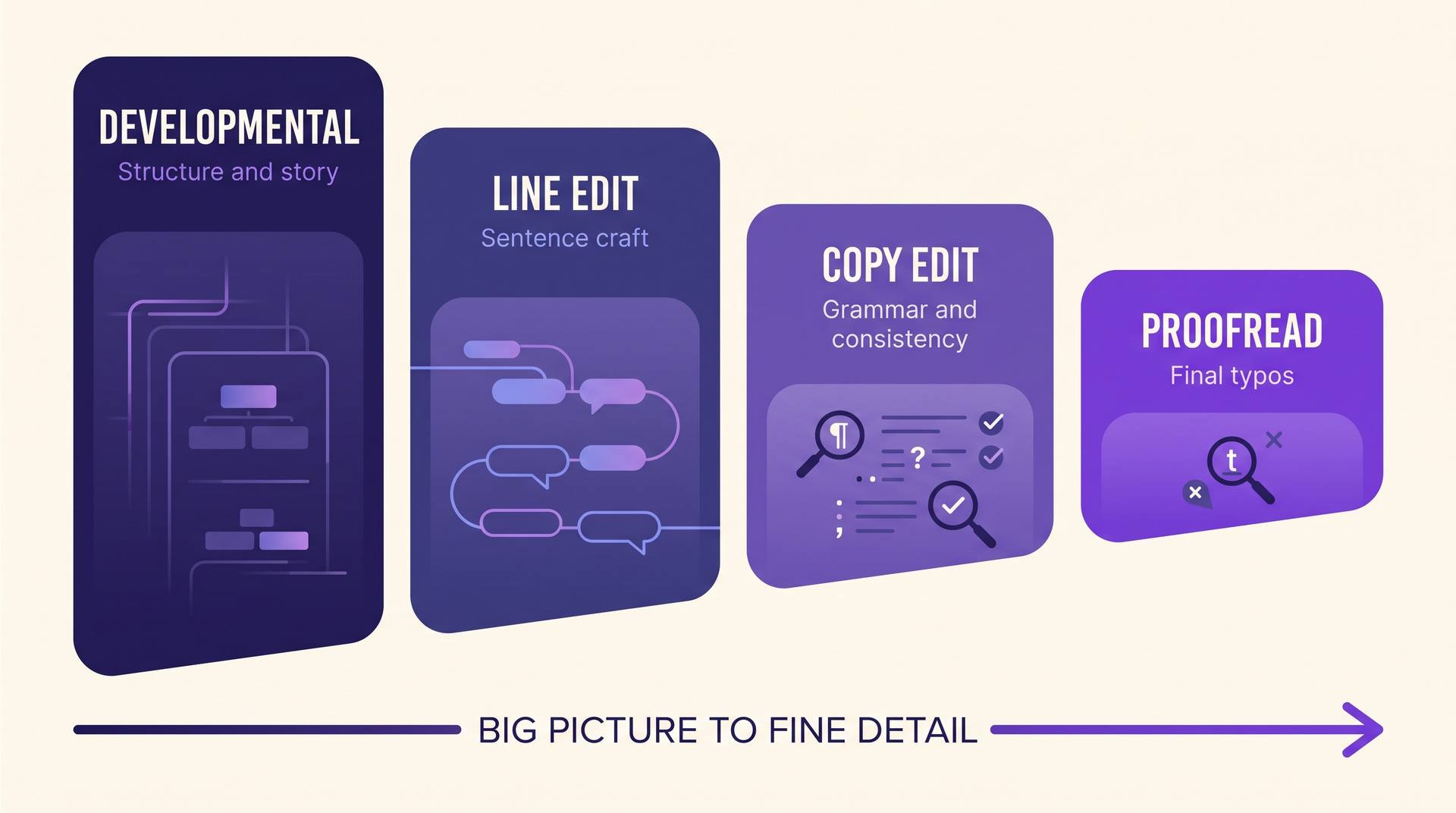
Developmental edit
Structure, pacing, character arcs, argument logic. You get a written editorial report, often 10 to 25 pages, plus margin notes. This is the only level that can tell you a subplot is not working, and the only one worth paying for while the book can still change shape.
Line edit
Rhythm, clarity, voice, paragraph-level craft. The editor rewrites at sentence level and explains the reasoning. Authors confuse this with copy editing constantly, and it is roughly twice the work.
Copy edit
Grammar, usage, consistency, style sheet. The style sheet is the deliverable people forget to ask for: every name spelling, hyphenation and timeline decision in one document, which your proofreader and your next book will both need.
Proofread
The final pass on the typeset file, hunting typos, bad breaks, wrong running heads. It is not a safety net for an unedited manuscript, and an honest proofreader will tell you so after two pages.
Pick one level per pass and never combine developmental and copy editing into one job. Restructuring invalidates the line-level work you just paid for, and any editor who agrees to do both at once is either charging for both or doing neither properly.
Estimate the real cost before you shop
Editing is priced per word, per page, or per hour, and quotes are not comparable until you convert them all to per word. Run your manuscript's word count against a per-word rate and you will know within minutes whether the quotes in your inbox are ordinary or eccentric.
Editing cost estimator
Enter your word count and adjust the per-word rate to match the quotes you are receiving.
Editing levelEstimated cost
$3,200
Per 250-word page
$10.00
Rate defaults are starting points for comparison, not quotes. The Editorial Freelancers Association publishes a periodically updated rate survey for the US market; check the current chart before you judge a quote as high or low, and expect rates outside it for specialised non-fiction and for editors with a waiting list.
Two numbers change everything: your word count and how clean the draft is. An 85,000-word novel costs more to copy edit than a 60,000-word one for obvious reasons, and a messy draft can push an editor's hourly quote up by half. If you are not sure what your manuscript weighs, the free word counter gives you an exact figure, and our breakdown of how many words a novel should be tells you whether the number itself is a problem worth fixing before you pay anyone.
Standard practice is a deposit of 25 to 50 percent to book the slot and the balance on delivery. Good editors are booked two to four months ahead, so the deposit buys a date in a calendar, not immediate work. Treat a deposit-free editor who can start tomorrow as information rather than luck.
Where good editors actually are
The channel you source from sets your baseline quality before you have read a single sample.
Professional directories
The Editorial Freelancers Association, ACES, CIEP in the UK, and equivalent national bodies list members who have paid dues and, for some grades, passed assessments. Slowest channel, highest floor.
The books you admire
The single most underused method: open the acknowledgments of three recent self-published books in your genre and look up the editors named there. You get a verified credit, a genre match, and a warm opening line for your email.
Author communities
Genre-specific Facebook groups, Discords, and writers' associations produce referrals with real reputational stakes behind them. Ask who people used twice, not who they used once.
Freelance marketplaces
Fastest and cheapest, and by far the widest quality spread. Usable if you vet hard and ignore star ratings, which mostly measure responsiveness. Never hire from a marketplace without a paid sample.
Whatever the channel, shortlist three. One candidate gives you no price signal and no read on what good looks like in your genre; five is more sample edits than you will meaningfully compare.
The five-step vetting sequence
Run these in order. Each step is cheap and eliminates candidates before the expensive step.
Check the genre track record
Ask for three titles they have edited in your genre, published within the last two years, with links. Buy one and read the first two chapters. A literary editor loose in a cosy mystery will fix the prose and quietly dismantle the genre's conventions.
Send a precise enquiry
Word count, genre, comparable titles, the level you want, your target delivery window, and whether the draft has been through beta readers. Editors answer specific emails first, and a vague enquiry produces a vague quote that changes later.
Commission a paid sample edit
One thousand to two thousand words, paid at their normal rate, from a middle chapter rather than your polished opening. Send the same pages to all three candidates on your shortlist so you are comparing like with like.
Take up two references
Email two authors they have worked with and ask three questions: did they hit the deadline, how did they respond to pushback on an edit, and would you hire them again for a different book. Testimonials on a website answer none of those.
Agree scope in writing before any money moves
Level, word count cap, deliverables, dates, number of query rounds, rate, and what happens if the manuscript grows. Every dispute authors have with editors traces back to one of those seven items being assumed instead of written.
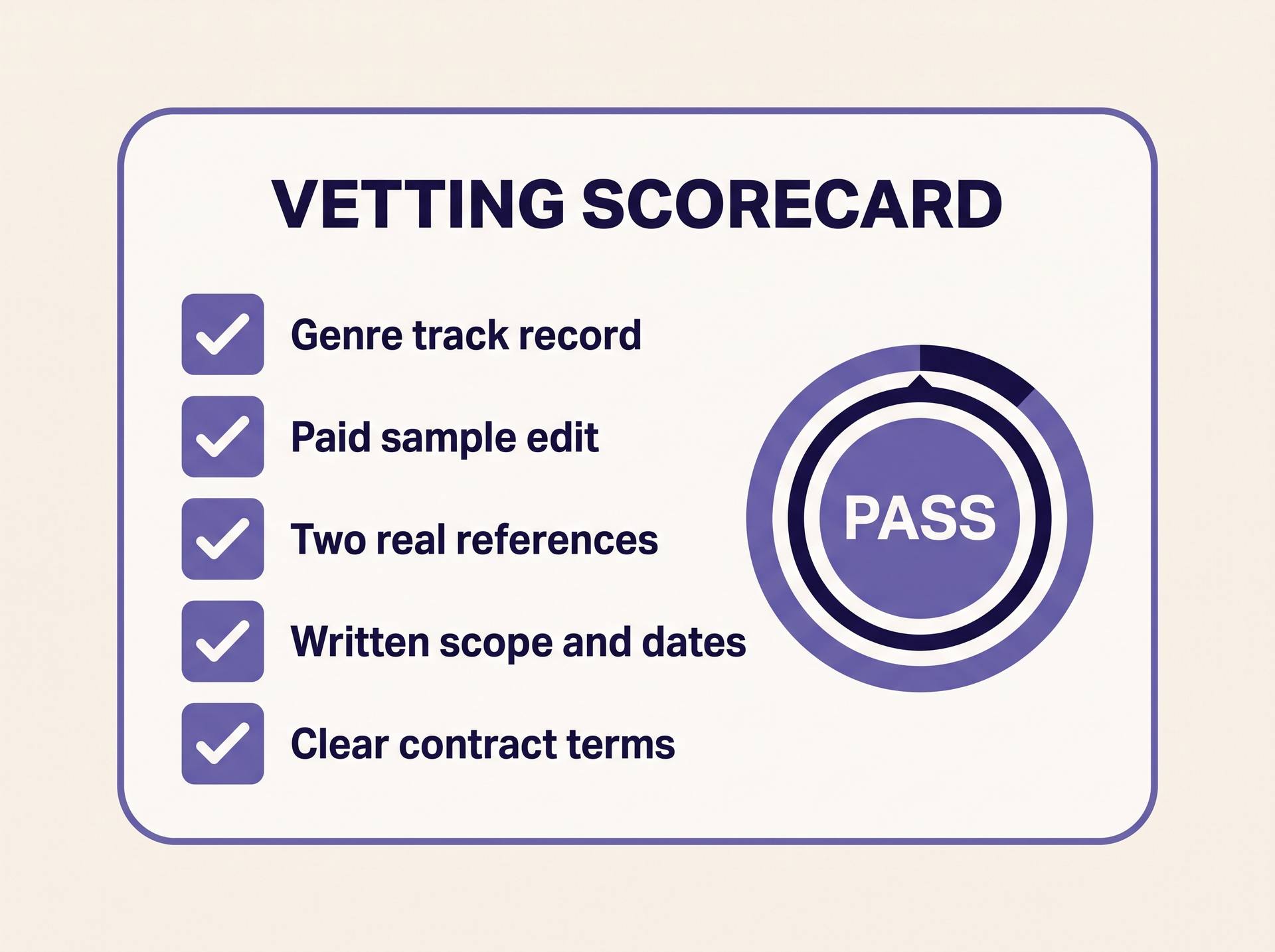
Vetting scorecard
Tick these off for each candidate. Anyone below four is a no, regardless of how good the sample felt.
The sample edit is the whole decision
A sample edit costs a fraction of the job and predicts almost all of it. What you are reading for is not whether the corrections are correct — they usually are — but how the editor thinks.
Do they explain, or only change?
A good line edit teaches. If comments say what changed but never why, you will finish the book no better at writing it, and you will be unable to judge the calls you disagree with.
Does your voice survive?
Read a marked-up paragraph aloud. If it now sounds like a generically competent writer rather than like you, that is the editor's voice replacing yours across 90,000 words.
Do they query rather than assume?
Strong editors leave questions in the margin about intent. An editor who silently resolves every ambiguity in their own favour will flatten the deliberate choices they did not recognise as deliberate.
Is the level what you paid for?
If you asked for a line edit and the sample is commas and spelling, you were quoted for a line edit and given a copy edit. Say so; the answer tells you how the whole project will go.
Red flags that end the conversation
A guarantee about outcomes
Nobody can promise an agent, a bestseller rank, or reviews. An editor who sells results rather than work is selling the wrong thing, and it usually comes bundled with expensive add-ons.
A quote without seeing pages
Price depends on the state of the draft. A firm number offered before anyone has read a paragraph will be revised upward once they have, or honoured by doing less work.
Refusing a paid sample
A busy editor may schedule it weeks out. Declining the concept entirely, while asking for a four-figure deposit, is not a scheduling problem.
No contract, or one that claims rights
An editing agreement never transfers copyright, never takes a royalty share, and never requires credit in the book. Any of the three is a hard stop.
Pressure and scarcity language
Discounts that expire tomorrow and last remaining slots this quarter are sales tactics. Editors with real waiting lists simply tell you the next available month.
Silence during the project
Agree a mid-point check-in for any job over a month. Editors who go quiet for six weeks and deliver on the last day are the ones who deliver late.
What the contract has to say
Two pages is enough, and most professional editors will send you theirs. Read it for these seven things and add anything missing.
- Scope: the editing level, the agreed word count, and the price per extra thousand words if the manuscript grows.
- Deliverables: tracked-changes file, margin queries, editorial report, and the style sheet where the level includes one.
- Dates: when you send the file, when they deliver, and how long you have to return queries.
- Query rounds: how many rounds of follow-up questions are included after delivery.
- Payment: deposit amount, balance trigger, and what a late payment costs you.
- Cancellation: what each side owes if you withdraw the manuscript or the editor becomes unavailable.
- Rights and confidentiality: you keep copyright, they keep your manuscript private, and no credit is required in the published book.
Keep the signed scope and the delivery emails in one folder. If a disagreement happens, it will be about what was promised, and the folder settles it in a minute.
Arrive with a cleaner manuscript
Editors price on the state of the draft, so every problem you fix before you send is money you keep. This is also where AI genuinely helps, and where it does not: it is good at the mechanical layer and useless at judging whether your third act works.
Clear the mechanical noise first
Inconsistent hyphenation, doubled spaces, tense slips, and the four crutch words you use nine hundred times. Running the free grammar checker over each chapter takes minutes and removes the corrections that would otherwise fill your editor's margins instead of their judgement.
Fix structure before you book the slot
Reorder scenes, cut the chapter that stalls, and resolve the subplot you already know is loose. Writing in AIWriteBook, the chapter AI chat shows every suggested rewrite as a diff you accept or reject line by line, so you can tighten a chapter without handing your voice over to a model.
Build the style sheet yourself
Character names, place spellings, invented terms, the timeline, and your chosen conventions for numbers and dialogue punctuation. Send it with the manuscript. Copy editors love it, and it shortens the query round that eats your week.
Know what you are not asking for
Tell the editor which choices are deliberate: the present-tense prologue, the unnamed narrator, the deliberately clipped fragments. Two sentences here prevents forty margin comments arguing with your style.
None of this replaces the editor. It moves their attention from things software can catch to the things only a person can — pacing, credibility, whether the ending lands — which is exactly what you are paying a few thousand dollars for.
Questions authors ask
Editing is usually quoted per word. Convert every quote to a per-word figure, multiply by your word count, and compare. The Editorial Freelancers Association publishes a rate survey for the US market that gives you a reference range per editing type; developmental editing sits at the top of the range and proofreading at the bottom, and a messy draft raises any of them.
Spend the money once
The authors who are happy with their editors did four things: they named the level they were buying, they paid for samples from three people, they took up references, and they wrote the scope down. None of that requires knowing anything about editing; it requires refusing to hire on a good feeling from a friendly email.
Do the cheap steps this week. A sample edit and two reference emails cost under a couple of hundred dollars and a few evenings, and they are the difference between a manuscript that comes back better and one that comes back different.
Editing is one stage of a longer process, and the rest of it — self-editing passes, proofreading order, formatting for print — is mapped out in our book editing guide.