

Why the number matters before you build a shortlist
Most authors approach this backwards. They collect three referrals, take three calls, hear three wildly different quotes, and then try to work out what a fair price is from a sample of three self-interested people. By then anchoring has already done its work: whoever quoted first shapes what the other two sound like.
The better order is to price the job first. A ghostwritten book is a labour contract with a fairly predictable input — somewhere between 250 and 600 hours of skilled work for a full-length nonfiction title, less for a short business book, considerably more for a researched memoir. Once you know roughly how many hours your book represents, every quote becomes legible: it is either paying someone a professional hourly rate for that work, or it is not.
And there is a second reason to get the number early. For a large share of authors, the honest answer after doing the arithmetic is that a ghostwriter is not the right purchase at all — the book is worth writing, but not worth thirty thousand dollars of someone else's time. Knowing that in week one saves months.
The four rate tiers, and who sits in each
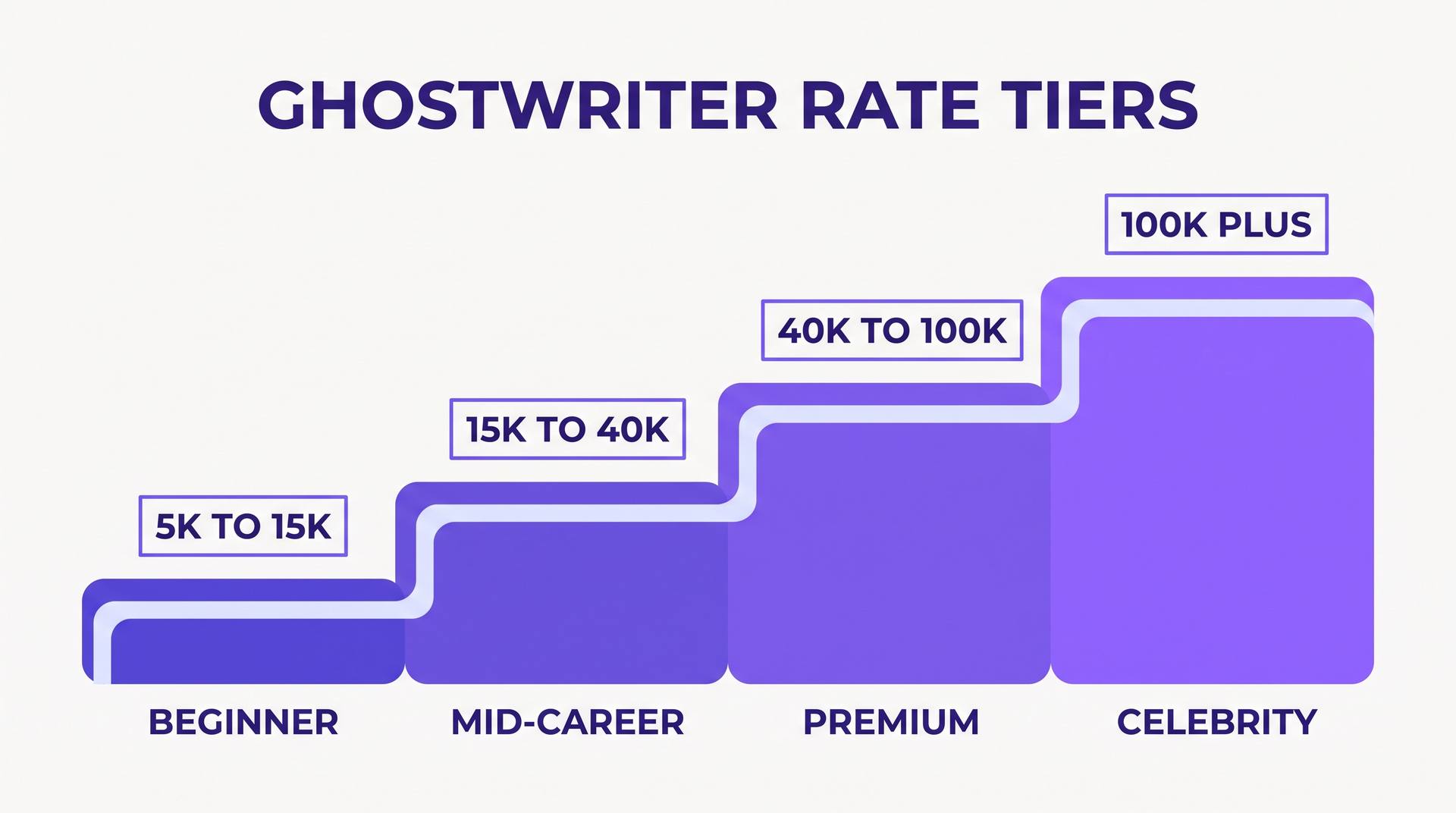
The market sorts itself into four fairly clean bands. These are typical published ranges for a full-length English-language book of roughly 50,000 to 70,000 words, quoted as a total project fee.
| Tier | Typical project fee | Equivalent per word | Who you get |
|---|---|---|---|
| Beginner | $5,000 – $15,000 | $0.10 – $0.30 | Freelancers with a few finished projects, often journalists or copywriters moving into books. Capable, but you will do more of the structural thinking yourself. |
| Mid-career | $15,000 – $40,000 | $0.30 – $0.75 | The working professional band: a portfolio of a dozen or more books, a defined process, contracts and interview protocols already in place. Most self-funded business books and memoirs land here. |
| Premium | $40,000 – $100,000 | $1.00 – $2.00 | Writers with traditionally published, well-reviewed, sometimes bestselling credits. They are being paid partly for the writing and partly for knowing what a publisher will buy. |
| Celebrity and trade | $100,000 and up | Rarely quoted per word | Publisher-arranged collaborations on a named memoir, usually paid from an advance and often structured with a share of royalties or a cover credit. |
Two things to notice. First, the per-word column is a translation, not a separate market — most book ghostwriters quote projects and only convert to per word when a client asks. Second, the jump between tiers is not a jump in prose quality nearly as much as it is a jump in judgement: what to cut, what the reader will not tolerate, and how to keep a 60,000-word argument standing up.
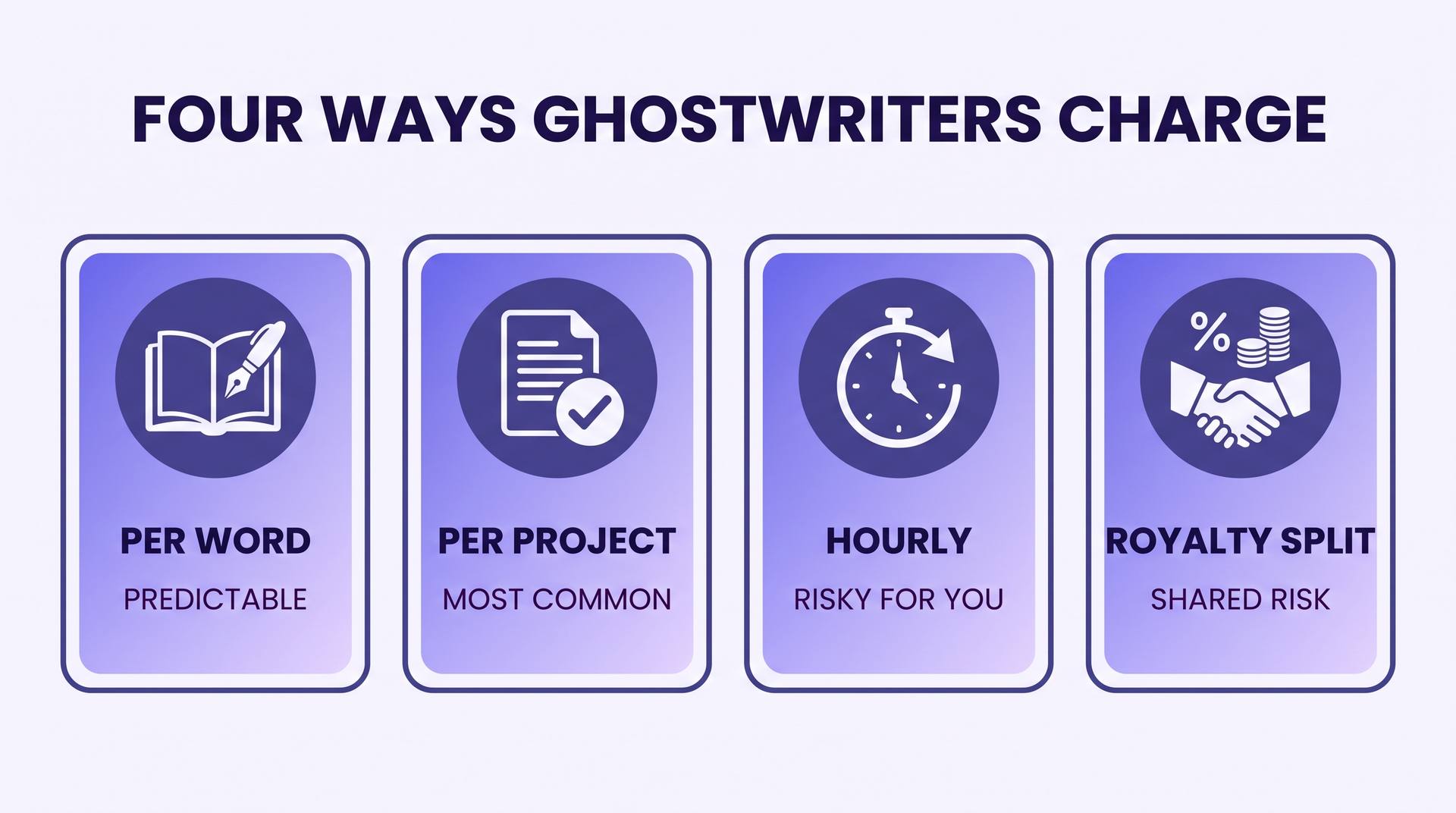
Per word, per project, hourly, or royalty split
The pricing model matters as much as the number. It decides who carries the risk when the book takes longer than anyone expected — and books almost always take longer than anyone expected.
Per word
Clean and comparable across writers, which is why clients like it. The catch is that it quietly rewards length. A writer paid by the word has no financial reason to cut the flabby chapter, and cutting is where most of the value in a book is created.
Best for: short, well-scoped nonfiction where the length is genuinely fixed.
Per project
The dominant model for books, and usually the right one. A single fee covers a defined manuscript — agreed word count, agreed number of interviews, an agreed number of revision rounds. Everything outside those numbers is a change order.
Best for: almost every self-funded book. Insist the scope is written down.
Hourly
Typical rates run roughly $30 to $150 an hour depending on tier. It is transparent and it is uncapped, which means you are buying an open-ended commitment. If you use it, cap the total hours in writing.
Best for: editing, consulting, or a partly written manuscript of unknown condition.
Royalty split
A reduced fee plus a share of earnings, often somewhere between 10% and 50% of net. It sounds like aligned incentives. In practice most self-published books earn little, so the writer is accepting a pay cut for a lottery ticket — which means experienced writers rarely offer it, and the ones who do often want a large share.
Best for: rare cases with a genuine existing audience and verifiable sales history.
Whatever the model, one clause does more work than all the others: written confirmation that you own the copyright and all rights to the finished manuscript on final payment, and that the writer waives any claim to credit unless you grant it. A ghostwriting agreement without an explicit assignment of rights is not a ghostwriting agreement.
What actually drives your quote
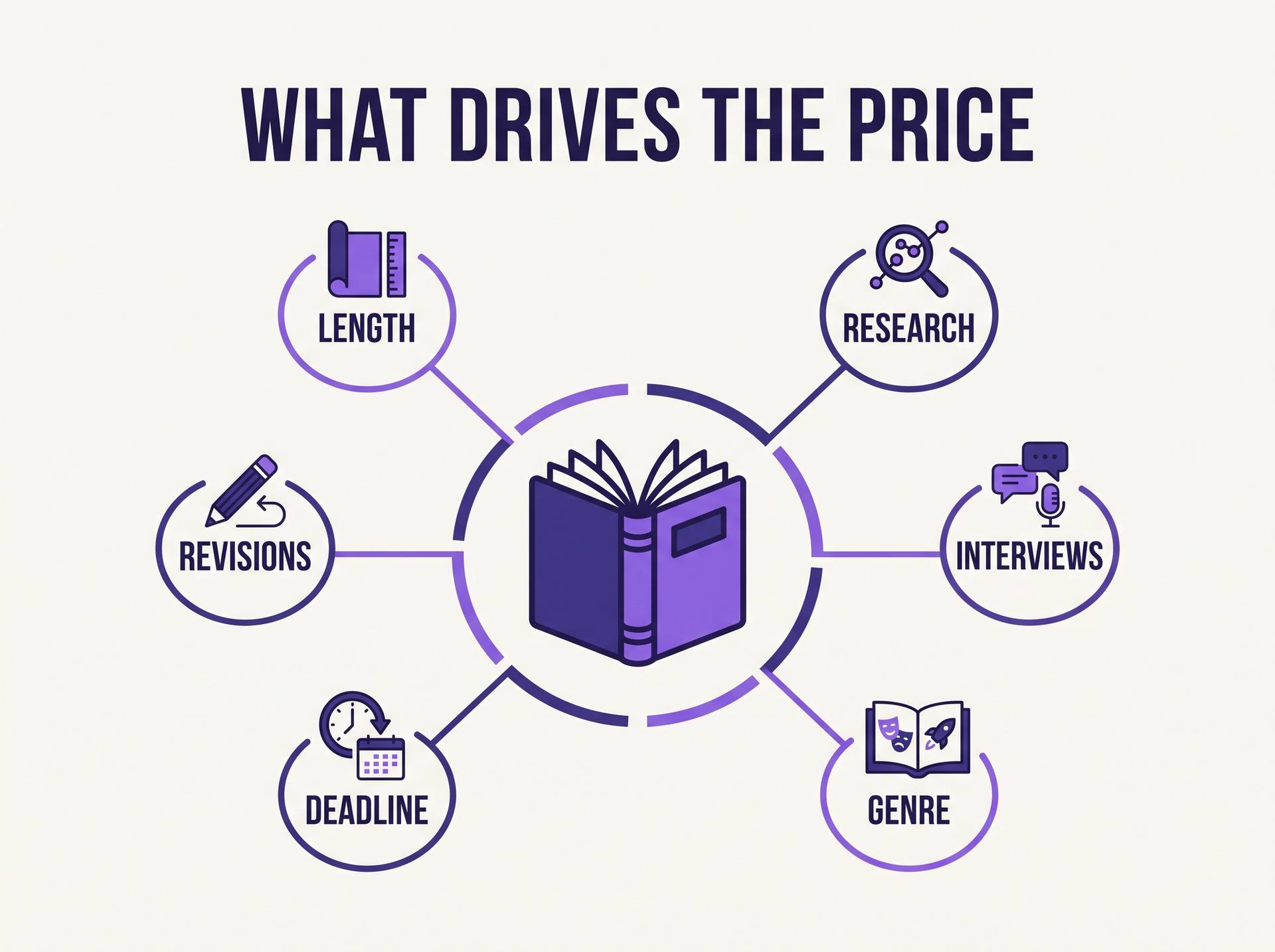
Two authors can be quoted $12,000 and $38,000 for what sounds like the same book. These six variables explain nearly all of the gap.
Length
The most obvious lever and the least interesting. A 30,000-word business book and a 90,000-word memoir differ threefold in drafting time — but only about twofold in total cost, because the setup work is fixed.
Research load
Where the real money hides. A book you can dictate from memory is a fraction of the price of one that needs source reading, fact-checking, and citations. Some writers price research separately at an hourly rate for exactly this reason.
Interview hours
Memoir and founder-story books are built from recorded conversation. Twenty hours of interviews means twenty hours in the room, plus transcription, plus the far longer job of turning talk into structure. Expect this to be scoped by the hour.
Genre
Nonfiction is priced higher per word than fiction on average, because the writer has to be right as well as readable. Highly technical or regulated subjects — medical, legal, financial — carry a premium again.
Deadline
A rush job displaces other contracts. A three-month turnaround on a book that would normally take eight commonly adds 25% to 50%, and a writer who does not charge a rush premium is either under-booked or about to miss your date.
Revision rounds
Two rounds is the industry norm. Unlimited revisions is not generosity, it is an unpriced risk that ends in resentment on one side or a padded fee on the other. Name a number.
Memoir, business book, fiction: three different purchases
The tier table above is a market average. What you are actually buying differs a lot by category, and so does where the hours go.
Memoir
The most expensive per word, and the most interview-heavy. You are paying for a listener who can hear the shape of a life inside forty hours of rambling audio, and for the nerve to tell you which of your favourite anecdotes does not earn its place. Budget for a discovery phase before anyone quotes a fixed fee — nobody can price a memoir before hearing the story. If you want to understand the structural decisions before you brief anyone, our memoir writing guide walks through the same choices a ghostwriter would raise on the first call.
Business and authority books
The most commonly ghostwritten category and the most predictably priced, because the material already exists in the client's head, talks and slide decks. Length is usually 30,000 to 50,000 words, the argument is fixed early, and the writer's real job is compression. This is also the category where the return on spend is easiest to justify: the book is a sales asset, not a product.
Fiction
Lower per-word rates, higher total risk. Ghostwritten fiction is dominated by genre series work — romance, thriller, cozy mystery — often at the entry tier and often per book in a series, where the same writer produces several titles a year to an established formula. Literary fiction is rarely ghostwritten at all, for the obvious reason that the voice is the product.
Payment schedules and what belongs in the contract
The schedule is where trust is either built or quietly destroyed. Standard practice is a deposit of 25% to 50% up front, then payments tied to delivery milestones rather than to calendar dates.
Deposit on signature, typically 25% to 50%. A writer asking for the full fee up front is a serious warning sign; so is one asking for nothing.
A payment on approved outline and chapter plan, before drafting begins.
Payments on delivery of drafted sections — thirds or quarters of the manuscript, each with a defined review window.
A final payment on delivery of the completed manuscript, after the agreed revision rounds are used.
Alongside the schedule, insist on five clauses: full copyright assignment to you on final payment; a confidentiality and non-disclosure term; a named word count with a tolerance band; the exact number of revision rounds and what counts as one; and a kill fee that says what each party owes if the project stops halfway. Everything else is negotiable. These five are not.
Where to hire, and what to walk away from
Rates cluster by channel, and so does risk. Broadly, the cheaper the channel, the more vetting work falls on you.
General freelance marketplaces
The widest range and the lowest floor. Real professionals work here, but so does everyone else, and the review systems reward volume over craft. Usable if you run your own paid sample test.
Specialist ghostwriting agencies
Higher prices for project management, a vetted writer, and a contract that already exists. You are paying an agency margin, often 30% to 50% of the fee, for reduced risk and a replacement if the pairing fails.
Referral and direct approach
The best value in the mid and premium tiers. Find books in your category with an acknowledgements page thanking a collaborator, and write to that person. Working ghostwriters are usually booked three to six months out, which is itself a quality signal.
Five red flags
A fixed quote given before anyone has read your material or asked what the book is for.
No sample of published work in a comparable category, or samples that cannot be verified because everything is confidential — a professional keeps clearable samples for this exact reason.
Unlimited revisions promised verbally and absent from the contract.
Reluctance to put copyright assignment in writing.
A price far below the beginner band for a full-length book. At $2,000 for 60,000 words, either the work is being subcontracted, or it is being generated and lightly edited without telling you.
That last one deserves a plain statement, because it is now common: some low-cost ghostwriting is undisclosed AI drafting sold at human rates. If you are going to pay for a machine-assisted draft, it is worth knowing you can commission it yourself, at cost, and keep the editorial control.
How AI drafting changes the math
The honest framing is this: AI does not replace a good ghostwriter, but it does replace the specific thing many authors were actually buying from a cheap one — a competent first draft from an outline and a pile of notes. If your reason for hiring was "I know what I want to say and I cannot face writing 60,000 words of it," the arithmetic has genuinely changed.
AIWriteBook is built for exactly that job. You give it the premise, it builds the outline, and it drafts chapter by chapter while you steer — with a chat assistant in the editor that shows every proposed change as an accept-or-reject diff, so nothing lands in your manuscript without your say-so. For nonfiction you can upload your own reference files and have the chapters grounded in and cited from them, which is the closest thing to handing a ghostwriter your research folder. If you already have a partial manuscript, you can import it and have the writing style extracted so the new chapters read like the old ones.
It is not the same purchase, and pretending otherwise would be dishonest. You keep the work of deciding what the book argues, and you keep the editing. What you save is the drafting, the calendar, and the four-figure minimum. Credits are the unit of cost inside the app — a chapter outline and a drafted chapter each cost a fixed number of credits, and the pricing page lists every action's cost. The paid plans start at $20 a month; a full-length book is a small fraction of even the entry ghostwriting tier.
If you want the fuller process rather than the price comparison, the practical workflow for writing a book with AI covers how to brief it so the output does not read like a machine wrote it, and there is a separate piece on whether you can legally publish an AI-assisted book if that is the part you are unsure about. Amazon's own position is narrower than most authors assume — the KDP AI disclosure rules require you to tell Amazon at upload, not your readers.
Not ready to spend $15,000 or more?
An AI ghostwriter built on your own talks, podcast and know-how writes the book in your voice for about $50 a month on Pro, with about 10 to 12 hours of your time instead of 50.
Compare the cost with a ghostwriterThe hybrid that most people should actually consider
The most cost-effective structure in 2026 is rarely all-or-nothing. Draft the manuscript yourself with AI assistance, then hire a professional for the two jobs machines are worst at: a developmental edit that tells you which chapters do not work, and a line edit that makes the prose yours rather than generic.
A developmental edit on a full-length book typically runs $1,500 to $6,000, and a line edit somewhere similar depending on length and condition. Together that is a fraction of a mid-tier ghostwriting fee for arguably the higher-value half of the service. You lose the convenience of handing the whole thing over. You keep the money, the copyright conversation, and the actual authorship.
Mistakes that cost real money
Paying for words instead of structure
The expensive part of a book is deciding what it says and in what order. Authors who arrive with a firm outline and a clear reader in mind routinely pay a third less than those who arrive with "I want to write a book about my career." Do the thinking before you commission the writing.
Skipping the paid sample chapter
Pay for one chapter at full rate before committing to a whole book. It costs a few hundred to a couple of thousand dollars and it is the only reliable test of whether this writer can hear your voice. Any professional will agree to it.
Treating the quote as the total cost
The ghostwriting fee is not the book budget. Cover design, proofreading, formatting, ISBN and launch marketing add meaningfully on top. Budget the whole journey or the manuscript sits finished and unpublished.
Not agreeing what happens if it goes wrong
Roughly a fifth of collaborations end early — mismatched voice, missed deadlines, a client who changes the book's premise in month four. Agree the kill fee and the ownership of partial work before it matters, not after.
Comparing quotes without comparing scope
A $14,000 quote for a drafted manuscript with two revision rounds and a $22,000 quote that includes twenty interview hours, research, a developmental pass and a proposal are not the same product. Normalise the scope, then compare.
Frequently asked questions
Typical total fees run from about $5,000 to $15,000 for entry-level writers, $15,000 to $40,000 for experienced professionals, and $40,000 to $100,000 for writers with strong traditionally published credits. Celebrity and publisher-arranged memoirs go well beyond that and are usually paid from an advance. Converted to per-word rates, that is roughly $0.10 to $2.00 depending on tier.
Per project is almost always the better structure for a book, because it fixes your total and forces the scope — word count, interviews, revision rounds — to be written down. Per-word pricing looks comparable across writers but quietly rewards length, and length is not what makes a book good.
Only if the contract says so explicitly. Ghostwriting agreements should assign full copyright and all rights to you on final payment and waive the writer's claim to credit unless you choose to give it. Do not rely on convention or on the word ghostwriting to imply this — get the assignment clause in writing.
Four to nine months is the normal range for a full-length book, including interviews, drafting and two revision rounds. Compressing that to three months typically adds 25% to 50% to the fee, because the writer has to displace other work to do it.
It replaces the drafting, not the judgement. If you already know what your book argues and who it is for, AI-assisted drafting gets you a complete manuscript for a small fraction of any ghostwriting tier. What it does not do is decide what the book should be, interview you skilfully, or tell you honestly that chapter four should be cut. Many authors get the best value by drafting with AI and paying a professional editor for those parts.
So what should you actually pay?
Price the job before you take the calls. Estimate the word count, the interview hours and the research load, then decide which tier that work honestly sits in. If your book is a well-understood business or authority title with the material already in your head, the mid-career band buys you a professional who will finish it. If it is a researched memoir, budget for discovery before anyone quotes. And if the real problem is simply that 60,000 words is a lot of typing, that is now the cheapest problem on the list to solve.
Whatever you decide, get the five contract clauses in writing and pay for a sample chapter first. Those two habits protect more money than any amount of negotiating on the headline number. For the wider picture of what AI can and cannot take off your plate, the AI writing assistant guide is the place to start.