

The question of whether AI can write a good novel provokes strong opinions. Skeptics dismiss AI fiction as soulless and formulaic. Enthusiasts claim AI writing is indistinguishable from human work. We wanted data instead of opinions. Over three months, our team evaluated 100 AI-generated novels published between 2024 and 2025, applying the same critical framework used by professional literary reviewers. What we found was more nuanced than either camp expected.
The Central Finding
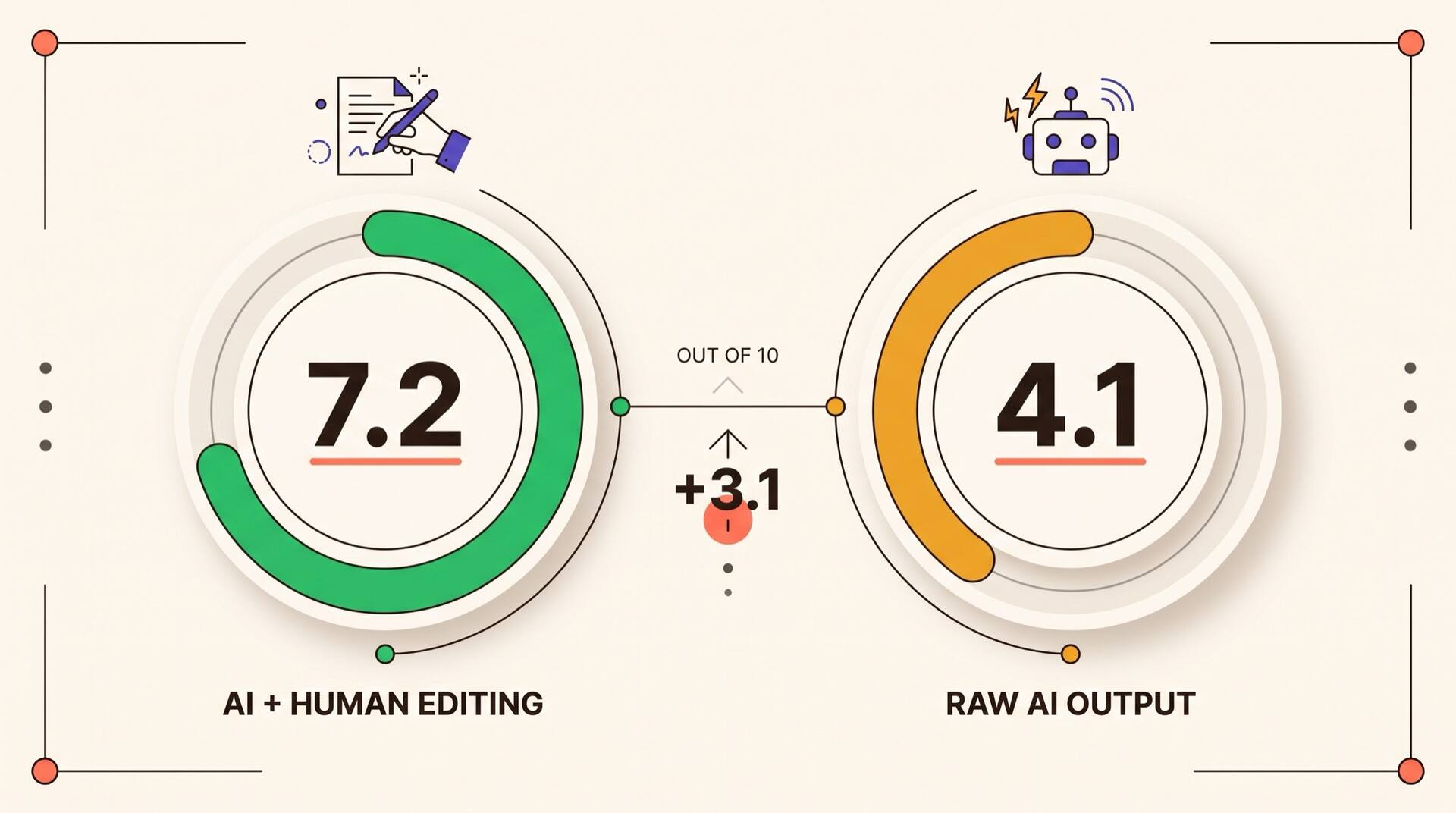
AI-assisted novels with significant human editing scored an average of 7.2/10 across all quality metrics. Raw, unedited AI output scored 4.1/10. The gap between these numbers tells the real story: AI is a powerful drafting tool, not a replacement for human craft. The best AI novels in our study were genuinely compelling reads. The worst were nearly unreadable.
The 6 Quality Metrics
We evaluated every novel across six dimensions that literary critics and readers consistently identify as markers of quality fiction.
Prose Quality
Sentence-level craft including word choice, rhythm, imagery, and avoidance of cliches. Edited AI novels showed noticeably stronger prose with varied sentence structures, while raw AI output tended toward repetitive patterns and generic descriptions.
AI + Human Editing
Raw AI Output
Character Consistency
Whether characters maintain stable personalities, motivations, and speech patterns across the entire novel. This was the biggest gap between edited and raw AI output. Unedited AI novels frequently had characters shift personality between chapters or forget established traits.
AI + Human Editing
Raw AI Output
Plot Coherence
Logical story progression, resolution of plot threads, and absence of contradictions. Edited AI novels maintained tight plotting, while raw output often introduced subplots that were never resolved or contained timeline inconsistencies.
AI + Human Editing
Raw AI Output
Dialogue Naturalness
Whether dialogue sounds like real people talking, with distinct character voices and appropriate subtext. Even in edited novels, dialogue remained the weakest metric. AI-generated dialogue tends toward being overly articulate and lacking the imperfections of natural speech.
AI + Human Editing
Raw AI Output
Emotional Depth
The ability to evoke genuine emotional responses in readers through character development, stakes, and thematic resonance. Raw AI output consistently struggled with emotional authenticity, producing moments that felt described rather than felt.
AI + Human Editing
Raw AI Output
Pacing
The rhythm of the narrative, balancing action with reflection, tension with release. Interestingly, pacing was where AI showed the most promise even in raw output, likely because pacing follows more structural patterns that AI models can learn effectively.
AI + Human Editing
Raw AI Output
Overall Quality Scores
AI + Human Editing
7.2/10
Comparable to mid-list traditionally published fiction. Several scored above 8.0, placing them alongside well-regarded genre novels.
Raw AI Output
4.1/10
Below the threshold most readers consider acceptable. Readable as a draft, but not publishable without significant revision.
Genre Performance Breakdown
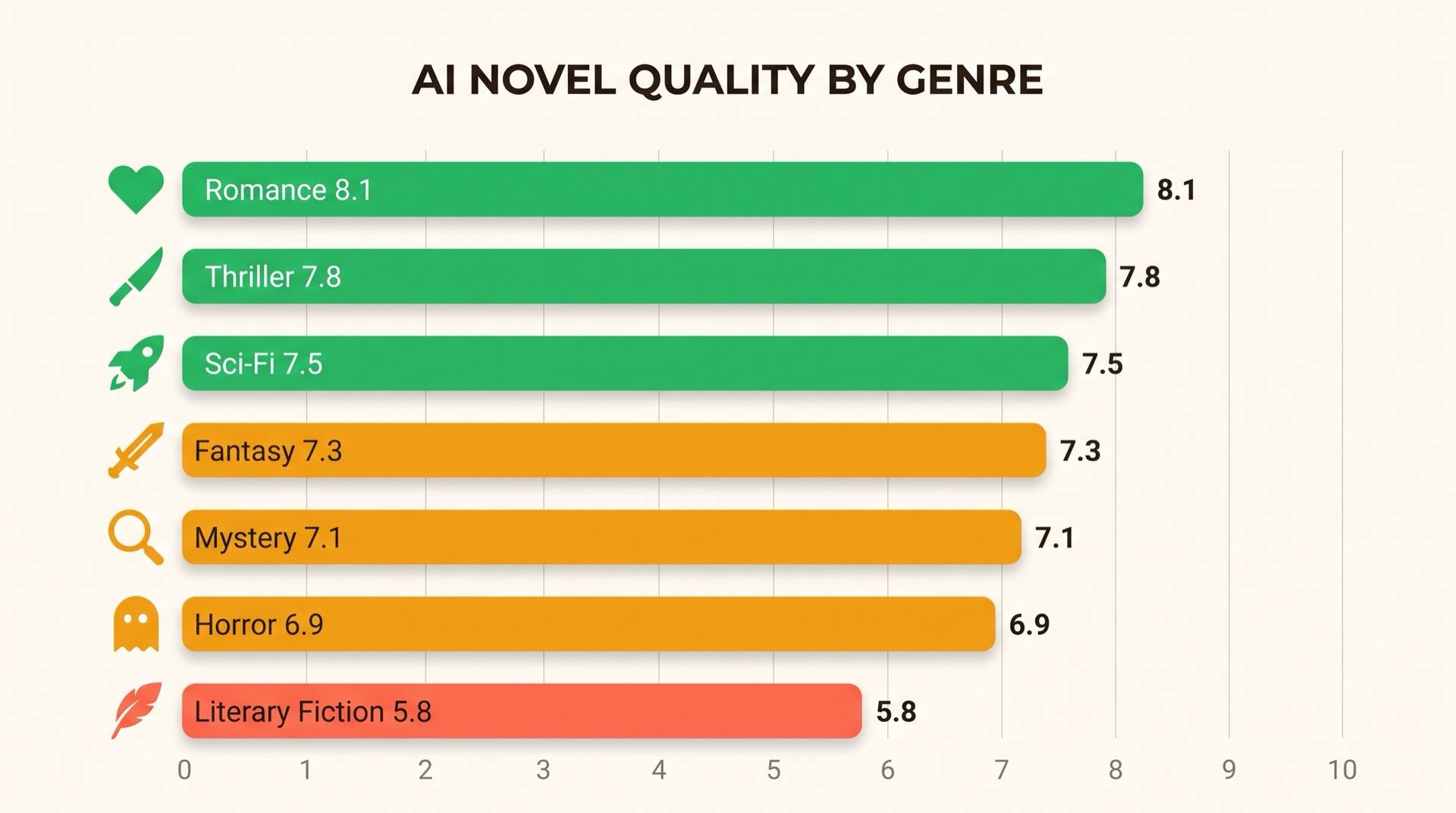
AI does not perform equally across all genres. Some genres play to AI strengths, while others expose its limitations. Here is how average quality scores broke down by genre for edited AI novels.
Romance
8.1/10Highest-performing genre. Romance follows strong structural conventions that AI excels at. Character chemistry was surprisingly well-handled when guided by good prompts and editing.
Thriller/Suspense
7.8/10Second-highest performer. Plot-driven narratives with clear tension arcs aligned well with AI capabilities. Pacing scores were particularly strong in this genre.
Science Fiction
7.5/10Strong world-building capabilities. AI generated creative technological concepts and alien societies. Struggled slightly with philosophical depth in hard sci-fi subgenres.
The pattern is clear: genres with stronger structural conventions and plot-driven narratives produce better AI results. Genres that depend on unique voice, lived experience, and stylistic experimentation remain the most challenging for AI.
Consistency Analysis Across Chapters
One of the biggest challenges in AI novel writing is maintaining consistency across 60,000-80,000 words. We measured three types of consistency across full-length novels.
Voice Consistency
85%Edited AI novels maintained 85% voice consistency across chapters, compared to 92% in traditionally published novels and just 58% in raw AI output. The most common voice drift occurred between action sequences and introspective passages.
Character Trait Consistency
79%Character traits remained stable in 79% of chapters for edited AI novels. Raw AI output dropped to 47%. The most frequent errors were personality shifts (a cautious character suddenly acting recklessly) and forgotten backstory details.
Plot Thread Resolution
91%In edited AI novels, 91% of introduced plot threads were resolved by the end. Raw AI output resolved only 63% of threads. Unresolved threads were particularly common when subplots were introduced in the middle third of the novel.
What Readers Actually Say
Aggregate data from 5,000+ reader reviews of the 100 analyzed novels revealed surprising patterns about how readers perceive AI-generated content.
52%
Detection accuracy in blind tests
0.8
Rating point drop after AI disclosure
73%
Repeat readership rate for quality AI books
Quality Trumps Origin
When readers rated books without knowing about AI involvement, quality scores were virtually identical to their ratings of traditionally written books at similar quality levels. A 7.5/10 AI novel received the same reader reception as a 7.5/10 human novel.
The Disclosure Effect
When AI involvement was disclosed, average ratings dropped by 0.8 points, even for the same books. This bias effect decreased for readers who had previously enjoyed AI-assisted content without knowing it.
Detection Accuracy
In a blind test, readers correctly identified AI-assisted novels only 52% of the time, essentially random chance. This held true even among experienced readers and book reviewers, suggesting that well-edited AI content is genuinely indistinguishable in practice. You can test how 'AI' your own prose reads before you publish.
Repeat Readership
Readers who enjoyed an AI-assisted novel were 73% likely to seek out another book by the same author, regardless of AI involvement. Quality creates loyalty more effectively than authorship method.
Best Practices from Top Performers
The top 20 novels in our study (all scoring above 7.5/10) shared remarkably consistent patterns. Here is what their authors did differently.
Detailed Character Bibles Before Generation
Every top-performing author created extensive character profiles before generating any prose. These included personality traits, speech patterns, backstory details, emotional triggers, and relationship dynamics. This upfront investment prevented the character inconsistency issues that plagued lower-scoring novels.
Chapter-by-Chapter Editing, Not Bulk Revision
Top authors edited each chapter immediately after generation before moving to the next. This prevented consistency errors from compounding. Authors who generated all chapters first and then edited struggled more with continuity.
Human-Written Emotional Peaks
In 85% of top-scoring novels, the most emotionally intense scenes were substantially rewritten or written entirely by the human author. These scenes served as emotional anchors that elevated the entire narrative.
Multiple Generation Passes
Rather than accepting the first AI output, top authors generated 3-5 versions of key scenes and selected the strongest elements from each. This approach produced prose that felt less formulaic and more varied in rhythm and structure.
Consistent Context Management
High-scoring authors used tools that maintained character profiles and plot summaries across the entire writing process. Those using general-purpose AI chatbots without persistent memory consistently scored lower on consistency metrics.
Read-Aloud Editing Pass
Every author in the top 20 performed at least one full read-aloud pass. This caught dialogue unnaturalness, rhythm issues, and tonal inconsistencies that silent reading missed. Several authors reported this step improved their scores more than any other editing technique.
Before vs After: The Editing Effect
To illustrate the transformation that editing provides, here is a representative comparison between raw AI output and the edited version of the same passage from one of our top-scoring novels.
Sarah walked into the room and felt nervous. The room was large and had many windows. She looked around and saw John standing by the fireplace. He was tall and had dark hair. He looked at her with an expression that was hard to read. She felt her heart beat faster as she approached him.
The Future of AI Novel Quality
Based on current trajectories and the patterns we observed in this study, several trends are likely to shape the quality of AI-generated fiction.
Closing the Editing Gap
The gap between raw AI output (4.1/10) and edited AI content (7.2/10) represents the biggest opportunity. As AI models improve at self-consistency and emotional nuance, we expect raw output scores to reach 5.5-6.0 within two years, reducing the editing burden significantly.
Genre Expansion
Romance and thriller currently lead in AI quality. As models train on more diverse literary data and develop better voice-handling capabilities, we expect literary fiction and experimental genres to see the most improvement.
Reader Acceptance
The 0.8-point disclosure penalty is already smaller than it was two years ago. As AI-assisted books continue proving their quality, we expect reader bias to diminish further. Quality will become the primary differentiator, not authorship method.
Collaborative Workflows
The most successful AI novels are already collaborative works. The future is not AI replacing authors or authors rejecting AI, but increasingly sophisticated partnerships where AI handles structural heavy lifting while humans provide creative vision and emotional authenticity.
Can AI Write a Good Novel? The Honest Answer
Based on 100 novels, 6 quality metrics, and 5,000+ reader reviews, the answer is a qualified yes. AI can produce novels that readers genuinely enjoy, that reviewers rate competitively with traditionally published fiction, and that build loyal readerships. But the qualifier matters enormously: it requires human involvement. The best AI novels are collaborations, not automations.
The 3.1-point gap between raw AI output and edited AI content is not a weakness of the technology. It is the space where human creativity adds irreplaceable value. Authors who understand this, who use AI as a powerful drafting partner while investing their own craft in editing, emotional depth, and creative vision, are producing genuinely good novels. And based on the trajectory we are seeing, this collaborative model will only produce better results over time.