

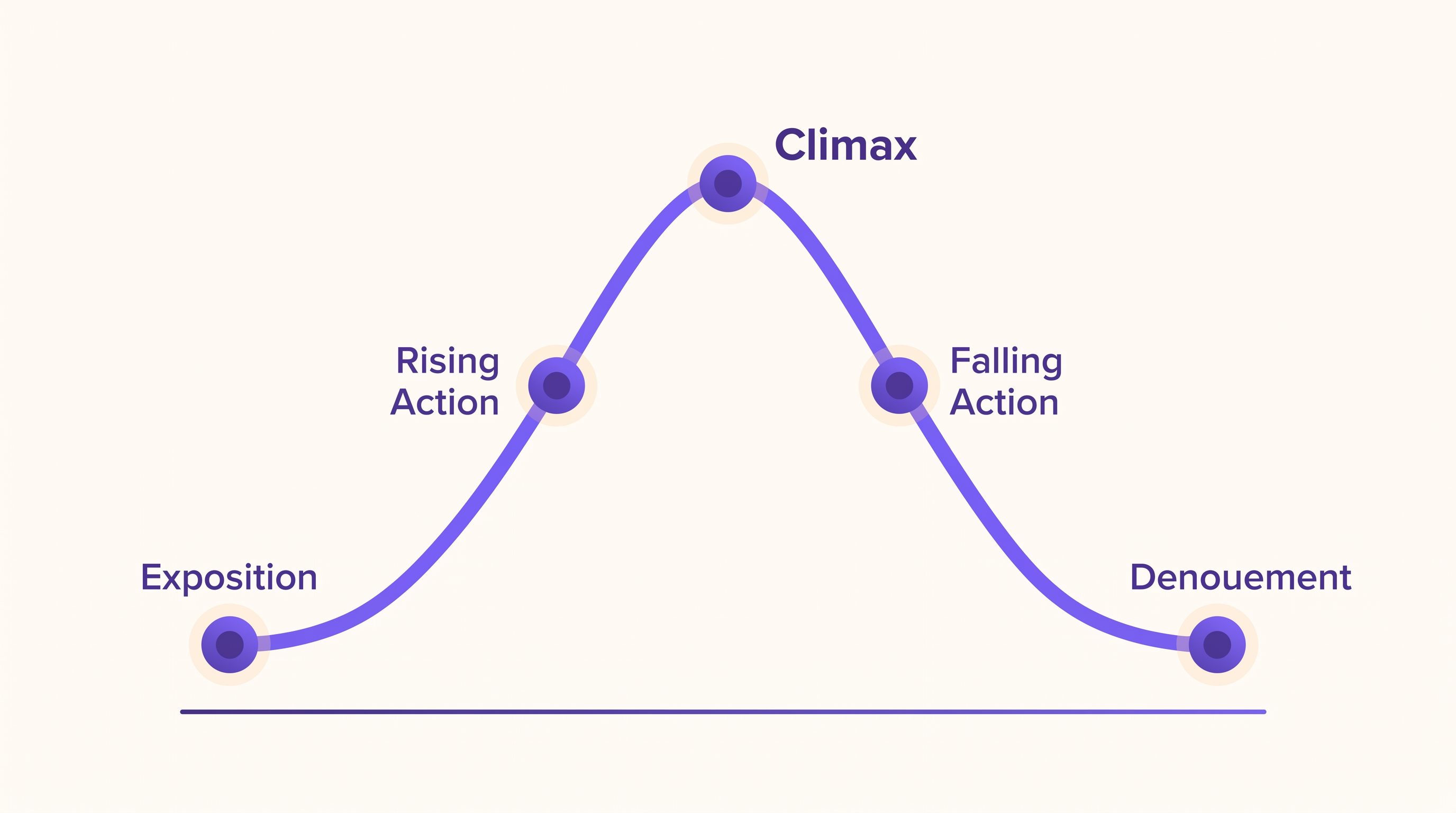
What Freytag's pyramid actually is
Gustav Freytag was a novelist and critic who spent years reading Greek tragedy and Shakespeare, looking for the shared skeleton underneath them. He published his answer in 1863 as Die Technik des Dramas — The Technique of the Drama. His claim was narrow and specific: a well-made five-act tragedy moves through five parts, and the turn happens in the middle, at the top of the arc.
Drawn on a page, that shape is a pyramid. The line climbs through complication after complication, reaches a peak where the protagonist's fortune reverses, then descends through the consequences to the ending. The reversal at the top is the load-bearing idea. Everything before it exists to make it inevitable; everything after it exists to pay for it.
One detail that survives almost nowhere in the classroom version: Freytag did not write about "rising action" and "falling action" as neutral pacing zones. He wrote about a rise and a return, driven by the hero's own choices, ending in a catastrophe. Strip the tragedy out of the model and you are left with a bell curve, which is roughly what happened to it on its way into modern textbooks.
It falls into five parts: introduction, rise, climax, return or fall, and catastrophe.
Freytag's own labels — note that his fifth beat is a catastrophe, not a tidy resolution.
The five stages, one at a time
Pick a stage to see what it is for, what Freytag originally called it, and the failure that shows up when writers get it wrong.
Exposition — the world before the trouble
Freytag's term: introduction
Establish who the protagonist is, what they want, and the balance that is about to break. Freytag treated this as a single strong scene, not a chapter of background. The exposition ends with what he called the exciting force — the moment that pushes the character off their normal path.
The trap: front-loading history. Readers tolerate a paragraph of context and abandon a chapter of it.
Macbeth, stage by stage
Freytag built the model on plays like this one, so it fits almost suspiciously well. Macbeth is also the clearest demonstration of why a centred climax is a tragic shape rather than a universal one.
Exposition
A victorious general meets three witches who greet him as the future king. The exciting force is the prophecy — nothing has happened yet, but ambition now has permission.
Rising action
Lady Macbeth pushes; Duncan is murdered; Banquo is murdered to protect the secret. Each act of concealment requires the next one. Macbeth is winning and losing simultaneously.
Climax
The banquet scene, in the middle of the play, where Banquo's ghost appears and Macbeth breaks in front of his own court. Nobody duels. This is the reversal: from here he can only be found out.
Falling action
The nobles turn, Lady Macbeth unravels, the second prophecy gives Macbeth a false sense of safety — Freytag's moment of last suspense — and the English army moves.
Catastrophe
Birnam Wood comes to Dunsinane, the man not born of woman kills him, Malcolm takes the crown. The order broken in act one is restored.
Notice where the peak sits: roughly halfway. A modern thriller with its turning point at the 50% mark would feel like it ends twice. That difference is the whole argument of the next section — and if you want the mechanics of the turn itself, the breakdown of what a story climax has to accomplish covers it beat by beat.
Freytag's pyramid vs the three-act structure
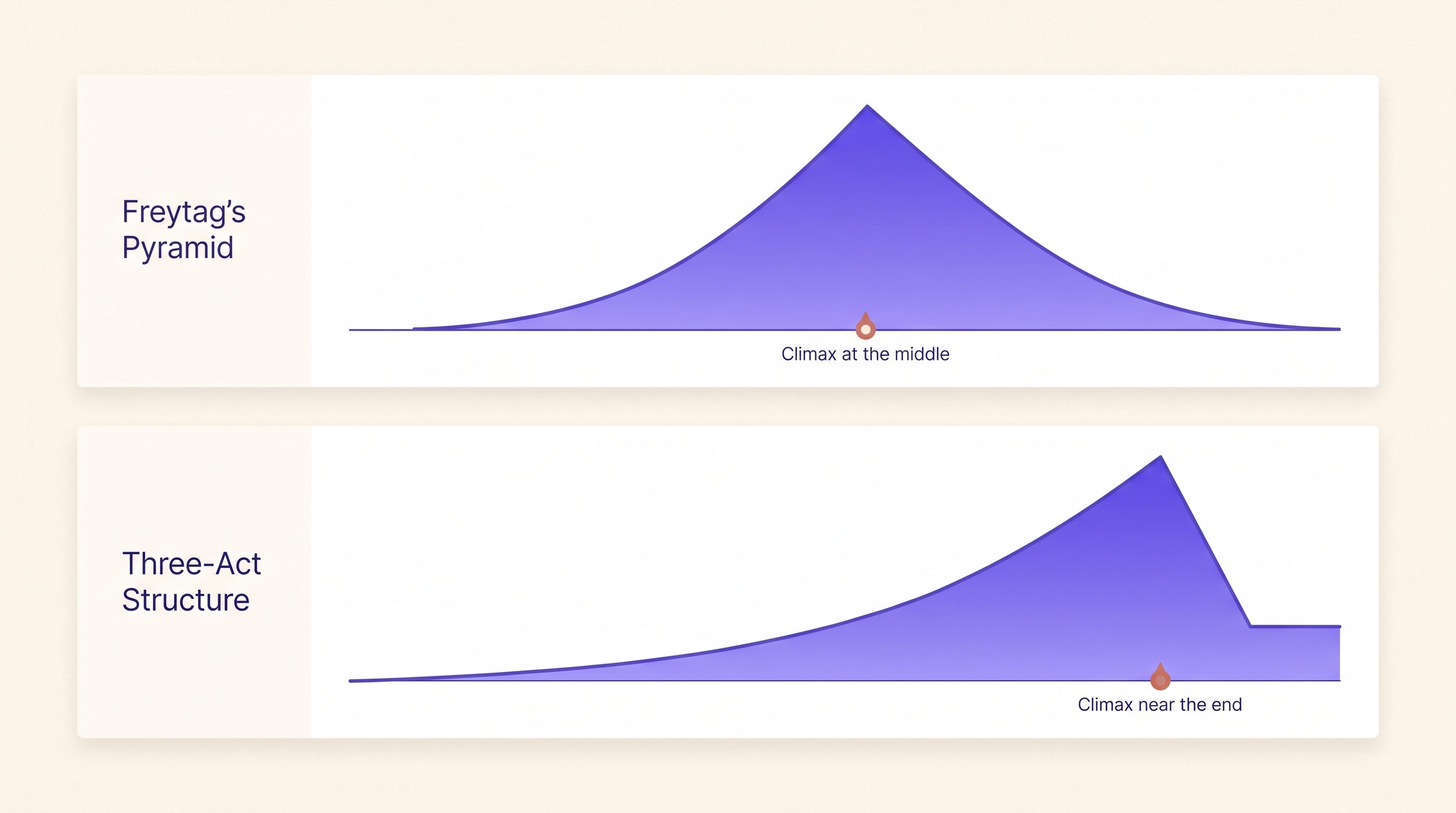
These two models are frequently presented as the same thing with different labels. They are not. They disagree about where the highest-tension moment belongs, which changes every pacing decision you make.
| Dimension | Freytag's pyramid | Three-act structure |
|---|---|---|
| Built for | Five-act stage tragedy | Screenplays and commercial novels |
| Climax position | Structural centre, near 50% | Late, roughly 85–90% |
| Weight after the peak | About half the work | A short resolution |
| Default ending | Catastrophe for the protagonist | Victory, or a cost the hero accepts |
| Best used as | A lens for analysis and tragic plotting | A drafting scaffold |
If you only want the general shape of a story arc without the tragic assumptions baked in, the plot diagram is the flexible tool for that — Freytag's pyramid is the specific five-act original it descends from. And if you are drafting genre fiction, the three-act structure will fight you less.
When to use it, and when not to
Freytag was describing a form, not prescribing one. Treated that way, the pyramid stays useful.
Reach for it when
- You are writing tragedy, literary fiction, or any story whose ending is a consequence rather than a triumph.
- You are analysing a finished work — the pyramid is an excellent diagnostic even for books that were never written to it.
- Your protagonist's downfall is self-inflicted. The rise-and-return shape is built for exactly that.
- You want to test whether the second half of your draft carries real tension or is just tying knots.
Skip it when
- You are writing thriller, romance, mystery, or anything where readers expect the peak late. A centred climax leaves 50% of the book after the answer.
- Your story is a series entry that has to end on an unresolved thread. Freytag's fifth stage assumes closure.
- You are using it as a drafting template rather than a description. Its five parts are unequal in length, and the diagram hides that.
- Your genre runs on a mystery engine, where the reveal has to sit close to the final page.
Four mistakes writers make with the pyramid
Reading the diagram as a timeline
The pyramid is drawn symmetrical because it is a diagram, not a schedule. Freytag's own commentary treats the introduction as brief and the rise as long. Spacing your five stages evenly across a novel produces a saggy opening and a bloated ending.
Putting the biggest set piece at the top
The climax is a reversal of fortune. Macbeth's is a dinner party. If your peak is the most explosive scene rather than the most consequential one, the structure is mislabelled.
Letting the falling action deflate
Freytag was explicit that the second half needs its own suspense, and he named the device: a moment of last hope for the doomed protagonist. Skip it and readers coast through your final act. There is a full breakdown of how to keep that stretch alive in the guide to falling action.
Applying it to a genre it was never built for
This is the expensive one. A cozy mystery plotted on Freytag's pyramid reveals its killer at the midpoint. The model is not wrong; it is simply describing a different kind of story than the one you are writing.
Getting the shape right before you draft
Structure problems are cheap to fix in an outline and expensive to fix in a manuscript. In AIWriteBook you describe your book and generate a chapter-by-chapter outline, then edit any chapter's summary and regenerate around it — so you can move the turning point, test a centred peak against a late one, and see how the chapter count redistributes before a single scene is written.
Want to try it without an account first? The free book outline generator takes a premise and returns a structured chapter outline you can pull apart.
The honest summary
Freytag's pyramid is a precise description of one story shape — the self-inflicted fall, turning at the centre, paid for across the second half. Used as a lens it will tell you things about your draft that no beat sheet can. Used as a template for a modern commercial novel it will hand you a book that peaks halfway and then explains itself for two hundred pages.
Learn the shape, name your own turning point honestly, and then choose where it belongs based on what your readers came for rather than what a diagram from 1863 says about five-act tragedy.