

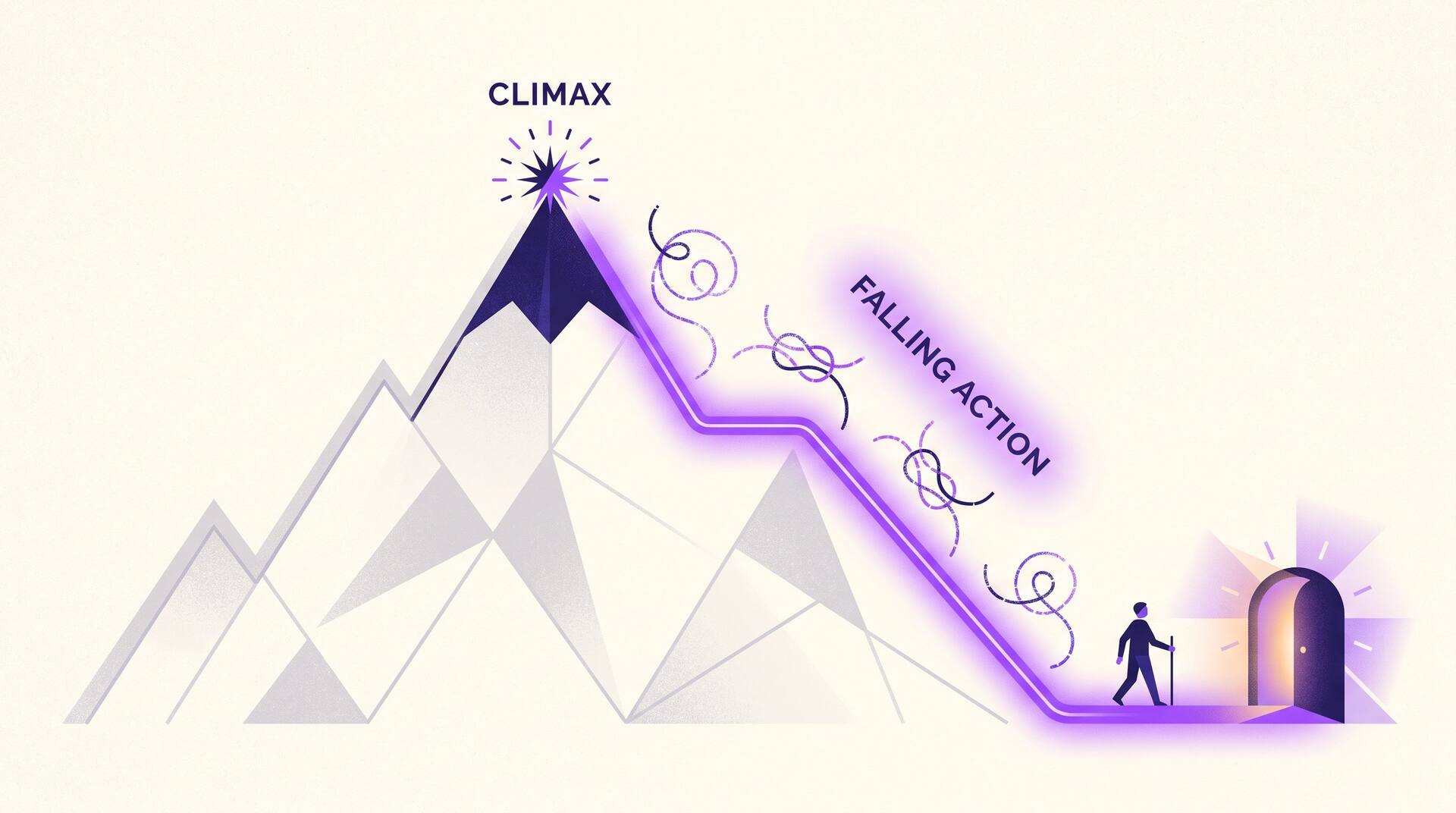
Search for falling action examples and you get the same three sentences everywhere: it comes after the climax, it ties up loose ends, see Romeo and Juliet. That is a definition you can repeat on a test and cannot use at a desk. It tells you nothing about how much of it to write, what belongs in it, or why the version you drafted feels like an appendix rather than an ending.
This guide takes the term seriously as a working tool. Where it came from, what it is honestly good for in a modern novel, how long it should run as a percentage of your manuscript, and four books and films that handle it in completely different ways — including one that runs it for six chapters on purpose and one that gives it about ninety seconds.
Definition
Falling action is the stretch of story between the climax and the final page, in which the consequences of the climax play out, remaining subplots close, and the reader watches the changed characters begin to live in the world the climax created.
The key word is consequences. Falling action is not decompression and it is not summary — it is the last stretch of dramatised story, and it still contains scenes with people making choices.
Where the term comes from, and why the pyramid lies a little
Falling action is the fourth of five parts in the diagram every schoolroom draws: exposition, rising action, climax, falling action, denouement or catastrophe. The shape is usually credited to Gustav Freytag, the German novelist and critic who laid it out in Die Technik des Dramas in 1863.
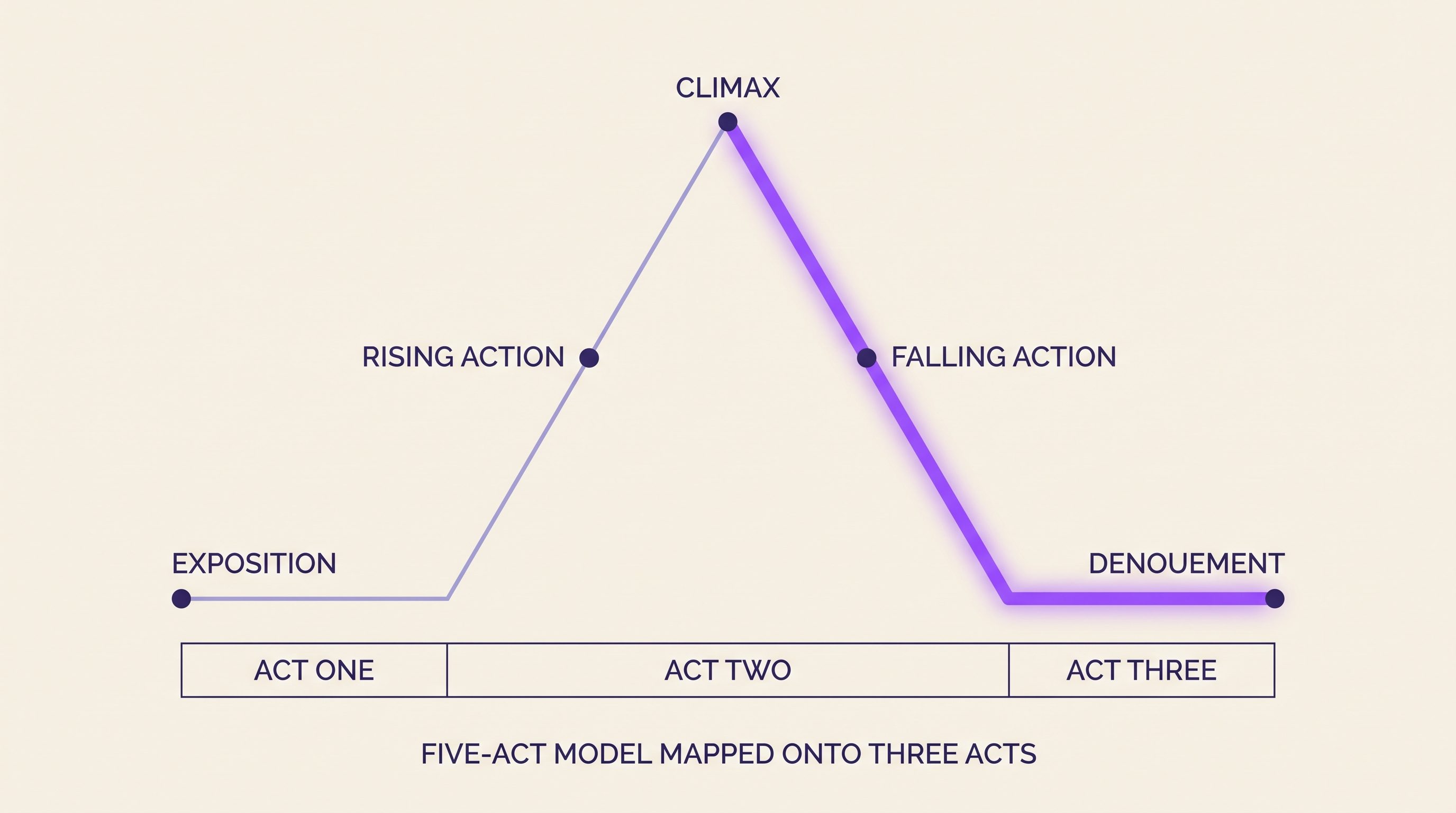
Here is the part the diagram never mentions. Freytag was describing five-act tragedy — Greek drama and Shakespeare — for playwrights working in that form. He was not describing the novel, and he certainly was not describing a 2026 romantasy or a domestic thriller. In his model the falling action is genuinely substantial: it is a whole act, the stretch after the hero's turn in which the counter-forces close in and the catastrophe becomes inevitable. In Shakespearean tragedy the protagonist often loses in act four and dies in act five.
Modern narrative moved the climax much later. In most contemporary novels the decisive confrontation lands somewhere in the last ten to fifteen percent of the book, which leaves nothing like a full act afterwards. So the pyramid, applied literally, will tell you to write a fourth act that your genre does not want.
Map it onto three acts instead and it becomes usable: exposition and the inciting incident are act one, rising action is act two, and the climax plus everything after it is act three. The five-act falling action and denouement collapse into what most writers now simply call the resolution. If you want the full architecture rather than this one segment, our three-act structure guide lays it out, and the plot diagram guide covers the pyramid as a whole.
Use Freytag as a checklist of things a finished story tends to contain, not as a floor plan with fixed room sizes. The names are useful. The proportions are two centuries out of date.
Every tragedy falls into two parts — Complication and Unravelling or Denouement.
Freytag's five parts are a later elaboration of a much older two-part idea: everything that ties the knot, and everything that unties it. Falling action is the untying, dramatised.
What falling action actually does
A resolution that feels flat is almost always doing one of these four jobs and skipping the other three. Check your draft against all four.
It makes the climax cost something
A climax is a decision under maximum pressure. Until the reader sees what that decision bought and what it destroyed, it was only a fight scene. This is why a hard-won victory that cuts to black feels cheap — the price was never shown being paid. Show the funeral, the empty chair, the bill.
It closes subplots the main plot cannot
The climax resolves one line of tension, usually the protagonist against the antagonist. Everything else — the sister, the debt, the rival's arc, the secret two characters are keeping from each other — has to land somewhere, and the only room left is here. This is the mechanical work of the section, and it is why falling action gets long in books with many viewpoint characters.
It shows the changed character in the new world
Character change is only a claim until the reader sees it operating under normal conditions. Give your protagonist one ordinary moment after the climax — a conversation they would have handled badly in chapter three — and let them handle it differently, without commentary. That single scene does more than any amount of narrated growth.
It converts adrenaline into meaning
Physiologically and emotionally, a reader coming out of a climax is keyed up. If you end there, the feeling dissipates in the car park with nothing attached to it. The falling action is where that arousal gets bound to whatever the book was about. Skip it and readers report the same symptom: it was gripping, but I do not remember how it ended.
How long should the falling action be?
There is no rule, but there is a strong convention, and it is worth knowing what you are departing from.
In most commercial novels, everything after the climax occupies roughly the last five to ten percent of the manuscript. On an 80,000-word novel that is four to eight thousand words — one to three chapters. Long enough for two or three real scenes and a closing image; short enough that the reader never feels the book has stopped and is now clearing its throat.
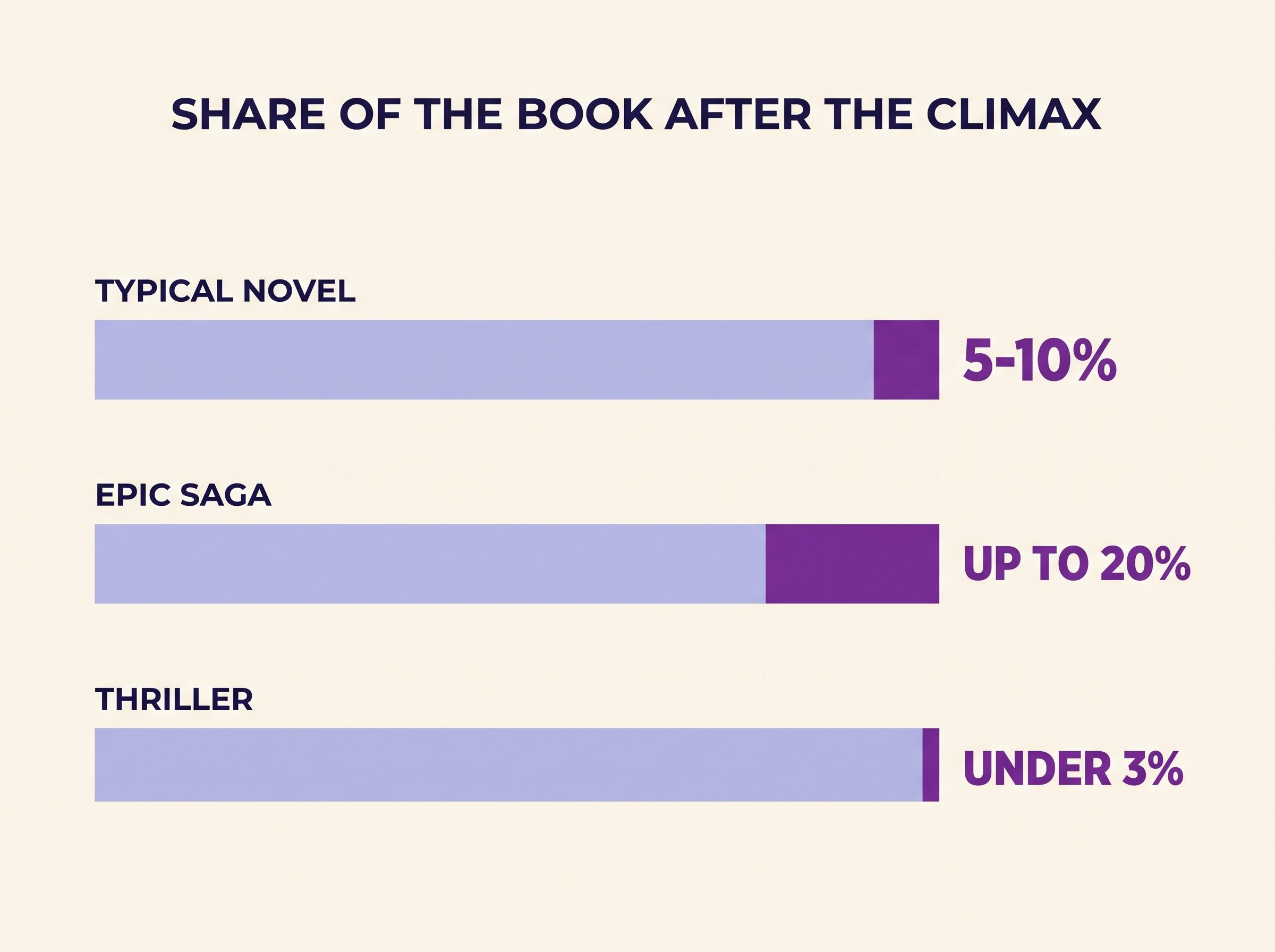
Epic fantasy and multi-generational sagas run longer, sometimes toward twenty percent, because the cast is larger and every thread has a home to be sent to. Thrillers and horror run far shorter — often under three percent, sometimes a single page — because the genre contract is momentum and a long wind-down leaks the tension the whole book was built to store.
The practical version of this: open your manuscript, find the climax, and calculate what fraction of the total word count comes after it. If you are at twenty-five percent in a psychological thriller, you have written a second book. If you are at one percent in a family saga, readers will finish feeling cheated. Our free word counter will give you the split in a few seconds if you paste the post-climax section in on its own.
One more proportion worth watching: the number of scenes, not just the words. Three short scenes that each resolve something beat one long chapter in which a character reflects on everything at once.
Four falling actions, analysed
Not a list of definitions with a book attached. Four different strategies, and what each one is buying.
The Lord of the Rings — the long one, on purpose
The Ring goes into the fire in the third chapter of the final book. Six chapters follow. Tolkien takes the reader through the field of Cormallen, the crowning of the king, the long series of partings as the fellowship dissolves, the journey home, and then — the part that stuns first-time readers — the Scouring of the Shire, in which the hobbits come back to find home occupied and have to fight one more time. Only then, the Grey Havens.
What it buys: the entire theme. The book is about whether you can go home after what you have seen, and every one of those chapters is an argument that you cannot, quite. The Scouring in particular is not padding — it is the last exam, and it is the only place the hobbits' growth can be demonstrated on their own ground. Peter Jackson cut it, which is exactly why his film ending is regularly mocked as having four endings: the same duration without the same argument.
The Great Gatsby — one chapter that reframes everything
Gatsby is shot at the end of chapter eight. Chapter nine is Nick trying to assemble a funeral almost nobody attends, the encounter with Gatsby's father, the last conversation with Tom, and the closing passage about the green light and boats against the current.
What it buys: judgement. The climax is a plot event; the falling action is where Nick — and therefore the reader — decides what the whole summer meant. Almost every line people quote from the novel is in the falling action, which should tell you something about where a book's meaning actually gets made.
Pride and Prejudice — the paperwork of a happy ending
The emotional climax is Darcy's second proposal and Elizabeth's acceptance. Austen then spends the remaining chapters on the practical aftermath: telling Mr Bennet, telling Mrs Bennet, Lady Catherine's fury, Miss Bingley's climbdown, and a final survey of where every couple ends up living and how often they visit.
What it buys: social reality. In Austen the point was never the kiss; it was whether two people can be reconciled within a system of money, family and reputation. The falling action is where the system gives its verdict, which is why a romance that ends at the declaration feels thinner than one that shows the couple surviving contact with everyone else.
Se7en and the near-zero ending
Fincher's film delivers its climax in a field, holds for a few seconds of aftermath, and ends. There is a single line of voiceover and the credits. Total falling action: well under a minute of a two-hour film. The novel-length equivalent is a thriller that ends within a page or two of the confrontation.
What it buys: refusal. Any wind-down would have offered comfort, and the whole design of the film is to deny it. That is the honest reason to cut a falling action short — not because you ran out of steam, but because consolation would contradict the book. If your reason is the first one, the reader can tell.
Falling action vs denouement vs resolution vs epilogue
These four get used interchangeably, including by people teaching them. They are not the same size or the same job, and knowing which you are writing tells you what belongs in it.
| Term | What it is | Scene or summary? | Test |
|---|---|---|---|
| Falling action | Dramatised consequences after the climax; subplots resolving through action | Scenes, with conflict still in them | Does anyone still want something and struggle to get it? If not, you have skipped ahead to the denouement. |
| Denouement | The untying: the final state of affairs, revealed and settled | Usually one short scene or passage | Could the book stop one line later without anything feeling unanswered? |
| Resolution | The modern umbrella term for everything after the climax — falling action and denouement together | Both | This is the word your editor will use. It is not a fifth structural unit. |
| Epilogue | A separate, labelled section set at a distance in time from the main story | One scene, later | Remove it entirely. If the story is now unfinished, it was not an epilogue — it was the ending, mislabelled. |
The practical consequence: falling action still contains conflict. Denouement does not. If you find yourself writing a chapter after the climax in which nobody wants anything and nothing is at stake, you have written a long denouement and called it falling action, and it will read as slow because it is.
Epilogues carry a specific risk that is worth naming. An epilogue set years later — the Nineteen Years Later of Harry Potter and the Deathly Hallows is the most argued-about example in modern publishing — converts an open future into a fixed one. Some readers want that guarantee; others feel their imaginative work has been overwritten. Neither reaction is wrong, but you should choose knowingly rather than adding one because the file felt short.
What must be closed before the last page
Work down this list against your actual manuscript, not against your memory of it. Each item that fails is a specific scene you owe the reader.
- Every promise made in act one. If chapter two established that the protagonist has never spoken to her father since the accident, the reader is owed a resolution of that — not necessarily a reconciliation, but a position. This is the same discipline as Chekhov's gun applied at book scale: what you hung on the wall must be taken down.
- Every subplot with a viewpoint character attached. Readers forgive an unresolved minor thread. They do not forgive being made to care about someone for 200 pages and then never learning what happened to them.
- The antagonist's fate, stated. Not always shown, not always just — but known. Ambiguity here is a deliberate choice with a cost, not a default.
- The protagonist's change, demonstrated in action. One scene where they do the thing they could not do at the start. Not narrated, not explained by another character. Performed.
- The cost, visible. Whatever the victory destroyed should appear on the page at least once after the climax. A story where winning costs nothing reads as a fantasy in the pejorative sense.
- The central question of the book, answered — or its refusal made deliberate. If your book asked whether this marriage survives, the last pages answer it. If you intend not to answer, the not-answering has to feel like a position, which usually means a character consciously choosing not to know.
- One image the reader takes away. Nick's boats against the current, Ralph weeping on the beach, the last look at the house. Not a summary, an image. This is the difference between a book people finish and a book people quote.
Five ways falling action goes wrong
Stopping dead at the climax
The most common failure, and it is almost always a stamina problem rather than a craft decision. The writer has been aiming at the confrontation for a year, writes it, feels finished, and types a paragraph of wind-down because something has to go there. Readers describe the result as abrupt or unsatisfying without being able to say why. The diagnostic is honest and simple: did you plan the ending, or did you stop?
Introducing a new conflict in the epilogue
The sequel hook that arrives after everything has closed. A hand rises from the water, a letter arrives, the villain's eye opens. If the new problem carries any real weight it reopens the tension the reader just spent a chapter letting go of, and the ending they were about to feel evaporates. Series set-up belongs earlier, woven into the falling action as an unresolved thread the reader notices but the characters do not — not bolted on after the final line.
Summarising instead of dramatising
Three pages of narration explaining what became of everyone. It is the cheapest fix available and it costs the reader all the pleasure of watching. If a thread matters enough to close, it matters enough to get a scene, even a two-hundred-word one. If it does not deserve a scene, ask whether it needed to exist.
Over-explaining the theme
A character sits someone down and says what the book was about. It is the single fastest way to make an intelligent reader feel patronised, and it usually appears in the second-to-last chapter of a first draft. The rule of thumb: whatever the book means, cut the sentence that says it and see whether anything is actually lost. Almost never is. Our piece on showing rather than telling applies harder here than anywhere else in the manuscript.
Resolving the wrong thing at length
Six pages on the fate of the sidekick's shop and one line on the marriage the entire novel was about. Rank your threads by how much page time they got before the climax and give them roughly proportional attention after it. Readers keep a rough ledger, even if they never articulate it.
When a near-zero falling action is right
Cutting fast is a legitimate strategy, not a shortcut, in a handful of situations:
- 1When comfort would contradict the book. Horror and bleak literary fiction often earn their effect by refusing to let the reader settle. Any resolution scene undoes the work.
- 2When the climax is itself the revelation. In a mystery where the reveal reframes everything, the reader needs quiet to reassemble the book, not more information. Give them the last piece and get out.
- 3When the character has not changed, and that is the point. Some endings turn on the fact that nothing was learned. A long falling action would keep looking for growth that is not there.
- 4When you are writing to a series and book two opens immediately. Even then, close this book's central question — the cliffhanger should hang on a new question, not a withheld answer to the old one.
What makes the difference is intent that the reader can feel. A short ending that lands as a decision reads as control; a short ending that lands as exhaustion reads as a manuscript that ran out of road. Reading the final chapter aloud is a surprisingly reliable test — fatigue is audible.
Drafting the falling action without losing the thread
The reason this section fails so often is not that writers do not know what it should do. It is that by the time they get there, forty subplots and eleven promises are scattered across 300 pages and nobody is holding the list. The work is bookkeeping, and bookkeeping is exactly what a planning pass is for.
Before you draft the ending, build the list backwards: read your own chapter summaries and write down every open question a reader could reasonably still have. That list, not the pyramid, is your falling-action outline. Our free outline generator is useful for the shape of it — you can take an existing premise and get a chapter-by-chapter structure you can edit in the browser, which makes the post-climax chapters visible as slots that need filling rather than as an afterthought.
If you are writing the book on AIWriteBook, the outline builder keeps that plan attached to the draft: you approve or rewrite each chapter's plan before any prose is generated, so a resolution chapter that is only clearing threads shows up as a thin plan while it is still two sentences instead of three thousand words. When you are revising rather than planning, the chapter AI chat lets you ask for a targeted change to a single ending scene and accept or reject each edit rather than regenerating the whole chapter.
Writing a series changes the calculus, because some threads are meant to stay open across books and some are not, and mixing those up is how a first book ends up feeling unfinished. Our series planner is built for exactly that decision — mapping which arcs close in book one and which carry forward — and AIWriteBook can then write book two with book one's characters and continuity already in context.
Two more craft references that matter specifically here: our guide to the climax of a story covers the beat this section has to follow, and rising action covers the escalation that determines how much debt you will owe the reader by the time you get to the end. Falling action is where every earlier structural decision comes due.
Common questions
The short version
Falling action is the stretch after the climax where consequences land, subplots close, and the changed character is shown living in the world the climax made. It is short in most novels — the last five to ten percent — and it still contains scenes with conflict in them, which is what separates it from a denouement. Freytag's pyramid names the parts usefully and sizes them badly; take the names, ignore the proportions.
The reason this section fails is almost always that it was never planned, only reached. Which makes it a structural problem rather than a prose problem — our guide to writing a book covers where the ending gets decided, which is far earlier than most first drafts assume.