

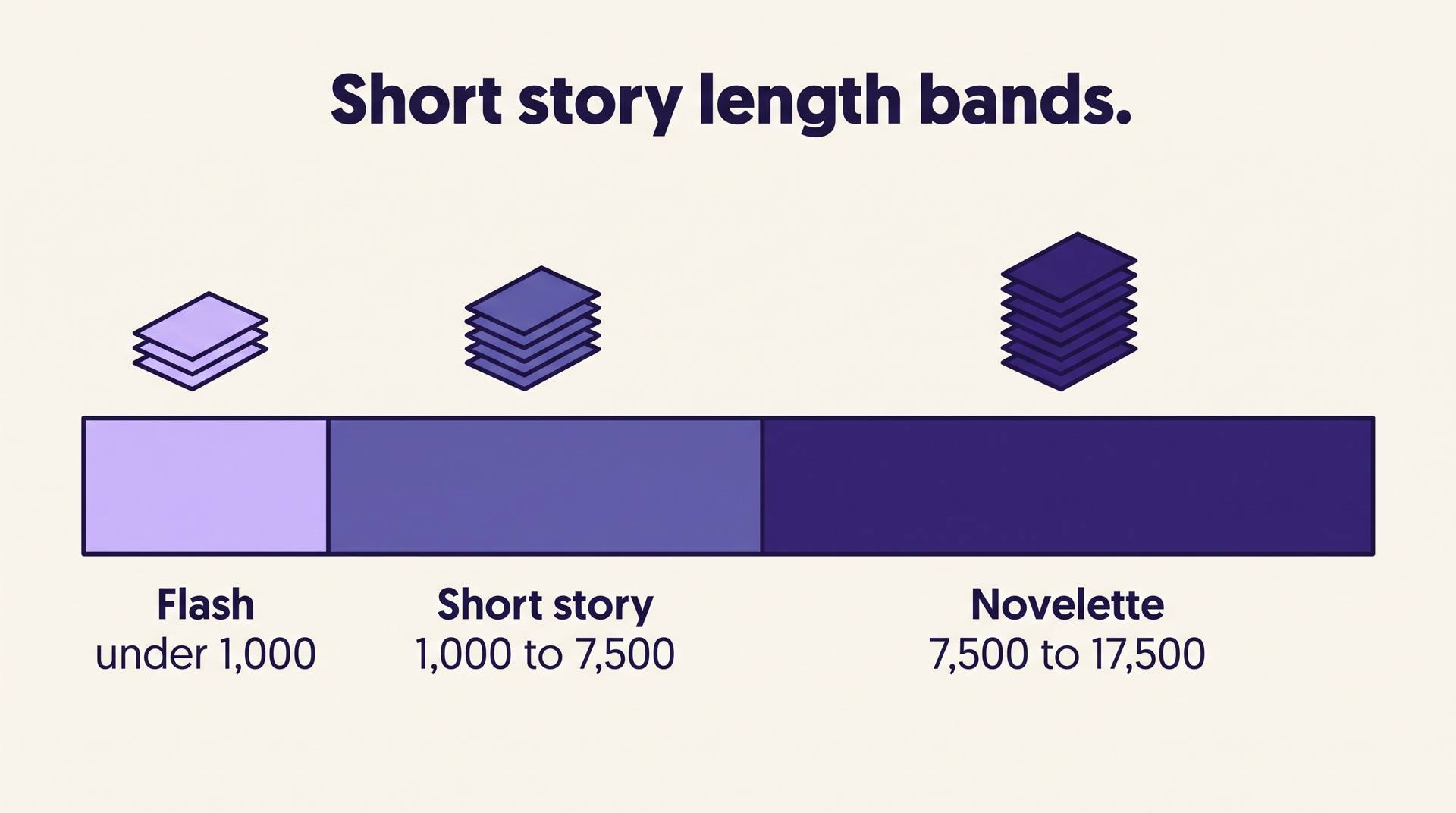
Most short stories run 1,000 to 7,500 words. The Science Fiction and Fantasy Writers Association draws the Nebula Award line at 7,500 words for a short story, and most magazines cap submissions somewhere between 5,000 and 7,500. Under 1,000 words you are writing flash fiction. Above 7,500 you have a novelette on your hands, whether you meant to or not.
Find your band
Drag the counter to your current draft length. The category changes at the thresholds editors and award juries actually use, and each band comes with the one piece of advice that matters most at that size.
Category
Short story
1,000 to 7,500 words
What to do at this length
This is the widest market by far. Anything in here is submittable somewhere, but note that the busy 3,000 to 5,000 stretch is where most literary magazines actually buy.
Two thresholds do most of the damage in practice. Landing at 8,200 words closes almost every magazine to you for the sake of 700 words you could probably cut in an afternoon, and landing at 950 means a flash market will read you but a standard short story market will call it slight.
What each market will actually take
The award definitions set the vocabulary; submission guidelines set your deadline. These are the ranges you will run into most often, but every call for submissions states its own limit and that number always wins over anything you read here.
| Market | Typical accepted range | What to watch |
|---|---|---|
| Literary magazines | 2,000 to 5,000 words | Many cap at 5,000 flat and run a separate flash category under 1,000. |
| Genre magazines | 1,500 to 7,500 words | Science fiction, fantasy and horror markets often allow the full 7,500 but buy most heavily around 4,000. |
| Themed anthologies | 3,000 to 6,000 words | The call sets the limit, and anthology editors are strict about it because the page count is already sold. |
| Contests | 1,500 to 5,000 words | Overruns are usually disqualified without being read, so count before you pay the entry fee. |
| Kindle short reads | 5,000 to 20,000 words | Amazon shelves these by reading time rather than word count, from fifteen minutes up to two hours. |
One more conversion to keep in your head: a market that talks in pages rather than words is usually assuming around 250 words to a double-spaced manuscript page, and our guide to how many words fit on one page covers the paperback and ebook versions of that maths.
How long the stories you already know are
Approximate counts, because editions and punctuation differ, but close enough to calibrate against. Notice how much of the canon sits in the lower half of the short story band.
Hills Like White Elephants
Ernest Hemingwayroughly 1,500 wordsAlmost entirely dialogue, with the actual subject never named once.
The Tell-Tale Heart
Edgar Allan Poeroughly 2,100 wordsA single narrator, a single night, and no scene that is not the confession.
The Lottery
Shirley Jacksonroughly 3,400 wordsA whole village, one morning, and a reveal that lands in the final paragraph.
Story of Your Life
Ted Chiangroughly 20,000 wordsNot a short story at all but a novella, which is why it became a feature film rather than a segment.
The morning of June 27th was clear and sunny.
Nine words of weather, and the whole story's cruelty depends on how ordinary they sound.
Cutting down and building up
Three cuts that lose nothing
Every draft has slack in the same three places. Work through them before you touch anything you actually like.
- 1
The arrival
Delete the paragraph where the character travels to the place the story happens. Open in the room. Readers reconstruct the journey for free.
- 2
The second example
When you have illustrated a trait twice, keep the sharper illustration and cut the other. A second proof of the same point reads as hesitation, not emphasis.
- 3
Dialogue that confirms
Lines where one character restates what another just said, or what the narration already told us, can go wholesale. This alone often clears several hundred words.
Three expansions that add something
Length that comes from new pressure reads as depth. Length that comes from more description reads as padding.
- 1
A cost you never charged
If the protagonist gets what they want, make them give something up for it. Consequence adds pages and tension in the same stroke.
- 2
A scene you summarised
Find the sentence that says something important happened and write the moment instead. That is the practical version of show, don't tell, and it is the single most reliable way to add real length.
- 3
One more pressure source
A second party who wants something incompatible, introduced early and resolved late, is usually worth 1,000 to 2,000 honest words.
Three ways word count goes wrong
Writing a compressed novel
Six characters, two timelines and a decade of backstory in 4,000 words reads as a synopsis. A short story can carry one decisive change well. Give the rest its own book.
An anecdote with no turn
Something happening is not the same as something changing. If the last page could be swapped with the first without a reader noticing, length is not the problem.
Padding to hit a target
Adding weather, mirrors and meals to reach a minimum is obvious to anyone who reads submissions for a living. A tight 2,600-word story beats a bloated 3,000-word one every time.
Doing this inside AIWriteBook
Counting is the boring half, so use the free word counter whenever you need an exact figure plus the reading time Amazon shelves short reads by. Paste the draft, get the number, decide which band you are in.
If you are stuck at the other end and have no story yet, the story starter generator hands you premises sized for short fiction rather than sprawling series ideas.
And when a story genuinely will not stop growing, that is a signal rather than a failure. Import what you have, let AIWriteBook build an outline from it, and use the chapter generator to draft the rest at novella or novel length with Gemini or Grok, keeping your voice and your existing pages intact.
Pick the band, then write to it
Length is a decision, not an accident. Choose the market first, read its guidelines, and write toward that ceiling from the beginning. A story shaped for 5,000 words is a different story from one cut down to 5,000, and editors can tell which one they are holding.
If the number keeps climbing past 17,500, stop resisting it and read up on where a novella ends and a novel begins, or check the target word counts for a finished novel before you commit.
More market-by-market craft advice lives in our genre fiction guide.