


In this guide
Why an author brand sells books
Readers do not buy books the way they buy toothpaste. They buy a predicted experience: the specific mix of tension, comfort, voice and payoff they expect between page one and the last line. Your brand is the shorthand that lets a stranger make that prediction in two seconds from a thumbnail, a series name or your name alone.
That is why branding matters more for authors than for most small businesses. Every new book is a new product launch, and without a brand each launch starts from zero. With one, your backlist, your newsletter and your past readers carry part of the weight. The goal is a name that has become a genre of one: when someone says "it's a very [your name] book", your brand is working.
The good news is that a brand is built mostly from decisions, not from spending. The bad news is that most authors make those decisions in the wrong order, starting with a logo and an Instagram account before they can say in one sentence what a reader gets from them.
The author brand stack
Think of your brand as four layers. Each one rests on the layer below it, so building from the top down is how authors end up with a polished website that says nothing.
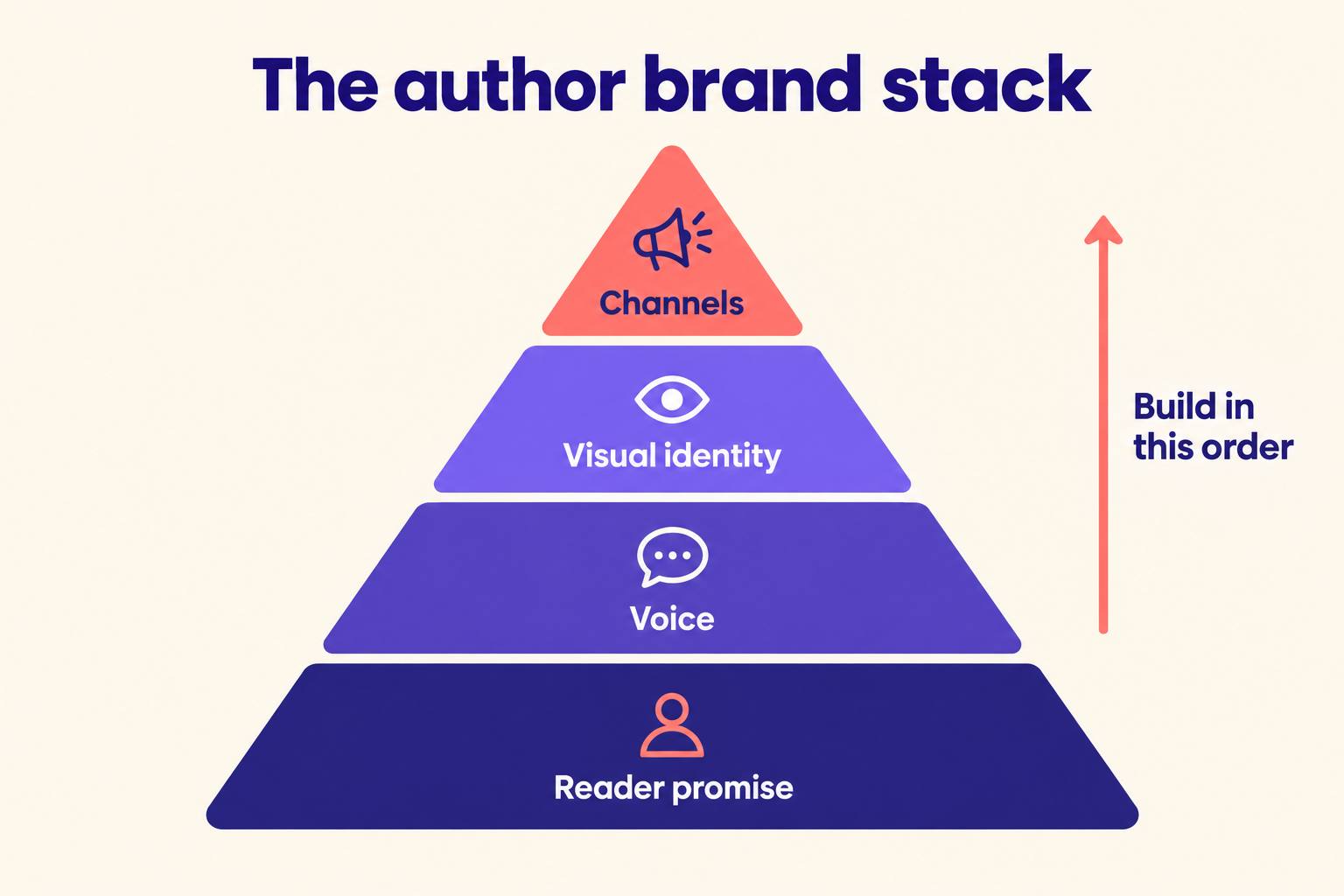
Channels
Where you show up: a newsletter you own first, then one or two social platforms your readers already use. Never all of them at once.
Visual identity
Cover style, author photo, fonts and colors that repeat across every book in a series and every place readers meet you.
Voice
How you sound on the page and off it. Your newsletter, bio and social captions should read like they came from the person who wrote the books.
Reader promise
The emotional experience every one of your books delivers. It is narrower than a genre: not "romance" but "grumpy-sunshine romance with banter you read aloud to your partner".
Write your reader promise
Everything else in your brand gets easier once this sentence exists. Fill in the three blanks with your real answers. Be specific enough that a reader of a different subgenre would say "not for me". That rejection is the point.
Your reader promise
I write for readers who love small-town mysteries who want to feel cozy, clever and a little bit hungry, with a baker-detective and a recipe in every chapter.
Test it on three readers of your genre. If they can name a book of yours from it, keep it. If they shrug, the third blank is too generic. The writing style builder turns this kind of answer into instructions the AI follows when it drafts, so your voice stays consistent across a whole series.
Build your author brand in five steps
This is the order that wastes the least time. Each step uses the output of the previous one.
- 1
Pick your lane before your logo
Choose the subgenre and the reader promise you can deliver for at least three books. A brand is repetition, and you cannot repeat something you will abandon after one book. If you write in two unrelated genres, consider a second name; our pen name guide covers when that makes sense.
- 2
Make the books look like siblings
Series covers should share a title font, a layout and a color logic, so a reader who loved book one spots book two from across a store page. The AI book cover designer lets you design a cover from your book's own content and keep the style consistent across a series; our book cover design tips explain what readers scan for in a thumbnail.
- 3
Write one bio and one tagline you can reuse everywhere
Draft a 50-word and a 150-word bio that open with what readers get, not with your day job. The free author bio generator produces both lengths in a few seconds, so you can compare angles before you commit.
- 4
Build a home you own
Social platforms change their rules; a mailing list does not. Start with an author page and a signup offer, then follow our author website essentials for what the page needs. AIWriteBook's author page gives you a public page with your books and a subscriber list, and you can send a launch announcement to those subscribers when a new book goes live.
- 5
Choose one social channel and show up in your voice
Pick the platform where your genre's readers already talk. For many romance and fantasy authors that is TikTok; our BookTok strategy guide breaks down what works there now. Post things that reflect your promise, not generic writing tips: a cozy mystery author shares recipes and village gossip, a thriller author shares unsettling true details from research.
Keep your voice consistent across every book
A brand lives or dies on consistency. AIWriteBook learns your writing style from your own pages and keeps characters, tone and series details aligned from book one to book five.
Author brands that work, and why
Three different shapes of brand, from a global bestseller to a working indie.
Brand built on transparency and reliability
Brandon Sanderson
Sanderson publishes progress bars for his manuscripts, lectures openly on craft, and is known for magic systems with clear rules. Readers trust that he finishes what he starts. In 2022 that trust turned into a Kickstarter for four secret novels that raised about $41.7 million, the largest in the platform's history at the time.
Two names, two clear promises
Joanna Penn
As Joanna Penn she has run The Creative Penn, a site and podcast for authors, since 2008, with one consistent promise: practical, honest advice on writing and the business of books. Her thrillers appear under J.F. Penn, so neither audience is confused by the other. One person, two brands, each with a sharp promise.
Small brand, very specific promise
A cozy mystery indie (example)
Picture a writer with a series of village bakery mysteries. Every cover uses the same illustrated storefront style, every book ends with a recipe, and the newsletter is a monthly "from the bakery" letter. She never posts about writing craft. Her readers are not writers; they are people who want a warm puzzle and a scone. That narrowness is exactly why it works.
Common author branding mistakes
- Branding yourself as "a writer"
- Readers do not follow writers in general. They follow a promise. "Author of dark academia thrillers" beats "writer, dreamer, coffee lover" every time.
- Changing cover styles mid-series
- A redesign of book three breaks the visual link to books one and two. If you must refresh, rebrand the whole series at once.
- Being on every platform
- Five half-abandoned accounts look worse than one active one. Pick one channel plus your mailing list.
- Hiding the books
- A brand that never mentions what you sell is a hobby. Every profile, bio and post series should make the next book one click away.
- Copying a bigger author's voice
- Borrowed voice reads as borrowed. Your brand voice should be how you actually write, made consistent, not someone else's persona.
Copy-ready brand templates
Replace the brackets and keep the structure. Each template opens with the reader, not with you.
Short bio (about 50 words)
[Name] writes [subgenre] for readers who want [feeling]. [Series name] follows [protagonist in five words] through [setting]. When not writing, [one specific, on-brand detail]. Get a free [reader magnet] at [website].
Newsletter welcome email
Subject: Your [reader magnet] is inside

Hi [first name],

Thanks for joining. Here is your copy of [reader magnet]: [link].

What to expect from me: one email a month with [on-brand content, such as behind-the-scenes notes, recipes, or real cases that inspired a plot], plus first word when a new [series name] book is out.

Hit reply and tell me the last [subgenre] book you could not put down. I read every answer.

[Name]
Social profile line
[Subgenre] author. [Reader promise in under 10 words]. Book [number] of [series name] out now. Free story: [link]
Need more than a welcome email? The launch email sequence generator drafts a full launch sequence, and the social post generator turns your book into posts in your own tone.
Start with one sentence
You do not need a brand designer or a content calendar to start. You need the reader promise, two books that look related, a bio that leads with what readers get, and a list you own. Everything else is repetition.
If you are still deciding what your books promise, writing them is the fastest way to find out. Your brand gets clearer with every finished book, which is the real reason prolific authors seem to have the strongest brands.
For launch plans, ads and reviews, continue with our book marketing guide.