


Why authors use pen names
The reasons are practical far more often than mysterious. A pen name lets you keep a day job separate from steamy romance, give each genre its own readership, pick a name that is easier to spell and search, or publish as a writing team under one byline. Some authors simply want a clean start after earlier books that did not sell.
- Separate genres so a thriller reader is not recommended your cozy fantasy
- Keep your employer, clients or family out of your reading list
- A name that is short, memorable and not shared with a famous author
- One byline for a co-writing team
- A name that fits the genre's expectations
- A fresh start without the sales history of earlier books
The famous cases show both sides. Nora Roberts publishes her futuristic crime series as J.D. Robb and says so openly. Stephen King wrote as Richard Bachman to test whether his books would sell without his name, and J.K. Rowling wrote crime as Robert Galbraith. Both secrets broke, and neither leak came from Amazon.
What KDP actually allows
KDP's metadata guidelines say you are free to use a pen name, as long as it does not impair customers' ability to make good buying decisions. In practice that gives you a short list of rules.
- 1The name cannot be confusingly similar to a well-known author. KDP itself suggests adding a middle name or an initial if your name is close to a popular one.
- 2You cannot use another real person's name.
- 3The author name on the cover must match the author field in your metadata, letter for letter.
- 4The author field has no room for extras: no titles, no punctuation flourishes, no keywords. Anything that is not part of the name can be rejected.
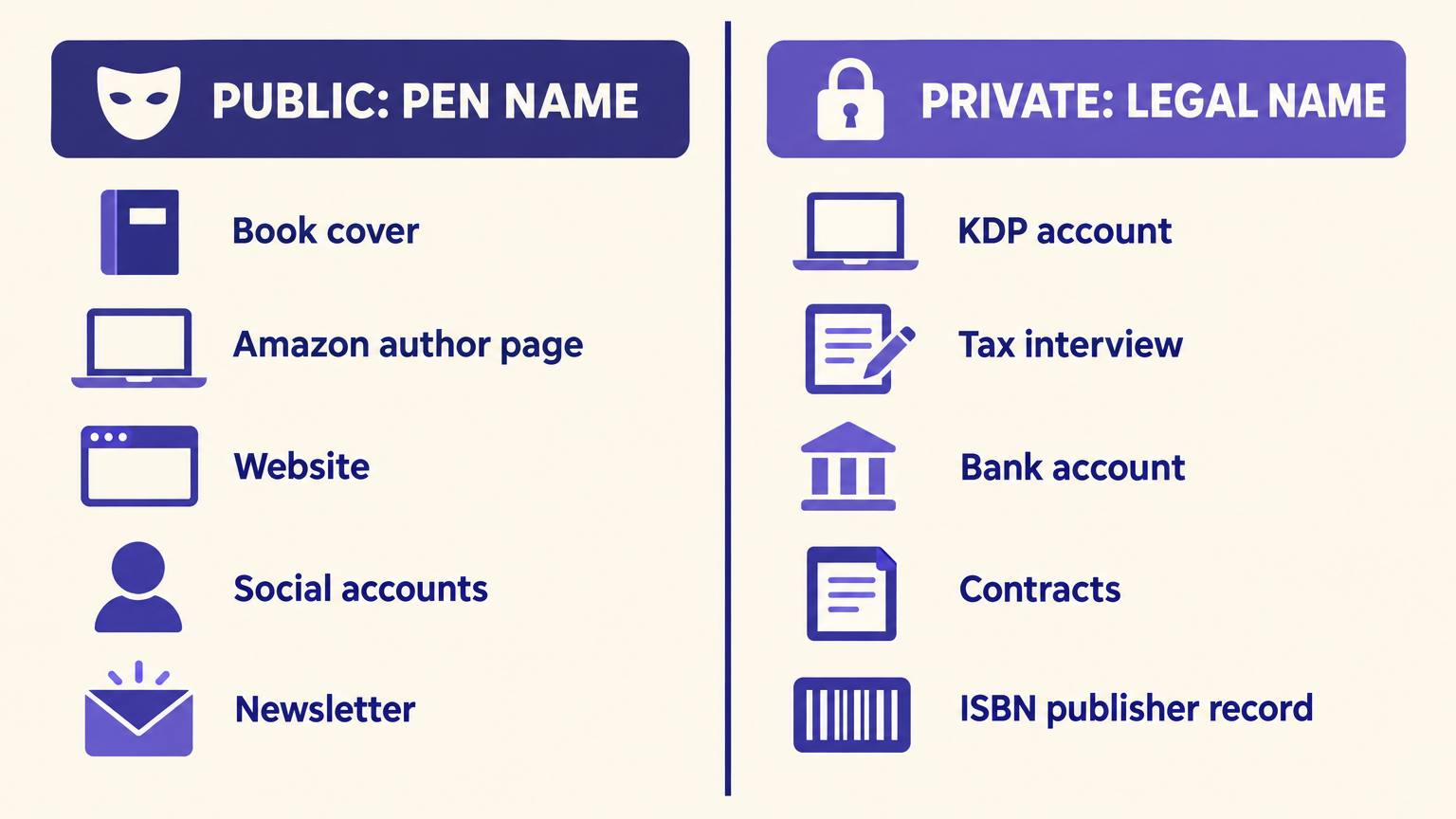
- 5Your KDP account, tax information and bank details are always in your legal name. The pen name only appears on the book.
KDP warns that the author name should be treated as final once a book is published. Changing it later means a new edition and new reviews, so pick the spelling before you press Publish.
Step-by-step setup
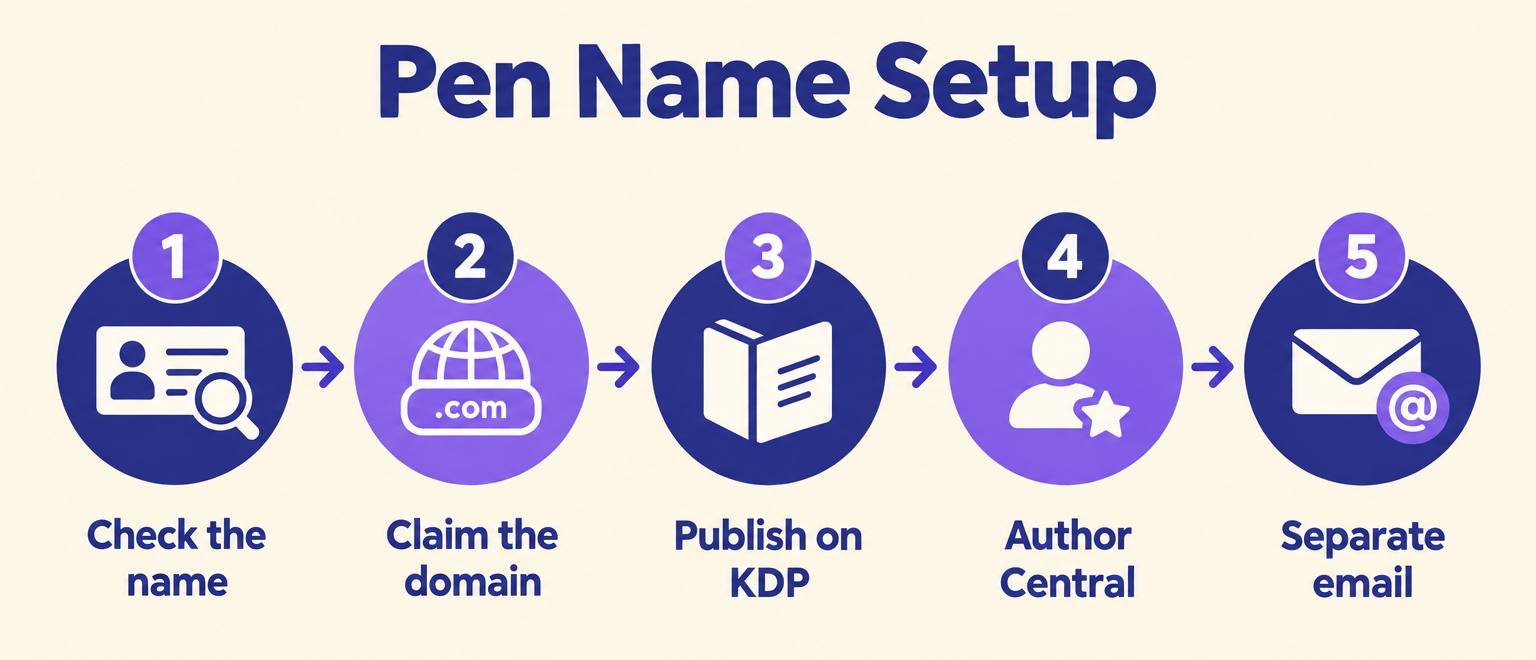
Do these in order. The first two cost nothing and save you from a rename later.
- 1
Check the name
Search Amazon books, Goodreads and Google for the exact name. If another author in your genre already uses it, change it now. Say it out loud, then type it the way a reader would after hearing it once.
- 2
Claim the domain and handles
Register the .com and the social handles you plan to use before the first book is out. Turn on domain privacy so your registration details are not published.
- 3
Publish the first book on KDP
Use your existing KDP account. Type the pen name in the author field exactly as it appears on the cover. One KDP account can publish books under many author names, so there is no need for a second account.
- 4
Claim the author page
Once the book is live, claim the pen name in Amazon Author Central from the same Amazon login. One account can manage several author profiles without linking them publicly. Our Author Central guide walks through it.
- 5
Give the pen name its own email
Use a separate address for the newsletter, reader mail and social sign-ups. That one change prevents most accidental leaks.
Copyright and contracts under a pseudonym
Your copyright exists the moment you write the book, under any name. The pen name itself is not protected by copyright, because names and short phrases never are. If you build a brand on it across a series, trademark is the tool that protects a name, not copyright.
Registration with the US Copyright Office is optional but useful if you ever need to sue. The application has a Pseudonymous box, and the Office states there is no legal requirement to give your real name. The catch: every registration record is public and searchable online, and once a certificate is issued, a real name you disclosed stays on the record.
The term changes too
For a pseudonymous work where your real name is not in the Copyright Office records, protection lasts 95 years from publication or 120 years from creation, whichever ends first. If your identity is on record, it becomes the usual life plus 70 years.
Contracts are signed in your legal name. Editors, cover designers, narrators and translators all need to invoice a real person or business, and the cleanest wording names you and the pen name together, for example Jane Smith, writing as J.S. Hart. If a publisher offers you a pen name it created, check the contract for who owns that name, because a house name may stay with the publisher when you leave. For the registration steps themselves, see how to copyright a book.
Taxes and payments
A pen name is a marketing choice, not a business. KDP's tax interview asks for your legal name and your taxpayer number, and royalties from every pen name on the account are paid to the same bank account and reported together under that legal identity.
If you want a business name between you and the money, the tax interview has a separate line for a business or trade name. Some authors register a DBA or form an LLC that acts as the publisher. Keep in mind that business filings are often public too, so an LLC named after your real surname protects nothing.
The ISBN is the quiet leak. If you buy ISBNs yourself, the publisher name you register travels with the book's data to retailers and libraries. Register them under an imprint name rather than your personal name, or use KDP's free ISBN, which lists the book as independently published. Our ISBN guide compares both routes.
Running several author brands
One KDP account can publish under as many pen names as you like. The work is not on Amazon's side; it is keeping each brand coherent.
Closed pen names
No public link between names. Separate websites, newsletters, social accounts and also-by lists. Best when genres share no readers, or when privacy is the point. Costs more time, since each brand builds its audience from zero.
Open pen names
Different names, openly connected, like Nora Roberts writing as J.D. Robb. Readers know where to find the other books, and you can mention both on one website. Best when you want genre separation for the store but not secrecy.
Either way, never cross-promote two closed brands in back matter, and never let one Amazon ad campaign mix them. Readers who buy both confuse the also-bought recommendations for each. If you are planning more than one series per name, a series planner keeps the catalog for each brand straight.
Keeping it private
Stephen King's Bachman cover broke when a bookstore clerk looked up the copyright records at the Library of Congress and found King's name. Rowling's broke when someone at her law firm told a friend. Real leaks come from records and people, not from the store page. Run this audit on your own setup.
Privacy leak audit
Tick everything that is already true for your pen name.
Your real name is easy to find. Start with the highest-risk items.
The file properties item catches people out. Word documents store the author name from your Microsoft account, and that name can travel into exported PDFs and EPUBs. Open File, Info, Properties before you send a file to an editor, a reviewer or a retailer.
Put the pen name on the book from page one
In AIWriteBook the author field takes the name exactly as it will appear on the cover, so your title page and exports carry the pen name from the first draft.
The AI-assisted shortcut
Most pen-name mistakes are consistency mistakes: one spelling on the cover, another on the title page, a third in KDP. When you create a book in AIWriteBook, the author field asks for your pen name or real name as it will appear on the cover, and that one value feeds the title page and your exports. The KDP Publishing Assistant extension then fills the author fields in KDP's setup form from the same book, so the metadata matches the cover letter for letter.
A new pen name also needs words about a person who does not exist yet. The free author bio generator takes a pen name and a few facts and writes several bios for the book, Amazon and social profiles. The copyright page generator accepts a pen name in its author field. And an author page gives the brand a public home with your books, a chapter preview and a reader email list, without building a website first.
Common mistakes
- Opening a second KDP account for the pen name. Use one account and add names per book.
- Choosing a name before checking it. A thriller pen name one letter away from a bestselling author is exactly what KDP's guidelines tell you to avoid.
- Writing the pen name differently on cover, title page and metadata.
- Registering copyright with your real name, then expecting the pen name to stay secret.
- Using your personal Facebook or Instagram to promote a closed pen name.
- Assuming a pen name shields you legally. Defamation, contract and tax obligations still attach to you.
Templates
Bracketed parts are yours to fill. Contract wording varies by country, so have anything binding checked.
Copyright line under a pen name
Copyright © [Year] [Pen name] All rights reserved. Published by [Imprint name]
Contract party wording
[Legal name], professionally known as [Pen name] ("Author")
Pen name bio starter
[Pen name] writes [genre] for readers who [what they love]. [One specific, true-in-spirit detail.] Join the newsletter at [website].
Pen name FAQ
No. You publish every pen name from your existing account and type the pen name in each book's author field. KDP ties the account, taxes and payments to your legal identity, not to the names on the books.
Treat it as permanent. KDP warns the author name should be final at publication, and changing it in practice means publishing a new edition, which starts without the old reviews and rankings.
Yes. Pseudonymous publishing is legal and common. What you cannot do is use a real person's name or a name designed to be confused with a known author.
Not on the product page or the author page. Your legal name stays in your account and tax records. Leaks usually come from copyright records, ISBN publisher data, domain registrations and file properties.
Yes. One of you publishes from their KDP account and you agree in writing how royalties are split, since KDP pays only the account holder.
Bottom line
A pen name is a label on the book, not a separate legal person. Pick it carefully, check it before you publish, keep the spelling identical everywhere, and remember that your legal name still signs the contracts and receives the money. Privacy comes from the records you file and the accounts you keep apart.
Once the name is settled, it goes on the title page, the copyright page and the about-the-author page. Our guide to front matter and back matter shows where each of those pages sits.