

What's on this page
Why the opening carries so much weight
An opening does three jobs at once, and it does them before the reader has agreed to care about anything. It has to promise a kind of book — this is funny, this is frightening, this is going to take its time. It has to make one concrete thing happen or exist, so the reader has somewhere to stand. And it has to leave a gap the reader wants closed.
That third job is the one most first drafts skip. A first page can be beautifully written and still fail, because it answers questions nobody asked yet. Description of weather, a character waking up, a paragraph of history — all of it is information handed to someone who has not yet decided they want information.
There is a practical reason to take this seriously beyond craft snobbery. Retailers hand shoppers a free sample that is typically the first ten percent of the book, and the preview pane on most storefronts opens on page one. Your opening is not just the start of the story; it is the largest piece of free marketing your book will ever have, and you cannot A/B test it after launch.
Which is why the opening is worth more revision passes than any other page you write. Most authors write it first and never look at it again. Write it last, or at least rewrite it last, once you know what the book actually turned out to be about.
Five ways to open a book
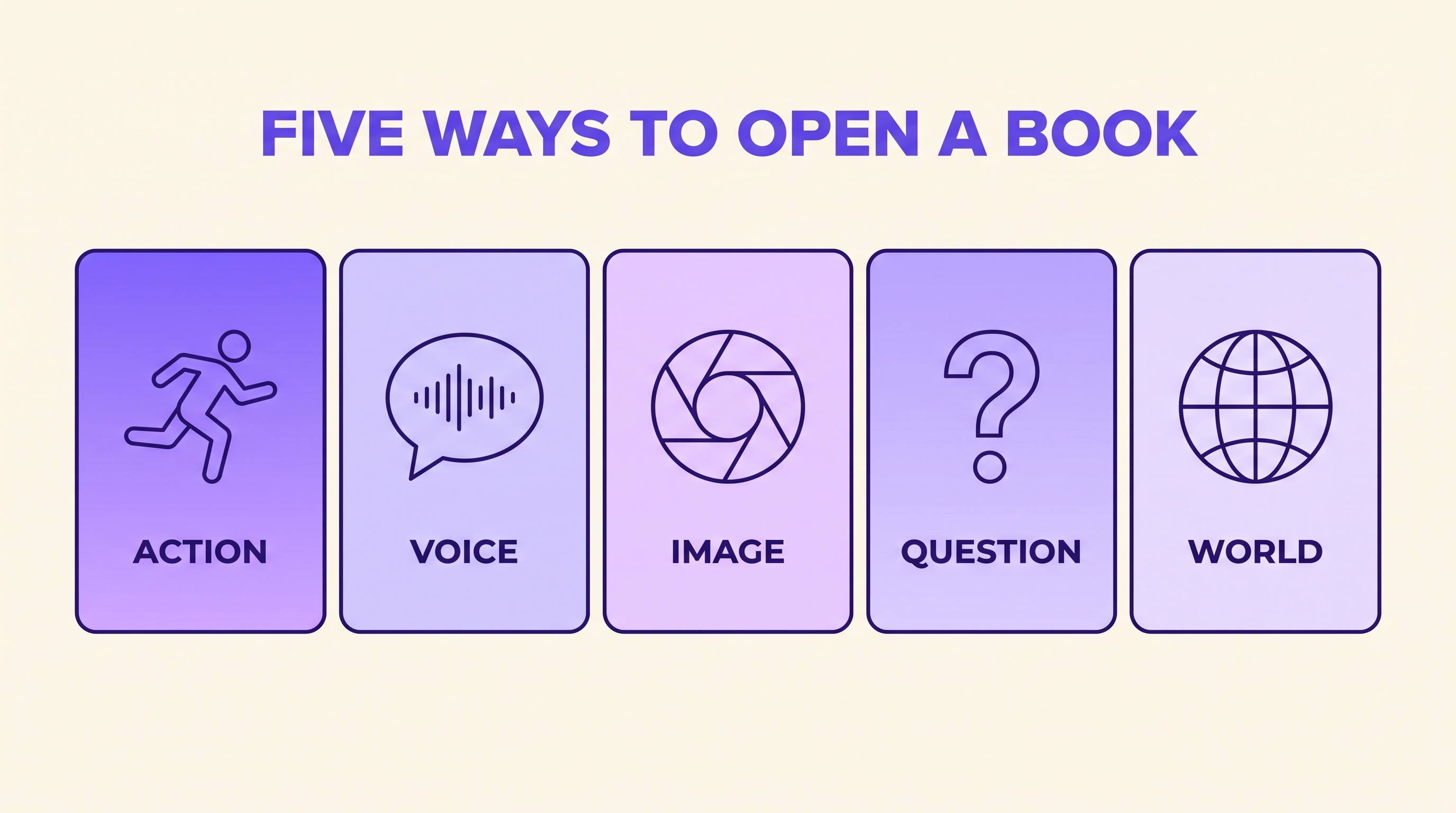
Almost every strong opening in print is one of five moves, or a blend of two. Pick deliberately rather than defaulting to whatever your last favourite novel did.
Action
Start inside a moment
Drop the reader into something already happening — a decision, a threat, a departure. The trick is that action does not mean explosions; it means motion with consequence. García Márquez opens a family epic with a man in front of a firing squad and then swerves to a childhood memory of ice, and the sentence pays for the next four hundred pages of patience.
Many years later, as he faced the firing squad, Colonel Aureliano Buendía was to remember that distant afternoon when his father took him to discover ice.
Two time frames in one sentence: a crisis you have to wait for, and a memory you cannot place yet.
Best for thrillers, mystery, action-driven fantasy, and any book where the plot is the promise.
Voice
Let the narrator introduce themselves
Sometimes the hook is the person telling the story. Three words can establish a narrator confident enough to command you, evasive enough that "call me" is doing suspicious work, and casual enough that you know the book will be talkative. Voice openings buy patience: readers will follow a personality much further than they will follow a plot they do not yet understand.
Call me Ishmael.
Not "my name is" — "call me". The evasion is the hook.
Best for memoir, literary fiction, comic novels, and first-person books with a strong personality.
Image
Show one thing precisely
One exact, slightly wrong image can do more world-building than a page of explanation. Gibson describes a sky by comparing it to dead television static, and in eleven words you know the genre, the decade the book is imagining, the mood, and the fact that the narrator's frame of reference is machines rather than nature.
The sky above the port was the color of television, tuned to a dead channel.
The comparison is doing the world-building. Nothing is explained, and everything is established.
Best for science fiction, literary fiction, atmospheric horror, and any book selling a mood.
Question
State something that cannot be true yet
Assert something confidently that the reader cannot parse, and they will keep reading to resolve it. Morrison opens with a house number given a temperament. It is not a puzzle for its own sake — by the end of the paragraph you know a house is haunted and a family is trapped — but the first three words work because they refuse to explain themselves.
124 was spiteful.
A number and an emotion, no verb of explanation. The gap is the whole engine.
Best for mystery, horror, upmarket fiction, and books with a secret at the centre.
World
Show the ordinary, then break it
Establish a familiar frame and put one thing in it that does not belong. Orwell gives you an April afternoon — completely normal — and then has the clocks strike thirteen. The reader now knows the rules of this place are not the rules of theirs, and they learned it without a single line of exposition.
It was a bright cold day in April, and the clocks were striking thirteen.
Everything is ordinary except one detail — and that detail redefines the whole sentence retroactively.
Best for speculative fiction, fantasy, dystopia, and historical novels set somewhere unfamiliar.
Blending two types
The strongest openings usually stack two of these. Morrison's is question plus world. Gibson's is image plus world. What you should not do is attempt all five in one paragraph — that produces the overwritten first page that agents recognise instantly. Pick a lead type, let a second one support it, and cut the rest.
If action is your instinct, it's worth understanding what starting mid-scene actually costs you in setup, and whether the scene you're skipping belongs in a prologue instead of a flashback.
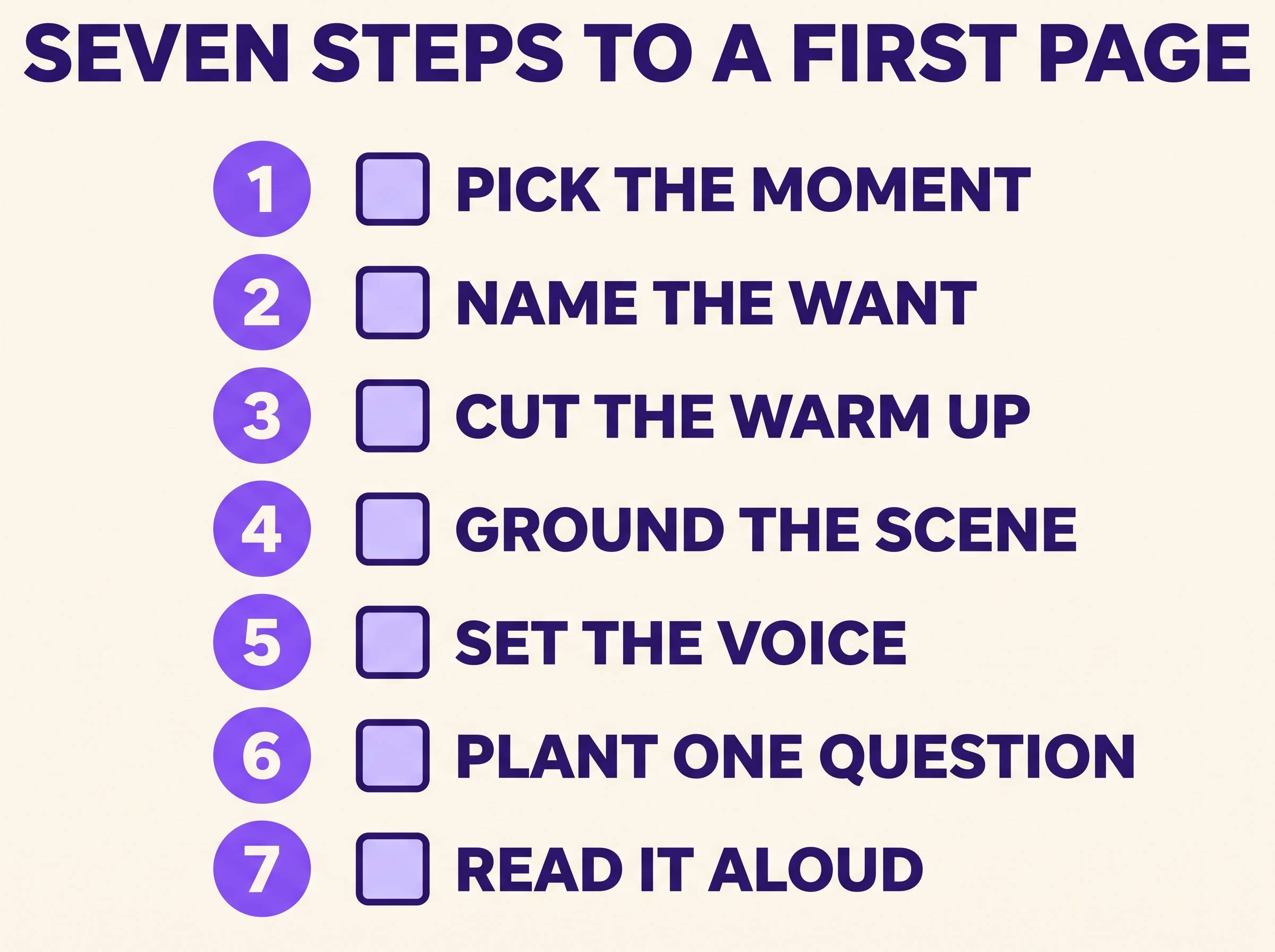
The seven-step first page checklist
Run your opening through these seven in order. Tick each one off as it holds up — the boxes are yours to click and nothing is saved or sent anywhere.
0/7 steps cleared
Mistakes that kill a first chapter
These are the patterns that show up over and over in openings that don't work — and most of them come from anxiety, not incompetence.
The alarm clock
A character waking up, showering, looking in a mirror to describe themselves. It is the single most recognisable amateur opening because it delays the story while pretending to start it. If your character must wake up, start after the eyes are open and something has already gone wrong.
Weather with no owner
Weather is fine when a character is experiencing it and has an opinion about it. Weather described by nobody, for a paragraph, is a camera pointed at nothing. Attach every detail to a point of view — this is show, don't tell applied at the sentence level.
Front-loaded history
Two pages of kingdom lore, family background, or how the technology works. Readers cannot hold context for people they don't care about yet. Give the context in the third chapter, when they will actually absorb it.
Too many names at once
Five characters introduced on page one is five things to memorise before any of them matter. Open with one or two. Everyone else can arrive when they earn a scene.
A prologue used as a bandage
Prologues work when they carry information the main timeline genuinely cannot. They fail when they exist because the author suspects chapter one is slow. If your prologue is more exciting than your first chapter, that is a diagnosis, not a solution.
Rewriting page one for six months
The most expensive mistake of all. You cannot know what your opening should promise until you know what the book delivers. Draft the whole thing, then come back — you will rewrite it in an afternoon instead of a season.
The AI-assisted shortcut: write twenty openings, not one
The reason openings are hard is not that writing one is difficult. It is that comparing openings is difficult when you only ever have one. You cannot tell whether an action opening is better than a voice opening for your book until you have both in front of you, in your own prose, about your own characters.
That's the part worth automating. In AIWriteBook you set up the book — genre, premise, characters, outline — and then generate chapter one as a full draft rather than a paragraph. Because the generator is working from your outline and character sheets, the opening it produces is about your story, not a generic sample. Run it a few times with different opening instructions and you have real alternatives to choose between within minutes.
Then the choosing happens in the editor. The chapter AI chat lets you ask for changes to a specific passage — "open on the argument instead of the drive there", "make the first three sentences shorter", "cut the backstory in paragraph two" — and shows the result as a diff you accept or reject line by line. Nothing changes unless you approve it, which is what makes it usable on a page this sensitive. You can also paste in a sample of your own writing so the model matches your voice rather than inventing one.
If you only want to sharpen the hook and aren't ready to draft the whole chapter, the free first chapter hook generator takes a premise and returns opening angles you can react to. And when you have no premise at all yet, the story starter tool is a faster way to find one than staring at a document.
None of this replaces judgement. The model will happily hand you a competent, slightly generic first page — that is exactly the AI-slop failure mode readers complain about. Use it to produce options, then apply the seven-step checklist above and cut hard. Generated openings almost always improve by deleting their first paragraph, for the same reason human ones do.
Draft chapter one and see the opening in context
Set up your premise, generate a full first chapter, and rework the opening line by line with the AI chat. Free to start.
First-line templates to steal
These aren't formulas to publish verbatim — they're shapes. Fill one in badly, five times, and one of the five will show you what your real opening wants to be.
The morning [character] [did the irreversible thing], [nobody / someone specific] noticed.
Puts the change first and the consequence second.
There are [number] things you should know about me, and [number minus one] of them are lies.
Establishes personality and unreliability in one breath.
[Concrete object] sat on [surface] where [character] had left it [length of time] ago.
One object, one absence — the reader fills in the story.
[Odd fact stated flatly, with no explanation offered].
The Morrison move. Confidence is what makes it work.
In [place], [ordinary custom] was [ordinary], except on the days when [rule breaks].
Establishes normal, then cracks it.
[Character] had exactly [time] to [goal] before [consequence].
Blunt, unfashionable, and extremely effective in commercial fiction.
Once you have a first line you like, check that chapter one earns it. A strong opening followed by a slack chapter is worse than an average opening followed by a good one — and if you're unsure how long that chapter should even be, chapter length norms are a useful sanity check.
Start badly, then start again
The opening you publish will almost never be the opening you drafted. That's not a failure of talent; it's how the form works. The first page has to promise a book that doesn't exist yet, which is why the writers who agonise over it hardest are usually the ones who finish least.
So write a rough one, keep going, and come back when you know what the book is. Then apply the checklist, test two or three alternatives side by side, and read the winner aloud.