

Writing for children seems simple—after all, the books are short. But that brevity is deceptive. Every word must earn its place. Every illustration must captivate. This guide takes you from concept to published book, whether you're creating a picture book, early reader, or chapter book, and it builds on the fundamentals in our guide to writing a book.
Why Children's Books Matter
The books children read shape how they see the world. A great children's book doesn't just entertain—it builds vocabulary, teaches empathy, sparks curiosity, and creates memories that last a lifetime. Pairing a story with simple reading worksheets can reinforce that vocabulary and comprehension once a child finishes the book. This responsibility makes children's book writing both challenging and deeply rewarding.
Understanding Age Groups
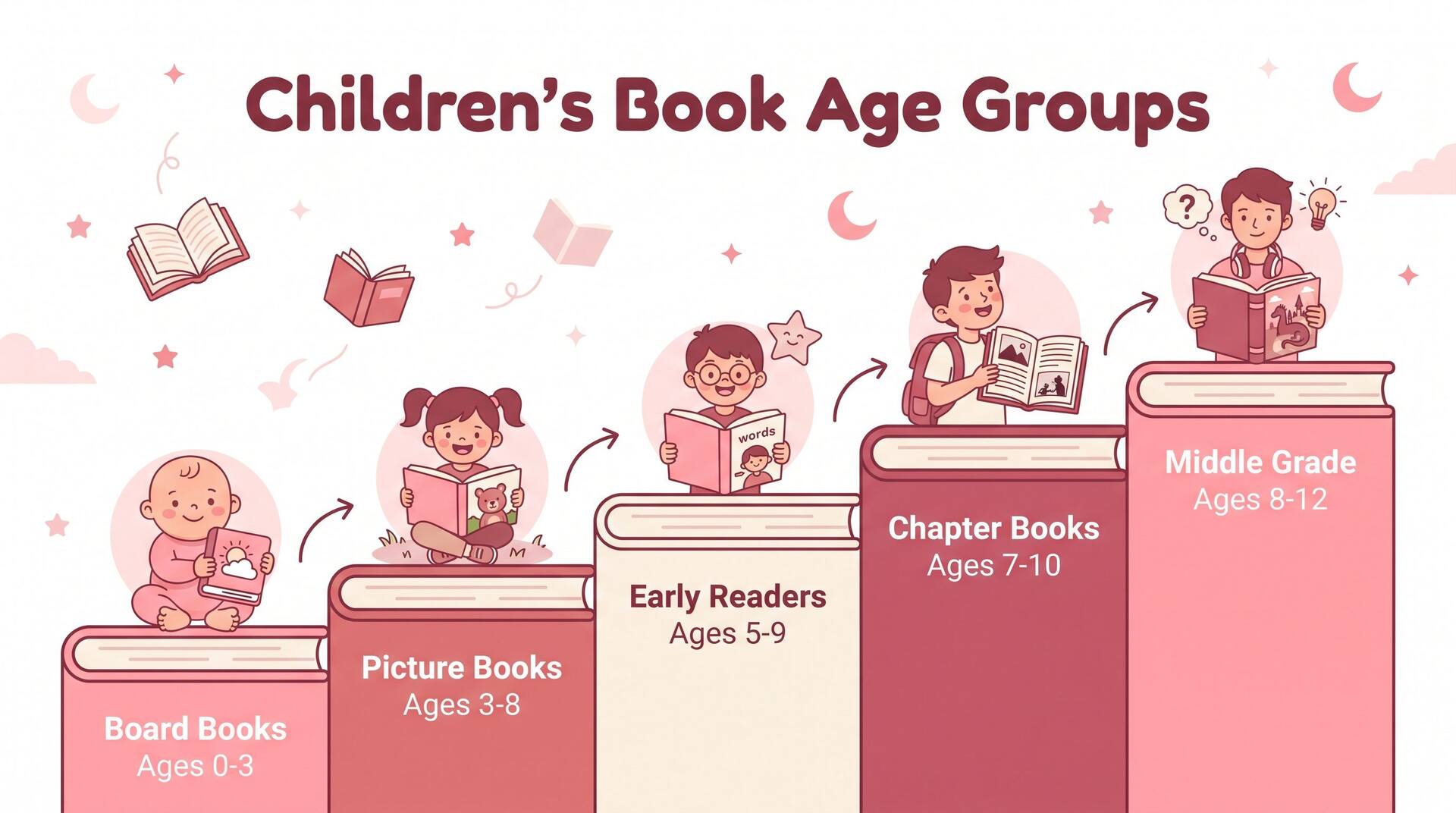
Children's books are categorized by age. Understanding your target age group, and what knowing your intended audience really means, shapes every decision you'll make.
Picture Books
Ages 3-8 years
Word Count
200-1,000 words
Examples
Where the Wild Things Are, The Giving Tree
Characteristics
Story-driven, illustrations on every spread, emotional themes
Focus On
Complete stories with beginning, middle, end; emotional resonance
Essential Elements of Children's Books
Relatable Protagonist
Children see themselves in your main character. The protagonist should be close to the reader's age (or slightly older), face challenges kids understand, and grow through the story.
Tip: Give your character a clear want and a relatable flaw. Perfect characters are boring to everyone, especially kids.
Simple, Strong Plot
Children's attention spans are limited. Your plot should be straightforward: a character wants something, faces obstacles, and achieves (or learns to accept not achieving) their goal.
Tip: The 'rule of three' works beautifully: three attempts, three characters, three wishes.
Vivid Language
Simple doesn't mean boring. Use sensory words, sound effects (onomatopoeia), and rhythmic sentences. Children love language that's fun to hear and say.
Tip: Read your text aloud. Children's books are often read to kids—they need to sound good spoken.
Meaningful Theme
The best children's books teach without preaching. Themes like friendship, courage, kindness, and persistence emerge through story, not lectures.
Tip: Trust young readers. They understand subtlety. Let the story carry the message.
Satisfying Ending
Children need closure. Your ending should feel earned and complete. The protagonist has changed or learned something, even if they didn't get exactly what they wanted.
Tip: Happy endings are traditional but not required. What matters is emotional resolution.
Illustration Considerations
For picture books, illustrations aren't decoration—they're half the story.
Text-Image Relationship
The best picture books have text and images working together, not repeating each other. If the text says 'she was scared,' the illustration might show WHY or add details the text doesn't mention.
Character Consistency
Your protagonist should be instantly recognizable across every page. Consistent clothing, distinctive features, and expressive faces help children follow the story.
Page Turns as Drama
The moment a child turns a page is powerful. Plan your spreads so page turns create suspense, surprise, or emotional impact.
Style Choices
Illustration style affects tone. Soft watercolors feel different from bold graphics. Match your visual style to your story's mood and target age group.
If you're not an illustrator: Many successful picture book authors work with illustrators. Publishers often pair writers with artists. You can also use AI illustration tools to create or prototype your visual story, and even design a children's book cover before you commit.
Bringing Children's Book Illustrations to Life
Once the visual style and characters are established, authors can also explore animation to extend their stories beyond the printed page. 2D animation services can transform illustrated characters, scenes, and storyboards into engaging animated sequences for social media, educational content, promotional videos, or digital storytelling. This approach can help authors reuse their existing visual assets while giving their stories another way to connect with young audiences.
The Writing Process
Start with 'What If'
The best children's books often begin with a simple 'what if' question. What if a caterpillar ate through everything? What if a boy's drawings came to life? What if you could befriend a monster?
Know Your Page Count
Picture books are typically 32 pages (industry standard for printing). That means roughly 14-15 spreads of story after title pages. Plan your beats accordingly.
Write a Rough Draft
Get the story down without worrying about word count or page breaks. Capture the emotional journey first.
Create a Dummy
Fold paper to create a mini-book. Sketch rough thumbnails of each spread. This reveals pacing problems and helps you see where illustrations will carry the story.
Revise Ruthlessly
Cut every word that doesn't absolutely need to be there. Children's book prose is poetry—dense with meaning, spare with words.
Test with Real Kids
Read your book to children in your target age group. Watch their faces. Note where they engage, where they fidget, what questions they ask.
Common Mistakes to Avoid
Writing for Adults
Many first-time children's authors accidentally write for the adults who will purchase the book, not the children who will read it. Kids don't care about subtle adult humor or nostalgic references.
Fix: Read recent bestselling children's books. Notice what actually appeals to kids today.
Being Preachy
Children recognize when they're being lectured. Stories about 'learning to share' or 'the importance of honesty' fail when the lesson overshadows the story.
Fix: Focus on entertaining first. If your theme needs to be stated explicitly, it's not working through the story.
Underestimating Young Readers
Children are smarter than many adults give them credit for. Overly simplified stories bore them. Children handle complexity, emotion, and even darkness when presented appropriately.
Fix: Trust kids to understand nuance. Don't explain everything.
Passive Protagonist
Children want to see kids (or child-like characters) driving the story. Adults solving problems for children makes for unsatisfying stories.
Fix: Let your child protagonist solve the problem themselves, even if adults help along the way.
Ignoring the Illustrator's Role
Picture book manuscripts that over-describe visuals leave no room for illustration. 'She wore a red dress with white polka dots and black shoes with silver buckles...' belongs in the art, not the text.
Fix: Focus on what only text can convey: dialogue, internal thoughts, information illustrations can't show.
Publishing Your Children's Book
You have several paths to getting your book into children's hands, and if you're drawn to activity titles, a coloring book business on KDP is another proven route:
Traditional Publishing
Pros
No upfront costs, professional editing and design, bookstore distribution
Cons
Very competitive, long timelines (2+ years), less creative control
Self-Publishing
Pros
Complete creative control, faster to market, keep more royalties
Cons
Upfront costs for illustration/editing, marketing responsibility is yours, harder to reach bookstores
Hybrid Publishing
Pros
Professional quality with more control, faster than traditional
Cons
Requires investment, quality varies by company, research carefully
Using AI for Children's Books
AI tools can help at every stage of children's book creation, and a quick story starter is a great way to spark that first 'what if':
- Story ideation: Generate 'what if' concepts and plot variations
- Character development: Create character profiles and backstories
- Illustration generation: Create consistent character art and scenes
- Text refinement: Ensure age-appropriate vocabulary and rhythm
- Cover design: Generate eye-catching covers that appeal to children and parents
AI is a powerful assistant, but the creative vision must be yours. Use AI to execute your ideas, not to replace your imagination.
Children's Book Checklist
Create Magic for Young Readers
A single children's book can spark a lifetime of reading. It can comfort a child through difficult times, make them laugh when they need it, or show them possibilities they never imagined.
That's the opportunity you have as a children's book creator. It's a responsibility, yes, but mostly it's a gift—to you and to the children who will love your story.