


What hyperbole actually is (and what it isn't)
Hyperbole is deliberate, extravagant exaggeration used for effect, not to be believed literally. "I've read that page a thousand times" is hyperbole; nobody counts, and nobody's meant to.
The trap is thinking hyperbole is just "saying something is bigger than it is." It isn't a lie and it isn't a mistake — it's a signal. When a narrator says she waited a hundred years for a text back, the exaggeration tells you about her impatience, not about elapsed time. The reader decodes it instantly and effortlessly, which is exactly why the device is so efficient: it delivers feeling faster than any literal description could.
It also isn't the same as its neighbors on the figurative-language shelf. A metaphor claims one thing is another; a hyperbole just cranks the dial past realism. If you want the fuller family, our guides to metaphor and simile and to symbolism map how those devices differ — but the tell for hyperbole is simple: could this be literally true? If obviously not, and obviously on purpose, you're looking at hyperbole.
The four jobs hyperbole does
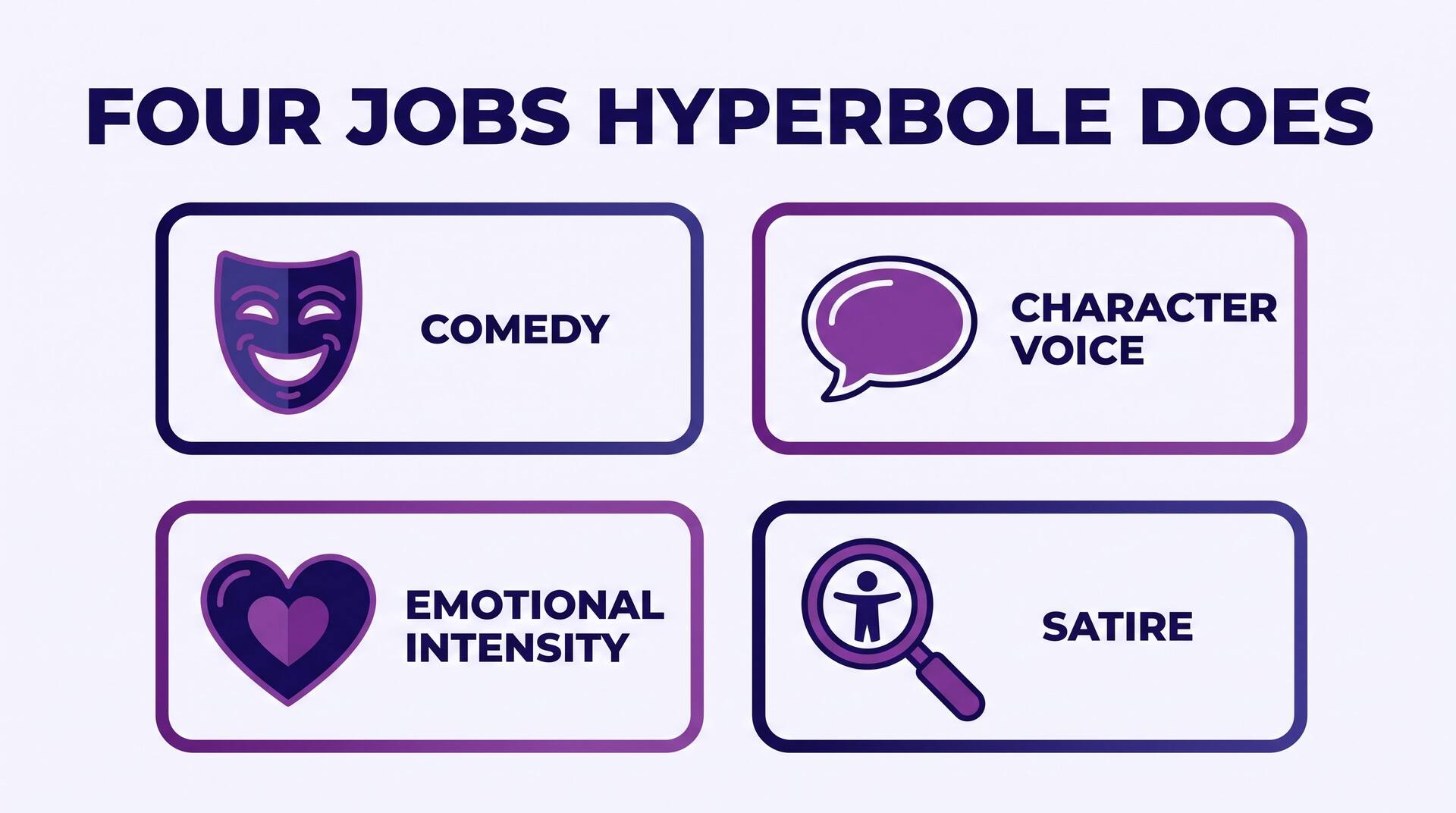
Group examples by effect and a pattern appears: strong hyperbole is always doing one specific job. Here are the four it does most, each with a writer who nailed it. Notice that in every case the exaggeration is doing work the plain version couldn't.
Emotional intensity
The oldest use: a feeling too big for accurate words, so the writer overshoots on purpose. In "A Red, Red Rose," Robert Burns swears he'll love his darling "Till a' the seas gang dry" and "the rocks melt wi' the sun." He isn't predicting geology; he's measuring devotion against the end of the world because ordinary scale would undersell it.
"Till a' the seas gang dry, my dear, / And the rocks melt wi' the sun."
Character voice
How a character exaggerates is characterization in miniature. Salinger builds Holden Caulfield almost entirely out of overstatement — everything "killed" him, everyone was a phony "about a thousand times." When Holden announces he's "the most terrific liar you ever saw in your life," the hyperbole isn't decoration; it is the character. Habitual exaggeration is one of the fastest ways to make a narrator sound like a person and not a camera.
"I'm the most terrific liar you ever saw in your life."
Comedy
Push an exaggeration far enough past the plausible and the gap itself becomes the joke. Douglas Adams runs on this: his characters value themselves at cosmic scale for laughs, as when Zaphod Beeblebrox demands, "If there's anything more important than my ego around, I want it caught and shot now." The humor is entirely in the size of the overstatement — dial it back to "I'm a bit self-centered" and the line dies.
"If there's anything more important than my ego around, I want it caught and shot now."
Satire
Blow a small thing up to enormous scale and its absurdity is exposed. Jonathan Swift built Gulliver's Travels on this: two empires wage endless war over which end of a boiled egg to crack, and "eleven thousand persons have at several times suffered death rather than submit to break their eggs at the smaller end." The grotesque body count is the argument — Swift is exaggerating trivial disputes to their logical, murderous end so we recognize our own.
"Eleven thousand persons have at several times suffered death rather than submit to break their eggs at the smaller end."
Four writers, four completely different effects, one device. Before you write a piece of hyperbole, ask which of these jobs it's doing. If the answer is "none, it just sounded dramatic," that's the warning sign the next section is about.
Hyperbole vs. overwriting: the line amateurs cross
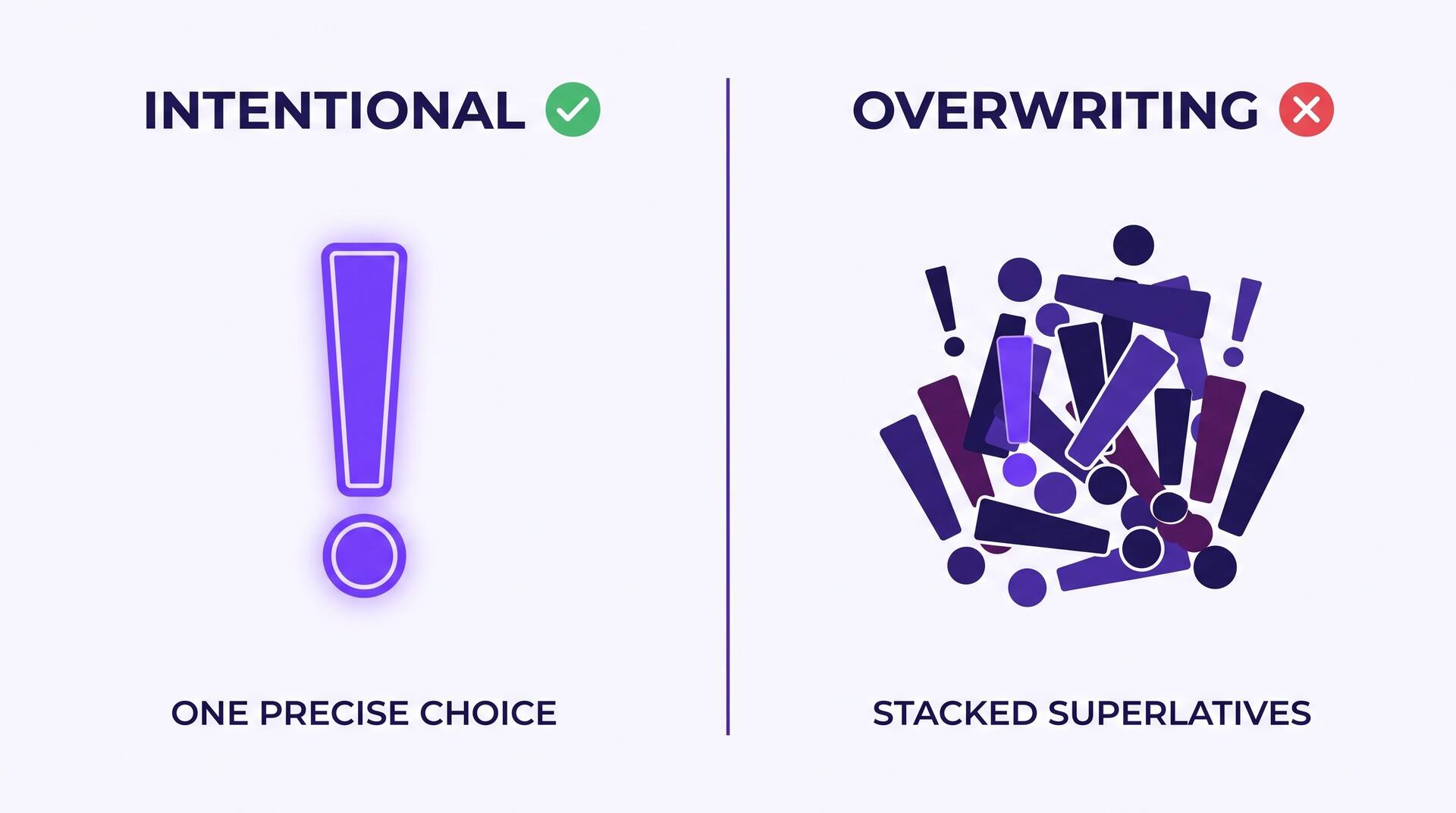
Here's the distinction most "hyperbole examples" articles skip. Exaggeration is not automatically good writing. Used without a job, it reads as purple prose — the single most common tell of an unedited first draft. The difference between deliberate hyperbole and overwriting comes down to three things.
What separates the two
Intentional: one precise exaggeration
Deliberate hyperbole is singular. One wild claim, chosen and placed, carries a whole mood. It has room to breathe because everything around it is literal.
Overwriting: stacked superlatives
Amateur exaggeration comes in piles — "the most beautiful, incredible, breathtaking, earth-shattering sunset in the history of the universe." Nothing was chosen, so nothing lands; the stack cancels itself out.
Intentional: tied to a voice or purpose
You can name the job — it's the character talking, or the comedy, or the emotional peak. The exaggeration belongs to someone or something.
Overwriting: tied to nothing
The exaggeration is the narrator reaching for drama the scene hasn't earned. Cut it and the passage gets stronger, which is the surest test that it was padding.
Intentional: fresh, not reflexive
"I could eat a horse" and "I've told you a million times" are dead hyperbole — so worn they've stopped exaggerating anything. A live piece of hyperbole surprises; a clichéd one just fills space.
The fast test: read the passage aloud and cut every exaggeration. If it reads flatter and something is genuinely lost, that hyperbole was doing a job. If it reads cleaner and sharper, it was overwriting. When a whole chapter reads as over-decorated, that's usually not a hyperbole problem but a naturalness one — running the draft through a free AI text humanizer can quickly surface where the prose is straining for effect instead of earning it.
Common mistakes and when not to reach for it
Exaggerating the stakes instead of the language
Hyperbole belongs in how a moment is described, not in what actually happens. A character can say the wait "lasted a thousand years"; the plot should not literally stall for a thousand pages. Overstate the telling, never the events.
Using it in the wrong register
A tense, high-stakes scene rendered in comic hyperbole undercuts itself, and a light comic beat drowned in operatic exaggeration feels overwrought. Match the device to the emotional key of the scene.
Reaching for the cliché exaggeration
The first hyperbole that comes to mind is almost always a dead one. "Killed me," "a ton of," "waited forever" — if you've heard it a thousand times (see what happened there), your reader has too. Push for the specific, unexpected overstatement instead.
Forgetting understatement exists
Sometimes the stronger move is the opposite: undershoot. "It stung a little," said of a mortal wound, can hit harder than any exaggeration. Hyperbole is a tool, not a default — reach for it when a feeling genuinely outruns literal description, not out of habit.
Putting hyperbole to work in your own book
Hyperbole is easiest to place in two spots: dialogue and close narration, where a distinct voice can carry the exaggeration without the whole book tipping into melodrama. That's also where a first draft most often goes flat — the character sounds like everyone else. This is where the tools help. Our free dialogue generator can rough out lines in a character's register so you can hear where a well-placed overstatement would sharpen their voice, and it pairs naturally with our deeper look at building a distinct narrator in the guide on writing a novel.
When you're drafting a full manuscript in AIWriteBook, the same idea scales. The chapter writer drafts in the voice you set, and the chapter AI chat lets you accept or reject each suggested change line by line — so you can dial a scene's hyperbole up in dialogue and strip it back out of the narration without rewriting the whole passage by hand. Exaggeration becomes an editing lever you pull deliberately, which is exactly the difference between craft and clutter.
Frequently asked questions
Hyperbole is deliberate, obvious exaggeration used for effect and not meant literally — like saying a bag "weighs a ton" or that you've "asked a million times." The reader knows it's an overstatement and reads the feeling behind it rather than the literal claim.
A metaphor says one thing is another ("her voice was velvet"); hyperbole simply exaggerates past what's realistic ("her voice could shatter glass across the city"). They often appear together, but the test for hyperbole is whether the statement is deliberately, impossibly overstated.
Only when it has no job. A single, purposeful exaggeration tied to a character, a joke, or an emotional peak is strong writing. Stacks of unmotivated superlatives — the "most incredible, breathtaking, life-changing" pile — are overwriting, and cutting them almost always improves the prose.
Yes. Constant exaggeration exhausts a reader and flattens contrast — if everything is the greatest thing ever, nothing is. Reserve hyperbole for the moments that genuinely outrun literal description, and keep the surrounding prose grounded so the exaggeration has something to push against.
"I'm so hungry I could eat a horse," "this bag weighs a ton," "I've told you a thousand times," "it took forever." These are useful for showing how natural the device is — but in writing they're dead hyperbole. Fresh, specific exaggeration you invent for the moment always reads stronger than the worn phrases.
The takeaway
Hyperbole isn't measured by how big the exaggeration is — it's measured by what the exaggeration accomplishes. Burns overshoots to capture love, Salinger to build a voice, Adams to land a laugh, Swift to expose a folly. In every case the overstatement does a job the literal sentence couldn't, and that job is the entire difference between a line readers quote and a line editors cut.
So the next time you reach for an exaggeration, name its purpose before you keep it. If you're building a whole manuscript, the complete guide to writing a book walks through voice, structure, and the other craft decisions that turn devices like this into a book worth finishing.