

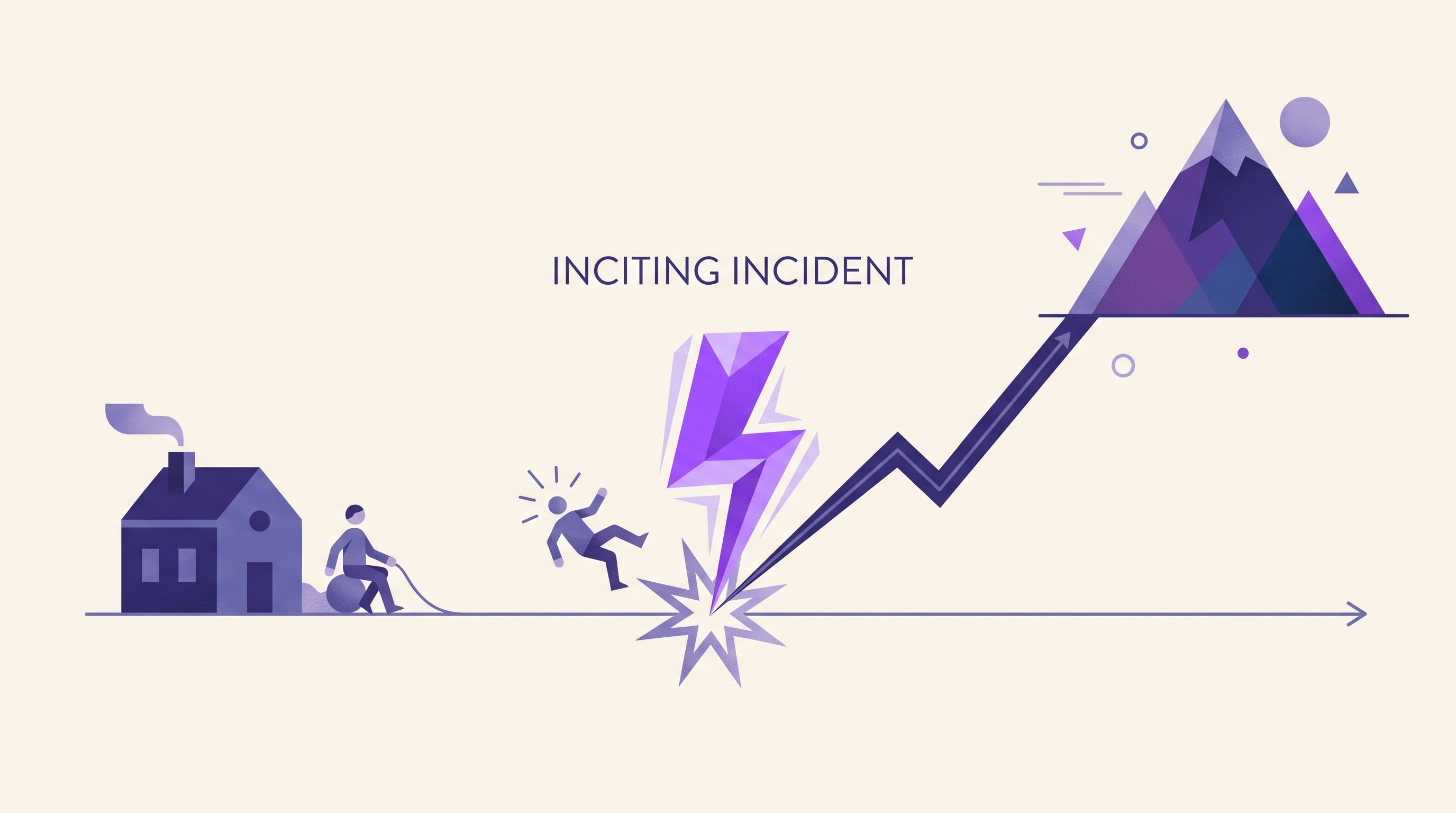
Inciting incident definition
The inciting incident is the first event in a story that the protagonist cannot ignore and cannot undo. It disturbs the balance of their ordinary life, raises the question the whole book will answer, and forces them into a situation they did not choose.
Note the two halves of that definition, because most writers only deliver one. An event that is dramatic but reversible is just an interesting scene — the character shrugs and goes back to work. An event that is irreversible but has nothing to do with what the protagonist wants is a news bulletin, not a story. It has to be both: unignorable and unfixable, and aimed squarely at this particular person.
It also does not have to be loud. A letter arriving is enough. A phone call. A neighbour moving in. What makes an inciting incident big is not the size of the event but the size of the hole it tears in one specific life — the same earthquake means nothing to a character with nothing to lose.
Structurally it sits early in the first act, usually somewhere in the first ten to fifteen percent of the book, after just enough ordinary world for the reader to feel what is being taken away. If you want the wider map it sits on, the three-act structure guide shows how it connects to everything downstream.
6 inciting incident examples from famous books
Tap any book to see the exact moment, why it works, and where it lands. Notice how differently they are staged — one is a public ceremony, one is a knock at a door, one is a woman who simply is not in the house.
At the reaping, Prim's name is drawn — and Katniss volunteers to take her place.
Collins stacks two beats into one scene. The lottery is the event Katniss cannot control; volunteering is the choice she makes inside it. That is why the opening feels so much more active than most dystopian setups: the protagonist is trapped and decisive in the same breath, and the reader instantly knows the question — can she come home?
End of chapter one
Yer a wizard, Harry.
Six words. No explosion, no chase — and after them, Harry cannot go back to the cupboard and pretend. That is the entire job of an inciting incident.
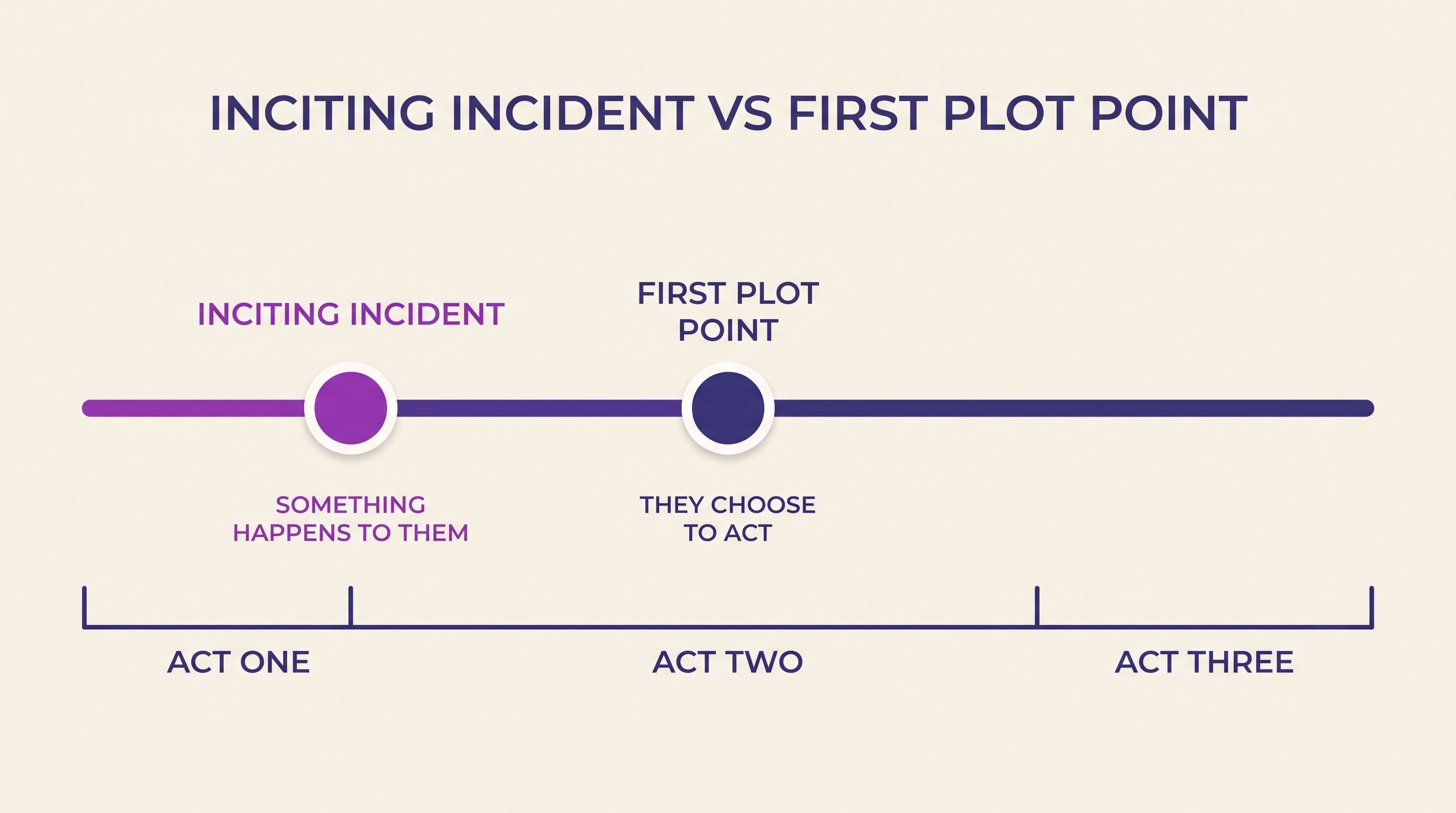
Inciting incident vs. first plot point
These two get muddled constantly, and the confusion is why so many first acts sag. They are different beats with different jobs, usually a chapter or several apart.
| Inciting incident | First plot point | |
|---|---|---|
| What it is | Something happens to the protagonist | The protagonist commits to acting |
| Who drives it | The world, another character, chance | The protagonist's own decision |
| Rough position | First 10–15% of the book | Around the 20–25% mark |
| Reader effect | Raises the story question | Locks the door behind them |
| In The Hobbit | The dwarves arrive with a contract | Bilbo runs out the door without his handkerchief |
The stretch between them is the reaction gap, and it is real writing, not filler: refusal, argument, a bad plan, a failed attempt to go back to normal. When the gap is zero the character feels like a puppet. When it runs past a quarter of the book, readers quit. Once you know where both beats land, mapping what follows is the job of the rising action, and the plot diagram guide shows the full shape on one page.
Four tests your inciting incident must pass
Before you write the scene, run the idea through these. If it fails one, it is a good scene sitting in the wrong slot.
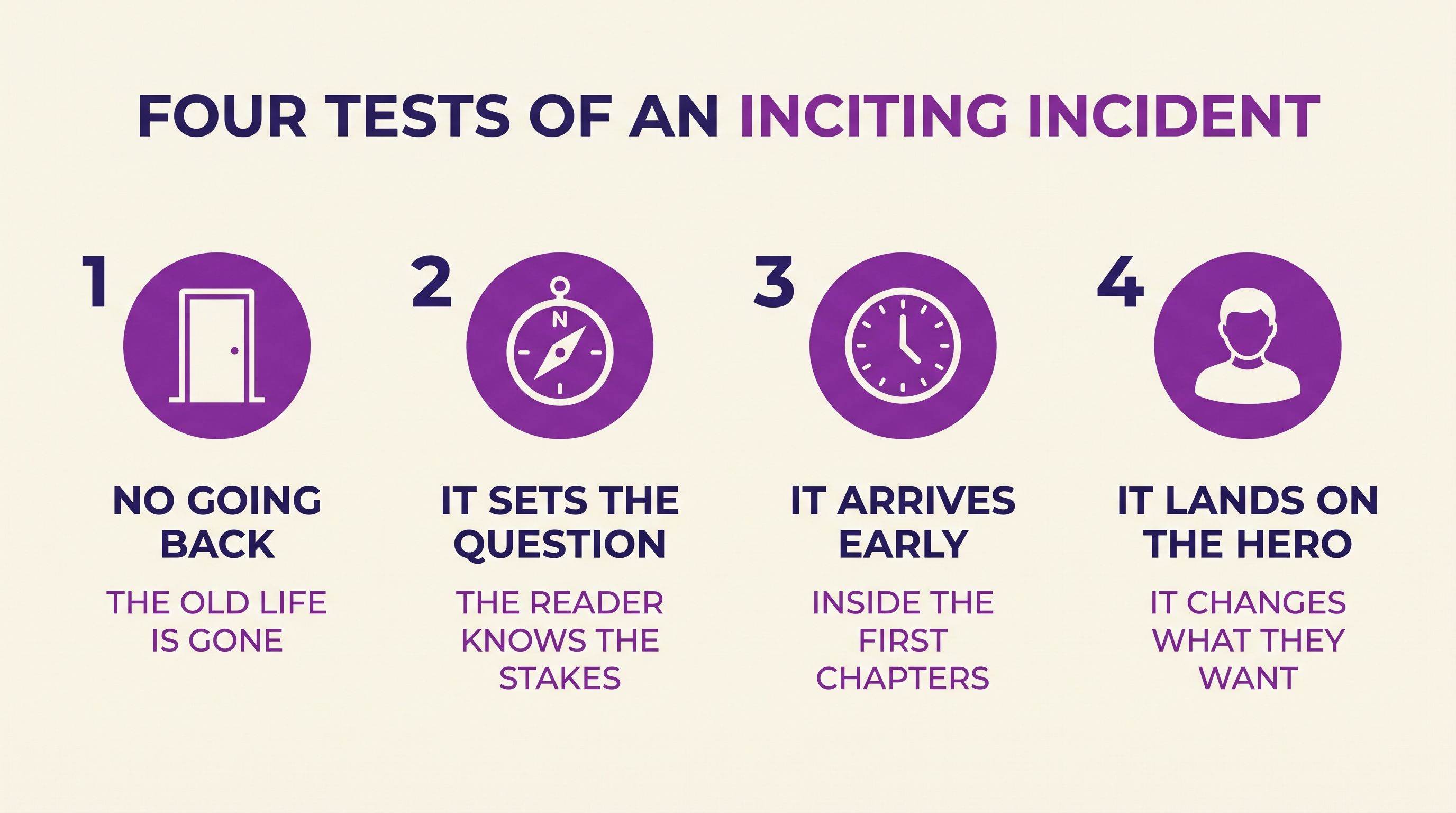
No going back
Ask what would happen if your protagonist did nothing at all. If the answer is nothing much, the scene is not your inciting incident. Prim still goes to the arena. The body is still in the Louvre.
It sets the story question
A reader should be able to state the question of your book in one sentence right after the scene ends. If they cannot, you have delivered atmosphere instead of an event.
It arrives early
Ordinary world first, but briefly. If you need seven chapters of setup before the incident makes sense, you are probably starting the book in the wrong place — cut in later and hand the backstory out in pieces.
It lands on this hero
The event must change what your specific protagonist wants or fears, not just what happens in the world. A war is not an inciting incident. A conscription letter with their name on it is.
Five mistakes that kill an inciting incident
Mistaking the hook for the incident
A body on page one, a sentence of tension, a strange letter — those are hooks. They buy you attention. The inciting incident is the thing that removes your protagonist's option to stay where they are, and it usually comes later.
Letting it happen to someone else
A common fantasy and thriller failure: the exciting event lands on a king, a scientist, a stranger in the prologue, and the protagonist reads about it. If you are writing a scene before chapter one, the prologue guide covers when that actually earns its place.
Making it reversible
If a phone call, an apology, or an insurance payout would undo the damage, readers feel the slack immediately. Burn the exit.
Explaining it instead of staging it
Summarising the incident in narration — 'that was the week everything changed' — costs you the only scene the reader will remember from act one. Put it on stage, in real time, with dialogue.
Delaying the consequences
The incident happens and then three chapters of ordinary life continue unchanged. Every scene after it should carry the pressure, even the quiet ones.
Writing yours with AI assistance
Structure is exactly the kind of problem where a second opinion helps, because the flaw is usually invisible from inside the draft. A few honest ways to use AI here — none of which mean handing over the book.
1. Generate ten candidate incidents, then throw away nine
The first inciting incident you think of is usually the genre default. Ask for a spread of options for your premise and you will normally find that one of them is the version that hurts your protagonist personally. Our free outline generator does this at the structural level — feed it your premise and it hands back an act-by-act skeleton with the incident placed rather than a blank page.
2. Pressure-test the scene you already wrote
Paste the scene and ask what your protagonist could do to undo it. If the answer is a list, your incident is reversible. This is the fastest single fix in this article, and it takes two minutes.
3. Write the chapter that carries it, then keep control of the voice
In AIWriteBook the incident lives in your outline, so the chapter that contains it is written against your structure rather than invented on the spot. Inside the chapter editor the AI chat proposes changes as a diff you accept or reject line by line — useful precisely here, where you want the beat sharpened but the voice left alone. If it is the very first pages you are wrestling with, the first chapter hook tool is a faster way in.
One honest limit: AI is good at telling you whether a scene is structurally an inciting incident and bad at knowing which one your book deserves. That choice is where your taste lives — keep it.
Where to put yours
Open with your protagonist wanting something ordinary. Give the reader roughly a chapter to want it with them. Then take it away in a scene they cannot un-see, and let the character resist for a while before they commit. That sequence is doing more work for your first act than any amount of world-building.
If you want the whole arc rather than this one beat, the how to write a book guide walks the process from premise to published, and the climax of a story is where the promise you make here finally gets paid.