

The short answer
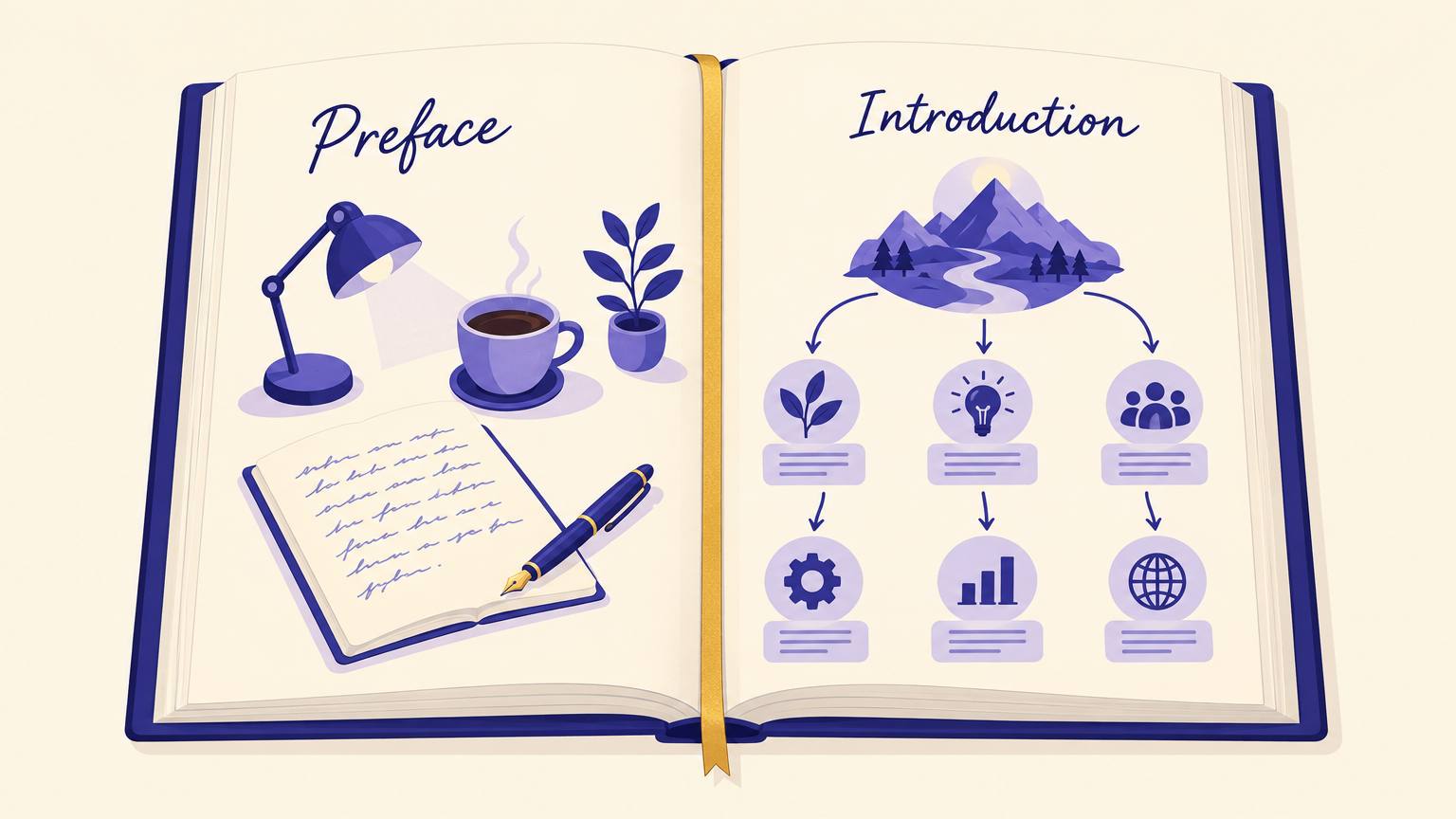
Ask one question of the pages you have written: if a reader skipped them, what would they lose?
- Preface
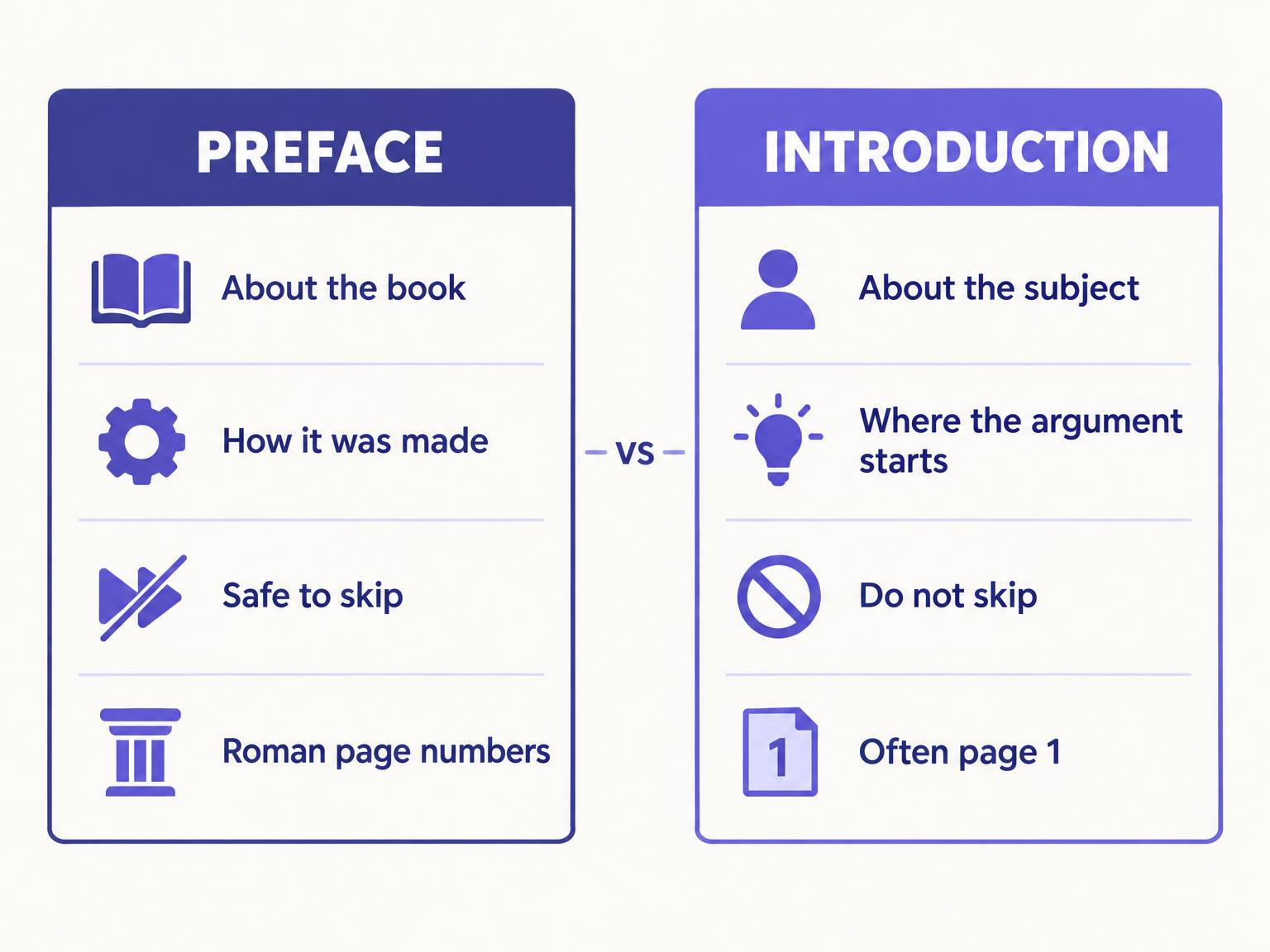
- If they would lose the story of how the book came to exist, the thanks, the note on sources, or what changed since the last edition, you have a preface. Useful, human, and optional.
- Introduction
- If they would lose the question the book answers, the terms it uses, or the map of where the chapters are going, you have an introduction. That is content, and nobody should skip it.
The foreword gets dragged into this argument constantly, but it is a different axis: a foreword is written by someone else. If that is the choice in front of you, our foreword vs preface guide covers it, and what a preface is, in full has a worked sample preface you can model. This page stays on the harder boundary, the one between your two voices.
Same material, written both ways
The clearest way to see the difference is to take one fact and let each section use it. Here is a hypothetical beginner's book on sourdough baking.
As a preface
I started keeping a baking log during a winter when my starter died three times. This book is that log, cleaned up. Every method in it was tested in an ordinary home oven, and the timings in chapter four were corrected after readers of the first edition wrote to tell me my kitchen runs warm.
As an introduction
Most failed loaves fail for one of three reasons: a weak starter, the wrong water temperature, or impatience at the proof. This book is built around those three. Part one keeps a starter alive, part two controls temperature, and part three teaches you to read the dough instead of the clock.
Notice what moved. The dead starter is the same fact in both, but the preface uses it to explain the author and the introduction turns it into the book's thesis. If you catch your preface doing the second thing, cut that paragraph and paste it into the introduction.
Preface or introduction? Sort these six lines
Each sentence could appear in the opening pages of a real book. Pick where it belongs.
This second edition adds a chapter on remote teams and drops the one on fax etiquette.
By the end of chapter three you will be able to read a balance sheet without a calculator.
I owe the archive staff in Leeds more than a line of thanks can repay.
The word burnout was coined in the 1970s, and its meaning has drifted ever since.
I wrote most of this book on the night shift, between rounds.
Three questions run through every chapter that follows.
Fiction vs nonfiction: when you need either
Most confusion comes from applying nonfiction habits to a novel, or the reverse. The two kinds of book treat these sections very differently.
Nonfiction
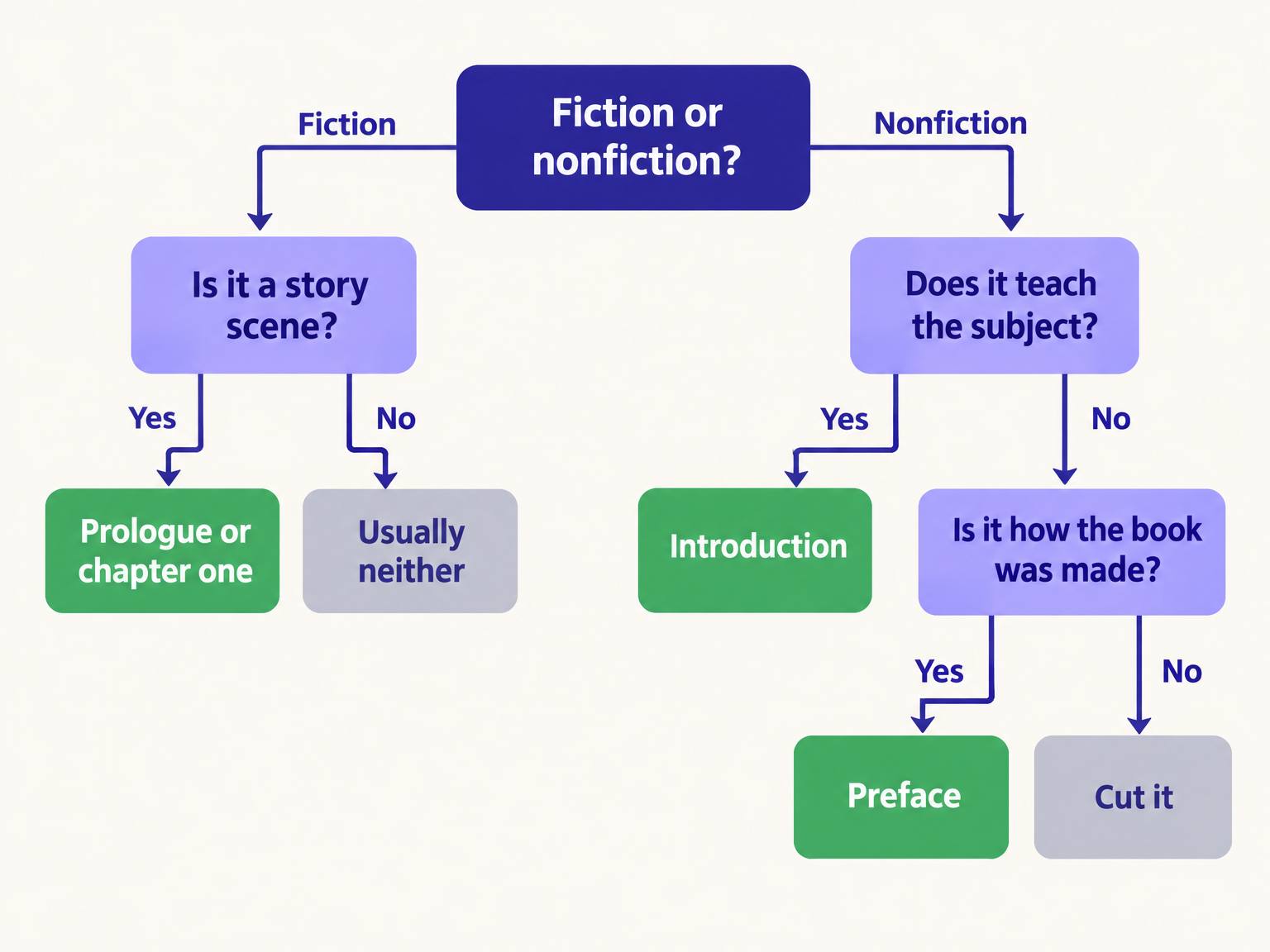
An introduction is close to mandatory. It states the problem, defines the terms, and tells the reader how to use the book: straight through, or dipping into the chapter they need. A how-to, business or self-help book without one often feels as if it starts mid-sentence.
A preface is optional. Add one when there is a real story behind the book, when your method needs explaining, or when a new edition changed something readers of the old one should know. Many strong nonfiction books have an introduction and no preface at all, and that is the more common shape.
Fiction
A novel rarely needs either. Readers open fiction to be inside the story, and every page before chapter one is a page they have to get past. If what you want to write before chapter one is a scene, you want a prologue, not an introduction, and if you just want the opening to grab harder, the first chapter hook checker will tell you whether your chapter one already does the job.
The exception you will actually see on shelves is the reissue. Classic novels are usually sold with an introduction by a scholar or another writer, and because it discusses the whole plot, some editions print a warning before it. Many readers save it for after the last page. If you are publishing a new novel, that is not your situation yet.
Famous examples of both, including both in one book
Three books that show the line clearly, each for a different reason.
- 1
The Scarlet Letter: an introduction, then a preface about the introduction
Hawthorne opened his 1850 novel with The Custom-House, a long sketch he subtitled Introductory to The Scarlet Letter, describing his job at the Salem customs office and the faded letter he claims to have found there. It frames the story, so it is an introduction. It also offended people in Salem, so the second edition added a preface, dated March 30, 1850, in which Hawthorne addresses the uproar and declines to change a word. One book, both sections, each doing exactly its own job.
- 2
The Picture of Dorian Gray: a preface that is a manifesto
When the novel came out as a book in 1891, after critics had attacked its magazine version the year before, Wilde added a preface of short aphorisms about art. It says nothing about the plot and everything about how he wanted the book read. That is the rare fiction preface that earns its place: it is about the book's reception, not its subject.
All art is quite useless.
Oscar WildeThe Preface, The Picture of Dorian Gray (1891) The last line of the preface: a provocation aimed at the critics, not at the story.
- 3
On the Origin of Species: an introduction that starts with a boat
Darwin's introduction opens with a personal memory, being struck by the distribution of species while naturalist on HMS Beagle, which sounds like preface material. It is not. Within a page he is stating the problem the book will solve and summarising the argument chapter by chapter. The personal detail serves the subject. That is the test: a story about you can sit in an introduction as long as it is doing the subject's work.
Where each one sits, and how it is numbered
In print, the conventional front matter order runs title page, copyright page, dedication, contents, foreword, preface, and then the introduction. The preface is always front matter and is traditionally numbered in lowercase roman numerals.
The introduction can go either way, and this is the detail most guides miss. The Chicago Manual of Style treats an introduction that belongs to the text as the start of the book proper, usually arabic page 1, while a short introduction that only orients the reader can stay in the front matter. If yours carries argument, number it with the chapters.
In an ebook, give the introduction its own entry in the table of contents so readers can find it, because many reading apps open a book at the start of the main text rather than at the title page. Readers who never see a buried introduction will never know what they missed. Our explainer on the EPUB format covers how that navigation is built.
Four mistakes worth avoiding
Hiding the thesis in the preface
Readers skip prefaces. If the book's central claim appears only there, a large share of your readers will never meet it. Put the claim in the introduction and let the preface tell the story of how you arrived at it.
Writing an introduction that is really a memoir
Three pages of how you came to the subject, with no statement of what the book will do, is a preface wearing the wrong heading. Either retitle it or cut it down to one paragraph and get to the point.
Saying the same thing twice
When a book has both, writers often repeat the origin story in each. Decide which section owns it. Usually the preface keeps the story and the introduction keeps only the lesson from it.
Calling a novel's opening scene an introduction
If characters act and time passes, it is story. Label it chapter one or prologue. An introduction in a novel signals commentary, and readers will skip it expecting nothing to happen.
Where AI helps, and where it should not
The preface should come from you. It reports your experience of making the book, and no model has that experience. The introduction is different: it is a promise the chapters have to keep, and keeping it is a structural job.
Start from the structure. The free outline generator gives you a chapter map you can turn into the introduction's how-to-read-this-book paragraph. Inside AIWriteBook, nonfiction books accept up to ten reference files and an include-citations option, so an introduction that makes claims can point at real sources rather than confident guesses. If your manuscript already exists, manuscript import reads a Word file, finds the chapters and the front and back matter, and lets you review how it split them before anything is saved.
Then draft the introduction last, with the finished chapters in view. The chapter writer works with the whole book as context, and its AI chat proposes edits you accept or reject one change at a time, which is exactly what you want when you are tightening an introduction to match what the book really delivers.
Questions writers ask
- What is the difference between an introduction and a preface?
- A preface is about the book: why and how the author wrote it, thanks, and edition changes. An introduction is about the subject: it sets out the question, terms and structure the reader needs before chapter one. Readers can skip a preface without losing anything essential; they should not skip an introduction.
- Which comes first, the preface or the introduction?
- The preface. The conventional order is foreword, then preface, then introduction, so the introduction sits closest to chapter one and leads straight into it.
- Can a book have both a preface and an introduction?
- Yes. Many nonfiction books do, and The Scarlet Letter has both. Keep them separate: the preface tells the story of the book and the introduction starts the book's argument. If you find material repeated between them, one section is doing the other's job.
- Does a novel need an introduction or a preface?
- Usually neither. New fiction works best when chapter one starts the story. An opening scene set apart from the main timeline is a prologue, and scholarly introductions mostly appear in reissued classics.
- How long should an introduction be compared with a preface?
- A preface is usually one to four pages. An introduction has no fixed limit, but in most trade nonfiction it runs closer to a short chapter, because it has real work to do: stating the problem, defining terms and mapping the chapters.
The short version
Preface: you, on the record about the book. Introduction: the book, beginning to speak about its subject. Nonfiction almost always wants the second and sometimes the first. A novel usually wants neither, and its first page should be story.
Front matter is one small decision in a much longer build. If you are still working out the chapters these pages will introduce, our step-by-step guide to writing a book takes you from the first idea to a finished file.