

What this guide covers
The Joker, or Trickster, is the archetype of the boundary-crosser — a character who breaks rules, blurs categories, and disrupts the established order, often through wit, deception, or sheer appetite for chaos. Crucially, the disruption is generative: the trickster's mischief exposes what the story's world was hiding.
The trickster is not a villain type or a comic-relief slot. It is a function. A trickster can be your hero, your antagonist, your mentor, or the fool in the corner — what makes them a trickster is what they do to the order around them.
Trickster vs. Joker: the same energy, split in two
People search for the "Joker archetype" and the "Trickster archetype" as if they were interchangeable. They are the same root split into two branches. Understanding the split is the single most useful thing you can know before writing one.
The older, wider mythological figure — Hermes, Anansi, Coyote, Loki, Puck. Their chaos is fertile. They cross the line between gods and mortals, order and wilderness, and they bring something back: fire, language, a lesson, a new rule. Even when they wreck things, the world is richer afterward.
The trickster's shadow — chaos stripped of its regenerative purpose. Where the trickster breaks a rule to reveal a truth, the Joker breaks it to prove there was never any truth to begin with. Nolan's Joker doesn't want anything he can spend; he wants to show you the order was a joke. That nihilistic edge is what makes the modern Joker feel dangerous rather than merely mischievous.
Writer's takeaway: decide early which branch you are on. A trickster with a generative streak earns the reader's affection even at their worst. A pure Joker earns dread. Muddle the two and readers can't tell whether to root for them or fear them — which is only a problem if you didn't intend the ambiguity.
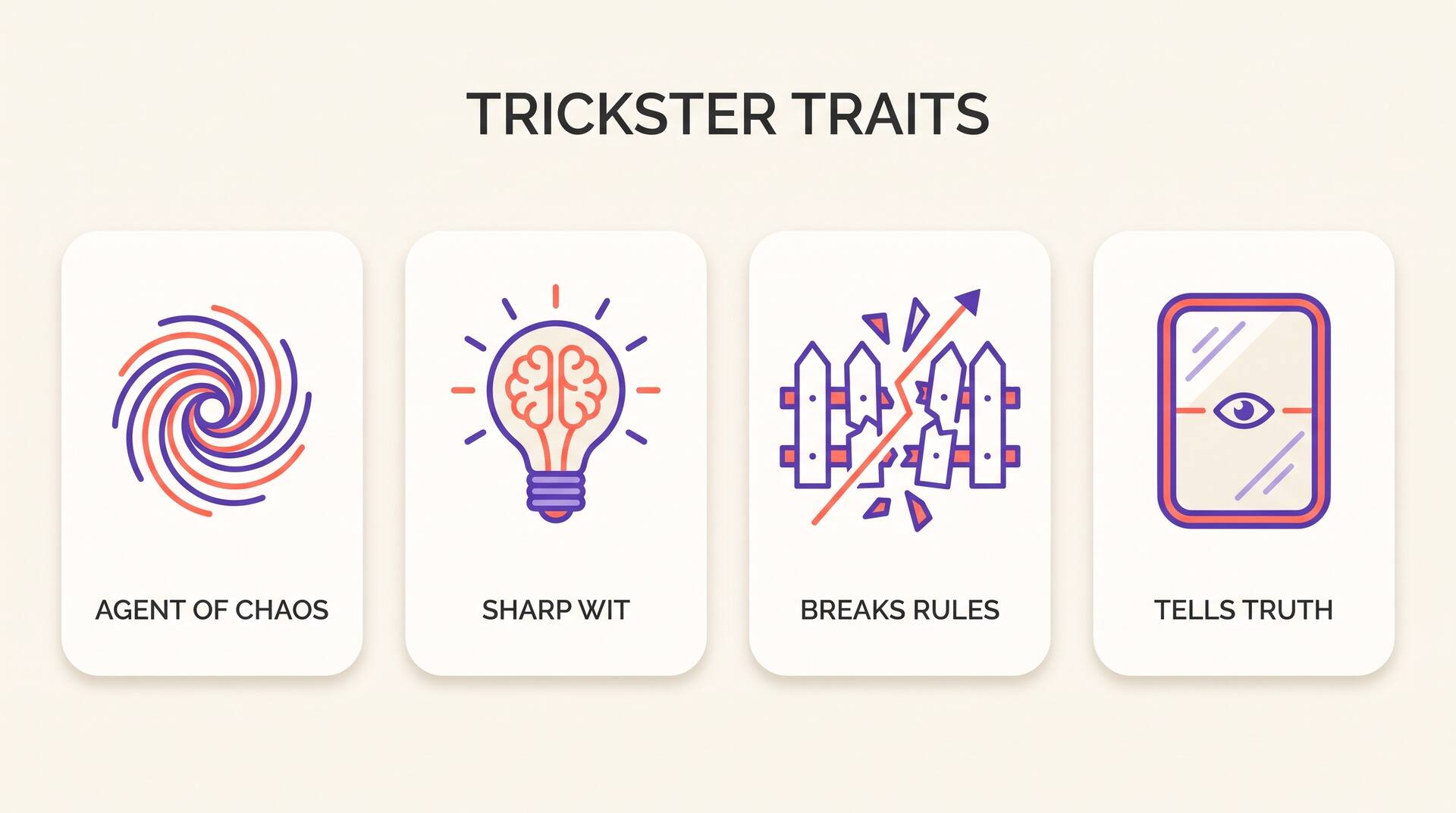
The nine traits of a trickster
No single character has all nine. But if yours has fewer than three, you don't have a trickster — you have a quirky sidekick. Toggle the ones your character already has to see where the gaps are.
The psychology beneath the mask
Carl Jung placed the Trickster among the deep, recurring figures of the collective unconscious — the part of the psyche that refuses to be socialized. He read the trickster as a "shadow" figure: everything the ego suppresses to stay respectable, given a body and a grin.
Chaos that renews
In Jung's reading, the trickster's destruction clears space for something new. That is why folklore keeps the figure around instead of exiling it — a culture needs a licensed rule-breaker to test which rules still deserve to stand.
The return of the repressed
The trickster voices what a society has agreed not to say. Lewis Hyde argues the figure lives on the threshold — at crossroads, doorways, borders — precisely because they belong to no single side and can therefore expose all of them.
Why readers forgive them
Audiences let tricksters get away with cruelty that would sink any other character, because the trickster acts out an envy every reader feels: the wish to stop performing and just say the true, rude, funny thing out loud.
Famous tricksters, decoded
Six tricksters across myth, theatre, prose, film, and folklore. Open each to see which traits are doing the work — and which branch of the archetype they sit on.
What a trickster does to your plot
The archetype is a tool. Here are the five jobs it does better than any other character type. Unlike a dynamic character who transforms across the story, the trickster changes everyone around them while staying the same.
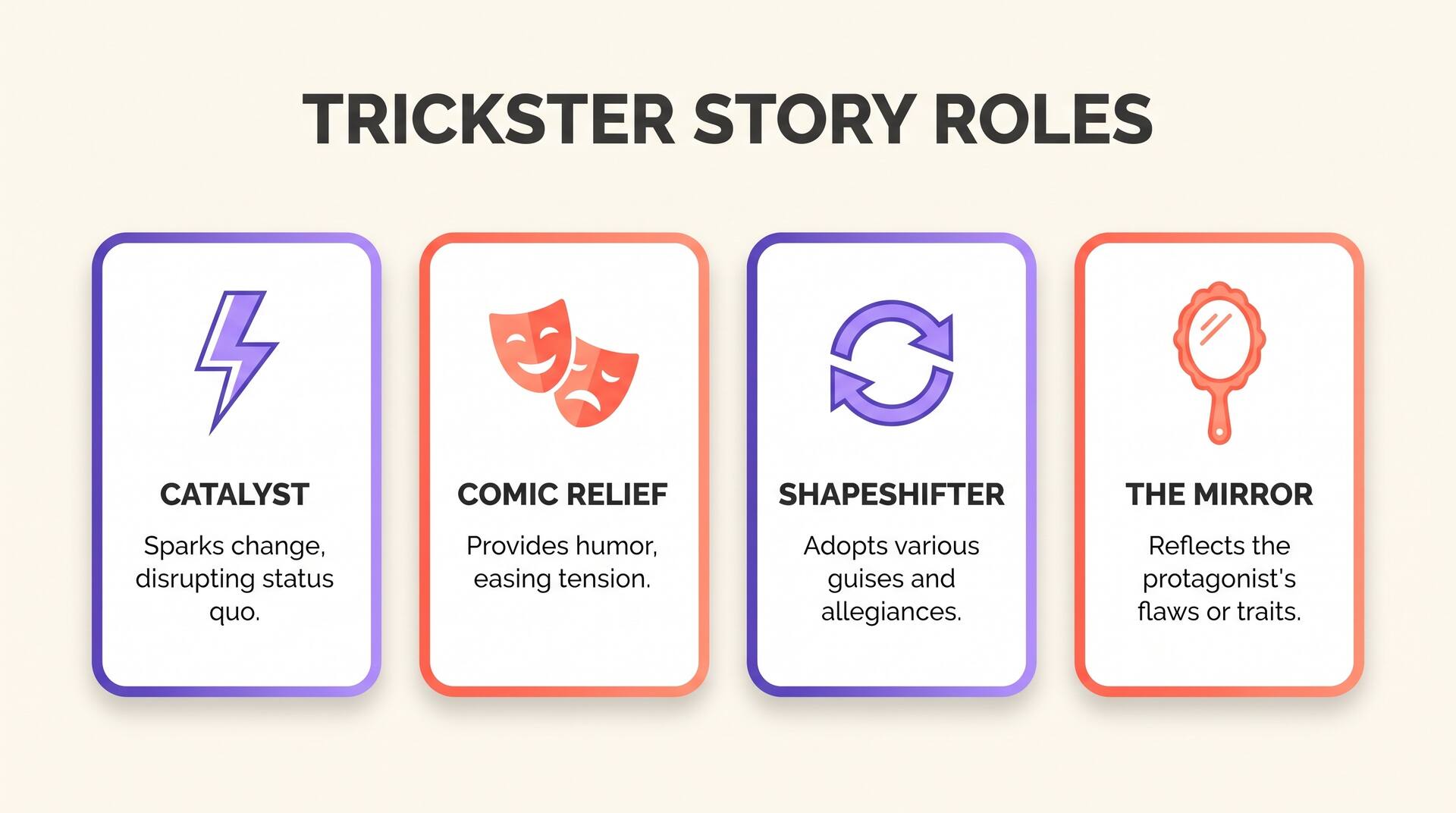
The catalyst
Drop a trickster into a stable situation and it stops being stable. They are the cheapest, most character-driven way to kick a static plot into motion.
The truth cannon
They say the thing your protagonist can't afford to say and the antagonist doesn't want to hear — and get away with it because it's "just a joke."
The mirror
By refusing to take the hero's quest seriously, the trickster forces the hero to justify it — to the reader as much as to themselves.
The wildcard
Because their loyalty is to their own logic, no one — including the reader — can predict which side they'll help. That uncertainty is free tension.
The pressure valve
In a grim story, the trickster's humor gives the reader permission to breathe, which paradoxically lets you go darker everywhere else.
How to write your own trickster
The failure mode is always the same: a character who is chaotic and "random" and therefore boring, because randomness has no stakes. Here is how to avoid it.
Give the chaos a rulebook
A great trickster is internally consistent even when their behavior looks unpredictable. Decide their one unbreakable rule — Bugs never strikes first; the Joker never lies — and let everything chaotic flow from it.
Anchor every trick to a wound or a want
Tyrion's wit is armor over a lifetime of contempt. The mischief lands emotionally only when it's compensating for something. Randomness without a wound reads as a writer showing off.
Let them win — sometimes
A trickster who always fails is a clown; one who always succeeds is a god. The archetype lives in the middle, where a clever plan works just often enough to be dangerous.
Pair them with a straight man
Trickster energy needs a rigid surface to bounce off. Give them a rule-bound foil — a soldier, a bureaucrat, a true believer — and the contrast does half your characterization for free.
Use them to voice the forbidden
Whatever your story is secretly about, the trickster is the one character who can name it out loud. Hand them your theme and let them joke about it.
Make the humor cost something
The best trickster scenes end with the reader realizing the joke was hiding grief, or that someone got genuinely hurt. Comedy that never bruises is just filler.
Design a trickster that steals scenes, not your plot
AIWriteBook's character creator builds a full profile — wound, want, voice, and contradictions — so your trickster stays consistent even at their most chaotic. Then write the whole book around them.
Subverting the archetype
Readers know this figure cold. The fresh version comes from breaking one of their expectations on purpose.
The trickster who is right
Everyone treats them as a joke until, one scene, their absurd worldview turns out to be the only accurate reading of the situation. The dismissed fool becomes the only sane voice.
The exhausted trickster
What happens when a lifetime of performing chaos finally empties someone out? A trickster who wants, desperately, to be sincere for once — and no longer remembers how — is quietly devastating.
The trickster forced to commit
Strip away their exit routes. Corner the boundary-crosser somewhere they can't cross out of, force them to pick a side and mean it, and you've turned a wildcard into a hero or a monster in a single choice.
The joke that was never funny
Reveal, late, that the character everyone read as comic relief has been grieving in plain sight the whole time — that every punchline was a flinch. Re-reads become unbearable, in the best way.
Frequently asked questions
The last word on the fool
The trickster endures because every reader recognizes the impulse behind the mask — the wish to stop performing, break the rule everyone's tiptoeing around, and say the true, rude, funny thing out loud. Your job as the writer is to give that impulse a rulebook and a wound, so the chaos means something.
Get that right and the trickster does more work than any other character in your cast: they start your plot, voice your theme, and let the reader breathe right before you take that breath away. Get it wrong and they're just noise. The difference is entirely in the craft.