

Superhero name generator
Press generate to combine a power word with a noun and spark ideas. Use the results as raw material — the best name is usually a generated spark you then refine by hand. For names that arrive with built-in meaning, our character name generator digs deeper than this quick combiner.
See one you like? Save it, then read the principles below to pressure-test whether it actually fits your character.
What makes a great hero name
A great superhero name does three jobs at once: it tells you what the character can do, it carries an emotional tone, and it is easy to say and remember. Spider-Man does all three in two syllables — you instantly know the power, the slightly friendly tone, and you will never misspell it.
The name is also a promise about genre and register. Wolverine sounds feral and dangerous; Mr. Fantastic sounds like Silver Age optimism; The Punisher sounds exactly as grim as he is. Before a single line of dialogue, the name has set expectations the character will either meet or subvert — the tone often flags the hero's underlying archetype long before the story confirms it.
Crucially, the best names leave room. They suggest a power without locking the character into a single trick, and they hint at personality without explaining it. A name that is too literal becomes a label; a name that is too abstract becomes forgettable. The sweet spot is evocative but specific.
The three jobs of a hero name
- Signal the power or domain without over-explaining it
- Carry an emotional tone that matches the character and genre
- Be easy to say, spell, and remember on first contact
The naming principles
Generators give you sparks. These principles turn a spark into a name that earns its place on the cover.
Say it out loud
Names live in conversation — readers will subvocalize it hundreds of times. If it is awkward in the mouth or ambiguous in pronunciation, it fails. The rhythm matters: strong names often land on a stressed first syllable.
Use sound symbolism
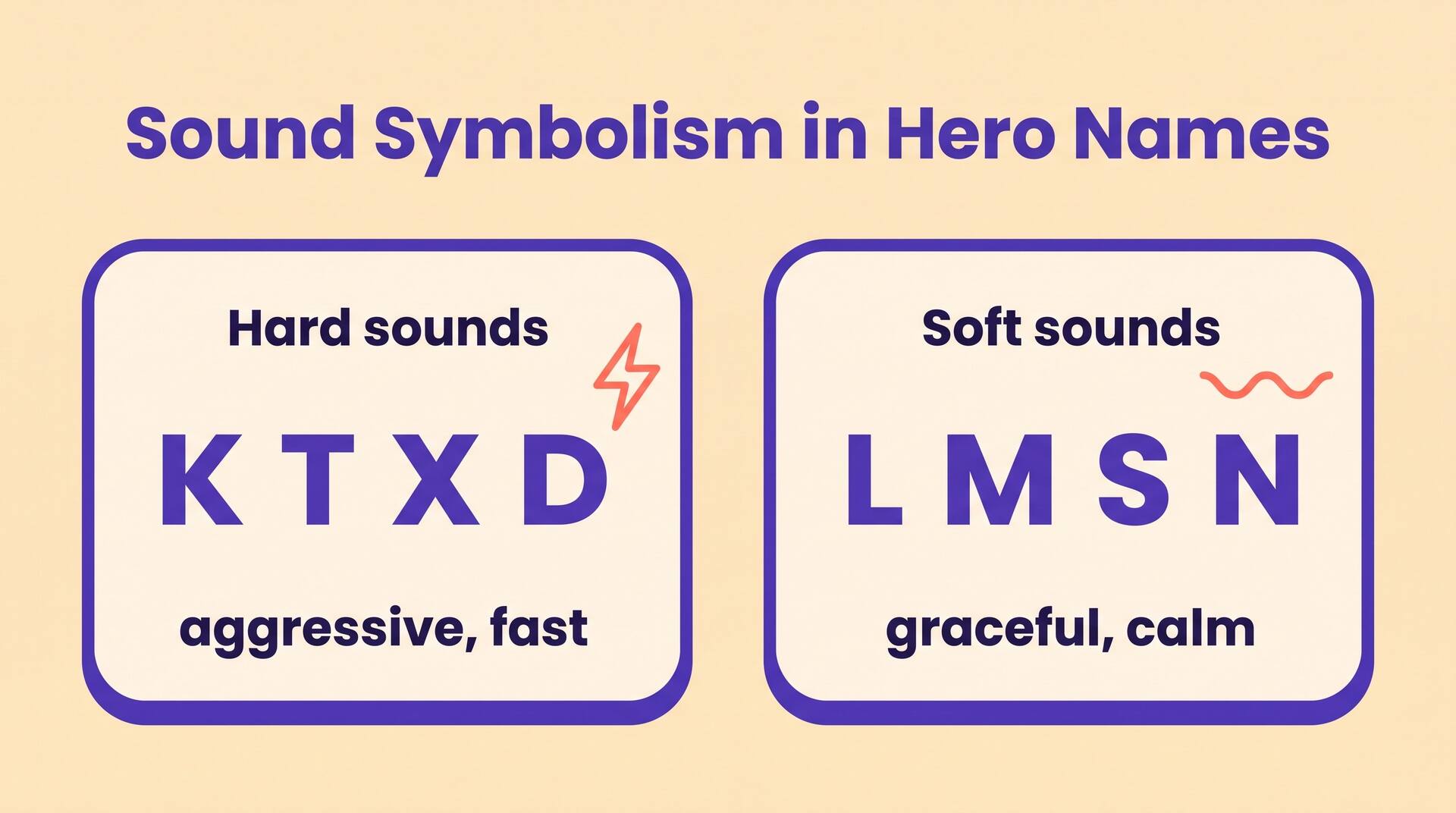
Hard consonants (K, T, X, D) sound aggressive and fast — perfect for fighters. Soft sounds (L, M, S, F) feel graceful or eerie. "Wolverine" snarls; "Mystique" slips. Match the phonetics to the power.
Anchor it to identity, not just power
The strongest names connect to who the character is, not only what they do. "Batman" is built on a childhood fear turned into a weapon. The name carries the wound, not just the gadget.
Mind the syllables
Two to four syllables is the durable range. One syllable can feel thin; five or more gets unwieldy in dialogue and on a cover. Compound names (Night + wing) are an easy way to hit the range with built-in meaning.
Avoid the over-literal trap
"Fire Guy" or "Ice Woman" tells the reader everything and suggests nothing. Reach one step sideways: not Fire but Ember, Pyre, or Cinder. The slight abstraction is what makes it feel like a name rather than a description.
Leave room to grow
Your character will change. A name welded to a single power becomes a cage when the powers evolve. Pick a name with metaphorical reach so it still fits when the character is three books deeper than you planned.
Famous names, analyzed
The fastest way to learn naming is to reverse-engineer names that work. Here are six and exactly why they land.
Spider-Man
Power + everymanTwo syllables of power plus the humble "Man." The hyphen and the ordinary noun keep him relatable — he is not Spider-God or Arachno-Lord. The name itself encodes the "friendly neighborhood" promise.
Wolverine
Animal as characterNot a power, an attitude. The name borrows a real animal famous for ferocity far beyond its size — telling you everything about his temperament before he pops a claw. Hard consonants do the snarling.
Storm
Elemental simplicityOne word, vast scope. "Storm" suggests weather control without listing wind, lightning, and rain. It is also majestic and a little ungovernable — which is exactly her arc. Proof that one strong word can beat a clever compound.
The Flash
Power as instant imageA flash is speed and light in a single syllable you can almost see. The definite article ("The") elevates it from a description to a title. Short, punchy, and impossible to mishear.
Mystique
Personality over powerHer power is shapeshifting, but the name points at mystery and seduction instead. The soft sounds and the French spelling make her feel slippery and dangerous — the name characterizes rather than catalogs.
Doctor Manhattan
Irony and scaleA godlike being named after a project and a place. The mundane title "Doctor" against the weight of "Manhattan" (and the atomic bomb it evokes) creates unsettling irony — the name does thematic work, not just descriptive.
Naming sidekicks and villains
Supporting characters follow their own naming logic. Get the relationships between names right and your whole cast feels designed rather than assembled. Many of the most memorable antagonists are trickster-archetype villains, and their names should carry that mischief.
Sidekicks
- Echo the hero, don't outshine them. Robin is lighter and smaller than Batman by design — the name signals junior status while still standing on its own.
- Use contrast for chemistry. A grim hero pairs well with a brighter-sounding partner; the naming contrast mirrors the dynamic.
Villains
- Villains can be bigger, darker, and more theatrical than heroes — Magneto, Thanos, Doctor Doom. Heavy sounds and grand titles signal threat.
- The best villain names mirror the hero. Green Goblin to Spider-Man's friendly neighbor; the contrast or inversion makes them feel like fated opposites.
- Avoid pure cackle. A name that is only menacing (Lord Deathskull) reads as parody. Anchor the threat in an idea — Killmonger fuses death with grievance and gives the menace meaning.
Naming across a series
When you are naming a whole team or a franchise, the names need to relate to each other — a naming system, not a pile of names.
Establish a naming convention
Decide whether your world uses code names, titles, mononyms, or real names — and stay mostly consistent. A team where everyone has a slick code name except one person with a plain first name reads as a mistake unless it is the point.
Vary the rhythm across the roster
If every team member has a two-syllable compound name, the cast blurs. Mix lengths and structures — one mononym, one title, one compound — so each name is distinct in dialogue.
Protect your hero's name
Make sure your lead's name is the most memorable in the cast. If a side character has a cooler name than your protagonist, readers will gravitate to the wrong person.
Plan for the team name
A group needs a banner — Avengers, X-Men, Justice League. The team name should be broader than any single member and should not date the roster, since members come and go.
Trademark and originality
If you plan to publish, a quick originality check now saves a painful rename later. None of this is legal advice — but these are the practical habits.
Search before you commit
Run any name you love through a search engine and your book retailer of choice. If a famous character already owns it, readers will assume derivative — and a publisher's legal team may object.
Know that big names are protected
Established superhero names from major publishers are trademarked. You cannot name your hero Batman or Superman, even in an unrelated book. Generic words ("Storm," "Flash") are riskier to reuse than coined ones.
Coined names are safest
Invented compound words and original coinages are far easier to clear and to own. "Nightveil" is safer to build a brand around than a common dictionary word another franchise already made famous.
Check the domain and handles
If the character could anchor a series, a quick check of available domains and social handles tells you whether the name is realistically yours to build on.
Using AI to name your heroes
AI is excellent for the explore-and-refine loop of naming — generating volume, then pressure-testing the few you love. Once a name sticks, our character creator turns it into a full profile, with powers, wound, and arc already in place.
- Generate fifty names in a specific register (gritty, Silver Age, cosmic) and shortlist the ones that fit your tone.
- Pressure-test a name: ask what power and personality it implies, and whether that matches your character.
- Check a name against your whole cast for rhythm clashes and accidental duplication.
- Brainstorm villain and sidekick names that mirror or contrast your hero's name on purpose.
- Generate three variations of a name you almost like to find the one with the right sound and length.
AI is a tireless brainstorming partner, but the final call is taste. The name has to feel right in your character's mouth and yours.
Superhero names: frequently asked questions
Start from the character's power and their core identity, then reach one step sideways into metaphor. Combine a power word with a noun, say the result out loud, and keep it to two to four syllables. Use a generator for volume, then refine the best spark by hand against the naming principles.
Naming the hero readers remember
A superhero name is small but load-bearing. It is the first power your character shows, the promise readers carry into every scene, and often the word on the cover that decides whether they pick the book up at all. Use the generator to break the blank page, then refine with the principles until the name says the power, the tone, and the identity in a single breath.
Get the name right and the rest of the character has something to live up to. Then build the world, the powers, and the arc around it. For everything that comes after the name — from origin to final battle — see our complete how to write a book guide.