

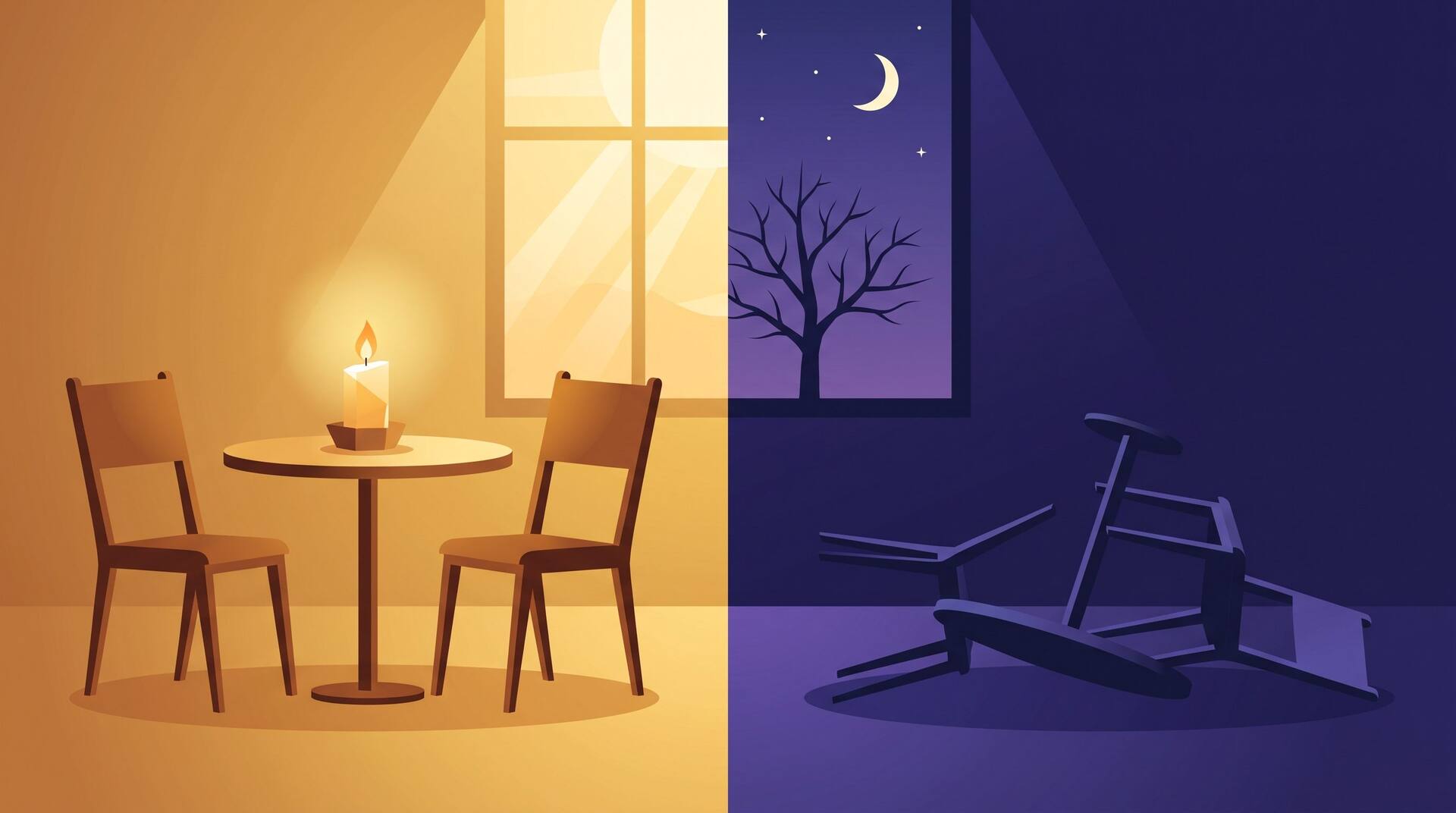
The device has no grammar of its own. There is no juxtaposition sentence pattern to memorise, no signal word, nothing to underline in a text. It happens entirely in the gap between two things a writer chose to place in the same frame — and the meaning the reader builds in that gap is never stated by anyone.
That is what makes it powerful and what makes it slippery. This guide separates it from the three devices it gets confused with, takes apart five famous examples at the level of mechanism rather than vibe, walks the six levels it operates on from single word up to whole-book structure, and finishes with the three ways it usually goes wrong.
What is juxtaposition
Juxtaposition is the deliberate placement of two contrasting elements close enough together that the reader reads them against each other, and takes meaning from the difference the author never explains.
Two requirements, both strict. The elements must be adjacent — separated by a hundred pages, contrast is just variety. And the meaning must stay unstated — the moment a narrator explains the contrast, you have written commentary, not juxtaposition.
What it is not: antithesis, oxymoron, and foil
These four get treated as synonyms in most search results, and the differences are practical rather than academic. Each one lives at a different scale and does a different job.
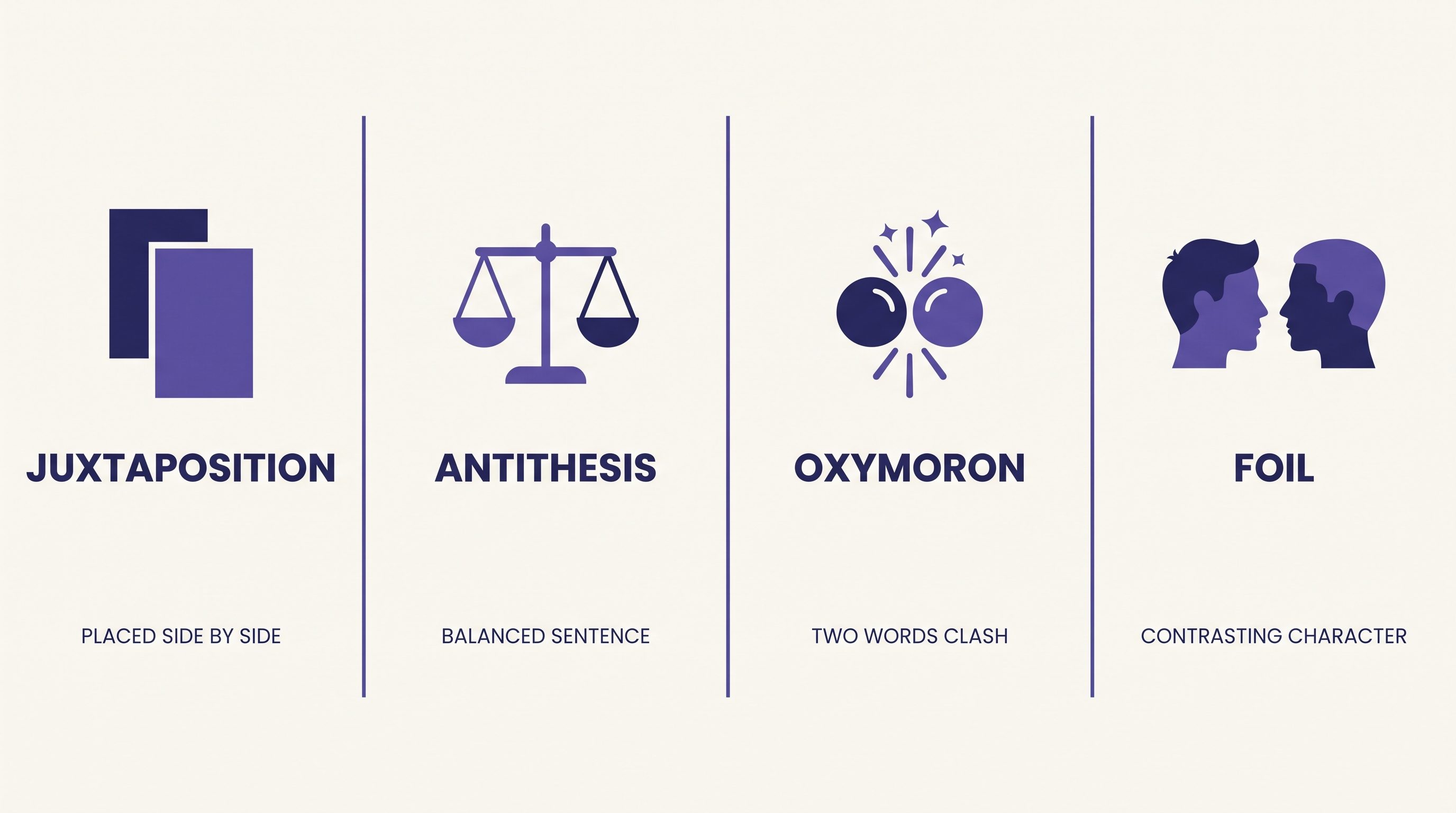
Antithesis is juxtaposition that has hardened into a sentence structure. Dickens' famous opening pairs its opposites inside a balanced grammatical frame — best against worst, wisdom against foolishness, clause matched to clause. Every antithesis is a juxtaposition; most juxtapositions are not antithesis, because they carry no parallel syntax at all.
Oxymoron compresses the contrast into a single phrase, so the two terms do not sit side by side — they fuse. "Deafening silence" is one image made of two impossible halves. Juxtaposition keeps the halves separate and lets the reader travel between them.
Foil is the character-shaped version, and it is a subset rather than a rival term. A foil is a person built so that standing next to another person exposes something about them. Watson is not stupid; he is ordinary, which is what makes Holmes legible. That is juxtaposition applied to characterisation and held in place for a whole book.
Contrast, meanwhile, is the general category — any difference anywhere. Juxtaposition is contrast made deliberate by proximity. The word that matters in the definition is placed.
Five famous juxtaposition examples, taken apart
Analysis that stops at "this shows the contrast between rich and poor" teaches nothing. What is worth looking at is the mechanism: what is adjacent to what, and what the reader is forced to do in the gap.
Dickens — A Tale of Two Cities (1859)
The opening is the textbook case, and it is worth being precise about why. Dickens is not simply contrasting a good era with a bad one; the paired clauses describe the same period, so the reader cannot resolve them into a sequence. The structure forces you to hold both readings at once, which is the argument the whole novel then makes about revolutionary France. Note that this is antithesis specifically — the parallel grammar is doing half the work.
Fitzgerald — The Great Gatsby (1925)
The valley of ashes opens Chapter 2, and Gatsby's party fills Chapter 3. Fitzgerald could have put the wasteland anywhere; he puts it on the road every guest drives along to reach the party, so the two places are not merely contrasted but physically connected. The mechanism is adjacency in the world, not just adjacency on the page — the money and the ash share a route.
Shakespeare — Macbeth, Act 2 Scene 3
Duncan has just been murdered offstage, and the next thing the audience gets is a drunk porter doing an extended joke routine about being the gatekeeper of hell. The tonal collision is so abrupt that some early critics — Coleridge among them — refused to believe Shakespeare wrote the scene. It is not decoration: the comedy makes the horror land harder by denying the audience the solemnity it has braced for.
Coppola — The Godfather (1972)
The baptism sequence cross-cuts between Michael Corleone standing as godfather, renouncing Satan on his nephew's behalf, and his men murdering the heads of the rival families. Neither strand comments on the other. The film simply alternates them and lets the priest's liturgy narrate the killings, which is the clearest demonstration in cinema of how juxtaposition transfers meaning across a cut.
McCarthy — The Road (2006)
The whole book runs on one sustained juxtaposition: extreme tenderness between the father and boy set inside a landscape of ash and cannibalism. McCarthy never softens either side, and never has a character remark on the irony. The restraint is the technique — the contrast stays load-bearing because nothing in the prose acknowledges it.
It was the best of times, it was the worst of times, it was the age of wisdom, it was the age of foolishness.
The most-quoted juxtaposition in English, and the one most often mislabelled. It is antithesis: the contrast is locked into parallel clauses of matching length and shape.
Six levels juxtaposition works on
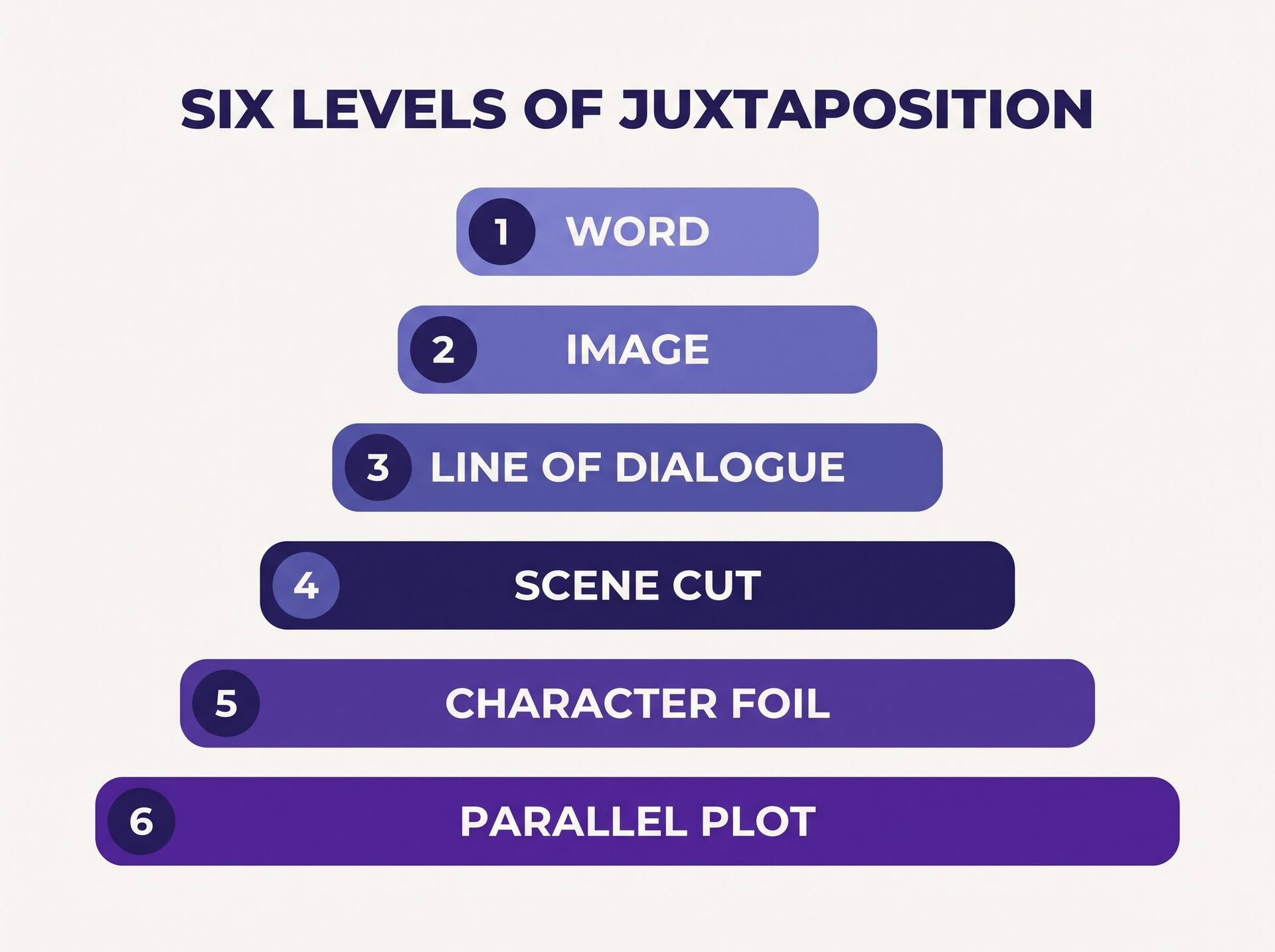
Most writing advice treats this as a sentence-level ornament. It is not — it scales all the way up, and the higher levels do far more work than the lower ones.
- 1WordTwo nouns rubbing against each other inside one phrase. Cheap, instant, and easy to overspend: three per page and the prose starts to feel like it is nudging you.
- 2ImageA description that holds two incompatible pictures in one frame — flowers growing out of a bombed foundation. This is where juxtaposition does its quietest work, because the reader rarely notices being steered.
- 3Line of dialogueOne character's register set against another's in consecutive lines: bureaucratic calm answering panic, a joke answering a confession. Dialogue juxtaposition characterises two people in the space of four lines.
- 4Scene cutThe edit. End a scene on a wedding, open the next on a coffin. Film calls this montage and treats it as a primary technique; prose fiction under-uses it badly.
- 5Character foilTwo people designed to be read against each other for the length of the book. Sustained, structural, and the version readers remember longest.
- 6Parallel plotTwo storylines whose beats rhyme or invert. Steinbeck alternates the Joads' journey with short intercalary chapters about the wider migration in The Grapes of Wrath, and the private story and the national one keep commenting on each other without a word of authorial explanation.
How to build it into a draft on purpose
Juxtaposition rarely arrives by accident in a first draft, because drafting minds work in sequence and this device works in pairs. Three ways to put it there deliberately.
Reorder before you rewrite
Open your chapter list and look only at what each scene ends on and what the next one opens on. Most missed juxtapositions are not missing scenes — they are correctly written scenes in a merely chronological order. Moving a scene two slots costs nothing and can create a cut the reader feels.
Build the foil from the protagonist's blind spot, not their opposite
The instinct is to make the foil the inverse: brave against cowardly, warm against cold. That produces a diagram. The better move is to give the foil the thing the protagonist cannot see about themselves — same values, one different assumption — so the comparison generates argument rather than symmetry.
Write the second element first
If you know a chapter needs to land on devastation, draft the devastating scene, then go back and write the preceding scene to be as ordinary and warm as you can honestly make it. Writing the setup with the payoff already on the page keeps the contrast from being announced in advance.
Three ways it goes wrong
Contrast with nothing behind it
A rich scene followed by a poor scene is not an idea. If the pairing produces only the observation that these two things are different, the reader gets a rhetorical gesture where they expected meaning. Test: write the sentence stating what the juxtaposition argues. If that sentence is obvious or empty, cut the pairing.
Explaining it
The single most common failure. A narrator adds "how strange, he thought, that laughter could sound so much like weeping" and the device dies on the spot — the reader has been handed the conclusion they were about to reach. Trust the gap. If you genuinely doubt readers will make the connection, sharpen the adjacency instead of adding the gloss.
Running it on a metronome
Alternating light and dark chapter after chapter turns a technique into a pattern, and a pattern the reader can predict stops producing meaning. Vary the interval. Let three quiet chapters run together so the fourth cut can bite.
When to leave it alone
There are places the device actively hurts. It undercuts sustained emotional scenes — grief written over ten pages needs continuity, and a wry cut halfway through reads as flinching. It is wrong in most procedural or instructional non-fiction, where the reader wants a straight line rather than an implied argument. And it fights comedy that is already built on contrast: an absurd premise juxtaposed with something else absurd flattens into noise.
The honest question is whether you want the reader doing interpretive work at this point in the book. Juxtaposition always hands them a job. Sometimes the right thing is to let them read.
A pass to run over your draft
- List what every scene ends on and what the next one opens on — the whole book on one page.
- Mark every adjacency that already produces meaning. Protect those.
- Find the three flattest transitions and ask what reordering or a different closing image would buy.
- Search the manuscript for narration that explains a contrast, and delete the explanation.
- Check your foil: same values with one different assumption, or just a mirror image?
- Count the tonal cuts per fifty pages. If the interval is regular, break it.
Doing this without rereading the whole book
The reordering pass above is the useful one and the one nobody does, because it needs a view of the entire book at once and a draft in a word processor does not give you that.
If you are building the book on AIWriteBook, the outline builder is where this pass belongs: you see and approve every chapter's plan as a list before any prose exists, so moving a scene to create a cut is a drag rather than a rewrite. Pair that with the chapter AI chat, which proposes edits as a diff you accept or reject line by line — the right shape for surgical work like stripping out a narrator's explanation without disturbing the paragraph around it.
For a single scene rather than a whole structure, our free scene builder will draft a scene from a premise, which is a fast way to try the same beat in two registers and see which one makes a sharper contrast with the scene before it. And if you are constructing a foil, the character creator is a quick way to generate a profile you can deliberately bend against your protagonist's blind spot.
On the reading side, symbolism in writing covers the device juxtaposition most often works alongside, and show, don't tell is the same underlying discipline applied at sentence level — both are about refusing to state the thing you have already demonstrated.
Common questions
The short version
Juxtaposition is proximity plus silence. Put the two elements close enough that the reader meets them together, then say nothing about the relationship. Everything that goes wrong with the device goes wrong on one of those two conditions — either the contrast is too far apart to register, or the writer could not resist pointing at it.
Because most of the good versions live at the level of scene order and character design, this is a planning decision more than a line-editing one. Our guide to writing a book covers where structure work like this fits between premise, outline and first draft.