

How the policy got here
The rules did not arrive all at once. Two changes landed within weeks of each other in late 2023, and Amazon has been quietly refining the wording since.
The disclosure requirement arrives
Amazon updates the KDP content guidelines: when you publish a new book, or edit and republish an existing one, you must tell Amazon whether it contains AI-generated text, images, or translations. The same update introduces Amazon's definitions of AI-generated and AI-assisted content, which still drive the policy today.
Publishing volume limits
Facing a wave of low-effort AI titles, Amazon caps new title creation at three per day per account. Amazon has said the limit can change and that publishers with a legitimate need can request an exception.
Quiet refinements, same core rules
The guidelines page and the form wording have been tweaked, but the substance has not moved: disclose AI-generated content, and meet the same quality bar as every other book. Amazon updates the page without announcements, so it is worth rereading before each launch.
AI-generated vs AI-assisted: the distinction everything hangs on
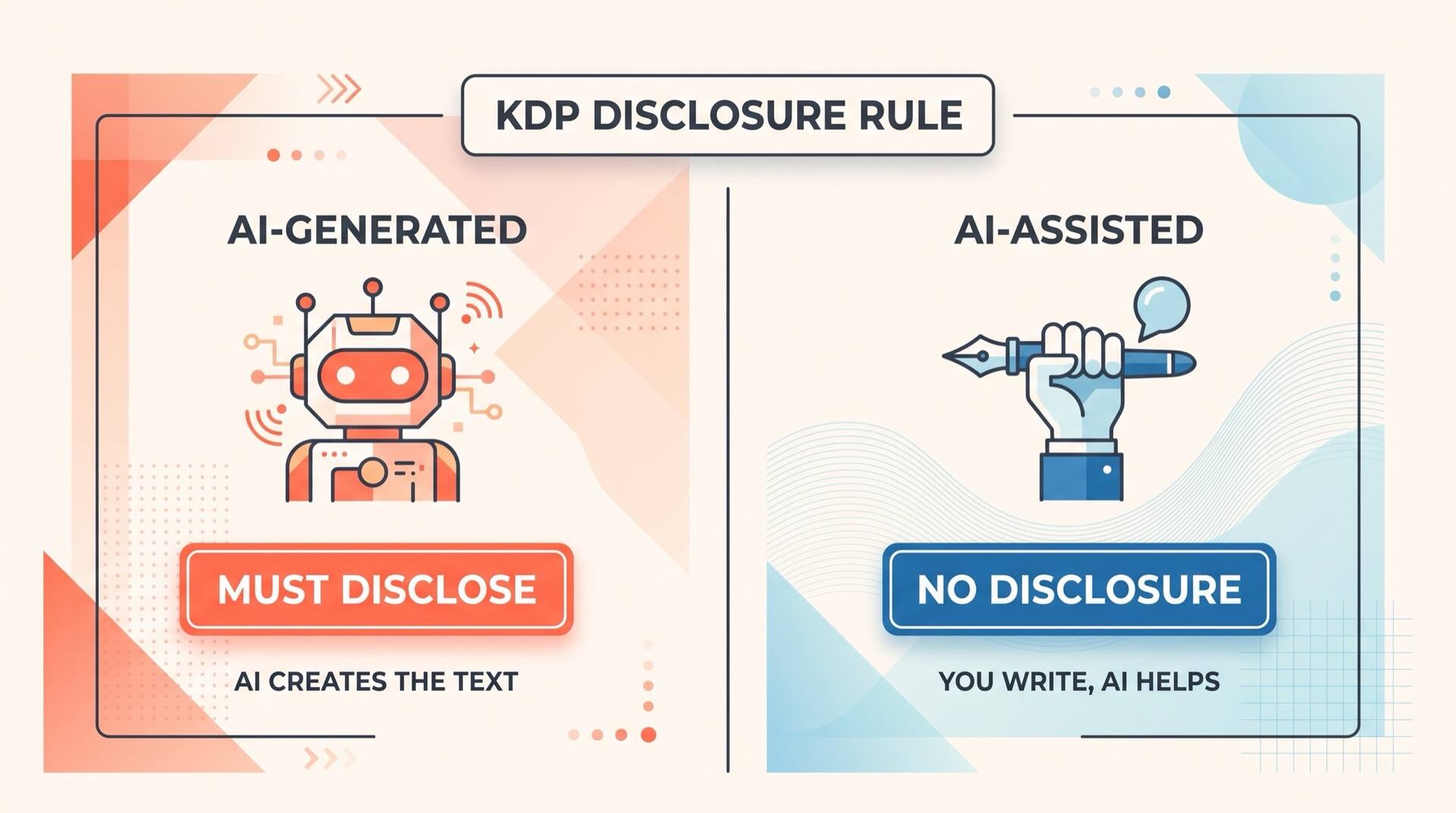
Amazon's entire policy rests on one question: did the AI create the content, or did it help you improve content you created yourself? How much you edited afterward does not change the answer. Origin does.
| AI-generated | AI-assisted | |
|---|---|---|
| What it means | Text, images, or translations actually created by an AI tool — even when you wrote detailed prompts to get them. | Content you created yourself, with AI used to edit, refine, error-check, or improve it — or to brainstorm and outline ideas. |
| Does editing change it? | No. In Amazon's definition, substantial edits to AI-created content still leave it AI-generated. | Also no. Polishing your own writing with AI never turns it into AI-generated content. |
| Do you disclose? | Yes — for each affected type: text, images, translations. | No. Amazon states plainly that AI-assisted content does not need to be disclosed. |
Four scenarios, called correctly
AI drafted the chapters, you rewrote them heavily
The draft came from the AI, so it stays AI-generated no matter how hard you edited. The form even has an option for exactly this: entire work, with extensive editing.
You wrote the manuscript, AI polished the grammar
You created the content; the tool refined it. No disclosure needed — this is the case Amazon carved out explicitly.
AI brainstormed the outline, you wrote every sentence
Ideas, outlines, and research prompts are assistance, not creation. The prose is yours, so nothing to disclose.
You wrote the book, an AI tool made the cover
Covers count. You would answer no for text and yes for images. Many authors with fully human manuscripts still have a disclosure to make here.
One thing AI detectors cannot do is decide your disclosure for you: the obligation follows how the content was made, not how it scores. If you are curious how your manuscript reads to detection tools anyway, run it through our free AI content detector — just never use a low score as a reason to skip an honest answer.
The disclosure form, step by step
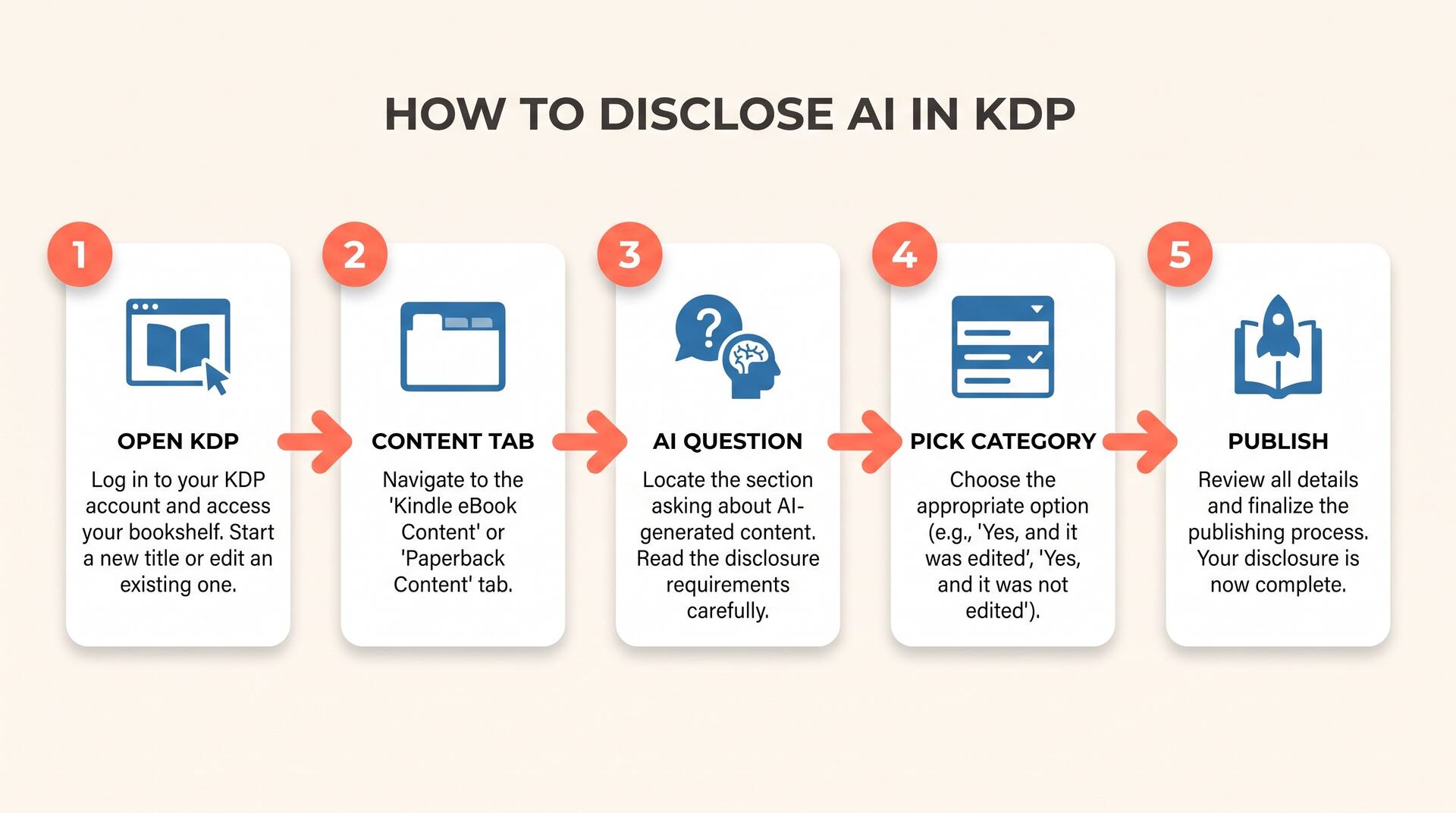
The questions live inside the normal publishing flow — there is no separate application, review queue, or fee. Here is exactly where they appear and what each screen asks.
Open your book's details page
Create a new title from your KDP Bookshelf, or click edit on an existing one. The AI questions sit on the first details page, in the same section where you confirm you hold the publishing rights.
Answer the yes/no question
KDP asks whether you used AI tools in creating texts, images, or translations in your book. Answer no and you are done. Answer yes and three short follow-ups open.
Describe the text
You select how much of the text is AI-generated — some sections or the entire work — and whether you made minimal or extensive edits afterward. Note that even the extensive-editing options are still disclosures of AI-generated text.
Describe images and translations
The same choices repeat for images and for translations. An AI-generated cover belongs under images even when every word of the manuscript is yours; an AI translation of your own human-written book belongs under translations.
Save and continue publishing
That is the whole process. Nothing extra to upload, and no AI label appears on your product page — the disclosure is between you and Amazon.
What gets blocked — and what disclosure doesn't do
The most persistent myth in author forums is that ticking the AI box triggers rejection. Disclosure and content review are separate tracks: the first is information you give Amazon, the second applies to every book on the store.
Disclosure does not
- Put a label on your product page — Amazon does not display the disclosure to readers
- Reject or block your book by itself
- Change your royalty options, pricing, or KDP Select eligibility
- Trigger any announced ranking penalty — Amazon has said nothing publicly about visibility effects, in either direction
What actually gets books blocked
- Violating content guidelines — misleading, deceptive, or garbled content, whether AI wrote it or you did
- Infringing intellectual property — AI text or covers that reproduce protected characters, brands, or artwork
- A poor customer experience — repetition, nonsense passages, and typo floods draw complaints and takedowns
- Exceeding the volume limit — more than three new titles per day per account
- Misrepresenting your answers — an undisclosed AI book that Amazon determines is AI-generated puts your whole account at risk
Disclosure covers your relationship with Amazon; copyright is its own topic with its own rules. We have covered whether you can sell AI-generated books on Amazon — including the ownership question — separately.
Best practices before you hit publish
Answer honestly — it's a checkbox, not a confession
The real account risk on KDP is misrepresentation, not AI use. Amazon accepts disclosed AI-generated books; it terminates accounts that lie about them.
Read every AI-drafted chapter yourself
Quality complaints, not disclosure, are what remove books. If a chapter would embarrass you in a review quote, it is not ready.
Audit your cover and back matter too
The images question catches authors who only thought about text. AI cover art, AI illustrations, and AI translations each need their own answer.
Keep your process records
If a book is ever flagged for review, being able to show your outline, drafts, and revision history makes the conversation short.
Publish for a catalog, not for volume
The three-titles-a-day cap exists because spray-and-pray publishing broke the store. Slower, better books outlast every volume tactic the limit was built to stop.
Where AIWriteBook stands
Plainly: books drafted with AIWriteBook are AI-generated under Amazon's definition, even after you rework them in the editor — so answer yes on the text question, and on images if you generated the cover here too. That is one honest checkbox, not a penalty. What Amazon actually polices is quality, which is why the work happens before the upload: the chapter AI chat lets you accept or reject every suggested change line by line, and the export produces KDP-ready EPUB, PDF, and DOCX files when the manuscript is genuinely done.
Frequently asked questions
No. Under the current policy the disclosure is information you give Amazon during publishing — it is not displayed on the product page or anywhere readers can see. Amazon could change that in the future, but it has announced no plan to.
Yes. The disclosure covers text, images, and translations separately, and cover art falls under images. A fully human-written book with an AI cover still discloses the images portion.
No. Amazon's definition follows the origin of the content, not the editing effort. An AI-created draft remains AI-generated even after substantial rewrites — the form simply lets you note that you edited extensively.
Amazon has published nothing saying disclosure affects visibility, rankings, or store eligibility, and there is no verified evidence that it does. Claims about automatic shadow bans are speculation. The documented risk runs the other way: failing to disclose content Amazon determines is AI-generated violates the guidelines.
The requirement applies when you publish a new book or edit and republish an existing one. A back-catalog title you have not touched does not need retroactive disclosure, but the moment you push an update, you answer the current questions.
The honest bottom line
KDP's AI disclosure policy asks for one honest answer and imposes no announced penalty for giving it. The books that get removed are the ones that read like nobody checked them, copy someone else's work, or lie on the form — problems disclosure neither causes nor cures.
If the policy left you wondering whether the platform still rewards the effort, that is really a question about your genre and your catalog — we have run the honest math on whether KDP is worth it separately.
The full Amazon KDP guide covers the rest of the journey, from keyword research to launch.