


Why research beats volume
An agent is not a gatekeeper you have to sneak past. They are a small business owner choosing which manuscripts they can personally sell to editors they personally know. That is the whole mechanism, and it explains everything else: an agent who has never sold a cozy mystery has no editor to call about yours, so your cozy mystery is a no from them regardless of how good it is.
Which means the research is not admin work you do before the real work. It is the work. A writer with forty well-chosen agents will beat a writer with two hundred random ones, every time, and will burn far less of their own morale doing it.
It also protects you from the quiet trap: agents are not interchangeable, and a fast yes from the wrong one can cost you years. An agent who cannot sell your book still holds the rights to try.
Where to actually look
There is no single master list, and any site that claims to sell you one is selling you a scraped directory. Real research means triangulating a handful of sources that each show you something different.
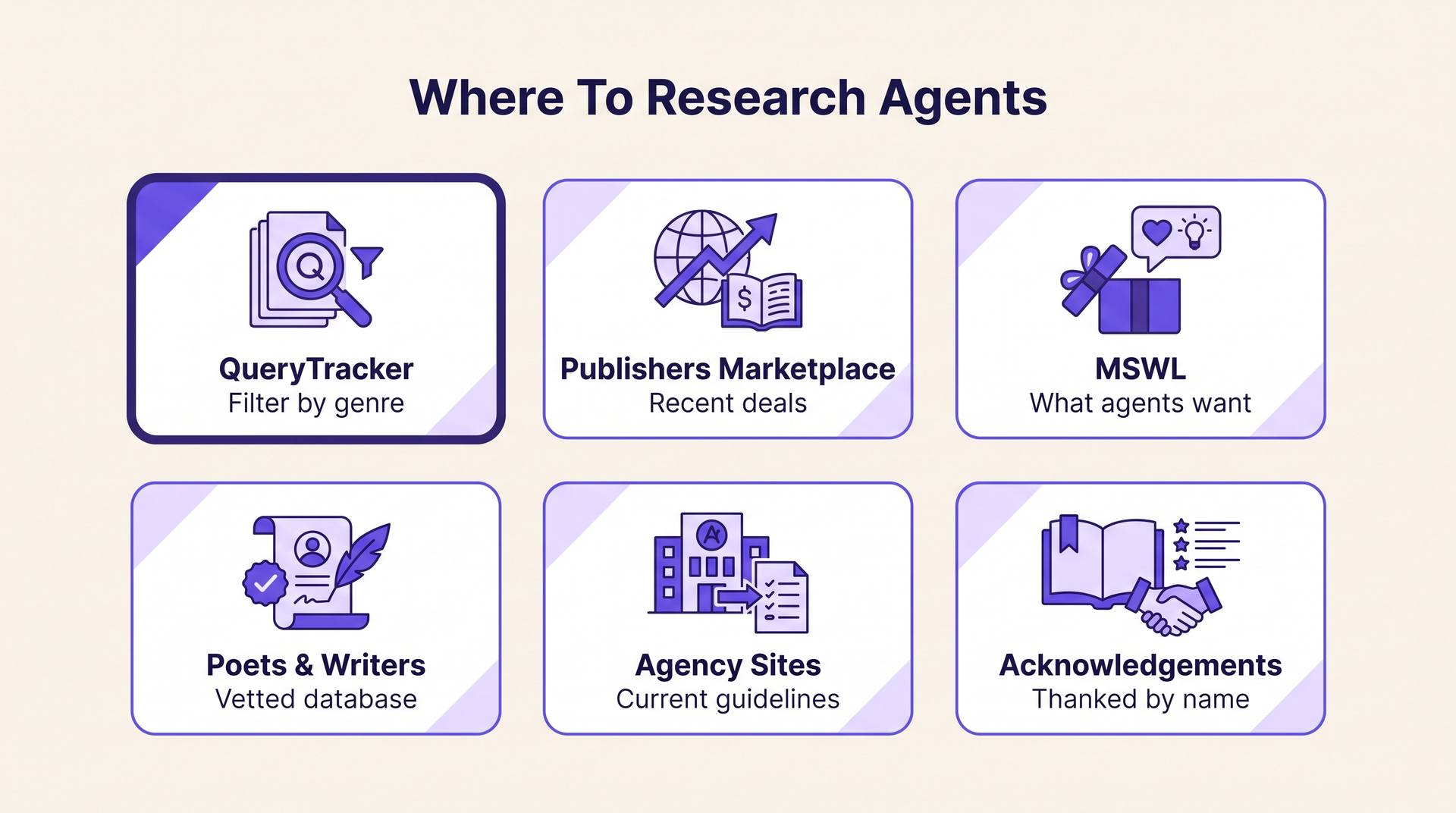
- QueryTracker
- The workhorse. Filter by genre, see which agents are open, and — the part most writers miss — read the aggregate response data other users have logged. It tells you whether an agent actually replies or just runs a no-response policy.
- Publishers Marketplace
- Paid, and the only place where you can search deals rather than profiles. Look up books that sit next to yours on a shelf and see which agent sold them, to which imprint, and when. A deal from last year matters far more than a bio written five years ago.
- Manuscript Wish List
- Agents describe, in their own words, what they are hungry for right now. The website and the #MSWL hashtag are the closest thing publishing has to a live demand signal.
- Poets & Writers
- A free, human-maintained agent database with a screening standard. Useful as a sanity check when a name you found elsewhere seems too good to be true.
- Agency websites
- Always the final authority. Guidelines change, agents move agencies, and lists close. Whatever a database told you, the agency page is what you follow.
- Acknowledgements pages
- The oldest trick and still the best one. Open five recent books you would want yours shelved beside and read who the author thanks first. That is a working agent in your exact corner of the market.
Publishers Weekly deal reports do the same job as Publishers Marketplace at a lower resolution, and are worth skimming weekly if you would rather not pay. If you are still deciding which books your novel genuinely sits beside, our free competition analyzer will pull comparable titles and their positioning for you, which doubles as your acknowledgements-page hunting list.
Build a tiered list before you send anything
Querying is a batch process, not a broadcast. The list is the asset, and it should be sorted by fit rather than fame. A spreadsheet with these columns will carry you through the whole campaign, and the synopsis guide covers the one document most of these agents will ask for next.
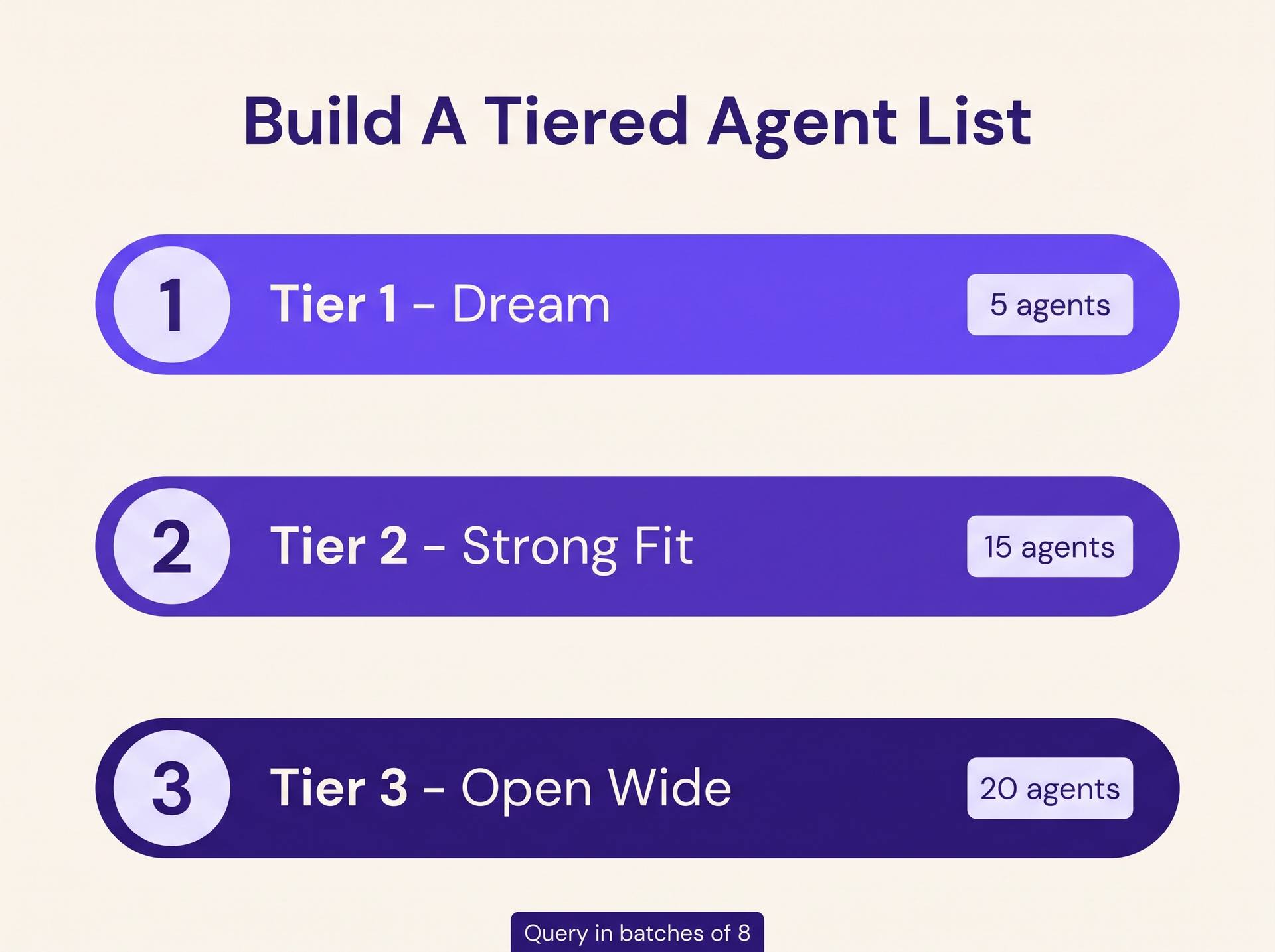
Tier 1 — the dream agents
Five or so. Big sales in your genre, long client lists, notoriously selective. Do not query them first. Their rejection is expensive because it teaches you nothing while your materials are still untested.
Tier 2 — strong fit, active, mid-career
Fifteen to twenty. They have recent deals in your genre, a manageable client list, and enough hunger to read a debut carefully. Statistically this is where your offer comes from.
Tier 3 — newer agents at established agencies
Fifteen to twenty. Building a list, actively looking, often faster to respond. The agency's senior staff supervises them, so the sale still has the same machinery behind it.
Query in batches of eight to ten, drawn from Tier 2 and Tier 3. If the first batch returns nothing but form rejections, the problem is the query or the opening pages, not the list — fix the materials before spending Tier 1 on them.
| Column | Why it earns a column |
|---|---|
| Recent deal, with the year | Proof they are actively selling your genre right now, not five years ago. |
| Submission portal or email | Half of agents use QueryManager forms, half take email. You need to know before you sit down to send. |
| Exact materials requested | First ten pages, first three chapters, synopsis, or none of the above — this differs per agent and ignoring it is an instant pass. |
| Personalisation hook | One specific, true sentence about why this agent. Written during research, not invented at 1 a.m. |
| Date sent and response | Without it you will double-query someone or miss a nudge window. |
Reading an agent's page properly
Agent bios are written to attract the right submissions and repel the wrong ones, and most writers read only the genre list. Read the rest. "I am looking for voice-driven suspense with a domestic core" is a specification. If your book is a plot-forward international thriller, that agent has told you no in advance and you should believe them.
Two details are worth more than the whole bio. First, the client list — open it and check whether the books look like yours in scale and shelf position. Second, the word "closed". Query lists close constantly, and querying a closed list marks you as someone who did not read the page.
One more filter that saves months: check whether the agency is a member of the Association of American Literary Agents or an equivalent national body, and whether the agent has verifiable sales attached to their name. Not every good agent is a member, but membership means someone else has already checked the basics for you.
Submitting through QueryManager
QueryManager is now the default submission route for a large share of agents, and it changes the mechanics of querying in ways worth understanding before your first send.
Every form is different
One agent asks for a query and the first five pages. The next wants a synopsis, comp titles, and your publishing history in separate boxes. Read the whole form before you start typing, because there is no draft-saving safety net.
Paste as plain text
The boxes strip formatting. Curly quotes, italics, and em dashes can come through as garbage, so paste your pages into a plain-text editor first and read them back before submitting.
The tracking link is the receipt
Each submission gives you a status URL. Save it in your spreadsheet — it is the only way to see whether the agent has marked your query read, and it is how you check status without emailing to ask.
One submission per agent, not per agency
Most agencies treat a rejection from one agent as a rejection from the house. The form usually says so. Query the best-fit agent there and nobody else.
Several fields recur on almost every form: a one-paragraph pitch, comparable titles, and a short third-person author biography. Write those once, keep them in a file, and reuse them. Our free author bio generator gets the biography to a professional two-sentence version quickly, and the query letter guide covers the pitch paragraph in full.
Vetting: fees and other red flags
Legitimate agents make money one way — a commission, typically fifteen per cent of domestic sales, paid only after the book sells. Anything that reverses that flow is the whole warning.
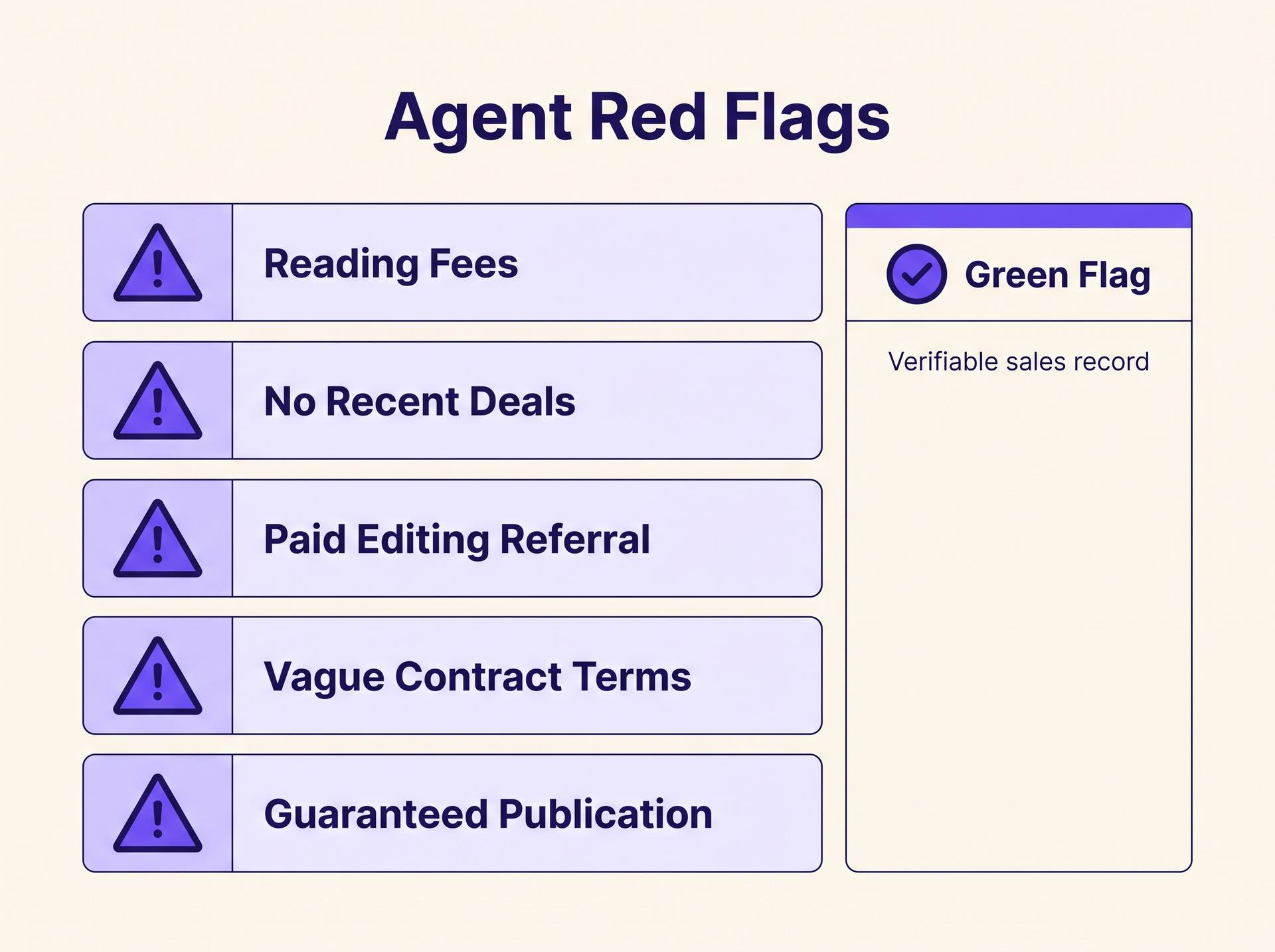
Reading fees or submission fees
Charging to read a manuscript is the oldest scam in publishing and remains the clearest disqualifier. There is no legitimate version of it.
No verifiable recent deals
If you cannot find a single sale to a real publisher in the last two or three years, you are looking at someone who cannot sell your book either. "Deals confidential" is not an answer.
A referral to a paid editor
An agent who loves your book but requires you to pay a specific editing service first is usually earning from that referral. Real editorial agents do their notes themselves, free.
Vague or absent contract terms
Ask for the agency agreement before you sign. Look for commission percentage, what happens to unsold rights, and how either side terminates. A refusal to show it is your answer.
A guarantee of publication
No agent can guarantee a sale. An offer that promises one, or that steers you toward the agency's own affiliated press, is not representation.
Cross-check any name that survives against Writer Beware and the Absolute Write forums before you send pages. Ten minutes there has saved a great many writers a very bad year.
Response times and what silence means
The single most common reason writers give up is that they misread normal timelines as failure. Calibrate before you start.
| Stage | Typical window | What to do |
|---|---|---|
| Query | Four to twelve weeks | Nothing. Keep writing the next book. |
| Partial or full request | Two to six months | One polite nudge after the agent's stated window has passed. |
| No response at all | Many agents state a no-reply policy | Treat their stated window as a rejection and move on. |
| Offer of representation | You set the clock | Tell every agent holding your material that you have an offer and give them one to two weeks. |
A full request is not a near-miss and a form rejection is not a verdict on the book. The useful signal is the ratio: if fifty queries produce no requests, the query is the problem; if requests come but fulls come back with warm passes, the manuscript is close and the middle probably sags.
Mistakes that cost writers a year
Querying before the manuscript is finished
For fiction, the book must be complete, revised, and ready to send the day an agent asks. Requesting a full and being told it will be ready in three months ends the conversation.
Sending everything at once
A hundred simultaneous queries means a hundred rejections of the same flawed pitch, and no second chance with those agents. Batches let you learn.
Personalising with flattery
"I love the books you represent" tells an agent nothing. "You represented a novel with a similar structure" tells them you did the work and understand your own shelf.
Mis-stating the genre or word count
A 190,000-word debut fantasy or a novel described as "fiction for everyone" gets passed on the first line. Know your category's real range before you send.
Treating rejection as data about the book
Most rejections are about the agent's list, their current capacity, and what they already sold last season. Very few are about your prose.
The AI-assisted shortcut
Nothing about querying should be automated end to end — an agent recognises a mass-generated letter instantly, and a submission built on invented comp titles fails at the first click. But the slow, repetitive parts of the process genuinely respond to help.
The pieces worth speeding up are the ones you rewrite for every agent: the synopsis, the comparable titles, the third-person bio, and the pitch paragraph you tune per submission. Getting a solid draft of those in an afternoon rather than a fortnight is the difference between a real submission campaign and an abandoned one.
There is also a harder version of the shortcut. The reason many writers never reach the querying stage is that the manuscript is not finished. AIWriteBook is built for exactly that gap — outline to full draft with your own characters and voice, chapter-level editing with accept-or-reject changes, and export to clean manuscript files. If you already have a partial draft, import it and keep writing in the voice that is already there.
When self-publishing is the better path
Agent representation is not a promotion. It is a specific business arrangement that pays off in specific situations: you want bookshop distribution, a print run, foreign rights sold on your behalf, and an advance paid before publication. If that describes your goal, query, and be patient about it.
It is the wrong arrangement in several common cases. Genre series that publish three or four books a year — romance, cozy mystery, litRPG, much of thriller — move faster than a traditional schedule allows, and the readers who buy them live on retailer platforms rather than in bookshops. Niche non-fiction with a small, reachable audience rarely reaches an advance an agent can justify spending a year on. And a first book written to test whether you enjoy writing books is better published than shelved.
The honest comparison of self-publishing and traditional publishing is worth reading before you spend a year on submissions, and if you land on the other side of it, the practical steps from finished manuscript to a live Amazon listing are laid out in full. Either way, the same manuscript serves both paths — so finish it first and decide second.
Common questions
Plan for forty to sixty well-researched agents, sent in batches of eight to ten. Fewer than about thirty rarely gives the process a fair test, and more than sixty usually means the fit filter was too loose.
For fiction and memoir, yes — complete and revised. For most other non-fiction you query with a proposal and one or two sample chapters instead, because the book is sold on the idea and your platform.
Yes. Submitting through an agent's QueryManager form costs nothing. Any submission that asks you for money is a red flag regardless of the platform it arrives on.
Usually no. Most agencies state that a pass from one agent is a pass from the whole house. Pick the single best fit and read the agency's stated policy before assuming otherwise.
Not by itself. Agents care about sales figures for that specific title. Strong numbers help you, modest numbers are usually neutral, and either way a new, unpublished manuscript can be queried normally.
Do the research once, properly
The querying writers who succeed are rarely the ones who sent the most letters. They are the ones who spent a weekend building a real list, read every agent page as a specification rather than an advertisement, submitted in batches, and kept writing while the responses came in.
None of that works without a finished, revised manuscript behind it. If yours is not there yet, that is the thing to fix first — the rest of the how to write a book guide covers getting the draft done, and the agents will still be there when it is.