


Where the word comes from
The term was coined by Angus MacPhail, a British screenwriter and a friend of Alfred Hitchcock's, and Hitchcock is the one who made it stick. He told the story often enough that it hardened into a set piece — most famously to Francois Truffaut, in the long series of interviews they recorded in 1962.
Two men are sharing a compartment on a train to Scotland. One points at a package on the luggage rack and asks what it is.
It's a MacGuffin. It's an apparatus for trapping lions in the Scottish Highlands. But there are no lions in the Scottish Highlands. Well then, that's no MacGuffin.
The joke is the definition. The MacGuffin has no content. It exists only so two men have something to talk about on a train — and so your characters have somewhere to be by chapter four.
Hitchcock was blunt about how little it mattered. In The 39 Steps it is a set of stolen plans for an aircraft engine. In Notorious it is uranium ore hidden in wine bottles, which the studio thought was absurd and which turned out, a year later, to be the most topical substance on earth. In North by Northwest it is government secrets so vague that Hitchcock described the MacGuffin there as having been boiled down to nothing at all — and considered that his best version of it.
The definition, precisely
Definition
A MacGuffin is an object, goal, or piece of information whose specific nature is irrelevant to the story, and whose only job is to motivate the characters and set the plot in motion.
Two halves, both load-bearing. It must drive the characters hard. It must not matter what it actually is. Drop either half and you no longer have a MacGuffin — you have a plot device with a different name.
The swap test
There is one reliable test, and it takes about ten seconds. Replace the object with something completely different — a stolen ledger, a vial, a name written on a napkin — and reread your outline. If nothing else in the book has to change, you have a true MacGuffin. If the ending stops working, you have a plot-critical object that has been wearing a MacGuffin's coat.
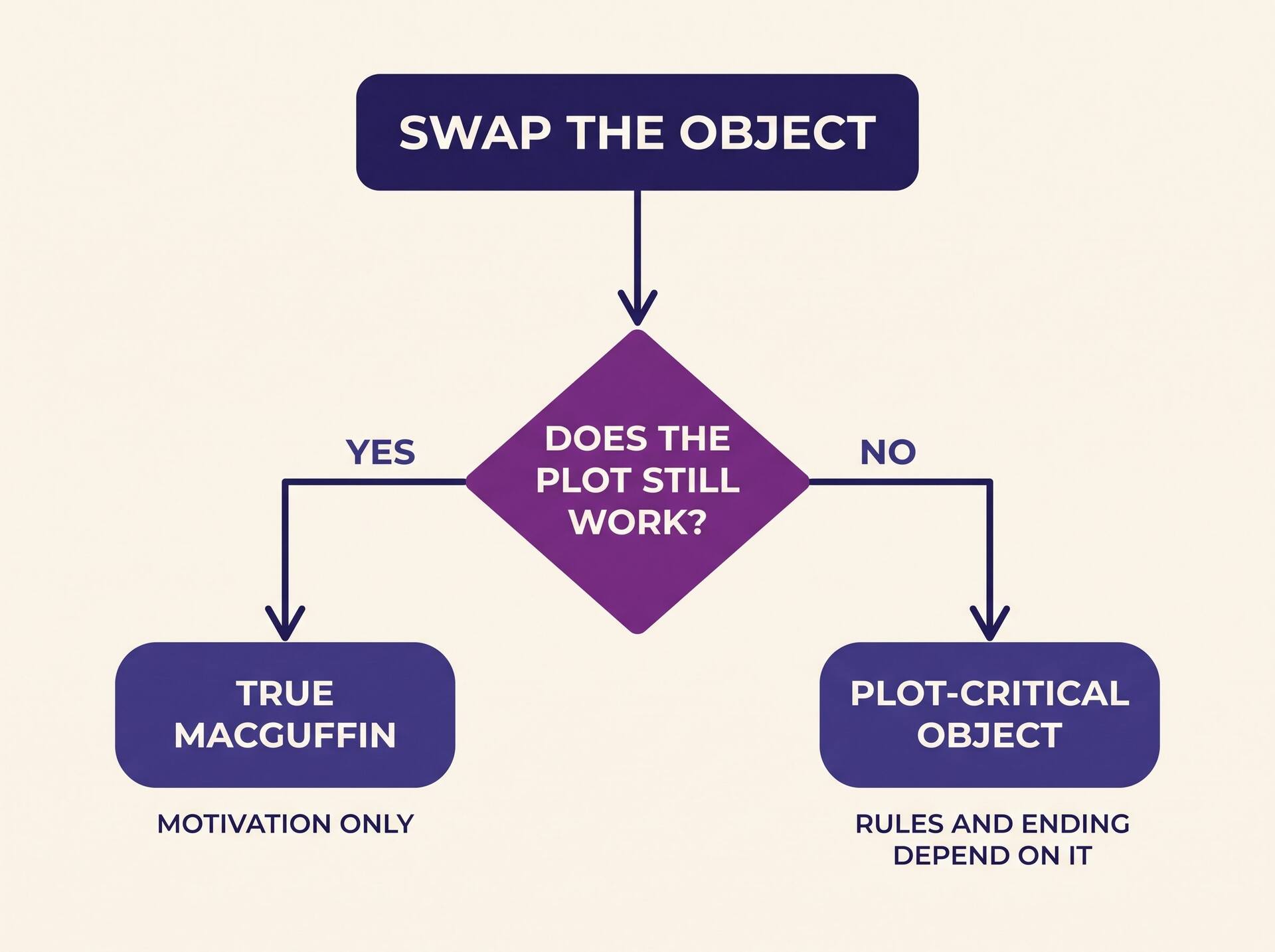
This matters more than it sounds. A true MacGuffin buys you enormous freedom: you never have to explain it, you never have to make it consistent, and you can raise its value arbitrarily whenever the middle sags. A plot-critical object costs you the opposite — every rule you attach to it becomes a promise you have to keep for four hundred pages.
Most first drafts get into trouble by treating one as the other. Writers explain their MacGuffins at length because they feel guilty about the emptiness, and they under-specify their plot-critical objects because explaining feels like exposition. Both instincts are backwards.
The spectrum, from briefcase to ring
MacGuffin is not a binary category. It is one end of a scale, and knowing where your object sits tells you how much page time it has earned.
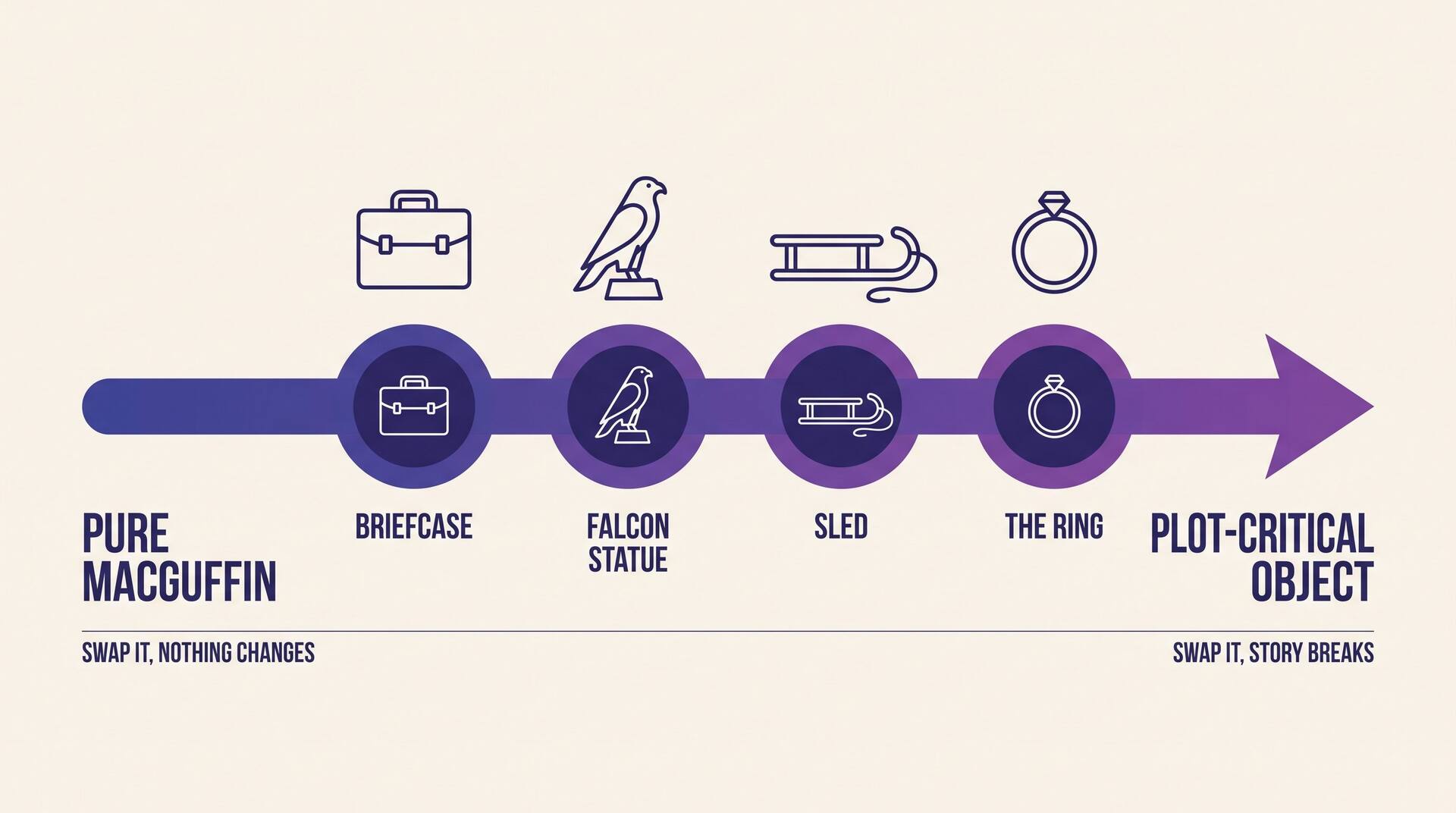
The briefcase in Pulp Fiction (1994)
The purest example in modern film. It glows, everyone who opens it is transfixed, and Tarantino never says what is inside. Whole essays exist about the combination on the locks. None of them affect a single scene, which is exactly the point — the contents are unstated because there are no contents.
The Rabbit's Foot in Mission: Impossible III (2006)
Named, never explained. A character speculates that it might be a biological weapon and is told to stop asking. J.J. Abrams has been openly cheerful about it being a MacGuffin. Nothing about the film's chase logic depends on what it does.
The Maltese Falcon (Hammett, 1930)
A jewelled statuette that four people will lie, betray and kill for. It is a MacGuffin with a twist: at the end, the bird proves to be a lead fake. That reveal is not about the falcon — it is about what the chase revealed in each of them, which is why the 1941 film adaptation could close on Bogart calling it the stuff that dreams are made of.
Rosebud in Citizen Kane (1941)
Halfway along the scale. For the reporter it functions as a pure MacGuffin — a word that gives him somewhere to go. For the audience it turns out to be thematically loaded: the sled is the childhood the man traded away. Swap it for a different word and the investigation still works, but the last shot stops meaning anything.
The Ark of the Covenant in Raiders of the Lost Ark (1981)
A MacGuffin for most of its runtime and then abruptly not one. For two hours it is simply the thing both sides want. In the final ten minutes its actual properties decide who lives, which retroactively pulls it toward the plot-critical end. This is common and it is fine — objects are allowed to migrate along the scale, as long as you know when yours does.
Notice that the further right you travel, the more the object owes the reader. A briefcase owes nothing. A sled owes one emotionally exact reveal. An Ark owes rules that were established, however lightly, before it starts making decisions.
Why the One Ring is not a MacGuffin
This is the most common misuse of the term, and it is worth settling properly, because the reasoning generalises to your own book.
The argument for calling it one is superficial: it is a small object, everyone wants it, and the plot is a journey to get rid of it. But run the swap test. Replace the Ring with a stolen ledger of equal value, and almost nothing in The Lord of the Rings survives.
- Its specific properties generate scenes. It turns the wearer invisible, which is how Bilbo escapes Gollum and how Frodo slips away from Boromir at Amon Hen — and putting it on at Weathertop is precisely what draws the Ringwraiths to him. A ledger does none of that.
- It corrupts its bearer, which is the engine of the character work. Boromir's fall, Gollum's entire existence, Frodo's failure at the Cracks of Doom — none of these have a mechanism without the Ring's specific nature.
- Its origin dictates the destination. It can only be unmade where it was forged, which is why the plot is a walk to Mordor rather than any other plan. Change the object and you change the map.
- It fails at the climax in a way only it could. Frodo cannot give it up. The book's argument about power depends entirely on what the object is, not on the fact that people want it.
So the Ring is the far right of the spectrum: a plot-critical object with thematic freight. Tolkien is also on record resisting readings that flattened his book into a code — he distinguished allegory from what he called the applicability a reader brings, which is a related argument about the same instinct to treat objects as stand-ins. Our piece on allegory examples works through that distinction if you want the longer version.
Practical takeaway: if you find yourself writing rules for your MacGuffin, you no longer have one. That is not a failure — it is a decision, and it should be a conscious one, because it changes what you owe the reader in act three.
Choosing one for your own book
The MacGuffin is one of the few structural choices you can make in an afternoon. Four questions, in this order.
1. What would these specific people cross a line for?
The MacGuffin is empty, so all of its power is borrowed from who wants it. A grieving father, a broke fixer, and a state agency will not chase the same object for the same reasons — and the reader is reading the reasons, not the object. Write the wanting first, then name the thing.
2. Can it change hands at least three times?
This is the real structural job. A MacGuffin that sits in one place is a destination; a MacGuffin that keeps moving is a plot. Sketch the possession chain before you draft — who has it at the end of each act, and who loses it, and what that costs them.
3. Is its value obvious in one sentence?
You need the reader to accept the stakes instantly and then stop thinking about them. Everyone in this room will be executed if that file is published works. A twelve-page briefing on the file's provenance does not.
4. Does it still matter on the last page?
The most common structural failure is a MacGuffin that quietly stops mattering around the midpoint because the real conflict has become interpersonal. Sometimes that is the correct book — but then you should retire the object deliberately, on the page, rather than letting it evaporate.
If you are stress-testing possession chains, our free plot twist generator is a fast way to shake loose the reversal where the object changes hands for the wrong reason, and the scene builder will turn a single handover into a scene with its own turn. Both run in the browser without an account.
When you are ready to commit the chain to a structure, the plot generator inside AIWriteBook lays out the beats chapter by chapter and lets you approve or rewrite each one before any prose is generated — which is the cheapest possible moment to notice that your object disappears for eleven chapters in the middle.
Four ways writers break it
Over-explaining it
The single most common error. A page of technical detail about the device does not raise the stakes; it converts a live want into a homework assignment, and it invites the reader to find the hole. Hitchcock's rule holds: the characters care enormously, the audience does not care at all, and that asymmetry is the whole effect.
Making the reader care about the wrong thing
If the emotional weight of your book ends up sitting on the object rather than on the people, you have accidentally promised a payoff you cannot deliver. Tarantino can leave the briefcase closed because nobody was ever asked to love it. If you spend a chapter on your artefact's tragic history, the reader will expect it to be redeemed, and a shrug in act three reads as a cheat.
Letting it stop mattering halfway
Watch for the midpoint where the chase becomes a relationship and the object becomes luggage. The fix is not to force it back in — it is to make the abandonment a choice a character makes out loud, so the reader experiences a shift of priorities rather than authorial forgetfulness.
Attaching rules and then breaking them
Every property you name is a contract. If the file cannot be copied, it cannot be copied in chapter twenty-eight because you need a duplicate. The safest MacGuffins carry exactly one rule, stated once, and never negotiated.
When not to use one
The MacGuffin is a solution to a specific problem: characters who need a reason to move against each other. If that is not your problem, it will actively hurt the book.
- 1Character-driven literary fiction where the pressure is internal. Bolting on an object to be chased flattens the interiority you are actually writing.
- 2Any story where the object's nature carries your theme. Then commit — build the rules, seed them early, and accept the maintenance cost. Half a MacGuffin is worse than either whole.
- 3Mysteries where the reader is invited to solve something. A mystery's central object usually has to be knowable and fair. An unexplained briefcase in a whodunit reads as a withheld card.
- 4Non-fiction and memoir, obviously — but also non-fiction that borrows narrative shape. A framing device that pretends to be an unanswered question and then never answers it will lose the reader's trust faster in non-fiction than anywhere else.
Chekhov's gun, red herring, and the rest
The MacGuffin lives in a small family of object-driven devices, and they are constantly confused with one another. The differences are functional, not decorative.
| Device | Its job | What it owes the reader |
|---|---|---|
| MacGuffin | Motivates the characters; content irrelevant | Nothing. It can end unopened. |
| Chekhov's gun | A planted detail that must be used later | A payoff. Planting without firing is the failure. |
| Red herring | Deliberately misdirects the reader's suspicion | A fair explanation once the misdirection collapses. |
| Deus ex machina | Resolves the plot from outside the established rules | Nothing good. It is a defect, not a technique. |
The sharpest contrast is with the planted detail: a MacGuffin points forward and never resolves, while Chekhov's gun exists purely to resolve. Put the two side by side in your outline and you will usually find you have mislabelled one of them.
The one to genuinely fear is the third row's neighbour. If your MacGuffin turns out, at the end, to solve the protagonist's problem by itself, you have written a deus ex machina with better branding. Objects should create pressure, not release it.
Questions writers ask
The short version
A MacGuffin is an engine, not a subject. It should be introduced quickly, wanted intensely, moved often, and explained almost never. The moment you catch yourself writing its backstory, stop and ask whether you actually want a plot-critical object instead — that is a legitimate choice, it just costs more.
Almost all of this is decided at the outline stage rather than in revision, because the thing a MacGuffin really is is a possession chain across your chapter list. Our guide to writing a book covers where that decision sits alongside premise, structure, and drafting.