

The four terms get used as if they were interchangeable, and they are not. Confusing them is why so many essays about Animal Farm end up describing it as "a metaphor for Russia," which undersells what Orwell actually built. The distinction is not academic pedantry. If you are trying to write one of these, picking the wrong one wastes a novel.
So the table comes first, then everything else.
Allegory vs symbolism vs metaphor vs parable
| Device | What it is | Scale | One-line test |
|---|---|---|---|
| Allegory | A complete story whose every major element corresponds to something outside the story | The whole work | Can you draw a second column listing what each character and event stands for, and does the list hold from first page to last? |
| Symbolism | Selected objects or images that carry extra meaning inside a story that is otherwise literal | Scattered moments | Remove the symbol and the plot still runs. It just means less. |
| Metaphor | A direct comparison that calls one thing another | A sentence or a passage | It fits in a line of dialogue without anyone stopping to explain it. |
| Parable | A short story told to deliver one moral lesson, usually with a stated or obvious point | A few paragraphs | You can state its lesson in a single sentence and lose nothing. |
The cleanest way to keep them apart: allegory is a sustained system, symbolism is a set of accents, metaphor is a comparison, and a parable is an argument wearing a plot. An allegory is full of symbols; a book full of symbols is not automatically an allegory.
If you want the scattered-accent version rather than the whole-book version, our piece on symbolism in writing covers how to plant an image so it accrues meaning without turning into a code. And if you are working at sentence level, our guide to metaphor examples is the more useful reference.
Definition
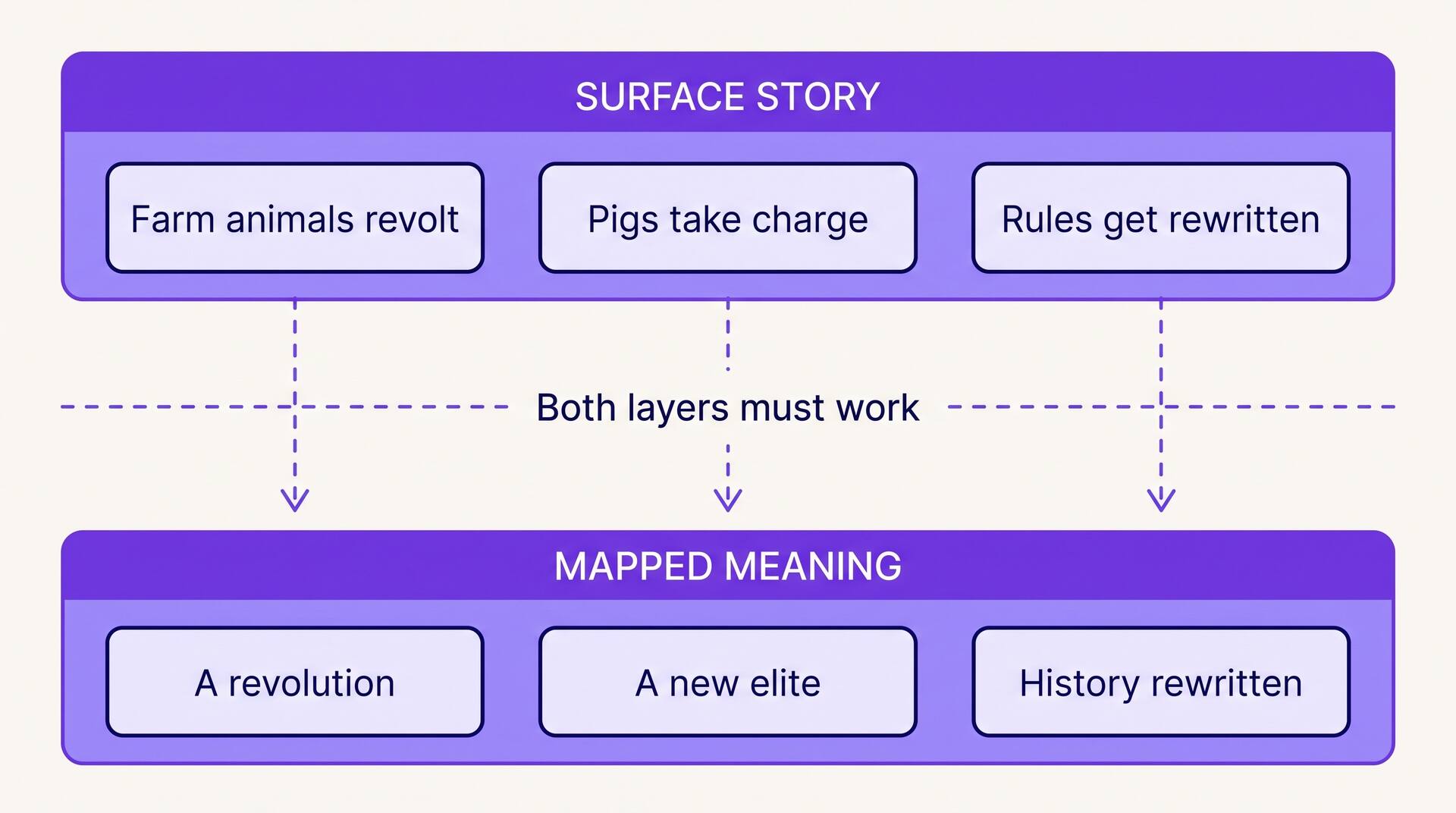
An allegory is a narrative in which characters, settings, and events consistently correspond to a second set of meanings — historical, political, moral, or spiritual — so that the story can be read coherently on both levels at once.
Both readings have to work. A story that only makes sense once you know the key is a puzzle, not an allegory.
The two kinds worth knowing
Almost every allegory belongs to one of two families, and knowing which you are writing changes how you plot it.
Historical and political allegory
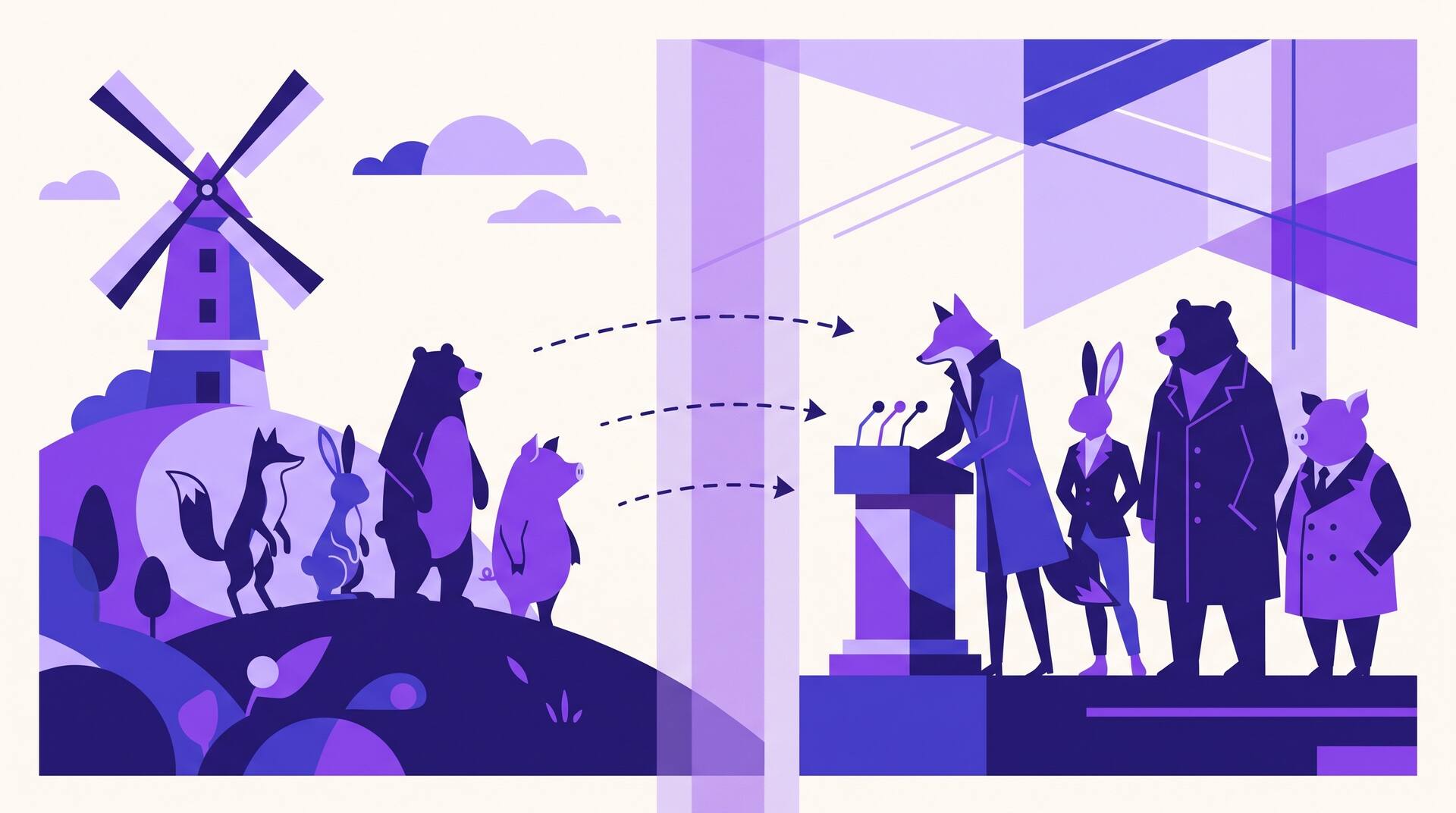
The second layer is a specific real event, movement, or period. Orwell's Animal Farm (1945) maps a farmyard revolt onto the Russian Revolution and what followed; Old Major, Napoleon, and Snowball have identifiable counterparts, and the pigs' slow drift toward the farmer's habits is the argument. Arthur Miller's The Crucible (1953) sets its story in the 1692 Salem trials while writing about the House Un-American Activities Committee hearings of his own decade — Miller said so openly in his later essays.
The risk here is a short shelf life. Once the referent fades from memory, the surface story has to carry the book alone. Animal Farm survives because a farm where the new bosses become the old bosses is still a good story in 2026.
Moral and spiritual allegory
The second layer is an idea rather than an event: the soul's progress, the state of a conscience, the nature of knowledge. John Bunyan's The Pilgrim's Progress (1678) is the purest example in English — a man named Christian walks from the City of Destruction to the Celestial City through the Slough of Despond and Vanity Fair, and the names are the map. Plato's Allegory of the Cave, in the Republic, does the same with prisoners who mistake shadows on a wall for the world.
These age better, because ideas do not go out of the news. They fail differently: they turn into sermons.
Six allegory examples, and what each one maps to
Animal Farm — George Orwell (1945)
Surface: farm animals overthrow their owner and run the farm themselves. Mapping: the 1917 revolution and its aftermath, with the pigs as a new ruling class. The commandment repainted on the barn wall is the whole thesis in one image.
The Pilgrim's Progress — John Bunyan (1678)
Surface: a journey on foot across dangerous country. Mapping: a Christian life from conviction to salvation. Every hazard is a named temptation, which is why it reads as the textbook case.
The Allegory of the Cave — Plato
Surface: prisoners chained facing a wall, watching shadows cast by a fire. Mapping: ordinary perception versus philosophical knowledge, and the hostility that greets whoever comes back to report.
The Crucible — Arthur Miller (1953)
Surface: a witch panic in colonial Massachusetts. Mapping: accusation, naming names, and reputational ruin under McCarthyism. The surface layer is itself historical, which is part of the trick.
Lord of the Flies — William Golding (1954)
Surface: schoolboys stranded on an island. Mapping: the thin membrane between social order and cruelty. Read narrowly it is a moral allegory; read loosely it is a novel with heavy symbolism, and both readings are defensible.
The Lion, the Witch and the Wardrobe — C.S. Lewis (1950)
Surface: four children in a snowbound country ruled by a witch. Mapping: sacrifice and resurrection. Lewis resisted the word allegory for it, preferring to describe the book as a supposal — what if Christ entered a world like this one — which is a real distinction, not a dodge.
I cordially dislike allegory in all its manifestations, and always have done so since I grew old and wary enough to detect its presence.
Worth knowing before you cite The Lord of the Rings as a World War II allegory in an essay: Tolkien denied it in print, and distinguished allegory from what he called the applicability the reader brings.
Notice how few of these are contested by their authors, and how sharply the two that are — Lewis and Tolkien — pushed back. Writers dislike the label because it implies the story was only ever a delivery mechanism.
How to build an allegory that does not read as a lecture
This is the actual failure mode. Nobody's allegory collapses because the mapping was too subtle. It collapses because the reader can feel the author steering, and reading stops being discovery and becomes obedience. Three fixes, in order of how much they help.
1. Let the surface story be capable of losing
If every plot turn resolves in the direction of your thesis, the reader stops believing in the world. Give the position you disagree with its strongest version and a real win somewhere in the middle of the book. Orwell lets the farm genuinely work for a while, and that stretch is what makes the ending land.
2. Never let a character state the mapping
The moment someone says out loud what the story is really about, the second layer flattens into a caption. Bunyan can name a swamp Despond because he is writing for readers who already accept the frame and expect the labels. You almost certainly are not. Keep the correspondence in structure, not in dialogue.
3. Cast for contradiction, not for roles
If each character is a single labeled quantity — Greed, Innocence, The Establishment — you have written a costume parade. Give the figure carrying your idea one appetite or loyalty that cuts against it. The pigs are not evil abstractions; they are persuasive, tired, and increasingly comfortable.
There is a practical fourth: check the mapping chapter by chapter before you draft, not after. Allegories fail late, and rewriting a novel's second layer at 60,000 words is the expensive way to learn this. Sketching the two columns — what happens, what it corresponds to — across your whole chapter list takes an afternoon.
When not to write an allegory
Three situations where the form will fight you:
- 1You do not yet know your own position. Allegory requires a conclusion; it is a shape for arguments you have already finished thinking. If you are still working it out, write the realist version and let the ambiguity stay.
- 2One image would do the job. If your second layer really amounts to a single idea, you want a symbol running through a normal novel, not a whole architecture built to carry it.
- 3The reader could just read the real thing. If the mapping is one-to-one with a documented event and adds no pressure or reframing, you have written a costume version of a history book.
Allegory earns its keep when the disguise lets you say something that could not be said plainly — because of censorship, because the direct version is too familiar to feel, or because the reader would refuse it stated outright.
Drafting one without losing the thread
The mechanical part of allegory is bookkeeping: fifty scenes, each of which has to work twice. Two things make that lighter.
For the planning pass, our free outline generator will turn a premise into a chapter-by-chapter structure you can edit in the browser — useful here because you can write the surface events first and then walk the list a second time annotating what each one corresponds to. Gaps in the second column are exactly where allegories break.
If you are building the book on AIWriteBook, the outline builder keeps that structure attached to the draft: you approve or rewrite each chapter's plan before any prose is generated, so you can catch a chapter that has drifted off the mapping while it is still two sentences instead of three thousand words. Choose Gemini or Grok for the writing itself; the outline stays yours either way.
If your allegory needs a coherent invented setting to hold the second layer — a farm, an island, a cave, a country with its own rules — our worldbuilding tips covers how to keep that setting consistent enough that readers trust it as a place before they read it as an argument.
The short version
An allegory is a sustained one-to-one correspondence across a whole narrative, not a scattering of loaded images. It comes in a historical flavour that dates and a moral flavour that preaches, and the craft is almost entirely about resisting the second failure. Write the surface story as though the second layer did not exist, then check that it does.
Allegory is a structural decision, which means it belongs in the planning stage rather than the revision stage. Our guide to writing a book walks through where that decision fits alongside premise, outline, and drafting.