

Most writing advice focuses on craft. But the software you write in shapes your creative process more than people realize. A novelist working in Google Docs has a fundamentally different experience than one using Scrivener or an AI-powered writing platform. We tested six tools across real novel-writing workflows to help you find the right match.
One thing no feature table tells you is how a tool will feel on your own machine. Corkboards, live previews and locally run AI models lean on the processor and the graphics card unevenly, so if your desktop already stutters with twenty chapters open, run your parts through a bottleneck calculator before you blame the software.
Software Categories Explained
Writing software falls into distinct categories, each designed around different philosophies about how writers work.
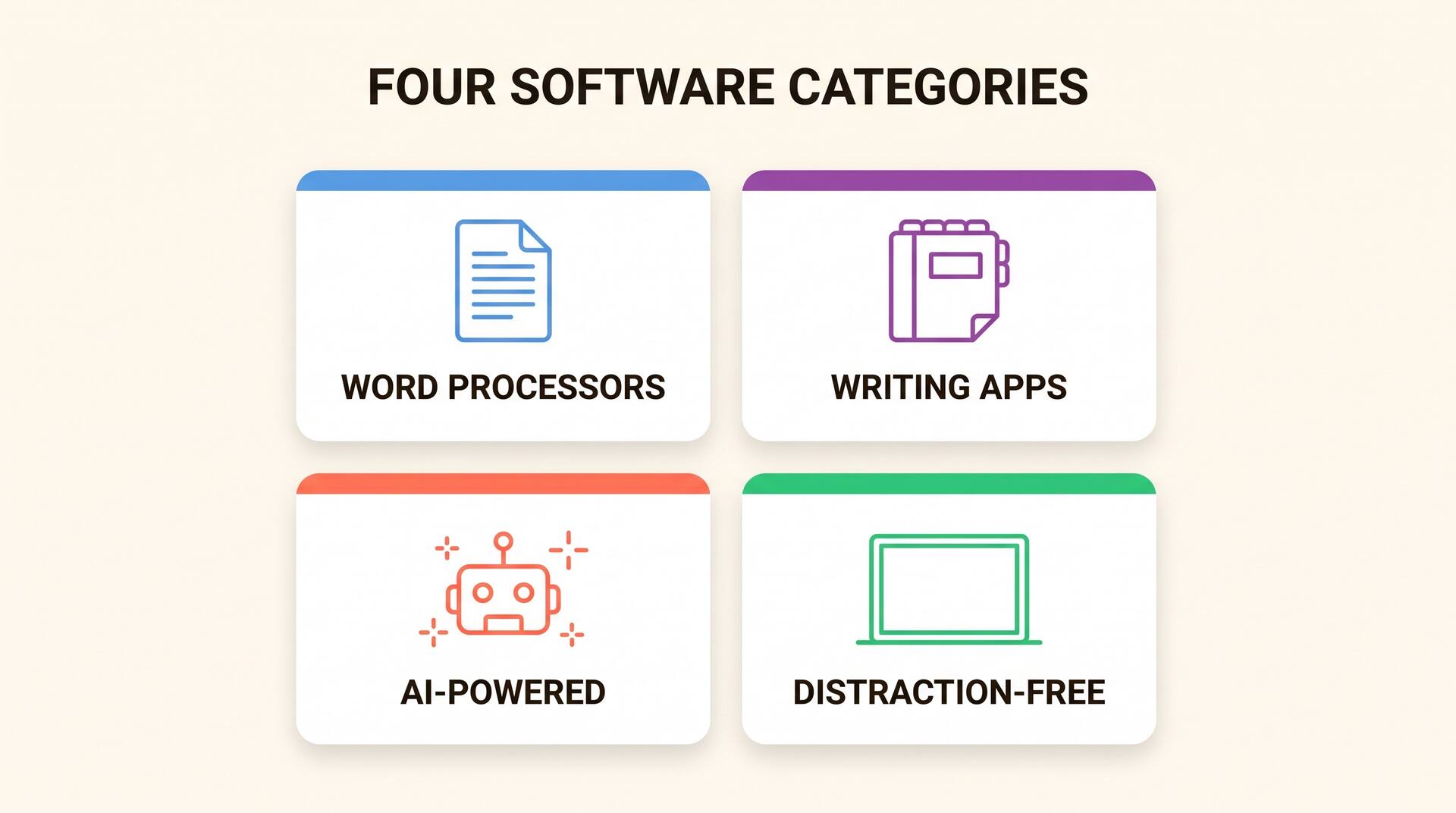
Word Processors
Traditional document editors like Microsoft Word and Google Docs. They handle text well but were not designed for novel-length manuscripts. You get basic formatting and spell-check, but no chapter management, no character sheets, no manuscript overview.
Best for: Short projects, writers who value simplicity, collaborative editing
Dedicated Writing Apps
Tools built specifically for long-form writing. Scrivener, Ulysses, Dabble, and Atticus offer features like binder navigation, chapter reordering, manuscript snapshots, and compile-to-format exports. They understand that a novel is not just a long document.
Best for: Plotters, writers managing complex manuscripts, authors who need organization
AI-Powered Writing Platforms
The newest category. These tools combine writing environments with AI assistance for drafting, brainstorming, and editing. AIWriteBook leads this space for full book creation, handling everything from outline generation to chapter drafting to export. AI-first challengers such as Novelcrafter compete in the same category.
Best for: Authors who want AI assistance throughout the writing process
Distraction-Free Editors
Minimalist tools like iA Writer and FocusWriter strip away everything except the text. No menus, no toolbars, no notifications. Just you and your words. They work beautifully for getting into flow state but lack organizational features for complex projects.
Best for: Writers who struggle with focus, drafting sessions, minimalists
In-Depth Tool Reviews
AIWriteBook represents a fundamentally different approach. Instead of just giving you a place to write, it actively helps you create your book. Start with an idea, and the AI helps you build a structured outline. Write chapters with AI assistance that maintains consistency with your characters, plot, and voice across the entire manuscript. When you are done, export directly to EPUB, PDF, or KDP-ready formats. Generate a professional cover. Even create an audiobook. The advantage over general AI tools like ChatGPT is that AIWriteBook understands book structure. It tracks characters, maintains plot threads, and produces output designed for publication. For authors who want to move from idea to finished book as efficiently as possible, nothing else combines the full workflow like this.
Best for
Authors who want AI-assisted book creation from outline to published format
Strengths
- Complete book creation workflow from idea to published format
- AI maintains character and plot consistency across chapters
- Built-in cover generation and audiobook creation
- Direct export to EPUB, PDF, and KDP-ready formats
- Designed specifically for book-length projects, not adapted from other tools
Limitations
- Requires comfort with AI-assisted writing workflow
- Newer platform compared to established tools like Scrivener
Find Your Perfect Writing Tool
Answer these questions to narrow down which tool fits your writing style and needs.
Pro Tips for Choosing Your Software
Use free trials ruthlessly
Write at least 5,000 words in any tool before committing. A weekend test reveals more than any review. Most tools offer 14 to 30 day trials.
Match the tool to the project
Many professional authors use different tools for different projects. A standalone novel might live in Scrivener while a collaborative nonfiction book works better in Google Docs. You do not have to commit to one tool forever.
Prioritize your weakest link
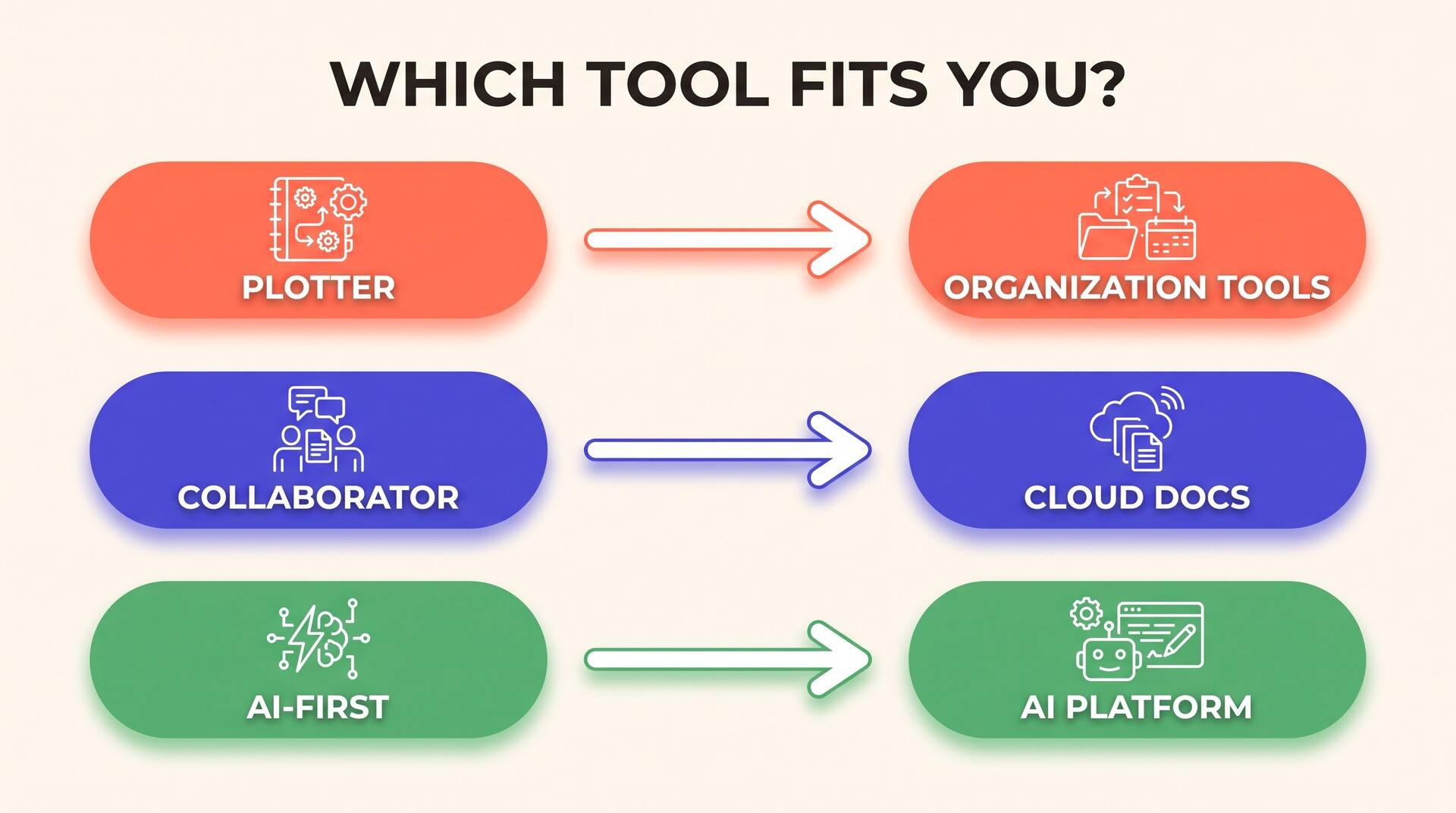
If you struggle with organization, get a tool with strong structural features. If you struggle with getting words on the page, consider AI assistance. If you get distracted easily, try a distraction-free editor. Let the tool compensate for your specific challenges.
Think about the full pipeline
Writing is only part of the process. Consider how you will format, publish, and market your book. Tools like Atticus and AIWriteBook handle more of this pipeline. Others require you to move your manuscript between multiple tools.
Do not let tools become procrastination
The best software is the one you actually write in. Researching and switching tools endlessly is a common form of productive procrastination. Pick something good enough and start writing.
The Bottom Line
There is no universally best novel writing software. The right choice depends on how you write, what you need, and where you are in your author journey. A first-time novelist has different needs than a prolific self-publisher.
If you want the deepest organizational features and don't mind a learning curve, Scrivener remains king. If you want simplicity and collaboration, Google Docs is hard to beat. If you want AI to accelerate your writing and handle the full book creation pipeline, AIWriteBook is the most complete solution available. Whatever you choose, remember: the tool should serve your writing, not the other way around.
How to Write a Novel
Once you have chosen your software, you need a process. Our complete guide walks you through the novel writing journey from concept to finished manuscript.
How to Write a NovelSelf-Publishing on Amazon KDP
Your software choice affects your publishing workflow. Learn how to take your manuscript from writing tool to live on Amazon.
AI Book Writing Guide
Interested in AI-powered writing? Our complete guide covers how to use AI effectively for book creation without losing your voice.
Best AI Writing Tools for Authors
For a deeper look at AI-specific tools, see our comprehensive comparison of every major AI writing platform.