

What's in this guide
Onomatopoeia, defined
Onomatopoeia is a word that imitates the sound it describes — the word buzz sounds like a bee, hiss sounds like a snake, and boom sounds like the explosion it names. The word does double duty: it means the sound and makes the sound at once.
The term comes from Greek roots meaning roughly 'name-making,' and that's exactly what's happening — you're naming a thing by the noise it makes. Because the reader's inner ear supplies the audio for free, onomatopoeia is the cheapest, most immediate sensory detail a writer has. One well-placed sound word does the work of a whole descriptive sentence.
It belongs to the same toolbox as other figurative devices, but it works differently from most. A simile compares one thing to another and a metaphor claims one thing is another — both ask the reader to think. Onomatopoeia skips thinking entirely and goes straight to the senses. That immediacy is its whole superpower, and also the reason it's so easy to overdose on.
37 onomatopoeia examples, sorted by category
Tap a category to filter, or browse them all. Each word comes with a sentence showing it in the wild, because a list of bare words is useless until you see one carrying its weight.
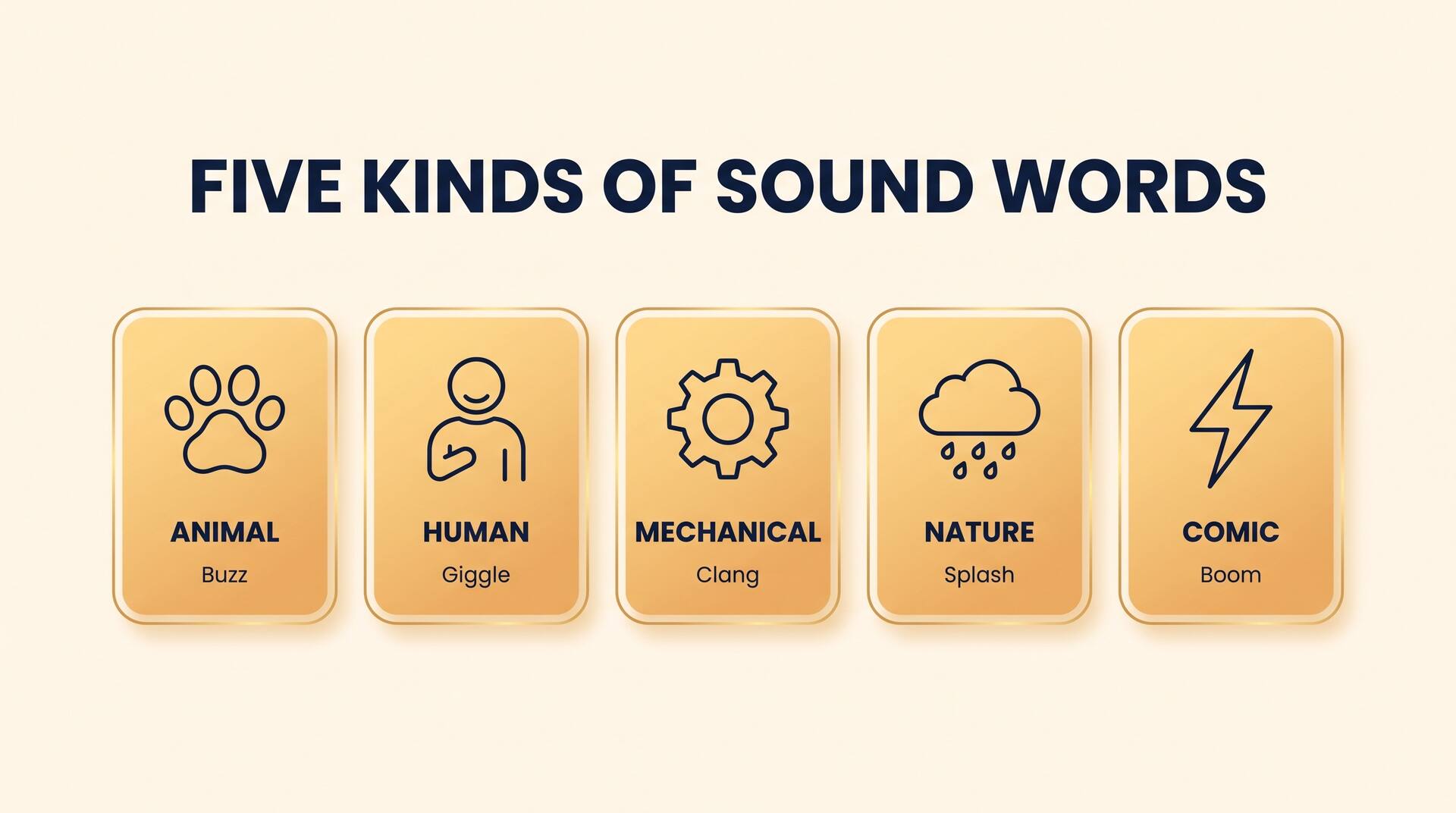
Animal sounds
Buzz
A wasp buzzed against the window screen, furious and trapped.
Meow
The cat meowed once, judged us, and left the room.
Moo
Somewhere past the fence a cow mooed into the fog.
Oink
The piglets oinked and shoved at the trough like commuters.
Cluck
The hens clucked their disapproval and scattered from the gate.
Hiss
The snake hissed, a slow leak of a sound that froze him mid-step.
Ribbit
A single frog ribbited, and then the whole pond answered.
Woof
The dog woofed twice at the mailbox, then wagged, apology accepted.
Human sounds
Giggle
She tried to giggle quietly and failed spectacularly.
Murmur
A murmur ran through the courtroom before the gavel fell.
Achoo
Achoo — his sneeze echoed off the marble like a gunshot.
Gulp
He gulped the water down and only then noticed everyone watching.
Mutter
She muttered the address under her breath so she wouldn't forget it.
Groan
The whole class groaned when he wrote the word 'exam' on the board.
Slurp
He slurped the last of the ramen, unbothered by the silence around him.
Chomp
The kid chomped through the apple in about four enormous bites.
Mechanical & city sounds
Clang
The gate clanged shut behind them with a finality nobody liked.
Honk
A taxi honked, then a second, and the whole street joined in.
Beep
The monitor beeped, steady and reassuring, and she finally exhaled.
Whir
The old fan whirred to life and pushed warm air around the room.
Click
The lock clicked open on the third try, louder than it should have been.
Screech
Brakes screeched, and the bus stopped an inch from the curb.
Ka-ching
The register went ka-ching, and the shop owner finally smiled.
Nature & weather sounds
Splash
The stone hit the lake with a splash that scattered the ducks.
Rustle
Leaves rustled overhead, and something small darted off the path.
Crackle
The campfire crackled, throwing sparks up into the dark.
Drip
Somewhere in the cave water dripped, patient and endless.
Whoosh
The wind whooshed down the canyon and stole the map off the rock.
Boom
Thunder boomed once, close enough to rattle the windows.
Patter
Rain began to patter on the tin roof, soft at first, then steady.
Comic-book & action sounds
Pow
POW — the punch landed and the villain folded like laundry.
Bam
BAM! The door slammed and the hero was already three rooftops away.
Zap
ZAP went the ray gun, and the robot's eyes went dark.
Thwack
THWACK — the bat connected and the ball vanished over the wall.
Kaboom
KABOOM shook the panel as the bridge blew sky-high.
Sploosh
SPLOOSH — she cannonballed into the pool and drenched the referee.
Whomp
WHOMP, the giant's fist hit the ground where the hero had just been.
Using onomatopoeia in a real sentence
The word is only half the job. Where you place it decides whether it sings or clangs. Here are three flat sentences rewritten with a sound word doing real work — notice the sound usually lands late, so the reader hears it as the scene arrives.
Flat version
The door closed and she knew the conversation was over.
With onomatopoeia
The door clicked shut, and she knew the conversation was over.
Flat version
He dropped the plates and everyone turned to look.
With onomatopoeia
The plates hit the tile with a crash, and every head in the room turned.
Flat version
The old floor made noise as he crossed the room quietly.
With onomatopoeia
The old boards creaked under him, betraying every careful step.
Onomatopoeia in famous books
The masters use sound words sparingly and precisely — usually one per scene, always load-bearing. Read how these carry weight the surrounding prose can't.
"...the moan of doves in immemorial elms, / And murmuring of innumerable bees."
"Chitty Chitty Bang Bang" — the car is named for the sputter and backfire of its own engine.
"The Pied Piper... And ere three shrill notes the pipe uttered, / You heard as if an army muttered."
Poe's raven arrives with a "tapping, tapping" at the chamber door before it ever speaks.
Four mistakes to avoid
Stacking too many in one scene
A page with buzz, crash, thud, bang, and screech reads like a cartoon soundboard. Sound words work by contrast with quiet prose. Pick the one noise the scene actually turns on and cut the rest — one perfect crash beats five decent ones.
Reaching for the comic-book register in serious prose
POW and KABOOM belong to comics and children's books, where the exaggeration is the point. Drop them into literary fiction and the tone snaps. Match the sound word to the register: a body hits the floor with a thud in a thriller, never a WHOMP.
Explaining the sound you just made
'The kettle whistled, making a high shrill whistling noise.' The whole point of the sound word is that it already contains the description. If you have to explain it, you chose the wrong word — swap it, don't annotate it.
Using the obvious word every time
Doors don't only bang; they click, thunk, groan, or rattle depending on the door and the moment. Rain doesn't only fall; it patters, drums, or hammers. The specific sound word characterizes the object — reach past the first one that comes to mind.
When to use onomatopoeia — and when not to
Reach for it when
- ✓A scene turns on a specific sound — a gunshot, a snapping branch, a slammed door.
- ✓You want to ground a moment in the body fast, without slowing the pace.
- ✓Writing for children, comics, or read-aloud picture books, where sound is play.
- ✓A single noise can replace a whole sentence of description.
Hold back when
- ✕You've already used a sound word in the same paragraph.
- ✕The register is serious and the word tips into cartoonish.
- ✕The sound is generic and adds nothing the verb didn't already carry.
- ✕You're tempted to spell out an unusual sound phonetically — it often just confuses.
Drafting sound-rich scenes with AI
Sound words are a revision tool as much as a drafting one. Most first drafts state actions flatly — 'the door closed,' 'the crowd reacted' — and the sound lives in the edit, where you swap a dead verb for one that rings. That targeted, one-line-at-a-time work is exactly where AIWriteBook's chapter AI chat shines: ask it to sharpen the sensory detail in a paragraph, and it returns every change as a diff you accept or reject, so you keep the three sound words that land and toss the ones that clang.
There's a second payoff most writers miss. Onomatopoeia is written for the ear, which means it pays off doubly when your book is read aloud. If you turn your finished manuscript into an narrated audiobook, every buzz, crackle, and thud you placed on the page becomes something the listener literally hears — sound words are the one device that rewards the audio format on purpose.
And when a noisy scene — a bar fight, a storm, a busy kitchen — feels muffled on the page, generating a quick alternate take can jolt loose better verbs and sharper sounds. The free dialogue generator is handy here: run the shouted, overlapping exchange through it and mine the result for the crackle you were missing before you rewrite the scene for real.
Make your scenes audible
Draft a chapter, then use accept/reject diffs to swap flat verbs for sound words that ring — starting with your own story, today.
Onomatopoeia FAQ
One sound word, placed exactly right
Onomatopoeia is the most immediate device you have because it skips the reader's mind and goes straight to the ear. The catch is restraint: the writers who use it best deploy one deliberate sound per scene, choose the specific noise over the obvious one, and never explain what they just made you hear.
Browse the 37 examples above, steal the one that fits your next scene, and read the sentence out loud. If you can hear it, it's working. If you can't, reach past the first word that came to mind.
Explore the full How to Write a Book guide for more craft techniques →