

The short answer
A typical chapter is 8 to 15 pages in a printed book, which works out to about 2,000 to 4,000 words. If you want a single number to aim for, 10 pages — around 3,000 words — sits comfortably in the middle for most adult fiction.
But page count is a measurement, not a target. You do not write toward a number of pages; you write a scene or a sequence of scenes and end the chapter where the tension peaks. The page count is whatever falls out of that decision — and the same logic sets how many chapters your book ends up with.
The reason 'pages' is a slippery unit is that a page is not a fixed amount of text. Trim size, font, line spacing, and margins all change how many words fit on a page. That is why this guide gives you words alongside pages — words are the stable measure.
Three things to remember
- A standard chapter is 8–15 pages or 2,000–4,000 words
- A printed page holds roughly 250–300 words at standard formatting
- End a chapter on a hook, not at a page or word target
Pages vs words: the conversion
Because a page is not a fixed size, the only way to talk about chapter length precisely is to convert between pages and words. Here is the working math editors use.
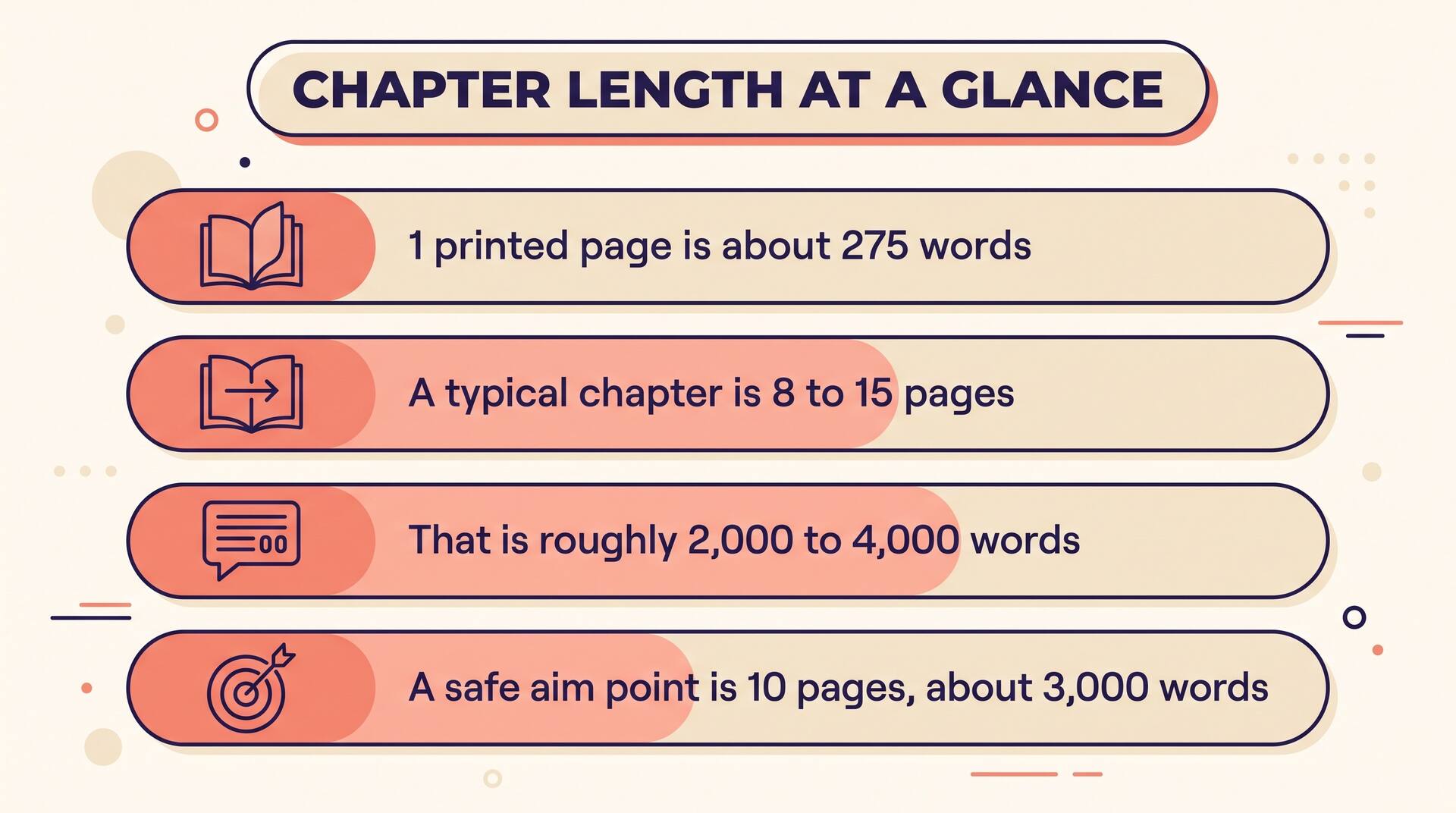
A standard 5×8 or 6×9 trade paperback at 11–12pt with normal spacing holds about 250–300 words per page. Larger trim sizes and tighter spacing push it higher.
Roughly 1,500–2,000 words. Fast, propulsive, common in thrillers and commercial fiction. Easy to read in a single sitting.
Roughly 2,000–4,000 words. The default for most adult novels across genres. Long enough for a full scene, short enough to stay brisk.
Roughly 4,000–7,000 words. Immersive and layered, common in literary and epic fiction. Demands stronger sustained writing to hold attention.
Quick chapter page estimator
Drag to set your chapter's word count and see the approximate printed page count at standard trade-paperback formatting (about 275 words per page). For a full manuscript, our word counter runs the same estimate across every chapter at once.
Word count
3,000
Approx. printed pages
~11
If you only ever remember one rule: a printed page is about 275 words. To estimate a chapter's printed length, divide its word count by 275. A 3,000-word chapter is about 11 pages. The same math scales up — see how word counts translate to page counts by length for a whole book.
Average chapter length by genre
Chapter length tracks genre because genre sets the reading experience. Here are the working ranges editors expect, in pages and words.
5–10 pages · 1,500–2,500 words
Short and punchy. The brisk chapter is the engine — every break is a cliffhanger that pulls the reader into the next one.
10–15 pages · 2,500–4,000 words
Medium chapters, often alternating POV between the two leads. Breaks tend to fall on emotional beats rather than plot cliffhangers.
12–20 pages · 3,000–5,000 words
Substantial chapters with room for worldbuilding. Multi-POV epics often break chapters by viewpoint character.
Highly variable
Often longer, less uniform chapters. Some literary novels use a handful of long chapters; others drop numbered chapters for fluid sections.
8–12 pages · 2,000–3,000 words
Shorter chapters keep momentum high for readers who want to fly through the book. Frequent breaks aid the 'one more chapter' pull.
6–10 pages · 1,500–2,500 words
Shorter still, matched to younger attention spans. Often each chapter is a self-contained mini-adventure with its own title.
10–25 pages · 3,000–6,000 words
Driven by argument, not scene. Each chapter is one major idea, usually broken into subheaded sections for navigability.
Why pacing sets chapter length
Chapter length is a pacing tool. The break between chapters is the single most powerful rhythm device you have — it is the moment the reader decides whether to keep going.
Shorter chapters read faster
Two books of identical length feel different if one has 10-page chapters and the other has 25-page chapters. Shorter chapters read faster because the reader keeps hitting the small reward of finishing one.
The break is a decision point
Readers pause at chapter breaks. A chapter that ends mid-tension borrows energy against the next — 'just one more chapter' is built entirely out of where you place your breaks.
Long chapters build immersion
A longer chapter lets a scene breathe and a mood deepen. The cost is a higher barrier to picking the book back up — a tired reader may not start a chapter they cannot finish.
Vary length on purpose
The professional move is mixing lengths. A long, immersive chapter followed by three short, fast ones is how skilled writers control acceleration through a book.
Short chapters vs long chapters
Neither is better — they create different reading experiences. Knowing what each does lets you choose on purpose.
Short chapters (5–8 pages)
+ Propulsive and addictive. Create the 'one more chapter' effect. Forgiving for readers with little time — easy to read in short bursts. Dominant in thrillers and commercial fiction.
− Harder to build deep, immersive scenes. Constant breaking can feel choppy if the hooks are weak.
Long chapters (15–25 pages)
+ Allow immersive, layered scenes and slow-burn tension. Signal a literary or epic register. Give complex POV shifts room to breathe.
− Higher barrier to picking the book back up. Demands stronger sustained writing to hold attention across the length.
When in doubt, err shorter. Modern readers, raised on screens, tend to favor brisker chapters — and a short chapter that ends on a hook almost always beats a long one that meanders.
How bestsellers actually break down
Looking at real books beats any rule. Here is how some well-known titles handle chapter length.
The Da Vinci Code — Dan Brown
3–5 pagesAn extreme of the short-chapter thriller. Chapters of a few pages each, almost all ending on a cliffhanger. The brevity is the page-turner.
Harry Potter and the Sorcerer's Stone — J. K. Rowling
~20 pagesLonger, fuller chapters of around 4,500 words each. Each is a self-contained mini-adventure with its own title — a middle-grade convention.
The Road — Cormac McCarthy
No chaptersAbandons chapters entirely for short, unbroken passages separated by white space. Proof that the 'chapter' itself is a choice, not a requirement.
It — Stephen King
30+ pagesLong, immersive chapters that sprawl across decades and viewpoints. The length matches the epic scope and the deliberate, dread-building pace.
Using AI to size your chapters
Chapter sizing is largely arithmetic and pattern — the part of writing AI handles well.
- Estimate the printed page count of any chapter from its word count and your target trim size and font.
- Audit a finished draft for uneven chapter lengths and flag outliers that should split or merge.
- Check whether each chapter ends on a hook by reviewing the final paragraphs across the manuscript.
- Map your average chapter length against your genre's working range and your book's total length.
- Suggest natural break points inside an over-long chapter that is really doing the work of two.
AI is excellent for structure, sizing, and balance. The scenes, the hooks, and the voice are still yours to write.
Chapter length: frequently asked questions
Most chapters run 8 to 15 printed pages, or about 2,000 to 4,000 words. A practical default is 10 pages. But the right length is whatever lets the chapter end on a hook — page count follows from that, not the other way around.
So how long should your chapters be?
Long enough to deliver a scene, short enough to break on a hook. If you need a starting number, aim for 8 to 15 pages — about 2,000 to 4,000 words — and let real chapters run shorter or longer where the tension demands it. Estimate pages by dividing word count by 275, and remember that a brisk chapter ending on a hook almost always beats a long one that meanders.
Stop counting pages and start counting hooks. Chapters that break in the right places will land on a length that feels inevitable in hindsight. For everything from outline to final chapter, see our complete how to write a book guide. complete how to write a book guide