

What purple prose actually means
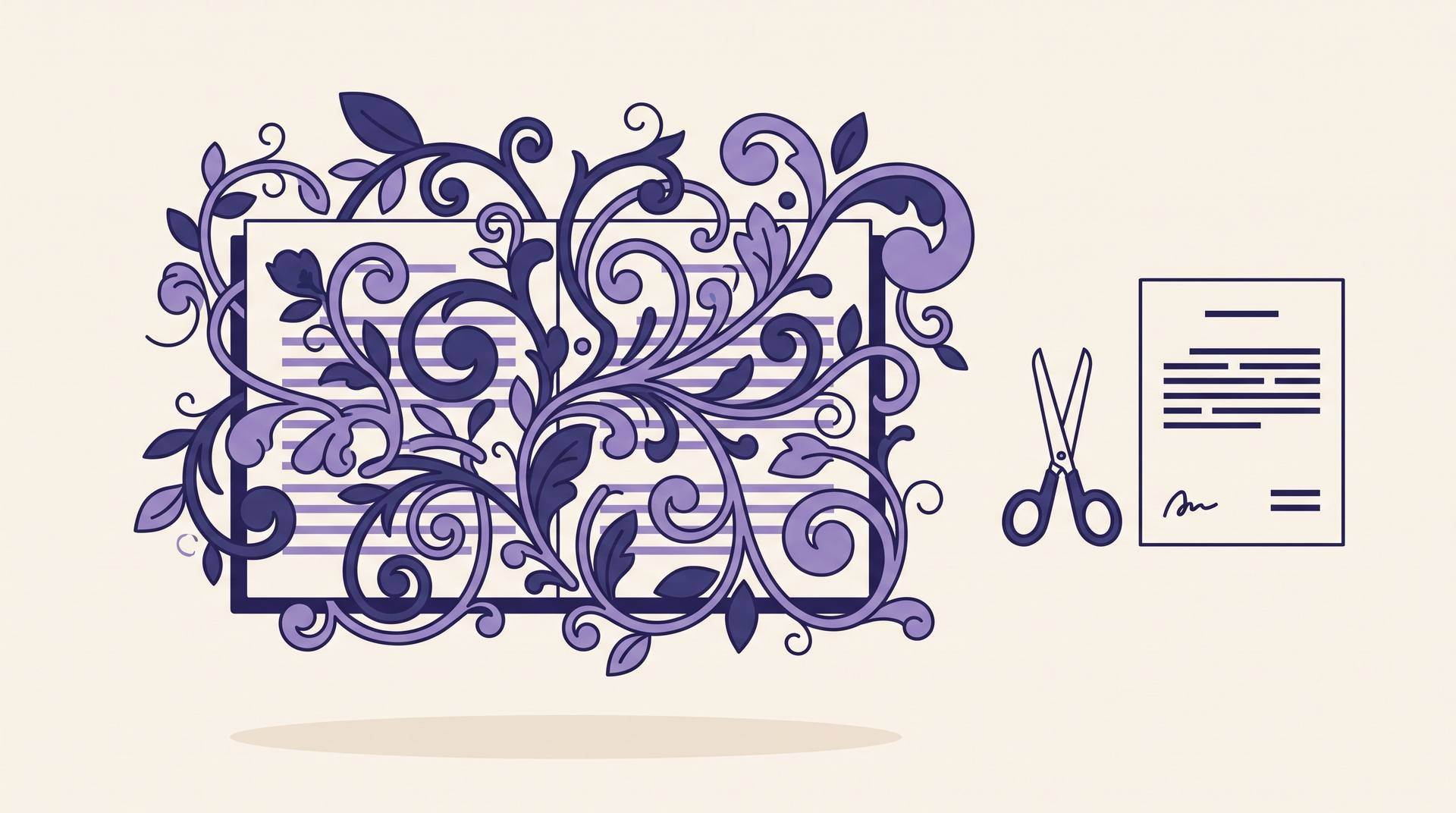
Purple prose is writing so ornate, so dense with adjectives, metaphor and elevated vocabulary, that the decoration draws attention away from what the passage is supposed to do.
The word people reach for is "overwritten", and that is close. But the diagnosis matters more than the label. A sentence is not purple because it is long or because it contains a metaphor. It is purple when the ornament stops paying rent — when a reader finishes the paragraph knowing less about the scene than before it started, and mostly noticing the writer.
That makes it a relative fault, not an absolute one. The same sentence can be gorgeous in a lyrical literary novel and unbearable in a thriller chase, because the two books have made different promises about pace. Which is why "cut all your adjectives" is bad advice; the fix is not fewer words, it is words that carry weight.
It is also the fault most commonly found in first drafts by people who read widely and write ambitiously. Nobody produces purple prose by being lazy. It is caused by effort applied to the wrong layer.
Why it is called purple
The phrase is roughly two thousand years old. In the Ars Poetica, Horace mocks writers who stitch a shining purple patch onto an otherwise plain work to catch the eye — purpureus pannus, the purple patch. Purple dye was the most expensive colour in the Roman world, reserved for the elite, so the image is precise: a costly scrap sewn onto ordinary cloth, drawing attention exactly where the garment is weakest.
That original meaning is sharper than the modern usage. Horace's complaint was not about ornateness in general but about ornament that does not belong to the thing it is attached to. Two millennia later, that remains the best test you can apply to your own paragraph.
Five symptoms you can test for
Vibes are unreliable at midnight on your own manuscript. These five are mechanical enough to check.
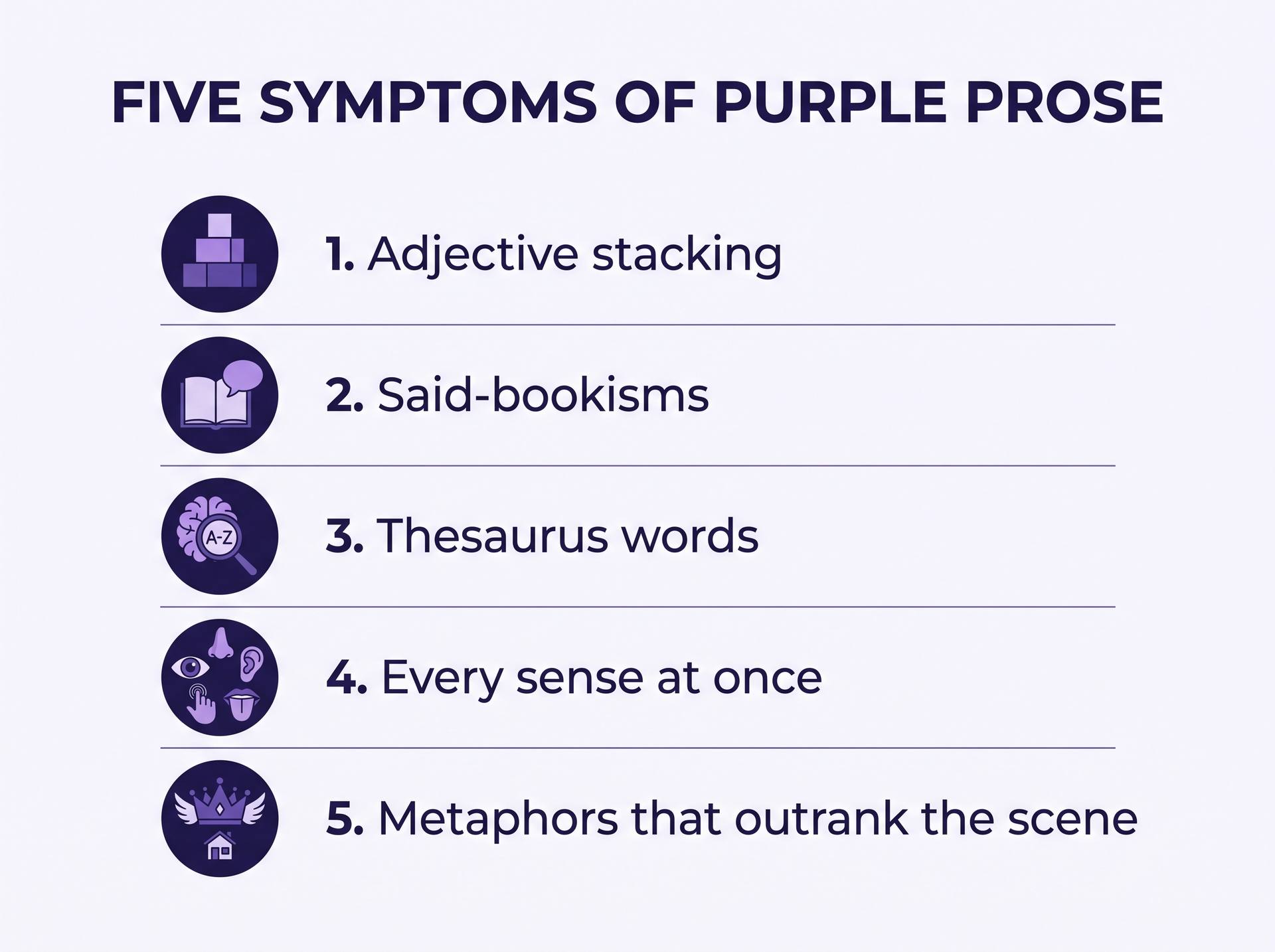
- 1
Adjective stacking
Three or more modifiers on one noun, none of which the reader could have guessed wrong. "The cold, dark, frigid, shadowy cellar." Each adjective after the second tends to cancel the first rather than add to it.
- 2
Said-bookisms
Dialogue tags doing emotional work the dialogue should do: expostulated, ejaculated, opined, sneered venomously. Readers skim "said"; they trip over "vociferated", and the trip is the only thing they remember.
- 3
Thesaurus words
A word you have never spoken aloud, chosen over one you have. "Orbs" for eyes, "tresses" for hair, "ambulated" for walked. The tell is that the fancier word is almost always slightly less precise than the plain one.
- 4
Every sense at once
A paragraph that reports sight, sound, smell, taste and touch in sequence because a craft book said to use the senses. Real attention is selective. A character in a panic notices two things, vividly, and misses the rest.
- 5
Metaphors that outrank the scene
The comparison is more interesting than the thing compared. If your metaphor for a slammed door involves a cathedral and a dying star, the door has been evicted from its own sentence.
Note that none of these is an argument against sensory writing. Precise, chosen detail is the opposite of purple — that is the distinction we draw in the seven types of imagery, where one exact sense beats five approximate ones.
The rewrite lab
Three passages, each shown twice. Read the purple version, guess what it is actually telling you, then reveal the rewrite. The word counts are worth noticing: the cure is rarely a 90% cut, and a cut that deep usually means you threw away content with the ornament.
Overwritten
35 words
The luminous, incandescent orb of the morning sun ascended with majestic and unhurried grandeur above the distant, undulating, emerald-hued hills, casting its resplendent golden radiance across the dew-bejewelled expanse of the sprawling verdant meadow below.
Overwritten
33 words
"I cannot possibly countenance such an arrangement," she expostulated vehemently, her cerulean orbs flashing with the incandescent fury of a thousand tempests as her alabaster fingers clenched into trembling fists of righteous indignation.
Overwritten
45 words
The ancient, weathered manor house loomed before him like some great slumbering leviathan of forgotten centuries, its countless darkened windows staring down at him like the hollow, accusatory eyes of the long-dead, its very stones seeming to whisper malevolent secrets into the shivering, expectant air.
If you want to run this exercise on your own paragraph rather than ours, the free paraphrasing tool will give you a plainer version of any passage in a few seconds — useful not as a final answer but as a control sample, so you can see exactly which of your flourishes were carrying meaning and which were carrying nothing.
The two-question test
When you are unsure about a sentence, these two questions settle it faster than reading it aloud for the ninth time.
Could the reader have guessed it?
Cross out every word describing something the reader would have assumed anyway. Snow is cold. Blood is red. Night is dark. Whatever survives is where your description actually lives.
Does the scene still move?
Put a finger on the last thing that happened and the next thing that happens. If more than a paragraph of ornament sits between them, the reader is standing still in a beautiful room waiting to be let out.
A sentence that fails both is purple. A sentence that fails only the first is merely wordy, and a lighter edit fixes it.
When purple works
Deliberate excess is a real technique, and pretending otherwise produces beige novels. Gothic fiction, decadent literature and a good deal of fantasy are ornate on purpose, and the ornament is the point — the prose is performing the same overwhelm the characters are experiencing.
The difference is always control. Ornate prose that works is dense with specific information; purple prose is dense with effort. Nabokov's sentences are baroque and every clause carries a fact. A purple sentence is baroque and the clauses are interchangeable.
There is also the comic register: a narrator who overwrites deliberately, whose grandiosity is characterisation. That is a genuine use, but it needs the reader to be in on the joke within a page or two, or it reads as the real thing.
Test for intent this way — try deleting the flourish. If the passage loses information or tone, it was doing work. If it only loses length, it was a purple patch.
Cutting without flattening
The common failure after a purple diagnosis is overcorrection: a writer strips every adjective, every rhythm, every risk, and produces prose with no fingerprints at all. Plain is not the goal. Precise is.
Work in this order. First cut the words the reader could have guessed. Then reduce competing metaphors to one. Then replace the fancy word with the plain one wherever the plain one is at least as accurate — usually every time. Only then look at sentence rhythm, and deliberately keep one or two long sentences, because uniform short ones read as their own kind of tic.
Do this on a printed page or a separate pass, never while drafting. Trying to write clean the first time is how people stop writing. Let the first draft be as lavish as it wants and fix it on the second — which is also why an overwritten first draft is a much better problem to have than a thin one.
Line-level self-editing is exactly the kind of work worth handing off in bulk. Inside AIWriteBook, the chapter chat rewrites a selected passage and shows the result as a diff you accept or reject line by line, so you can strip the ornament from a whole chapter without silently losing the two flourishes that were actually yours. The grammar and style checker catches the mechanical half — stacked modifiers, wandering tags — on the pass before that.
Frequently asked questions
Write lavishly, edit ruthlessly
Nobody ever wrote a memorable novel by being careful on the first pass. The instinct that produces purple prose — wanting the sentence to be worth reading — is the right instinct pointed at the wrong draft.
So let the first version be as ornate as it wants, and then go back with the two questions and a red pen. What survives will sound more like you than either extreme did.
Line-level style is the last layer of a book, and it sits on top of decisions about structure, point of view and voice made much earlier. Our complete guide to writing a book walks through those in order.