


What is a red herring?
A red herring is a deliberately planted detail — a suspect, an object, a line of dialogue, a gap in a timeline — that a reader will reasonably read as evidence for a conclusion the story does not support. It is a false signal placed on purpose, and it only counts as one if the writer knows it is false while writing it.
That last clause matters. A detail that misleads because the writer was sloppy is not a red herring, it is a plot hole wearing a costume. A red herring has a job: it absorbs suspicion for a stretch of the book so the real answer can sit in plain sight unnoticed.
The word gets used loosely for anything surprising, but it is narrower than that. A twist changes what the story is about. A red herring only changes where readers are looking.
Five famous red herrings
Each card stays sealed until you click it. Treat the ones you have not read as a reading list.
Spoilers ahead — each example stays hidden until you click it.
And Then There Were None
Agatha Christie, 1939
Ten strangers on an island, dying one by one, and no eleventh person on the rock.
The Murder of Roger Ackroyd
Agatha Christie, 1926
A country-house killing, narrated by the local doctor who assists Poirot.
Harry Potter and the Philosopher's Stone
J.K. Rowling, 1997
Someone in the castle is trying to steal the Stone, and one teacher is very obviously unpleasant about it.
Gone Girl
Gillian Flynn, 2012
A wife disappears, and the husband behaves exactly like a man who did it.
Knives Out
Rian Johnson, 2019
A nurse believes she gave her patient a fatal overdose and spends the film covering it up.
The fair-play rule
Here is the mechanic almost nobody spells out. A red herring is fair when the innocent explanation is shown to the reader before the reveal — not invented at the reveal.
Compare two versions of the same scene. In the first, the gardener is seen burning papers at midnight, and in the final chapter the detective announces he was burning love letters from a married woman — a fact that appears nowhere earlier. In the second, chapter nine gives the gardener one awkward, unexplained conversation with that woman at the gate. Same solution. Only the second one is fair.
The test is mechanical. For every misleading detail, find the page where its harmless explanation is visible. If you cannot cite one, you are not misdirecting, you are retconning — and readers feel that difference even when they cannot name it.
This is the same discipline behind Chekhov's gun and the reason Ronald Knox and the Detection Club wrote rules for the genre in the 1920s at all. Their commandments have aged unevenly, but the core demand has not: the reader must have been able to solve it.
The one-line version
A fair red herring is a true fact pointing the wrong way. An unfair one is a fact you had not shared yet.
How to plant one
Four techniques cover almost every red herring in print. Mix them — a book where every false lead is a shifty character gets predictable by chapter six.
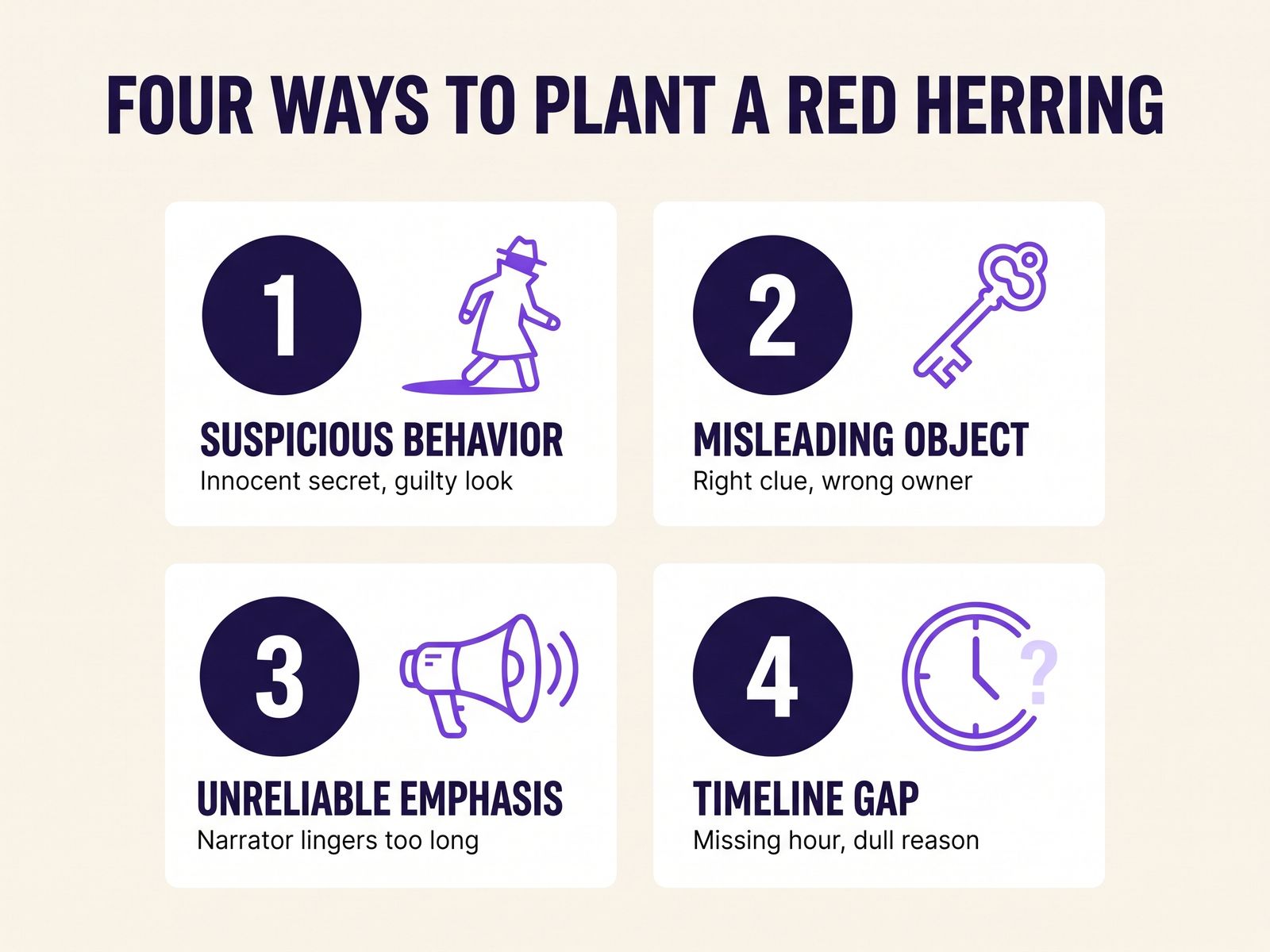
Suspicious behavior
A character hides something real and harmless — an affair, a debt, a diagnosis. They lie to the detective because the truth costs them something, and the lie reads as guilt. The most reliable technique, because their motive to conceal is genuine, so the evasions stay consistent under pressure.
Misleading object
The right clue attached to the wrong owner. A monogrammed lighter at the scene belongs to someone who lent it away last week. Give the object a second, dull history and place it somewhere unglamorous — a passing line in another scene, not a footnote at the reveal.
Unreliable emphasis
Nothing false is stated; the narration simply lingers. Three paragraphs on the greenhouse and one line on the study teaches readers where to look. Use sparingly — readers who catch you weighting scenes start reading the prose instead of the story.
Innocent-looking timeline gap
Someone cannot account for forty minutes and suspicion is automatic. The real answer should be tedious enough that nobody would volunteer it: asleep in a car, visiting a relative they are ashamed of. The cheapest herring to plant and the easiest to make fair — the true explanation needs one earlier sentence to be legitimate.
If you are stuck for a false lead that does not feel like the four you already used, our free plot twist generator is a fast way to shake loose candidate directions — take the ones that suggest a suspect, discard the ones that suggest a revelation.
Four mistakes that break them
Too many
Past roughly three active false leads, readers stop forming theories and start waiting to be told. Suspicion needs somewhere to settle to be worth misdirecting.
The suspicious character with no life
A character who exists only to look guilty reads as furniture. Give every herring an interior reason to behave the way they do, or readers will smell the authorial hand.
Explaining it away offstage
If the herring's resolution happens in summary — the detective mentions that the gardener has been cleared — the reader never gets the satisfaction of the correction. Resolve false leads in scene, with the same weight you gave them.
Herring as apology
Some writers plant misdirection because they suspect their real solution is guessable. It never fixes that. If the culprit is obvious, the fix is a better solution, not thicker fog.
When not to use one
Red herrings are a mystery tool, not a universal one. In a thriller where readers know the killer from page one, a false lead only delays a chase they want to run. In literary fiction, misdirection about motive usually flattens the ambiguity that was the point. In romance, false suspicion between the leads is a trope with its own conventions, not a herring.
The honest question is whether your reader is being invited to solve something. If they are not detecting, there is nothing to misdirect.
Testing your red herrings with AI
The hardest part of misdirection is that you cannot unread your own book. You know who did it, so you cannot judge whether chapter seven points where you think it points.
The chapter AI chat inside AIWriteBook is a workable stand-in for a first-time reader. Open a chapter and ask it who it suspects and which lines made it suspect them. It answers from the text in front of it rather than from your intentions, so its answer is a read on what the page actually does. If it names your real culprit in chapter three, your herring is not carrying weight.
Run the fair-play test the same way: ask it to find the innocent explanation for the detail you are worried about. If it cannot find one in the chapters you have written, neither can your reader — and any edit you accept arrives as a diff you approve line by line. For the wider structural picture, our guide to writing a mystery novel covers where in the arc these leads belong.
Write the mystery, then interrogate it
Draft chapters, plant your leads, and use the chapter chat to find out what a fresh reader would actually suspect.
The short version
A red herring is a true detail aimed the wrong way, and its quality comes down to one thing: whether the reader could have disarmed it before the reveal. Show the innocent explanation early, keep the false leads down to two or three, give every suspect a real inner life, and resolve each dead end in scene.
Do that and readers will reread you. That is the whole prize. Nobody rereads a book that lied to them.