


Why tropes sell romance
Romance is the best-selling fiction genre on the planet, and it runs on tropes more openly than any other. Readers do not browse for a surprise — they browse for a specific feeling delivered a specific way, then buy the book that promises it on the cover. A trope is the shorthand for that promise. "Grumpy/sunshine, small town, slow burn" tells a reader more about whether they will love your book than any plot summary could.
That is why the strongest romance authors treat tropes as structure, not seasoning. A trope decides where the tension lives, what the characters are fighting, and what the payoff has to feel like. If you are still building the emotional machinery underneath — chemistry, the push-pull, the earned happy ending — start with our full guide to writing a romance novel, then use this list to choose the promise you are making.
The full romance tropes list
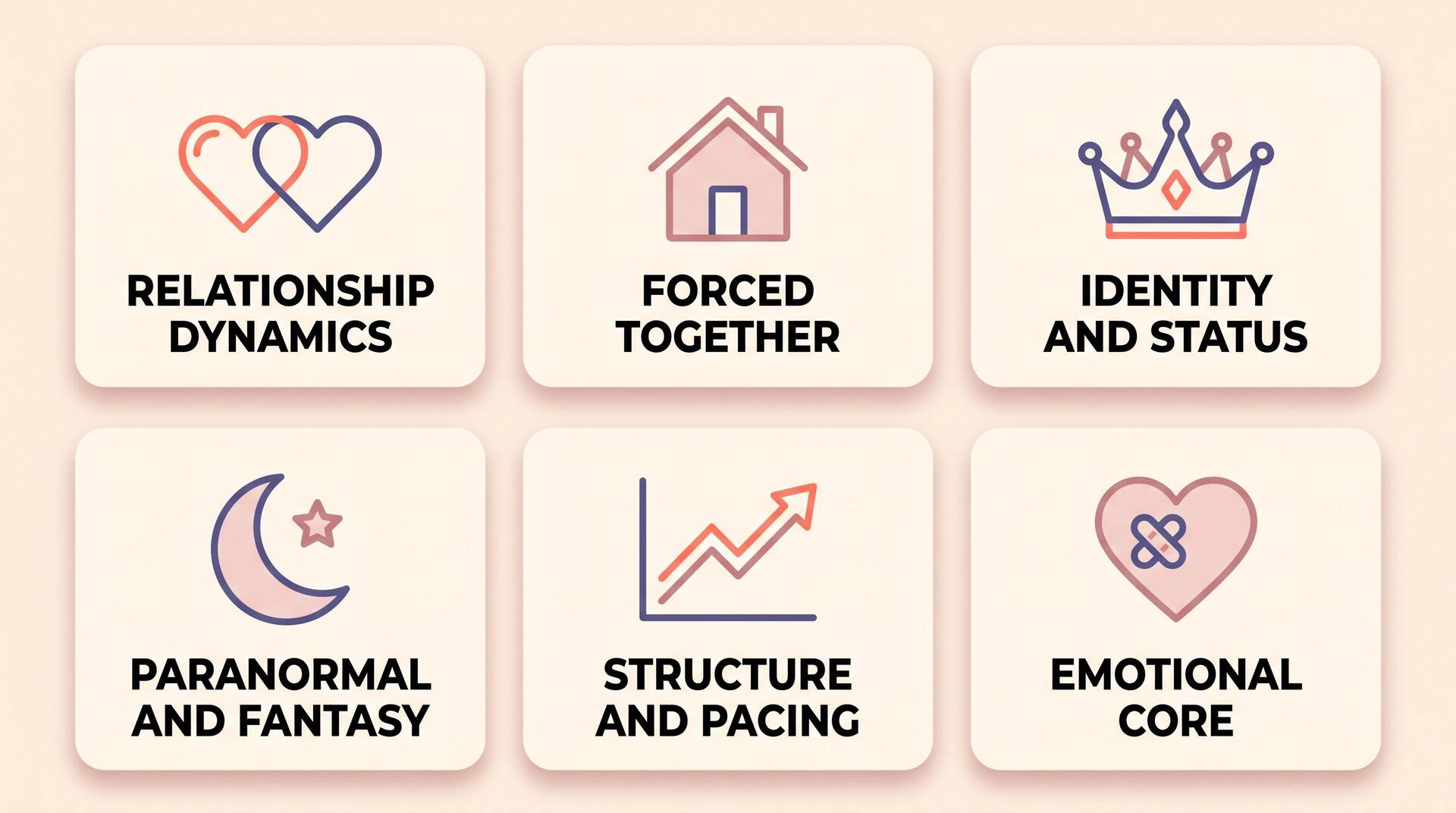
Sixty-two tropes, six categories. Open a category to see each trope and the one-line hook — the reason a reader buys it. Some of these overlap on purpose; "forced proximity" and "only one bed" are cousins, and most great books stack two or three. Note where the tension in each one actually comes from, because that is what you are really choosing. For tropes built on a hidden reveal — a love triangle resolution, a secret identity unmasked — you can rough out the turn with the free plot twist generator before you outline.
Enemies to Lovers
Every hostile exchange is chemistry in disguise; readers stay for the moment loathing has nowhere left to hide.
Friends to Lovers
The safety of an existing bond plus the terror of risking it — comfort and stakes wrapped in one person.
Rivals to Lovers
Two people who refuse to lose turn attraction into a competition neither wants to win too soon.
Grumpy / Sunshine
One thaws, one softens; readers buy the private, gentler version of the grump only she gets to see.
Fake Dating
A pretend relationship forces real proximity until neither one can tell where the act stopped.
Marriage of Convenience
Vows first, feelings second — the slow, delicious horror of falling for a contractual spouse.
Second Chance
The ache of almost; readers want to watch two people get right what time got wrong.
Opposites Attract
Friction from difference, chemistry from it too — the pull of the person who fills the blind spot.
Brother's Best Friend
Forbidden by loyalty, familiar by history — the crush that was always in the house.
Best Friend's Sibling
The one person off-limits precisely because losing them would cost two relationships.
Frenemies / Banter
Trading barbs as a love language; readers come for the wit and stay for the first crack in the armor.
A few of these are deep enough to run a whole book on their own. Enemies to lovers has its own nine-beat playbook if that is your headline trope. And every paranormal trope leans on the rules of your world — strong worldbuilding is what keeps fated mates or a magic bargain feeling inevitable instead of arbitrary.
How a trope actually works
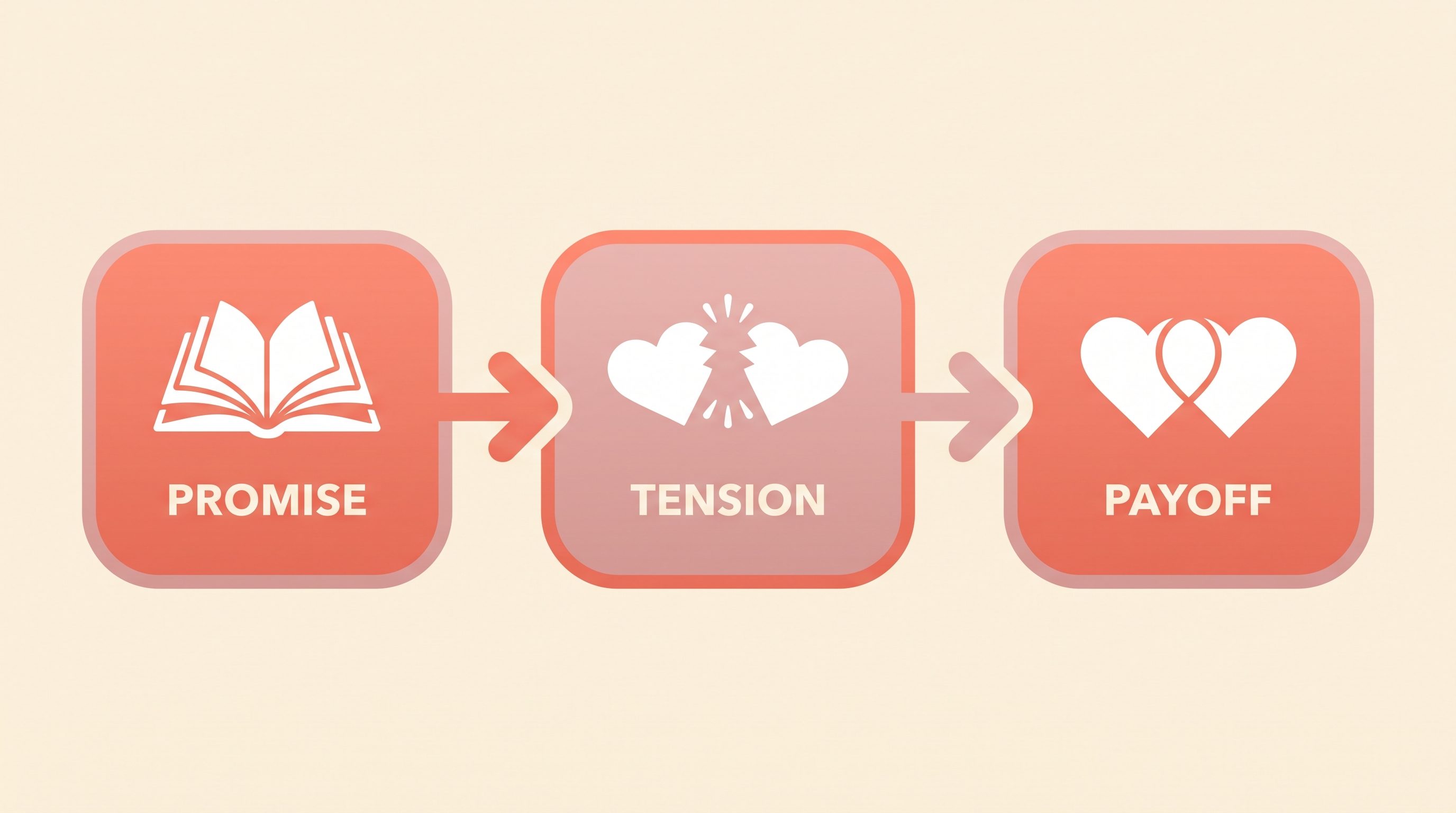
A trope is not a plot — it is a contract with three parts. Get all three right and readers feel satisfied; skip one and they feel cheated even when the writing is good.
Promise
The trope names the exact feeling on offer. "Grumpy/sunshine" promises a thaw; "second chance" promises a wrong made right. Make the promise on your cover, title, and blurb — this is where the reader decides.
Tension
The middle keeps the promise from being kept too soon. Every scene should widen or tighten the gap between what the characters feel and what they will admit. This is the part most drafts rush.
Payoff
The moment the promise pays out — the enemy confesses, the grump melts, the reunion holds. It has to feel earned by the tension, not handed over. Under-delivering here is the one thing readers never forgive.
The payoff usually lands at your climax, which is why tropes and structure are the same conversation. If you are mapping where each beat falls, our breakdown of three-act structure shows exactly where a trope's promise, midpoint, and payoff belong.
Build a trope stack (don't rely on one)
Almost no bestseller runs on a single trope. It stacks a relationship dynamic, a situation, and an emotional core into one premise — "grumpy/sunshine, forced proximity, hurt/comfort." Here is how to combine them without turning your book into a checklist. If a pairing like grumpy-and-sunshine is your anchor, you can spin up both leads with opposite temperaments in the free character creator before you draft.
Pick one anchor trope
Choose the single trope your whole premise can be summarized by. This is the one that goes on the cover. Everything else supports it.
Add one situation and one feeling
Layer a situational trope (forced proximity, small town) to generate scenes, and an emotional-core trope (hurt/comfort, grovel) to generate meaning. Two or three total — not five.
Check they don't fight each other
Insta-love and slow burn cancel out. Secret relationship and small-town gossip amplify each other. Keep tropes that raise the same tension; cut ones that release it early.
Write the one-line hook
Say it the way a reader would pitch it to a friend: "It's fake dating, but they're both terrible liars." If you can't make it sound irresistible in one line, the stack isn't tight yet.
Common mistakes that flatten a trope
The trope is rarely the problem — the execution is. These are the five that turn a beloved setup into a one-star review.
Confusing a trope with a plot
"Enemies to lovers" is not a story; it is a promise about the arc. You still need external stakes, a goal, and consequences. The trope tells you how the romance feels, not what happens on page 200.
Making the conflict a misunderstanding
If one honest conversation ends your book, the tension was never real. The best tropes are built on a structural obstacle — opposing goals, real duty, genuine risk — not on two people failing to talk.
Stacking too many tropes
Secret-baby, amnesia, fake-dating, royal, enemies-to-lovers, snowed-in — pick three at most. A premise crammed with tropes reads as parody, and none of them get room to pay off.
Hiding the trope from buyers
Romance readers shop by trope. If your title, cover, and blurb don't name the promise, browsers scroll past — even readers who would have loved it. A trope-forward blurb, which the free blurb generator can draft, is how the right reader self-selects.
Under-writing the payoff
Writers spend 300 pages building tension and two paragraphs releasing it. The proximity scene, the grovel, the reunion — those are the pages readers bought the book for. Draft the pivotal beat, like the only-one-bed scene, deliberately; the scene builder can block it out for you.
The AI-assisted shortcut
Once you have your trope stack and one-line hook, you still have to turn it into an outline and chapters that actually deliver the promise. This is where AIWriteBook is built to help: describe your premise and its tropes, and it generates a full outline and draft chapters that hit the beats each trope requires — the slow-burn near-misses, the forced-proximity scenes, the earned payoff — instead of a generic love story.
Because it learns your writing style, the draft comes back in your voice rather than flat AI prose — the difference between a trope that lands and one that reads like a template. And unlike general chatbots that refuse the material, AIWriteBook supports the full range of romance heat levels, so a spicy scene doesn't get you a lecture instead of a draft.
Romance readers binge, so the real payoff is a series. AIWriteBook can write book two based on book one — same couple's world, consistent characters, new central tension — which is how romance authors build the backlist that actually earns.
Your romance trope checklist
Before you outline, run your premise through this trope checklist. Check each box — if you can't, that is exactly what to fix first.
Frequently asked questions
Enemies to lovers, grumpy/sunshine, and fake dating consistently top reader polls and BookTok trends, with fated mates dominating paranormal. But "most popular" matters less than "most popular in your specific subgenre" — check the also-boughts and recent bestsellers in your exact niche before you commit, because trope demand shifts fast and varies wildly between contemporary, romantasy, and small-town markets.
Two to three is the sweet spot: one anchor trope on the cover, one situational trope to generate scenes, and one emotional-core trope to generate meaning. A single trope can feel thin, and more than three usually means none of them get enough room to pay off. The goal is a premise you can pitch in one irresistible line, not a bingo card.
No. A trope is a familiar structure readers actively seek out — the promise they are shopping for. A cliche is a trope executed lazily: the misunderstanding that one conversation would fix, the payoff rushed into a paragraph. Readers love tropes and hate cliches. The difference is entirely in whether you give the familiar shape fresh specifics and an earned emotional turn.
AI is strongest at the structural side of tropes — generating an outline that hits the right beats, drafting proximity or slow-burn scenes, keeping a series consistent. The emotional specificity still needs your judgment, which is why AIWriteBook lets you edit every chapter in your own voice and accept or reject changes line by line. Used that way, it removes the blank-page and pacing work while you keep control of the feeling.
Choose the promise, then keep it
A romance trope is the fastest way to tell a reader exactly what they are about to feel — and the fastest way to disappoint them if you make the promise and don't keep it. Pick your anchor from this list, stack one situation and one feeling around it, and put all three in your blurb so the right reader finds you.
Then do the hard part: build the tension all the way to a payoff that earns its place. That is the whole job, and it is more fun with the machinery decided up front.
Explore the full Genre Fiction guide for more trope-level craft →