


The one-camera rule
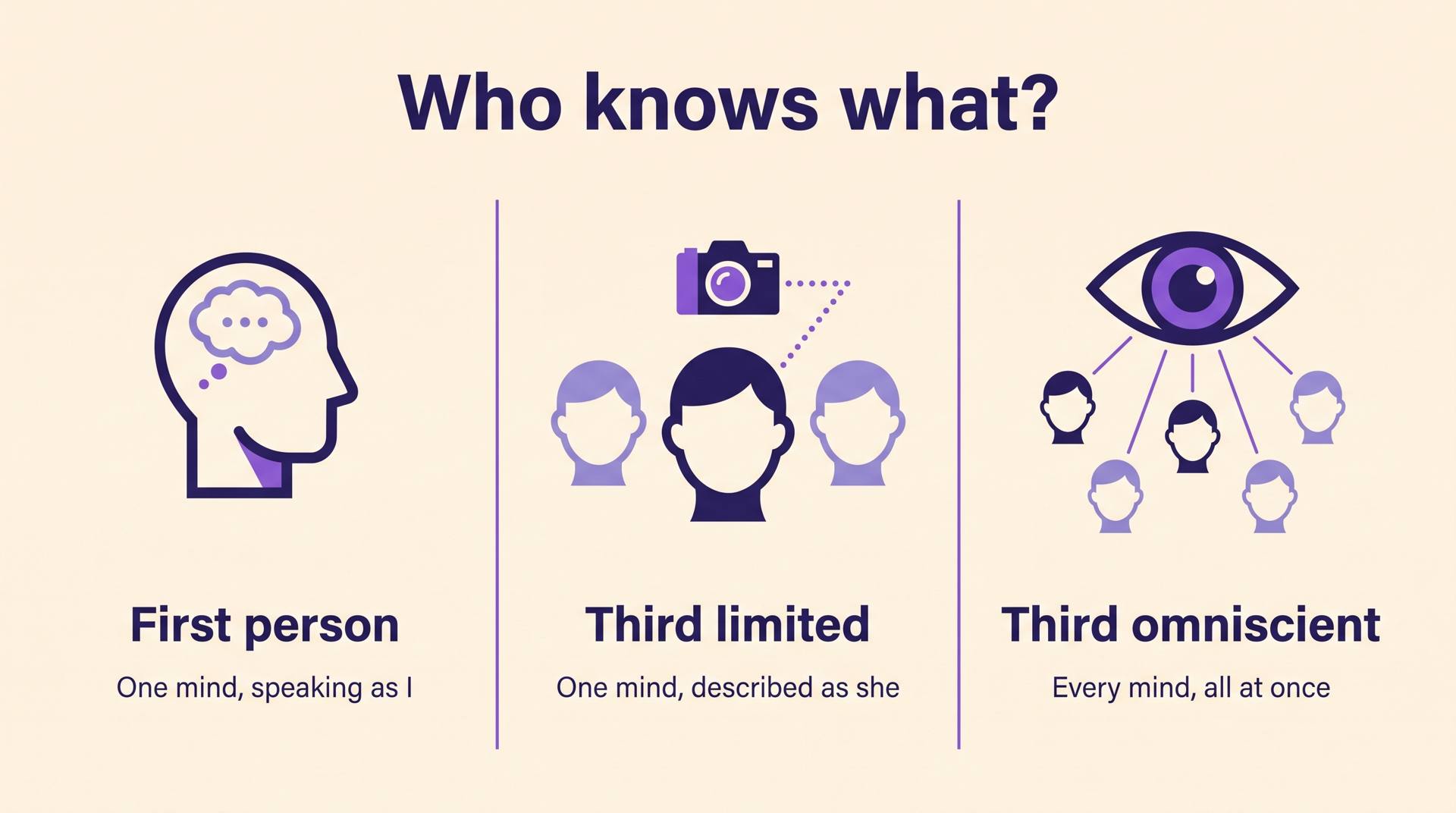
Picture a film crew with one camera strapped to one character's shoulder. It records what that character looks at, hears, remembers, and misreads. It cannot cut across the room to read the mind of the person opposite. When that character leaves, the scene ends.
That is the whole technique. How close the narration sits to the character's vocabulary is a dial you can turn. The camera itself does not move.
Across the table, Alina folded her napkin into smaller and smaller squares. Marek decided this meant she was about to say no, and spent the next minute building an argument against a sentence she had not said.
We never enter Alina. We get Marek's reading of a folded napkin, and that reading may be wrong. The gap between what the POV character concludes and what is actually happening is not a bug — it is the engine.
It is also why limited POV makes suspense cheap. The reader cannot know more than your character, so withholding costs you nothing: the information is not in the room yet.
Third person limited examples worth studying
Two of these are old enough to read for free. Two are what writers actually mean when they say "write it like that".
Emma Woodhouse, handsome, clever, and rich
Austen opens at a slight distance, then tightens onto Emma until the reader shares her misjudgments and gets ambushed by the same revelations she does. The earliest famous proof that limited POV can run a comedy, not just a thriller.
Mrs Dalloway said she would buy the flowers herself.
Woolf runs limited POV at its tightest, sliding between characters mid-paragraph and getting away with what would be head-hopping in anyone else's hands because every transition is deliberate. Study it to understand the rule, not as permission.
The two modern reference points
Harry Potter
J.K. RowlingAlmost entirely Harry's limited POV, which is why readers spend seven books misjudging Snape exactly as he does. The famous exception is the first book's opening chapter, narrated around the Dursleys before Harry can perceive anything — a break clear enough to register as an event.
A Game of Thrones
George R.R. MartinRotating limited POV: every chapter is titled with the name of the character whose head it occupies, and the narration never leaves that character inside the chapter. Many POVs, one per chapter, strictly enforced — the cleanest structural trick in the form, and free to copy.
Not an example: The Hunger Games
Suzanne CollinsListed as third person limited on half the craft blogs online, and wrong: Katniss narrates in first person, present tense. A reminder that "we only know what one character knows" describes first person too. The pronoun is what separates them.
The same scene in three points of view
Definitions are less useful than watching one paragraph change shape. Here is a single original scene rendered three ways.
Nadia counted the ceiling tiles above the reception desk until the numbers stopped meaning anything. The nurse's pen had stopped moving. That could mean nothing at all. It could mean the pen had run out of ink. She made herself believe the ink.
The reader gains
Her dread and her self-deception at once, without an "I" that must carry a whole personality.
The reader loses
Everything the nurse knows. The reader is stuck at the desk, which is the point.
The omniscient version is not worse writing — it is a different contract, trading Nadia's dread for the reader's advantage. If you want readers scared with your character, limited wins. Scared for her, and omniscient does.
Limited, omniscient, first person: the practical differences
Three dimensions decide almost every POV argument. If you only remember one row, remember the middle one — what the narrator is allowed to know is the contract you sign with the reader on page one.
| Dimension | Third limited | Third omniscient | First person |
|---|---|---|---|
| Distance from the character | Close, adjustable. Can sit inside the character's vocabulary or step back a pace. | Far by default. The narrator is a separate presence above the story. | Zero. The character is the narrator. |
| What the narrator knows | Only what the POV character perceives, remembers, or reasonably infers. | Everything — other minds, the future, facts no character has access to. | Only what the narrating character knows, filtered through how they want to be seen. |
| Typical genres | Thriller, crime, romance, fantasy, most commercial fiction. | Epic fantasy, literary and historical fiction, satire, many children's books. | YA, cozy mystery, memoir-adjacent literary fiction, noir. |
Limited POV is the modern default largely because it is forgiving: it reads as intimate without demanding that you sustain a distinctive first-person voice for ninety thousand words.
Four ways writers break limited POV without noticing
Each survives a read-through because it feels natural while you write. They become visible only when someone asks how the POV character could know that.
Head-hopping
Two characters' thoughts in one scene: "She hated the silence. He wished she would speak." A scene or chapter break buys you a new head; a paragraph break does not.
The narrator who knows too much
Describing the POV character's own face, eye colour, or expression. Nobody watches their own eyebrows rise. A mirror on page two is usually this mistake in disguise.
The "she didn't know that" slip
"She locked the door, not knowing the man was already inside." It sounds like tension; it is an omniscient narrator leaning in. Put the information in the room instead: a sound, a smell, a coat that is not hers.
Filter words
She saw, she felt, she noticed, she realised. Each sets a pane of glass between reader and experience. Limited POV already guarantees everything is her perception, so naming it is redundancy.
One rewrite, three fixes
Before
She saw the letter on the table and she felt her stomach drop. Across the room, Marek noticed her hands were shaking and wondered whether he should say something.
After
The letter was on the table. Her stomach dropped. Marek was across the room, saying nothing, and she could not tell whether that was kindness or cowardice.
Six words shorter, two filter words gone, and Marek's head is now closed — his silence is something she must interpret rather than something the narrator explains. More in our guide to showing instead of telling.
When to choose it, and when not to
Choose third person limited when
- Your plot depends on the protagonist being wrong about something — a mystery, a betrayal, a misread romance.
- You want interiority without sustaining a distinctive first-person voice for a whole book.
- You want the prose to disappear. Thriller, romance and fantasy readers are so used to limited POV that it reads as no style at all.
- You need several storylines but want each to stay claustrophobic. Rotate one POV per chapter and label them.
Reach for something else when
- The subject is a community rather than a person — a village, a war, a family across a century. That is omniscient's job, argued in our guide to third person omniscient.
- Your protagonist is absent from the events that matter most. A camera on the wrong shoulder produces secondhand reports.
- The voice is the product. If the appeal is a narrator nobody else could be, first person usually earns more; see first person versus third person, and second person pushes it further.
- The reader must know something the protagonist does not for most of the book. Dramatic irony at that length wants an omniscient narrator or a second POV character.
Keeping POV consistent across a whole draft
Head-hopping is a book-length problem, not a sentence-level one. It creeps in around chapter 14, when you have forgotten which character learned about the will and in which scene.
AIWriteBook keeps that record structurally. Every book carries character sheets with fields for voice, background, motivation, internal conflict and arc, and the chapter outline records who appears in each chapter and how they interact — so chapters are drafted against a record of who was present for what. To sketch a POV character first, the free character creator tool builds one in a minute.
For the cleanup, the chapter editor's AI chat proposes edits as a diff you accept or reject line by line — the right shape for a filter-word pass, because you can strip every "she saw" and still veto the three places it was doing real work. More on the chapter generator feature page.
Third person limited POV: common questions
Storytelling that uses "he", "she" or "they" for the main character while restricting everything the narration reports to that one character's perceptions and knowledge. You describe her from outside, but experience the story from inside her head.
The rule, once more
One camera, one head, one scene at a time. Every technique here — the filter-word cleanup, the chapter-titled rotation, the refusal to write "she didn't know" — protects that rule when the draft gets long and you get tired.
Pick the character with the most to lose and the least information, put the camera on their shoulder, and let them be wrong about things. For where POV sits among the rest of the decisions, see the full how to write a book guide.