

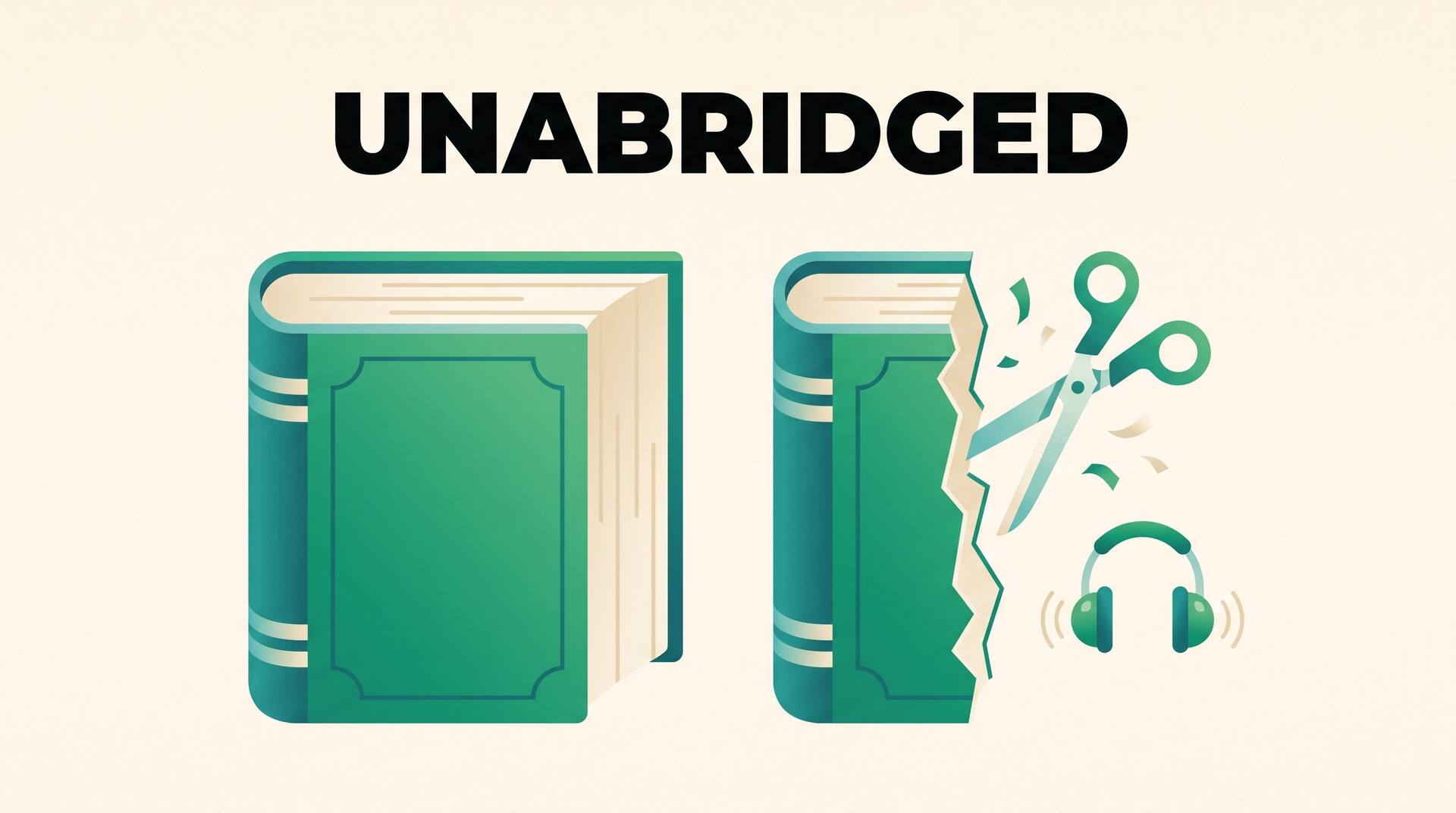
What unabridged actually means
Unabridged means "not shortened." An unabridged book is the author's complete text, exactly as it was published in its primary edition. Every sentence the author intended is present. No scenes have been cut, no chapters condensed, no descriptions trimmed for length. When you buy an unabridged ebook, paperback, hardcover, or audiobook, you are buying the whole work.
The label exists because abridged versions also exist. "Unabridged" is rarely worth printing on a cover unless there is a meaningful abridged alternative readers might confuse it with. That is why you almost never see "unabridged" on the cover of a contemporary novel — but you see it constantly on audiobooks, on classic literature, and on books that have been adapted for younger readers.
Two crucial points readers and authors miss. First: "unabridged" describes the relationship to the original work, not the length. A 200-page novel and a 1,200-page epic can both be unabridged. Second: "unabridged" does not mean unrevised — authors revise editions all the time. The author's final intended text in any given edition is what unabridged refers to.
Three things "unabridged" actually guarantees
- All chapters and scenes from the source edition are present
- Nothing has been condensed, summarized, or paraphrased
- Footnotes, appendices, and front/back matter are included as in the source
Unabridged vs abridged: side by side
The cleanest way to internalize the difference is to compare them across the dimensions that matter to a reader and to a self-publishing author.
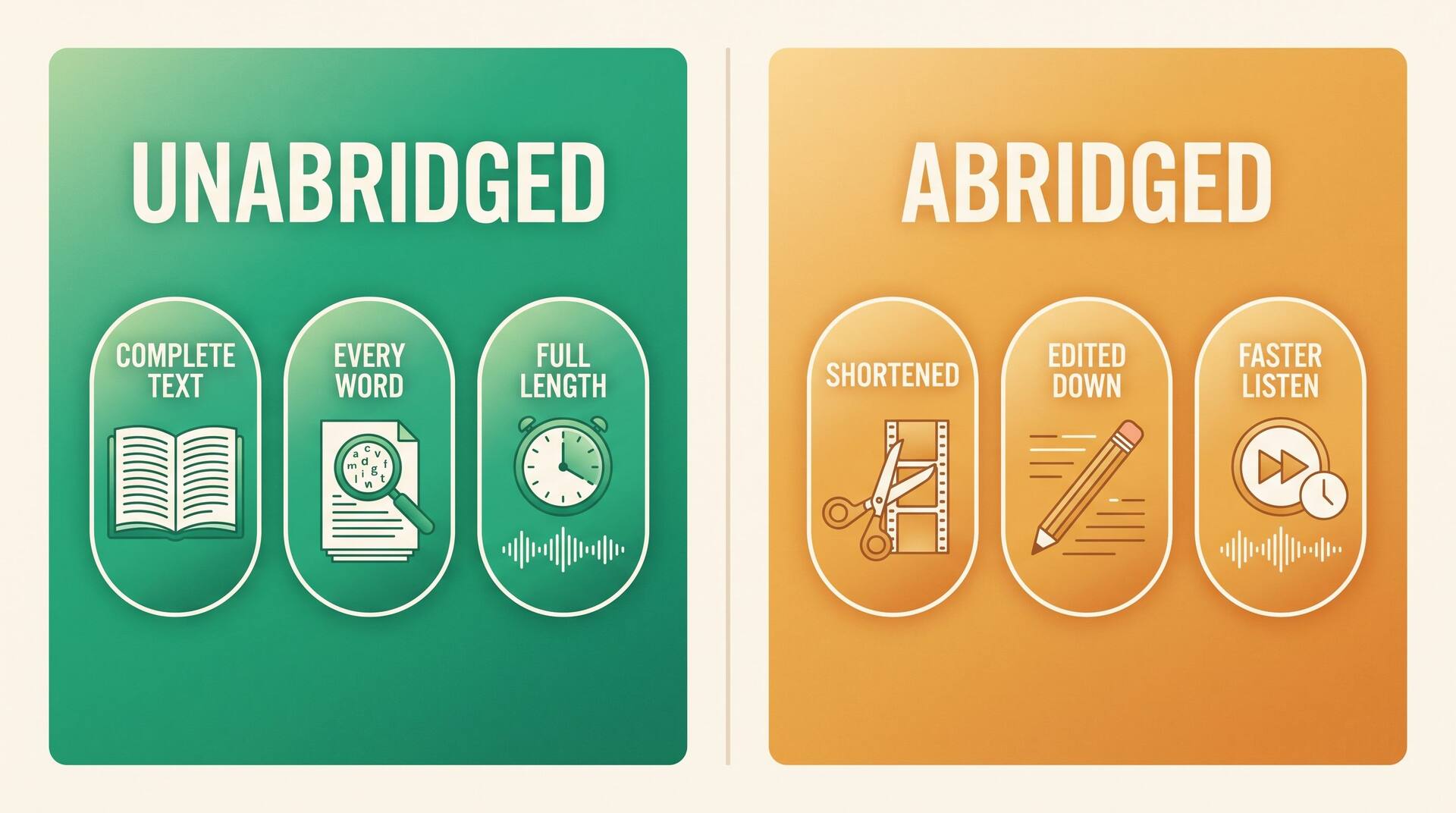
Unabridged
Length
Full original word count
Reader experience
The complete work as the author intended — full voice, full detail, full subplots
Best for
Most readers most of the time; literary study; collector editions; serious fans
Watch out for
Long classics can intimidate first-time readers; expect 12–40+ hours for audiobook
Why abridgment exists (a short history)
Abridgment is older than the printing press. Medieval scribes condensed religious texts and philosophy because copying by hand was expensive. Early printed editions were often shortened for the same reason — paper and labor cost money.
In the 19th and 20th centuries, abridgment expanded to serve two markets: school editions (long classics made accessible for younger readers) and commercial editions (long classics made accessible for time-pressed adults). Reader's Digest Condensed Books, launched in 1950, sold abridged versions of contemporary novels for decades.
The audio era added a third reason. Cassette tapes and CDs had hard limits on minutes. A 30-hour unabridged novel didn't fit on six cassettes; six cassettes was the commercial limit, so the novel got cut. That is why "abridged audiobook" became the dominant audio format from the 1980s through the early 2000s.
Then audio went digital. Streaming and downloadable audiobooks removed the physical limits. Today, unabridged audio is the overwhelming standard — Audible markets "unabridged" as a quality signal, and most listeners now expect the whole book.
Famous abridged and unabridged editions
These are the books where the unabridged-vs-abridged choice matters most — long, dense, beloved works that exist in both forms.
Les Misérables — Victor Hugo
Unabridged: ~1,400 pages with a 50-page essay on the Battle of Waterloo and a 30-page tour of the Paris sewers. Abridged: as short as 600 pages. The cuts are mostly Hugo's digressions, but those digressions are arguably the soul of the book.
War and Peace — Leo Tolstoy
Unabridged: 1,200+ pages, ~580,000 words. Several modern abridgments cut the philosophical and historical chapters Tolstoy wrote about determinism. Whether those cuts are improvements or amputations depends entirely on why you're reading.
Moby-Dick — Herman Melville
Unabridged: ~600 pages with extended chapters on whale anatomy, biblical metaphor, and the mechanics of nineteenth-century whaling. Abridged versions cut these to leave only the plot. The plot can be summarized in a paragraph; the book cannot.
The Brothers Karamazov — Dostoyevsky
Unabridged: ~800 pages including the famous Grand Inquisitor chapter and Father Zosima's life story. Abridgments routinely trim these long inset narratives — and they are arguably what makes the novel philosophy rather than melodrama.
It — Stephen King
Unabridged: ~1,100 pages, audiobook ~45 hours. Early audio editions were aggressively abridged (some down to 4 hours) — meaning entire characters and timelines were removed. The unabridged audio, now standard, is the only version that delivers the full book.
The Stand — Stephen King
Two completely different unabridged editions: the original 1978 trim (~800 pages) and the 1990 "Complete & Uncut" edition (~1,150 pages) that restored cuts the original publisher demanded. A reminder that even "unabridged" depends on which edition is the source.
Unabridged vs abridged audiobooks
Audiobooks are the format where the unabridged label matters most, because both versions are common, and the difference can be hours of listening.
Default is now unabridged
On Audible, Spotify, Apple Books, and most major platforms, audiobooks default to unabridged. Abridged versions are usually clearly labeled as such — and increasingly hard to find.
Pricing is the same
An unabridged audiobook costs no more than an abridged one, despite running 2–4x longer. The economics shifted entirely when distribution went digital and shelf space stopped mattering.
Audible specifies "unabridged" explicitly
Look for "Unabridged" next to the runtime on the product page. If it isn't there, check the publisher description. Self-published audiobooks on ACX must declare abridgment status during submission — and unabridged is the default.
Children's audio is the exception
Classic literature adapted for children — Treasure Island, Little Women, Oliver Twist — is regularly abridged and labeled as such. These are different products with different audiences, not failures to provide the original.
Digital audio also put translated editions within reach of self-publishers. With AI voice cloning, a finished unabridged audiobook can be dubbed into other languages in the original narrator's voice, so the complete book reaches new markets without booking a new narrator and recording every chapter again.
Which version should a reader choose?
For almost every reader, in almost every situation: unabridged. The default is unabridged for a reason — the book is what the author wrote. Abridgments are an editor's interpretation of what a different reader, with less time or less patience, might prefer.
Three situations where abridged might be the right call:
A long classic for a reluctant reader
If a 1,000-page Russian novel is the only thing standing between someone and discovering they actually like classic literature, an abridged version that hooks them is better than an unabridged version they never finish.
A specific use case (study, time pressure, accessibility)
Survey courses, language learners, short commutes, and accessibility needs all justify abridgment. The goal is not the full book — it is the core of the story in a format that fits.
Reader's Digest-style entertainment
Some readers genuinely prefer the condensed experience as its own form — faster pace, less digression, plot-forward. That is a legitimate preference, not a lesser one.
For everyone else: read the unabridged. The digressions are the book. Hugo's essay on the sewers is Les Misérables. Melville's whale anatomy is Moby-Dick. The book without the digression is a different, smaller book.
Self-publishing: should you abridge your own book?
If you're self-publishing, the unabridged question lands on you. Here is what every indie author should know.
On Amazon KDP, your book is unabridged by default
When you upload a manuscript to Amazon KDP, you are publishing the full text. There is no separate "unabridged" checkbox — your book is the unabridged edition because there is no other version. Don't claim "unabridged" in your title or subtitle unless there is also an abridged edition in market.
On ACX (Audible) you declare unabridged or abridged
ACX explicitly asks during audiobook submission whether your title is unabridged or abridged. The vast majority of indie audiobooks are unabridged because the production cost is the same, the price is the same, and listeners prefer it.
Consider a companion abridged edition only for specific markets
Children's editions of your own work, school-friendly adaptations, language-learner versions, or short "essential" editions for fans who want a re-read. These are separate products, with separate covers and ISBNs — not replacements for the original.
Self-edit before publication — that's not abridgment
Cutting your own draft before you publish is editing, not abridgment. You can and should remove what isn't earning its place. "Unabridged" only becomes a question after the book has an authoritative complete version readers can compare against.
Be transparent on the product page
If you publish an abridged companion, every listing — Amazon, Audible, your website — must say "Abridged Edition" clearly. Hiding it is the fastest way to one-star reviews from readers who thought they were getting the whole book.
Using AI to abridge — or audit — your manuscript
AI is a serious tool for both ends of the unabridged question.
- Draft a children's or YA abridgment of an out-of-copyright classic with chapter-by-chapter targets.
- Audit your own manuscript for over-padding before publication — "trim 10% without losing voice" is a legitimate AI prompt that beats most freelance edits.
- Generate a short-edition companion for fans (a 50% "essential edition") with the author's voice preserved.
- Run length checks against genre norms — your unabridged might be over the genre's commercial sweet spot.
- Cross-reference cut scenes with later callbacks so you don't break continuity when abridging.
AI is excellent at trimming. The judgment about what is structural and what is decoration is still yours.
Unabridged: frequently asked questions
No. Unabridged refers to length and completeness relative to the source edition, not censorship. A book can be unabridged and still be a censored version — the author or publisher may have removed content before publication. "Unabridged" only guarantees the published text is complete.
Unabridged is the default for a reason
Unabridged means the full book — every word, every scene, every digression the author chose to include. For readers, the default should almost always be unabridged. For self-publishers, your book is unabridged by default; the question is whether the work justifies a separate abridged edition for a specific audience.
The abridgment debate is really a debate about what a book is. If a book is a plot delivery system, abridgment is harmless. If a book is a voice, a worldview, a way of seeing — then every cut is a small amputation. Most great books are the second kind. For everything else about preparing your manuscript before publication, see our book editing guide.