


What you'll learn
The audiobook market crossed $9 billion in 2025 and is projected to double by 2030. But until recently, producing an audiobook meant either spending $3,000-$5,000 on professional narration or hours recording yourself. AI changed everything. Modern neural voices are nearly indistinguishable from human narrators in blind tests, and they let independent authors enter a market that was historically reserved for traditional publishers and bestselling indies. This guide walks you through the full production process, the platforms that matter, and the quality bar your audiobook needs to clear.
Why AI Narration Is Finally Viable
Three things changed in the last 18 months that make AI narration a real choice for serious authors.
Quality Crossed the Uncanny Valley
ElevenLabs, OpenAI, and Google's neural voices now deliver natural pacing, breath sounds, and expressive emphasis. Blind listening tests show listeners identifying AI narration correctly only 54% of the time. For most genres, the gap with mid-tier human narrators has closed.
Major Platforms Accept AI Audiobooks
Findaway Voices, Spotify Open Access, Apple Books, Google Play Books, and Audible's beta KDP audiobook program all accept AI-narrated content with proper disclosure. Distribution is no longer the blocker it was in 2023.
Costs Dropped 95% Per Finished Hour
A 10-hour audiobook professionally narrated runs $2,500-$5,000. The same audiobook produced with premium AI voices costs $30-$150 in compute, with most platforms charging by character count. This changes the math on which books are worth producing as audio.
Choosing the Right AI Voice for Your Book
Voice selection is the single biggest quality decision you make. Get this wrong and even perfect production can't save the audiobook. Here is the framework professional AI audiobook producers use.
Match Voice to Protagonist POV
First-person narratives need a voice that listeners would believe is actually the protagonist. A 60-year-old male voice cannot narrate a 22-year-old female protagonist convincingly. Third-person omniscient gives more flexibility, but warm storyteller voices outperform neutral narrator voices in retention metrics.
Genre Voice Conventions
Romance listeners expect warmth and intimacy. Thrillers want gravitas and slight tension in the baseline tone. Fantasy benefits from voices that can carry weight and grandeur. Self-help and business need authority and clarity. Test against bestselling audiobooks in your genre.
Accent and Cultural Authenticity
If your book is set in Edinburgh, an American Midwestern voice will feel wrong. ElevenLabs, Murf, and PlayHT now offer regional accent variants. Match the voice to the setting whenever possible, especially for character dialogue.
Pacing and Energy Level
Different voices have different baseline energy. Some neural voices feel energetic by default, others calm. Match this to your book's pacing. A frantic thriller paired with a low-energy voice creates a mismatch listeners feel even if they cannot articulate it.
The 60-Second Sample Test
Before committing to a voice, generate the same 60-second emotionally varied sample (calm description, dialogue, action, intimate moment) across 5-7 candidate voices. Listen to all of them in random order. The voice you keep wanting to hear more of is the right choice. Trust this gut response over technical features.
Directing Emotional Performance
Choosing a voice is half the work. The other half is directing it. AI voices respond to instructions, punctuation, and structural prompts in ways that dramatically change output quality.
Use SSML for Precise Control
Speech Synthesis Markup Language lets you control pause length, emphasis, pitch, and speaking rate at the word level. Most premium AI narration platforms support SSML or proprietary equivalents. Mastering it separates amateur AI audiobooks from professional ones.
Punctuation Is Performance
AI narrators use punctuation as their primary cue. Em dashes create thoughtful pauses. Ellipses suggest hesitation or trailing off. Italicized words receive emphasis when properly tagged. Edit your manuscript with the AI's interpretation in mind.
Stage Direction Tags
ElevenLabs v3 and similar tools accept inline tags like (whispered), (excited), (with sadness), and (laughing). These transform plain dialogue into performed dialogue. Use sparingly and intentionally, the way a director gives notes to a human actor.
Multiple Voices for Dialogue
Premium audiobook tools now support multi-voice narration where each character has a distinct voice. The narrator handles description, while character voices handle dialogue. Reserve this for books where character distinction matters: dialogue-heavy fiction, especially with large casts.
Skip the Production Hassle
AIWriteBook handles voice selection, chapter generation, mastering, and platform-ready exports automatically. Focus on the book, not the production pipeline.
Step-by-Step Production Workflow
Here is the production workflow that consistently delivers professional results, refined across hundreds of AI-narrated audiobooks.
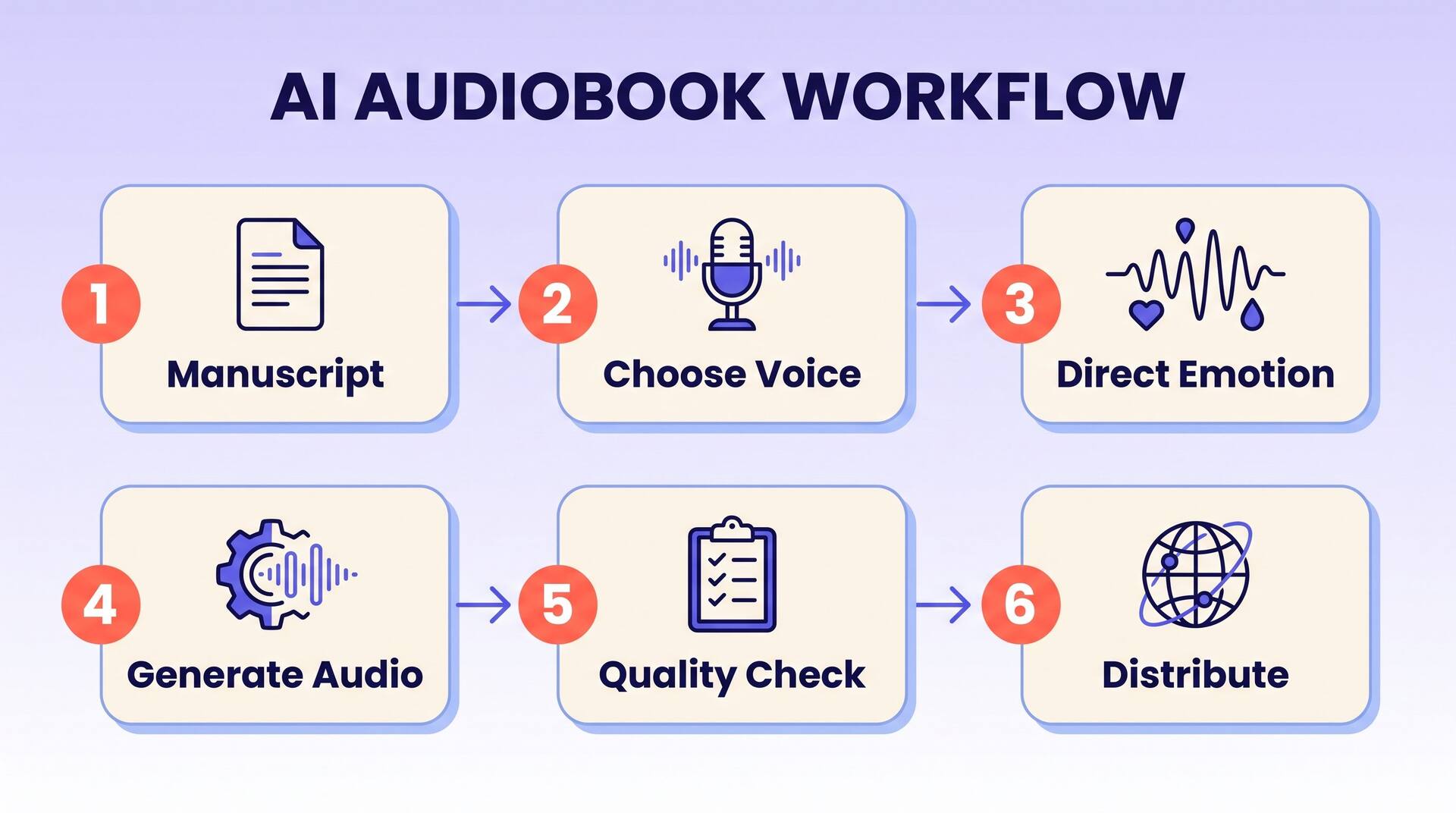
Prepare a Clean Master Manuscript
If you have not written the book yet, do that first — your manuscript becomes the script. Remove anything visual: page numbers, chapter art callouts, footnotes that cannot be spoken. Spell out abbreviations the AI might mispronounce (NASA, but also unusual character names). Add SSML or stage tags as needed.
Generate by Chapter, Not by Book
Generate audio one chapter at a time so you can quality-check before committing to a full book of issues. Save the source text and configuration alongside each chapter so you can regenerate later if a voice gets updated or deprecated.
Listen at 1x Speed Through Headphones
Listening at 1x catches issues 2x speed hides. Headphones expose breath sounds, mispronunciations, and unnatural pauses that speakers miss. Make a list of fixes per chapter rather than fixing as you go.
Fix Pronunciations and Mistakes
Use phonetic spelling (Aieran becomes air-uhn), SSML phoneme tags, or the platform's pronunciation dictionary. Common issues: character names, fictional places, technical terms, and homographs (wind the wind, lead the lead).
Master the Audio
Even pristine AI narration benefits from light mastering: normalize loudness to -23 LUFS for most platforms, -16 LUFS for Audible. Add 0.5 second of silence at the start and end of each chapter. Apply a gentle high-pass filter to remove any residual artifacts.
Add Chapter Markers and Metadata
Each chapter file should be tagged with title, author, narrator (yourself or 'AI Narration'), book title, and chapter number. Embed cover art as ID3 metadata. This makes the audiobook navigable on every player and enables proper distribution.
Quality Control Checklist
Run this checklist on every chapter before publishing
Where to Distribute Your AI Audiobook
Distribution policies vary widely, and getting your audiobook onto Apple Books follows different rules than Spotify or Findaway. Some platforms welcome AI audiobooks. Others require specific disclosure. A few still reject them outright.
Audible (KDP Audiobook Beta)
Policy
Accepts AI narration via the KDP virtual voice program for select titles. Disclosure required.
Royalty
Up to 40% royalty
Best for
Authors already publishing eBooks on KDP. Tightest integration with existing book listings.
Disclosure rules tighten constantly. Always check the current policy at upload time. Distributing AI narration without disclosing it can result in delisting and account suspension across platforms.
AI vs Human Narration: Real Cost Comparison
Here is the actual math for a 10-hour unabridged audiobook (roughly an 80,000-word novel), comparing professional human narration, indie human narration via ACX royalty share, and premium AI narration in 2026.
Professional Human Narrator
Timeline: 3-6 weeks
Per-finished-hour rates of $300-$500. Pay upfront. You own the recording.
ACX Royalty Share
Timeline: 2-4 months
Split future royalties 50/50 with the narrator for seven years. Quality varies. Limited narrator pool.
Premium AI Narration
Timeline: 2-7 days
Pay per character generated. You own the output. Iteration is cheap.
Self-Narration
Timeline: 1-3 months
Equipment, soundproofing, editing software. Best when you have time and a great voice.
AI narration changes which books are worth producing as audio. A backlist title selling 50 copies a year was never economical to narrate professionally. With AI it pays back in months even at modest royalty rates.
Common Mistakes to Avoid
Picking the Cheapest Voice
The price difference between basic and premium neural voices is small. The quality difference is enormous. Listeners abandon poor narration within the first chapter, regardless of how good the writing is.
Generating the Whole Book Before QA
If your voice has a recurring mispronunciation or unusual pacing tic, you will not catch it until chapter 3 or 4. Generate, listen, fix, then continue. Otherwise you regenerate everything.
Skipping the Pronunciation Pass
Character names and fictional places almost always need correction. Run a separate pronunciation review before the full generation. Build a project pronunciation dictionary you reuse across chapters and books.
Ignoring Loudness Standards
Audiobooks rejected most often for loudness issues. Audible requires -23 LUFS to -18 LUFS with peaks below -3 dBFS. Always master to spec, even if it sounds quieter than you expect.
Hiding the AI Disclosure
Listeners who feel deceived leave 1-star reviews. Listeners who knew upfront and enjoyed the experience leave 5-stars. Lead with the disclosure in the product description, not the fine print.
Where AI Audiobook Narration Is Heading
Voice Cloning for Authors
Within 12 months, you will be able to clone your own voice with 30 minutes of training audio and have it narrate your books. This solves the biggest current limitation: a memoir narrated by a generic voice instead of the author's.
Adaptive Performance
Next-generation models will read with awareness of context: knowing this scene is intimate or this dialogue is sarcastic, adjusting performance automatically. Stage tags will become optional rather than required.
Real-Time Audiobook Production
Cloud platforms will compile a finished, distribution-ready audiobook from a manuscript in under an hour. Author makes final approval, audio goes live across stores. Already in beta at several services.
The Bottom Line on AI Audiobook Narration
AI audiobook narration is no longer a compromise. It is a legitimate path to entering the audio market that was financially out of reach for most independent authors. The quality is real, the platforms accept it, and the math works.
The authors winning with AI audiobooks treat the production process with the same care a professional studio would: thoughtful voice selection, proper direction, tight quality control, and honest disclosure. Done well, an AI audiobook can earn back its production cost within 100 listens and continue earning passively for years.