


The math of small sessions
The single most useful productivity fact for writers is arithmetic. A modest daily habit produces several books a year. Even if you only write on weekdays, 500 words a day is more than 120,000 words a year: one long novel or two shorter ones.
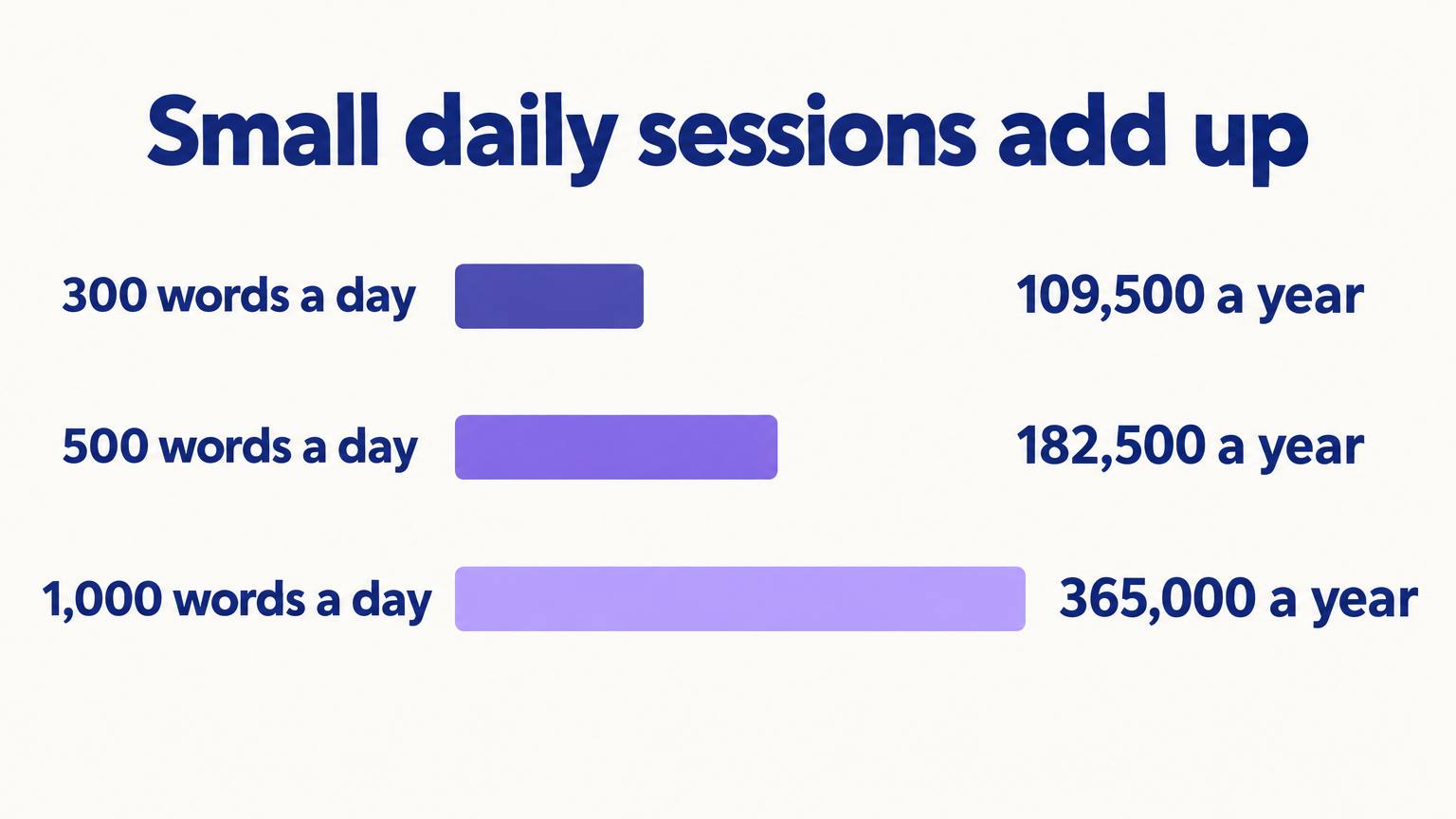
That changes the question from 'how do I find a free month to write my book?' to 'how do I protect 30 to 45 minutes a day?'. The second question has an answer.
Habits prolific authors share
Routines vary wildly, but the same patterns show up again and again in what high-output writers describe about their days.
A fixed daily quota
Stephen King describes aiming for around 2,000 words a day in On Writing. Anthony Trollope wrote against a watch before going to his day job at the Post Office, targeting a set number of words every quarter hour. The number differs; having one does not.
The same time every day
Haruki Murakami has described rising very early and writing for several hours before doing anything else. Most prolific authors protect one repeated slot, often first thing, before email and other people's priorities arrive.
Planning before writing
Fast writers rarely discover the whole story at the keyboard. They know what the next scene has to do before they sit down, even if they leave room for surprises inside it.
Physical maintenance
Running, walking, and regular sleep come up constantly. A long book is an endurance job, and the body is part of the tool.
Shipping, not polishing forever
High-output authors finish, revise in a defined number of passes, and move to the next book. A catalog grows from finished books, not perfect ones.
Time blocking for writers
Put writing on the calendar the way you would put a meeting there. A block that exists only as an intention gets eaten by everything else. Here is a sample week for someone with a full-time job.
| Day | Block | Task |
|---|---|---|
| Mon to Fri | 6:30 to 7:15 | Drafting only, 2 sprints |
| Tue, Thu | Lunch, 20 min | Plan the next two scenes |
| Saturday | 9:00 to 11:00 | Longer drafting session |
| Sunday | 30 min | Review the week, update the outline |
Notice that planning and drafting live in different blocks. When you sit down to draft you already know what to write, which is where most of the speed comes from. If you are planning a full book, the free outline generator gets you a scene list to work from.
Focus: the sprint method
A sprint is a short, timed burst of writing with no editing and no switching. It works because a fixed end point makes it easier to start.
- 1
Write one sentence describing what this sprint will cover.
- 2
Turn off notifications and close every tab you do not need.
- 3
Set a timer for 25 minutes.
- 4
Write forward only. Mark gaps with a placeholder and keep going.
- 5
When the timer ends, note your word count and the next sentence you would write.
- 6
Take a 5-minute break, then decide whether to run another.
The placeholder rule matters most. Stopping to look things up is the biggest hidden time drain in drafting. We go deeper on this in our guide to writing your first draft.
Your writing environment
Your brain learns cues. Writing in the same place, with the same playlist or the same mug, makes it easier to drop into focus over time. It does not need to be special, only consistent.
Reduce friction to zero. Leave the document open where you stopped. Keep your outline and character notes in the same tool as the manuscript so you never have to hunt for a name. And keep the phone in another room; even face-down, it competes for attention.
Where AI saves real hours
AI is most useful for the work around the writing, the parts that eat time but are not the creative core. Used that way it can shorten a book project noticeably without making the prose sound generic.
In AIWriteBook, characters, the outline and per-chapter story bibles live next to the manuscript, so continuity questions are answered in one place. The chapter generator can produce a first pass of a chapter from its bible when you are stuck, and you rewrite from there. For multi-book projects, book series support carries characters and events from book one into book two, which removes days of re-reading.
Small jobs go faster too: a free character name generator, a blurb generator for the back cover, and formatting and export to EPUB and print PDF when you are done.
Track the right number
Track words drafted per session and days written per week. The second number is more important. A streak of short sessions beats an occasional heroic weekend, and seeing the streak is motivating in itself.
Do not track hours at the desk. Hours reward sitting, not writing. A quick tally in a notebook or spreadsheet is enough; the free word counter works if your editor does not show totals.
Make it sustainable
Productivity that burns you out is not productivity. Plan rest days, finish sessions while you still have energy, and lower the quota rather than skipping entirely on hard weeks. A 100-word day keeps the habit alive.
And when words stop coming for weeks, treat it as information, not failure. Our guide to overcoming writer's block helps you work out whether the problem is the plan, the story, or simply fatigue.
Protect the slot, count the words
Pick a daily number, give it a fixed time, separate planning from drafting, and track days written. Do that for three months and you will likely have more pages than in the previous three years.
For the whole journey from idea to finished book, see our How to Write a Book guide.