

The job of a first draft
A first draft has exactly one job: to exist. It is raw material. You cannot revise a blank page, but you can revise a messy 70,000 words into a good book. Every decision you make while drafting should be judged by one question: does this get me closer to the last page?
That means your draft is allowed to be repetitive, to change a character's name halfway through, to contain a scene that just says what happens instead of showing it. Those are problems for the revising version of you, who works with completely different rules.
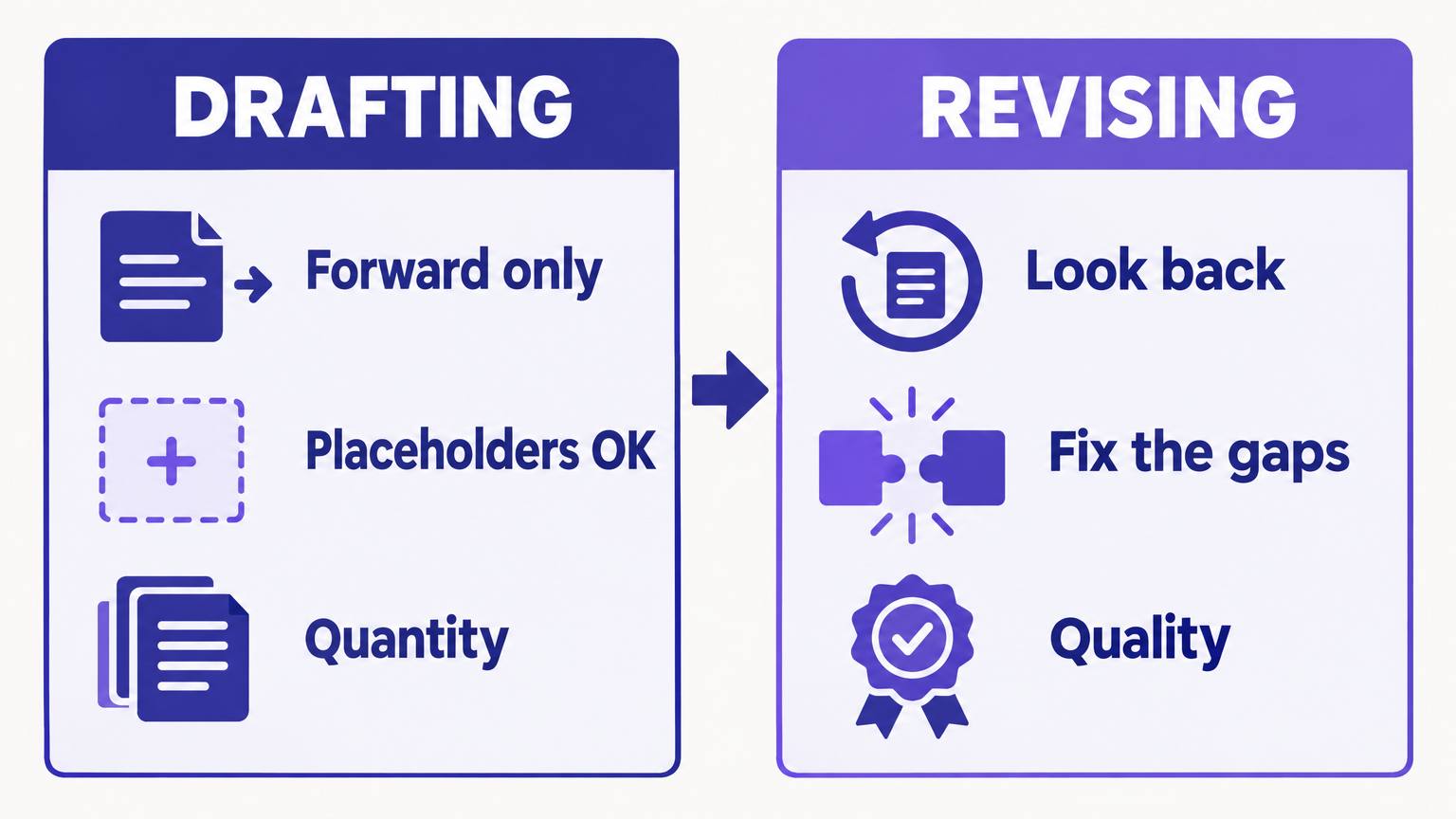
Separating the two jobs is the single biggest change most stalled writers can make. While drafting you move forward only. While revising you look back. Doing both at once is why so many people rewrite chapter one eleven times and never see chapter twelve.
Prepare just enough
Too little planning and you stall at the first plot fork. Too much and the outline becomes a place to hide. The sweet spot is a one-page map you can hold in your head: who wants what, what stops them, how it ends, and four or five big turning points in between.
If you have never built that map, our guide to creating a book outline walks through it, and the free outline generator can give you a first structure to argue with in a few minutes. You will change it. That is fine; the point is to know which direction tomorrow's scene points.
The minimum kit before day one
- →A one-sentence premise you could say out loud
- →Your protagonist's goal and the main thing in the way
- →A rough ending, even if it changes later
- →Four to six turning points or chapter clusters
- →A target length for the finished draft
Set a daily word goal you can hit on a bad day
Pick a number low enough that you would hit it with a cold, a deadline and a sick child. Consistency beats intensity: a writer who does 500 words every day finishes a novel faster than one who does 4,000 words on the rare inspired weekend.
Work backwards from your target length. A typical adult novel lands somewhere between 70,000 and 90,000 words (our post on how many words a novel needs breaks it down by genre). Divide by your daily number and you have a real finish date.
How long a 75,000-word draft takes
| Words per day | Writing days | Calendar time at 5 days a week |
|---|---|---|
| 250 | 300 | About 14 months |
| 500 | 150 | About 7 months |
| 1,000 | 75 | About 15 weeks |
| 2,000 | 38 | About 8 weeks |
Track progress with the free word counter if your editor does not show a running total.
Beat perfectionism with placeholders
Perfectionism usually shows up as research. You need a detail, you open a browser, and forty minutes later you know everything about 1890s railway timetables and have written nothing. The fix is a placeholder: type a marker and keep moving.
Use a symbol you will never type by accident, like double brackets, so you can search for every gap during revision.
[[NAME]]A minor character you have not named yet[[CHECK: train times 1890]]A fact to verify later[[FIGHT GOES HERE]]A scene you know happens but cannot face today[[BETTER LINE]]Dialogue that works but sounds flatThe rule that makes this work: you may not go back to fill a placeholder until the whole draft is done. If a minor name really bothers you, the character name generator takes ten seconds, so it costs less than the guilt.
Keep momentum through the middle
The middle is where drafts sag. The opening energy has gone and the ending feels far away. A few habits carry you across it.
Stop mid-sentence
End each session in the middle of a scene you know how to finish. Tomorrow you start by completing a sentence instead of facing a blank page.
Write the scene you want
You do not have to draft in order. If the confrontation in chapter twenty is calling you, write it now and bridge to it later.
Raise the stakes, not the word count
If a chapter feels dead, ask what your character could lose in it. A sagging middle is usually missing pressure, not detail.
Keep a 'later' file
Every new idea for an earlier chapter goes into a separate note, not back into the manuscript. You will revise with it, not now.
If you are truly stuck rather than just tired, our guide to overcoming writer's block has a diagnosis for each kind of stall.
Drafting with AI without losing the book
AI is most useful in a first draft exactly where perfectionism hurts most: getting from nothing to something. It is least useful when you hand it the whole book and walk away, because the result reads like nobody wrote it.
In AIWriteBook the draft is built from your own plan. You set the characters and the outline, and each chapter has a story bible with its events, locations, twists and a word-count target. The chapter generator writes a first pass of a chapter from that bible, which gives you something concrete to react to instead of a blank page.
Then you take over. The AI chat assistant inside each chapter rewrites passages on request and shows every change as a diff you accept or reject, so the voice stays yours. If you already have a few chapters written by hand, import them and use the writing style builder so new chapters match how you write.
What happens after you type The End
Celebrate, then close the file for at least a week. You need distance to see what is on the page rather than what you meant to put there.
When you come back, read it straight through like a reader, making only notes. Then work big to small: structure first, then scenes, then sentences, then typos. Our self-editing guide covers that four-pass method in detail.
Done beats perfect
A finished rough draft puts you ahead of most people who ever say they want to write a book. Keep the bar low enough to clear every day, move forward only, and leave the polishing for later.