

How an ISBN works
The ISBN standard was created in the 1960s and moved to its current 13-digit form in 2007 (older books carry a 10-digit ISBN-10, which maps to the same title). Each ISBN points to exactly one product: a specific title, edition, and format. Change the format and you change the number.
ISBNs are issued by national agencies, not by Amazon. In the United States, Bowker (through MyIdentifiers.com) is the only official source. A single ISBN from Bowker costs around $125, while a block of 10 brings the per-book price down sharply, so most serious self-publishers buy in bulk. Many countries hand them out free through their national library — Canada and the UK's registration systems, for example, work differently from the paid US model.
The rule that trips people up: you need a separate ISBN for every format. The paperback, the hardcover, and (if you assign one) the ebook each require their own. A major revised edition also needs a fresh ISBN, because it is technically a new product.
What an ASIN is
An ASIN — Amazon Standard Identification Number — is a 10-character alphanumeric code Amazon assigns automatically to every product in its catalog, from headphones to Kindle books. You never buy or register one; it appears the moment your listing goes live and shows up in the product URL and the "Product details" box.
For a Kindle ebook, the ASIN typically starts with "B0" and stands in for an ISBN entirely — Kindle does not use or require one. For a print book, Amazon often reuses the ISBN-10 as the ASIN. When you research keywords and categories for a listing, the ASIN is the anchor everything hangs on; our free KDP keyword research tool works from exactly this kind of Amazon listing data.
The catch is portability: an ASIN is meaningless outside Amazon. Kobo, Apple Books, libraries, and print distributors will not recognize it. If you ever go wide, an ISBN is the identifier that travels with your book.
ISBN vs ASIN, side by side
The two codes are often confused because both identify a book — but they come from different owners, look different, and behave differently.
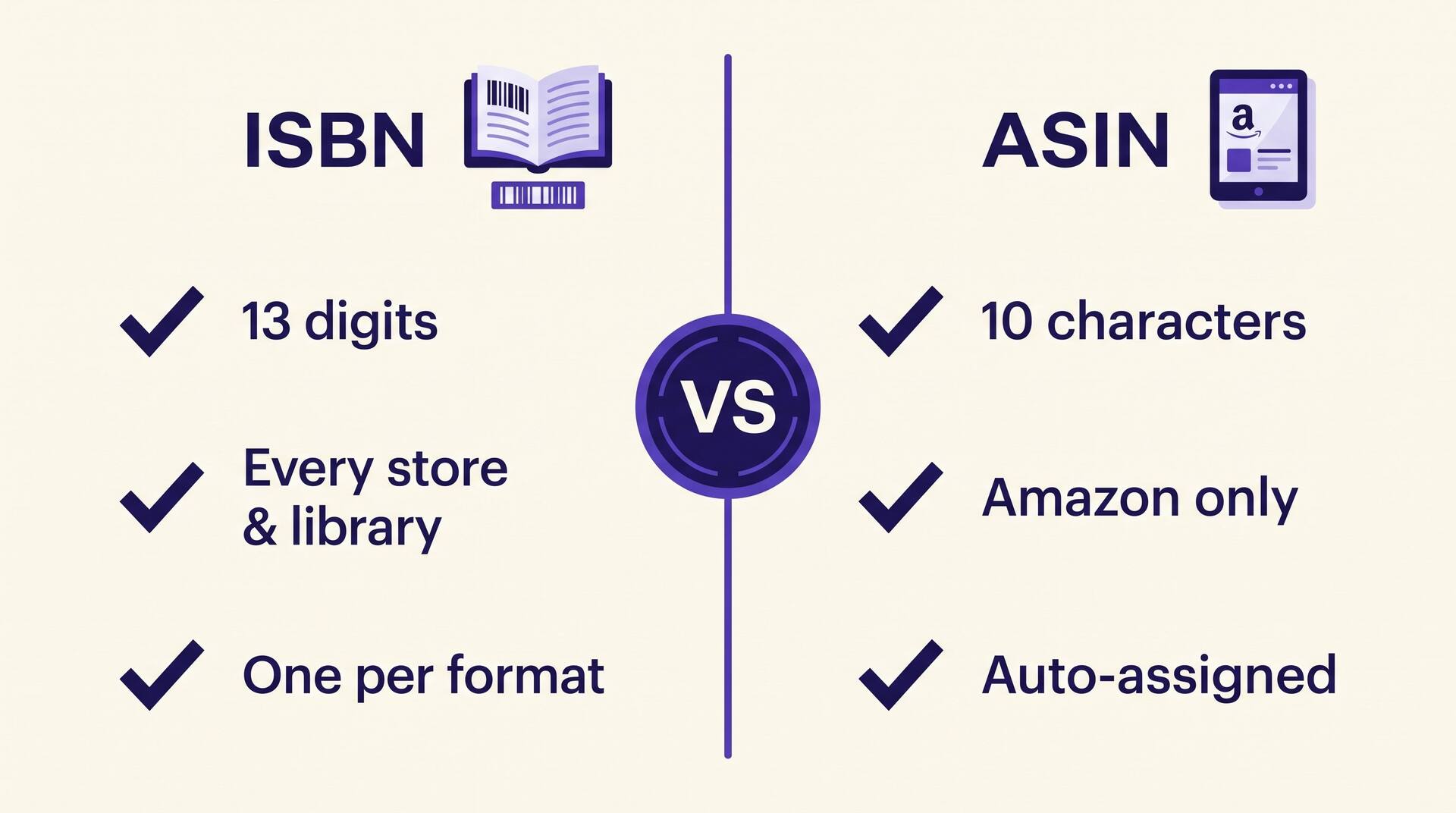
| Dimension | ISBN | ASIN |
|---|---|---|
| Full name | International Standard Book Number | Amazon Standard Identification Number |
| Who assigns it | A national agency (Bowker in the US) | Amazon, automatically |
| Format | 13 digits (older books: 10) | 10 characters, often starting "B0" |
| Works where | Every retailer, library and distributor | Amazon only |
| Cost | Paid from Bowker, or free from KDP (print only) | Always free and automatic |
| Needed for a Kindle ebook? | Optional and unused by Kindle | Yes — every Kindle ebook has one |
| Ownership & portability | You can own it and reuse it anywhere | Not transferable off Amazon |
Why it matters for self-publishers
When you publish a paperback or hardcover on KDP, Amazon offers you a free ISBN. It is genuinely free and it qualifies for Expanded Distribution, but there is a trade-off: the imprint on the book will read "Independently published," and that ISBN is tied to Amazon — you cannot carry it to IngramSpark or another printer.
Buy your own ISBN from Bowker instead and you become the publisher of record. You can set your own imprint name, reuse the same number across platforms if you go wide, and keep a clean, professional record that is yours rather than Amazon's. For a single book that will only ever live on Amazon, the free ISBN is fine. If you are building an author brand or a catalog, owning your ISBNs is usually worth it.
None of this applies to your Kindle edition — it rides on its ASIN, so you can skip the ISBN there entirely and save the money for the formats that actually need one. If you want the full picture of how ISBNs, imprints, and distribution fit together, our guide to getting an ISBN for a self-published book walks through each option, and the wider Amazon KDP guide covers the rest of the publishing setup.
Common mistakes and confusions
These four mix-ups cause most of the ISBN-versus-ASIN questions we see from new authors:
Buying an ISBN for a Kindle ebook
You do not need one. Amazon assigns an ASIN automatically, and Kindle ignores any ISBN you supply. Spending money here is spending it in the wrong place.
Reusing one ISBN across formats
The paperback, hardcover, and ebook are separate products. Each needs its own ISBN — you cannot share a single number between them.
Assuming an ASIN works everywhere
An ASIN only functions inside Amazon. Other stores, libraries, and print distributors need an ISBN to list or stock your book.
Taking KDP's free ISBN, then trying to go wide
A free KDP ISBN is locked to Amazon's distribution. If you later print the same book through IngramSpark, you will need to buy and assign your own ISBN first.
A quick worked example
Say Maria publishes her novel as a paperback and a Kindle ebook. The Kindle edition gets an ASIN like B0C1D2E3F4 automatically — no ISBN, no cost. The paperback gets an ISBN, either free from KDP or her own from Bowker.
Six months later she adds a hardcover: that is a third product, so it needs its own third ISBN. And when she decides to sell the paperback through IngramSpark as well, she discovers the free KDP ISBN will not travel — so she buys her own, reassigns it, and from then on the same number identifies her paperback on every store that stocks it.
Related terms
Keep exploring the identifiers and formats behind a KDP listing:
Frequently asked questions
The ISBN and ASIN questions self-publishers ask most often.
No. Amazon assigns a Kindle ebook its own ASIN automatically, and Kindle does not use an ISBN even if you have one. You only need ISBNs for print formats such as paperback and hardcover.
An ISBN is a universal 13-digit book identifier recognized by every retailer, library, and distributor. An ASIN is Amazon's own 10-character product code that works only on Amazon. A print book usually carries both; a Kindle ebook carries only an ASIN.
The free KDP ISBN is fine for a book that will only sell on Amazon, but it lists the imprint as "Independently published" and cannot be moved to another platform. Buying your own ISBN from Bowker lets you set your own imprint and reuse the number across stores if you go wide.
Yes. Every format is a distinct product, so the paperback, the hardcover, and any assigned ebook each need their own ISBN. A major new edition needs a fresh ISBN too.
They identify the same book. ISBN-13 has been the standard since 2007, and any older 10-digit ISBN can be converted to the 13-digit form. Amazon often reuses a print book's ISBN-10 as its ASIN.
Once you know that an ISBN travels everywhere and an ASIN stays on Amazon, the rest of the KDP setup falls into place. See the complete Amazon KDP guide.