

Why the page is worth real effort
Acknowledgments are the only page in a book where the author steps out from behind the work and talks directly to the people who carried them through it. Readers who reach it are already invested. Reviewers skim it for context. Everyone you name will read it, and several of them will read it more than once.
There is a practical side too. An acknowledgments page is a public record of who helped, which matters when you approach the same editor, sensitivity reader, or subject-matter expert for the next book. For non-fiction, naming the specialists who checked your claims quietly reinforces that the book was checked at all, which is a different job from the formal source notes you put in the back matter.
The cost of getting it wrong is asymmetric. A slightly flat acknowledgments page costs you nothing. A forgotten name costs you a friendship, and it is unfixable once the book is printed.
Where it goes and how long it should be
Acknowledgments sit in the front matter for most non-fiction and in the back matter for most fiction. Both are correct; the question is whether the thanks give the reader useful context before they start, or whether they would break the spell of a story's opening. Memoir and narrative non-fiction often split the difference by putting a short note up front and the full thanks at the end.
If you are unsure, look at three recent books in your genre and follow the majority. Front-matter placement also means the page can appear in the Amazon Look Inside sample, which is a reason some non-fiction authors keep it there and some novelists deliberately move it to the back so the sample gives readers story instead of gratitude.
Length is where most first-time authors overshoot. One page is the target: roughly 250 to 400 words. Debut novels tend to run longer because the author has waited years to thank everyone; later books get shorter as the routine collaborators become a single sentence. Anything past two pages reads as a speech, and speeches get skimmed.
Placement decides how the page is typeset, so settle it before you export. Our guide to formatting a book for KDP covers where front and back matter fall in an ebook versus a paperback, and the free back matter generator assembles the surrounding pages so the acknowledgments are not sitting alone.
The order of thanks that never offends
There is no legal order, but there is a convention that avoids awkwardness, and it works because it moves from professional distance to personal closeness. Ending with the people closest to you reads as a crescendo; opening with them and then listing your copyeditor reads as an afterthought.
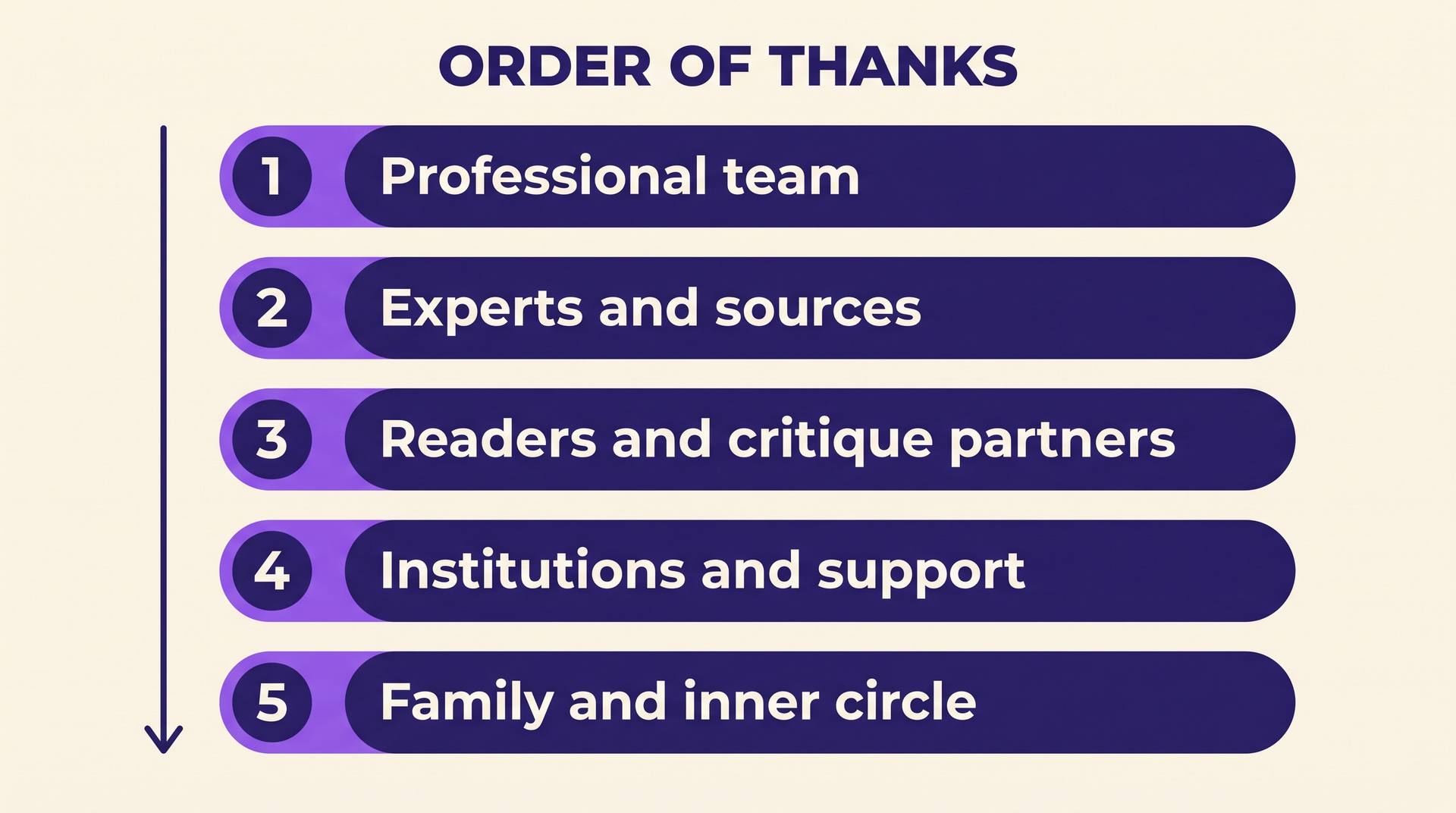
Professional team
Agent, acquiring editor, developmental and copy editors, cover designer, publicist. Name them and say what they did in four or five words — the specificity is what makes it read as thanks rather than a credits roll.
Experts and sources
Interviewees, subject-matter reviewers, archivists, translators, sensitivity readers. This tier carries the most weight in non-fiction and the most risk: check spellings and job titles with the person before you print them.
Readers and critique partners
Beta readers, workshop groups, the friend who read three drafts and told you the truth about chapter nine. Group thanks are fine here if the group has a name; individual thanks are better if the list is short.
Institutions and support
Residencies, grants, libraries, employers who gave you leave, the cafe that let you sit for four hours. Funding bodies often have required wording — look it up, because they do check.
Family and inner circle
Partner, children, parents, the friends who absorbed the moods. This is the emotional close, and it is the only tier where a private joke is allowed, because the people who need to understand it will.
Inside a tier, order by contribution rather than by how much you like someone. If two people did roughly the same amount, alphabetical order is a defensible answer you can point at later.
Pick a tone and hold it
The single most common failure is tonal whiplash: a formal opening paragraph, a joke in the middle, and an unguarded confession at the end. Choose one register and keep it for the whole page. These three cover almost every book.
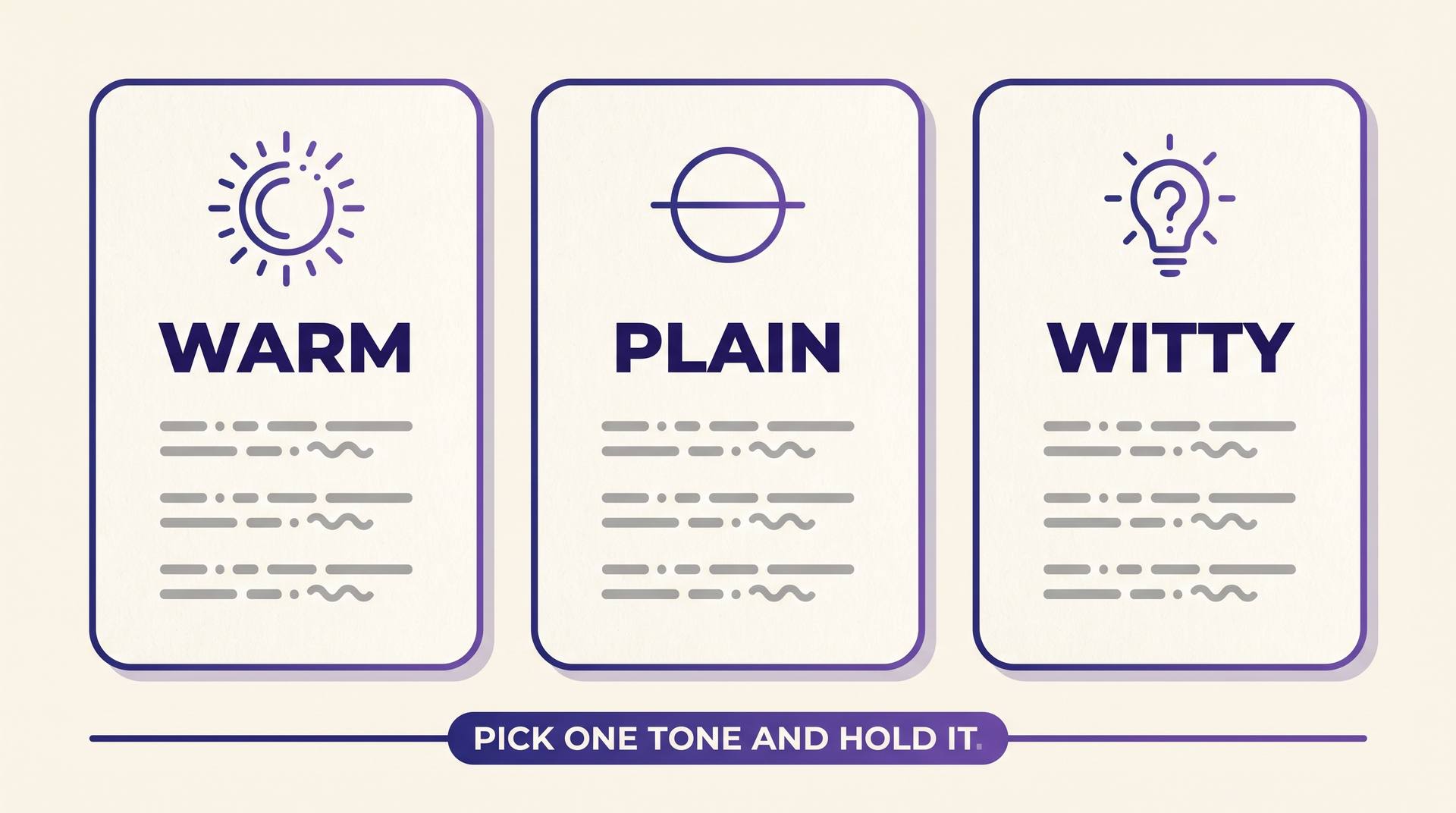
Best for memoir, literary fiction, and any book that cost you something personal.
To Ines Achebe, who read the first draft when it was still three unrelated stories in a folder and told me, kindly, that it was three unrelated stories in a folder. The book exists because she kept asking what happened next.
It names one person, states one concrete thing they did, and lands on what it changed. Emotion comes from the detail, not from adjectives.
Whichever you pick, read the page aloud once. Acknowledgments are closer to speech than any other page in a book, and the ear catches the false note before the eye does.
Six steps from blank page to finished draft
Do not start by writing. Start by remembering, because the panic of a blank page is what makes authors forget people.
Dump every name for fifteen minutes
Open your email, your messages, and the acknowledgments file you should have been keeping since chapter one. Write every name down with no filtering and no sentences. You are hunting for the person who answered one question in month two and has since fallen out of memory.
Tag each name with what they actually did
Three or four words each: read draft two, checked the medical scenes, watched the kids on Saturdays. These tags become the specific clauses that separate a real acknowledgment from a list.
Sort into the five tiers
Assign every name to one tier. If someone genuinely belongs to two — your agent who is also your friend — thank them once, in the tier that reflects the work.
Write one paragraph per tier
One paragraph, no bullet lists. Bullet lists in acknowledgments read like a conference programme. Keep each paragraph to three or four sentences and let the tiers carry the structure.
Cut a third
Remove every intensifier, every phrase that could apply to any book, and every sentence explaining how hard writing is. What remains is the page. This single pass is what takes an acknowledgments section from dutiful to memorable.
Send the draft to anyone you name in public
A one-line message with their sentence attached. It catches misspelled names, wrong job titles, and the occasional person who would rather not be associated with the book. Do this before the file goes to print, not after.
Step one is easier if the names already live with the manuscript. Writing in AIWriteBook, you can keep a running thank-you list in a chapter note beside the draft, then use the chapter AI chat to tighten the finished paragraph — it shows edits as a diff you accept or reject line by line, so the wording stays yours.
Mistakes that cause real damage
Thanking a category instead of a person
"Everyone who supported me" thanks nobody. If you cannot name them, the sentence is decoration. Either find the names or cut the sentence.
Ranking people by accident
Words like finally, last but not least, and above all create a podium you did not mean to build. Use tier structure for order and neutral connectives inside each tier.
Naming someone who did not consent
Therapists, doctors, sources who spoke off the record, and ex-partners can all be harmed by an appearance in print. Ask, and accept a no without negotiating.
Turning it into a sales page
Newsletter links, series teasers, and review requests belong in the back matter, not in the middle of your thanks. Mixing them makes the gratitude look like a device.
Leaving it until the file is final
Written in one exhausted sitting the night before upload, the page shows it. Draft it at the halfway mark of revisions, when you still remember who helped and why.
Copying the spelling from memory
Middle initials, accented characters, hyphenated surnames, and legal business names are the four things authors get wrong most. Copy and paste them from a message the person sent you.
Worked examples by book type
Same five tiers, three very different books. Notice how the weight shifts between tiers rather than the structure changing.
Two sentences for the agent and editor, one for the cover designer, a full paragraph for the critique group that saw eleven drafts, and a close on the partner who paid the rent through the last one. The critique group is the heart of a debut because that is where the book was actually made.
Opens with the reviewers and interviewees by name and field, carries the error disclaimer, then the publishing team, then a short personal close. Weight sits in tier two because the book's authority depends on it.
Shortest of the three. Regular collaborators get one combined sentence, this book's new contributors get named individually, and the page ends by thanking the readers who asked for book two — the only place where thanking readers as a group does not read as filler.
A fill-in template you can adapt
Use this as a skeleton, then delete every clause that is not true for your book. It is written to be cut down, not filled in.
This book reached print because of [agent], who saw the shape of it before I did, and [editor], whose questions rebuilt the middle third. [Designer] gave it the cover it needed. [Expert] checked [specific chapters or claims], and [source] gave me hours of their time and the detail on page [x]. Any errors that survive are mine. [Beta reader] and [beta reader] read the draft when it was still difficult, and told me so. [Group] kept me honest every [week or month] for [duration]. [Institution] gave me [space, time, funding, or access] in [year], without which the research would not have happened. And [name], who lived with this book as long as I did. Thank you.
Five paragraphs, one per tier, under 300 words once filled. If yours runs far longer, the extra length is almost always intensifiers rather than extra people.
The AI-assisted shortcut
Do not ask a model to write your acknowledgments from nothing — the result is smooth, generic, and instantly recognisable as such. Use it for the two jobs it is genuinely good at instead.
Turn your notes into prose
Paste your tier list with the four-word tags and ask for one paragraph per tier in your chosen tone. You supply every fact; the model supplies only the connective tissue, which is the part that is genuinely tedious.
Cut without losing anyone
Ask for a version 30 percent shorter that keeps every proper noun. It is a mechanical task that humans do badly under deadline, and you can check the result by counting names in and names out.
Then rewrite at least two sentences by hand. The page is supposed to sound like you, and the fastest way to make it sound like you is to make sure some of it literally is.
Questions authors ask
Both are correct. Acknowledgments is standard US spelling and acknowledgements is standard UK spelling. Match whichever variety the rest of your book uses, and make sure the heading matches your table of contents exactly.
Write it while you still remember
The best acknowledgments pages are not the most emotional ones. They are the specific ones: a real name, a real thing that person did, and a sentence about what it changed. That is the whole craft, repeated five times and cut by a third.
Open a file today and dump the names, even if the manuscript is only half done. Every author who has written this page in a hurry has also written an apology email afterwards.
The acknowledgments are one of the last pages you write, but they belong to the same process as everything before them — the full sequence is laid out in our guide to writing a book.