


Not legal advice. This article is general information for authors, not legal advice. Copyright rules differ by country, and fees and forms change. Confirm anything that matters to your case on copyright.gov or with a lawyer in your jurisdiction.
What this guide covers
The myth that costs authors money
Almost every question about copyrighting a book starts from a wrong premise. Sorting that out first saves you from the two classic wastes: paying for something you already have, and skipping the one thing that actually matters.
Your book is unprotected until you file something.
In the US, copyright exists the moment the work is fixed in a tangible form — the instant you save the file. No form, no fee, no notice required.
Mailing yourself a copy — the "poor man's copyright" — is a legal substitute.
A postmarked envelope is not a substitute for registration. It gives you no statutory damages, no attorney's fees, and no right to file suit.
Registration is optional, so it does nothing.
Registration is where the leverage lives. In the US you generally must register before you can file an infringement lawsuit, and only timely registration unlocks statutory damages and attorney's fees.
So the honest answer to "how do I copyright my book" is: you already did. The real question is whether you register it — and when.
Registering, step by step
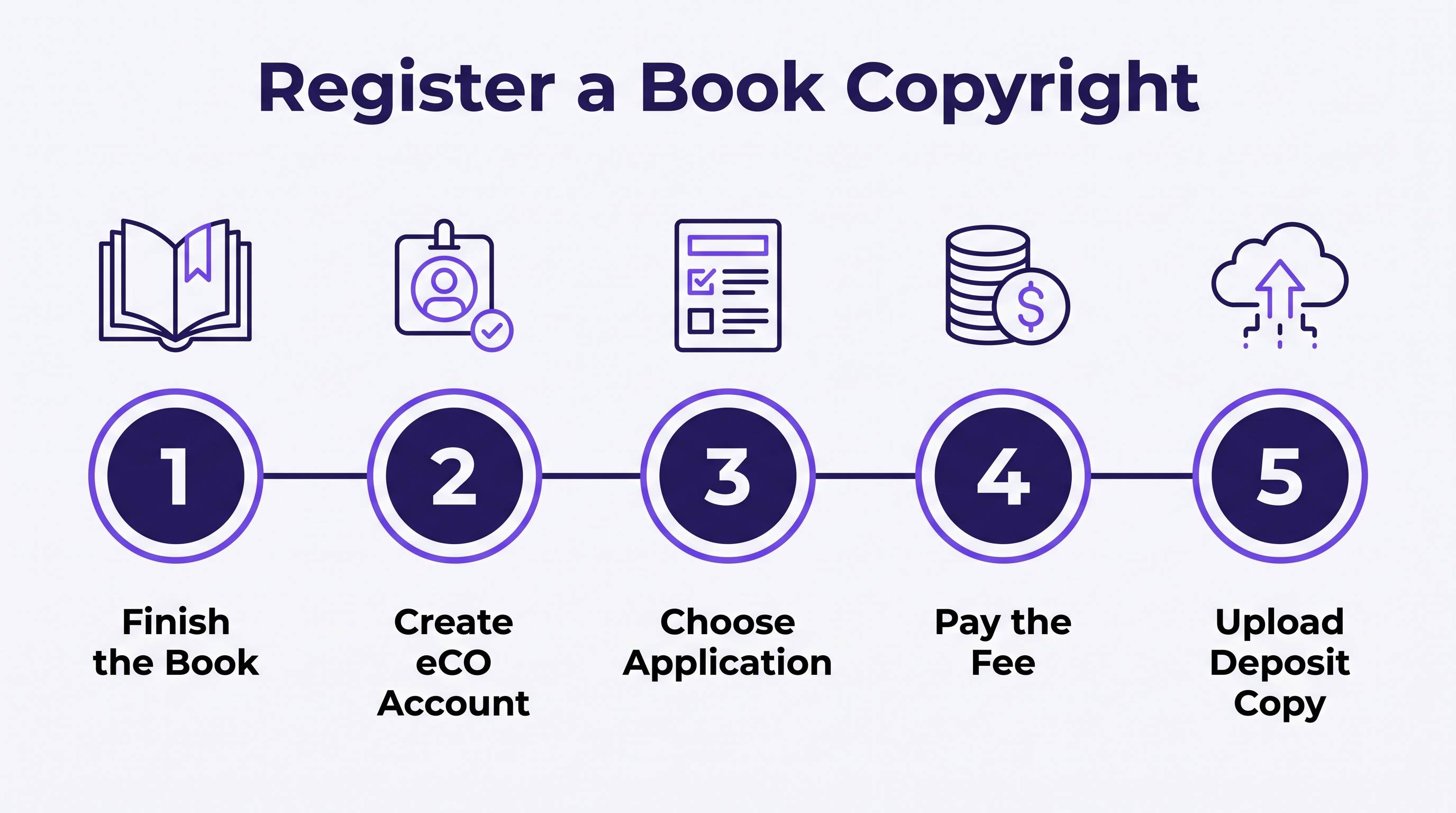
US registration runs through the Copyright Office's electronic system, eCO, at copyright.gov. Filing online is cheaper and faster than paper, and for a straightforward novel or non-fiction book the whole session takes well under an hour.
- 1
Finish the book first
Register the version you intend to publish. If you register a draft and then rewrite half of it, the registration covers the draft — and substantially new material would need its own filing. Wait until the manuscript is final, or at least until the text is stable.
- 2
Create an eCO account
Register a free account on copyright.gov. Use a name and address you will still control in five years: the Copyright Office record is public, and the certificate goes to whatever address is on file.
- 3
Pick the right application
Most self-published authors file a single application for a single work by a single author, where that author owns all rights. Co-authors, work-for-hire arrangements, anthologies, or a collection of previously published pieces push you to the standard application instead.
- 4
Complete the claim and pay
You will name the author, the year of completion, the publication status and date if it is already published, and any pre-existing material you did not write. Pay by card inside the session — the fee is not refundable if the claim is refused.
- 5
Upload the deposit copy
For a work published only electronically, upload the file directly. If the book was published in physical copies in the US, the Copyright Office generally wants physical copies mailed in, with a shipping slip printed from the same session.
- 6
Keep the effective date
Your registration takes effect on the day the Office receives a complete submission, not the day the certificate arrives. Save the confirmation email — that date is the one that matters if you ever need it.
What it costs and how long it takes
Figures below are the ballpark for US electronic filings and are the numbers most likely to change, so treat them as a planning estimate and check the current fee schedule before you file.
The practical read: under fifty dollars, once, on a book you plan to sell for years. If the book is a hobby project you will never enforce, skipping registration is a defensible choice. If it is a business asset, it is the cheapest insurance in publishing.
Copyright page vs. copyright registration
These two get conflated constantly, and the confusion is expensive in both directions — authors who print a copyright page and think they are registered, and authors who register and then ship a book with no copyright page at all.
The copyright page
Front matter, page ii
- A page inside your book stating the copyright notice, year, rights holder, edition, and usually the ISBN.
- Notice is optional under current US law, but it removes any "I didn't know" defence from an infringer.
- Costs nothing and takes minutes. Every professionally produced book has one.
- Creates no legal record anywhere outside your own book.
The registration
Copyright Office record
- A public record of your claim held by the Copyright Office, with a certificate to prove it.
- Generally required before you can file an infringement suit in the US.
- Timely filing preserves statutory damages and attorney's fees — the part that makes a case worth bringing.
- Costs a fee and takes months to issue, though the effective date is your submission date.
Do both. The copyright page is the five-minute half — our free copyright page generator builds a correctly formatted one from your title, author name, year, and ISBN, ready to paste into your front matter before you export.
AI-written books and copyright
This is the part of the topic that changed most recently, and where bad advice travels fastest. Two things are true at once, and authors need both.
Purely machine-generated text is not copyrightable
The US Copyright Office's position is that copyright protects human authorship. Material generated entirely by a machine, with no human creative contribution, is not itself protected — and a registration that hides such material can be challenged.
Your human contribution still is
The Office has recognised that human-authored contributions — your own written text, and your creative selection, arrangement, and modification of generated material — remain protectable. That is the part your registration covers.
Disclose, don't hide
If a meaningful amount of your book is AI-generated, the application asks you to identify it and to limit the claim to your own contribution. Getting this wrong is worse than getting it modest, because an inaccurate claim can undermine the whole registration.
Two sibling guides go deeper than this section can: whether you can legally write a book with AI covers the authorship question end to end, and the rules for selling AI-generated books on Amazon covers KDP's own disclosure requirement, which is separate from anything the Copyright Office asks.
This is one reason our writing flow keeps you in the loop rather than handing you a finished file: you set the outline, you steer each chapter through the chat with accept-or-reject edits, and you rewrite what doesn't sound like you. The human contribution is real, documented in your own revision history, and yours.
Mistakes that void the benefit
Waiting until someone steals it
Registering after you find an infringement still lets you sue, but you generally lose statutory damages and attorney's fees for infringement that began before registration. Filing after the fact is the single most common and most expensive mistake.
Registering each chapter as you write
One book, one registration, filed once the text is final. Serial registrations of drafts multiply fees and cover versions nobody will ever read.
Naming a pen name badly
A pseudonymous registration is allowed, but the term of protection is calculated differently when the author's legal name is never disclosed. If you want the life-plus-seventy term, your real name has to appear in the record.
Forgetting the second format
The registration covers the work, not the file format, so ebook and paperback of the same text are one claim. A substantially revised second edition, or a translation, is new material and needs its own filing.
Assuming it travels automatically
Most countries protect your work without registration under international treaties, but only the US system gives you the US statutory-damages leverage. If you publish internationally, check what registration means where you actually live.
Questions authors keep asking
The short version
You own your book already. Put a proper copyright page in the front matter before you export, and if the book is something you intend to sell and defend, register it within three months of publication while the timely-filing benefits are still available. That sequence covers the vast majority of authors.
Everything after that — co-authors, translations, revised editions, foreign markets — is a variation on the same two questions: who wrote it, and is the record current.