


Why worldbuilding decides whether readers stay
A world does not fail because it lacks detail. It fails because its details do not agree with each other. The moment a river runs uphill, a starving city throws a lavish feast, or a magic that heals any wound coexists with a war full of amputees, the reader stops believing — and a reader who stops believing stops reading.
Believability is not realism; it is consistency. A talking dragon is fine. A talking dragon who forgets it can fly the instant the plot needs tension is not. The whole job of worldbuilding is to make every element imply and support every other element, so the reader's subconscious never catches the seams. Every technique below serves that single goal.
Consistency over volume
A small world that never contradicts itself beats a sprawling one that does.
Implication over exposition
One sharp detail implies a hundred you never have to write down.
Consequences over inventions
Follow each rule to its human cost — that is where a world comes alive.
The core method: the iceberg principle
Ernest Hemingway argued that a story gains power from what the writer knows but leaves out — the dignity of an iceberg is that only one-eighth of it shows above water. Worldbuilding works the same way. You do not need to invent everything; you need three different depths of knowledge, each doing a different job.

Tap a layer to see its job:
Show 10% — the visible tip
The fraction that reaches the page: the smell of the market, the oath a soldier swears, the toll at the border gate. Concrete, sensory, load-bearing. This is all the reader ever experiences, so every shown detail must earn its place by revealing character, advancing plot, or raising a question worth turning the page for.
The mistake beginners make is inverting the ratio — showing 50%, knowing 10%, sketching nothing. The result is an info-dump standing on a foundation that cracks the moment a reader asks a single follow-up question.
Two ways in: top-down vs bottom-up
There are two honest routes into a world, and the one you choose should match the story you actually want to tell — not the one that feels most 'complete.'
Top-down
From cosmos to character
- Start with the big systems — geography, history, the laws of magic or technology — then zoom in to the character standing inside them.
- Best for epic fantasy, space opera, and any story where the world itself is a force the characters push against.
- Strength: a coherent backdrop that never contradicts itself, no matter where the plot wanders.
- Risk: you build for months and never start the book. Cap it — construct only what the first act actually touches.
Bottom-up
From character outward
- Start with one person, in one room, on one ordinary day, then ask what has to be true about the world for this exact moment to happen.
- Best for character-driven fiction, thrillers, and grounded near-future stories where the world stays close to the reader's own.
- Strength: every piece of world exists because a scene needed it, so nothing sits on the page as dead weight.
- Risk: without an occasional zoom-out, small contradictions creep in between scenes.
Most experienced authors work both directions at once: a loose top-down skeleton for consistency, filled in bottom-up as scenes demand. Whichever you pick, give the world somewhere to apply pressure — the three-act structure hands your setting a shape to push against, and a plot diagram shows where it should push hardest.
The step that makes it feel real: consequence chaining
This is the single technique that separates a decorated stage-set from a living world. Every rule you invent implies an economy, which implies politics, which implies daily life. Follow the chain three links deep and the world starts building itself.
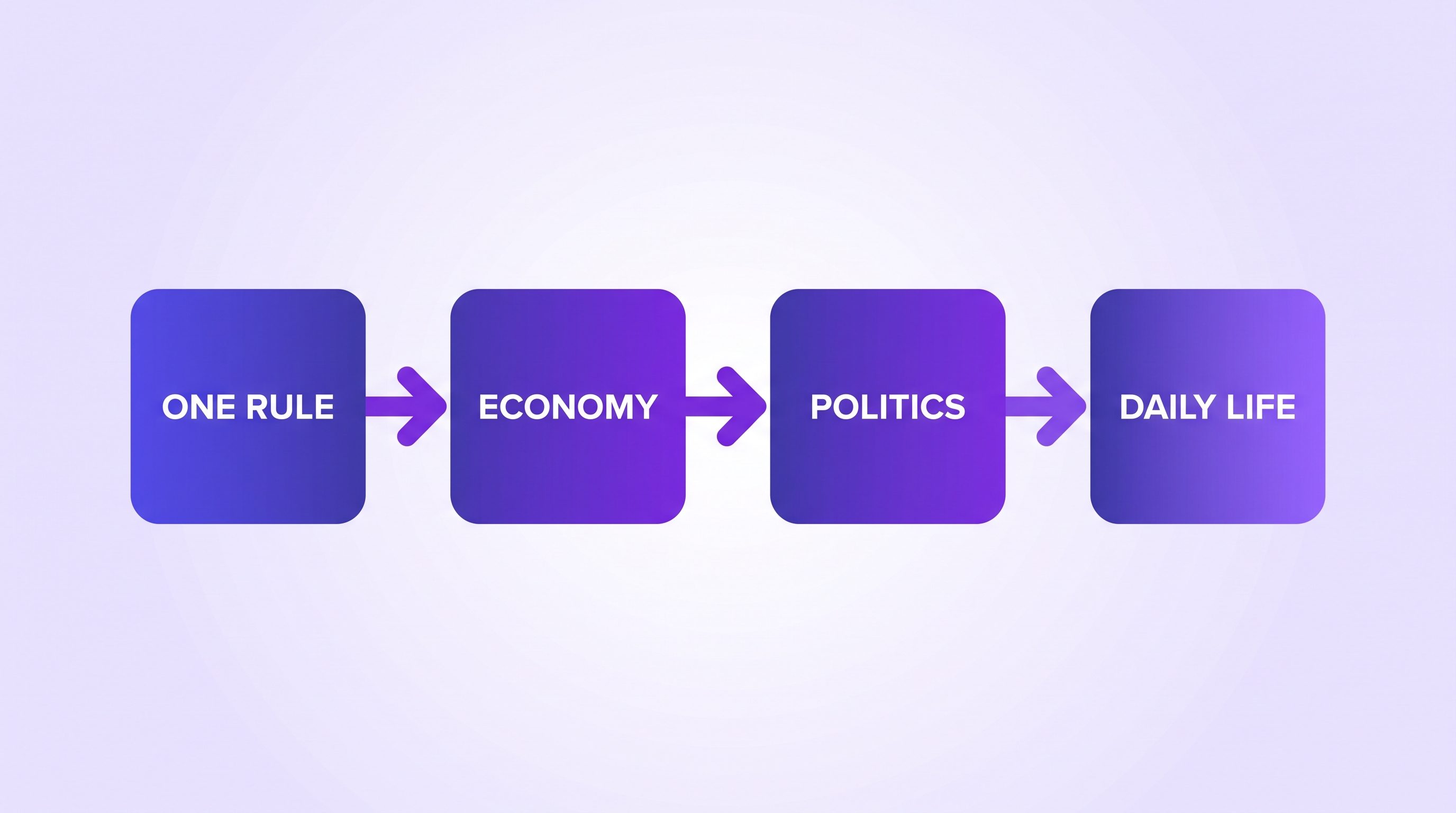
A worked example
Say you invent exactly one rule: healing magic exists, but only a handful of people are born able to use it. Watch what that single choice forces into being.
The rule
Healing magic is real but rare — perhaps one healer for every hundred thousand people.
Economy
A healer is worth more than gold. They cluster where the money is, so the rich rarely die of infection while the poor still do — and a black market in forged healer-marks appears almost overnight.
Politics
Every court, army, and crime syndicate wants a healer on retainer. Kingdoms go to war over a single gifted child, and laws spring up to register, protect — or quietly enslave — anyone born with the gift.
Daily life
A commoner mother hides her daughter's gift to keep the child from being taken. That fear, that hiding, is a scene — and it exists only because you followed one rule down three links.
Notice you never had to describe the whole economy. You followed one thread until it produced a human moment, and the reader infers the rest. Do this for your two or three most important rules, then stop. That restraint is the difference between a world and an encyclopedia.
The template: a worldbuilding bible that fits on two pages
A worldbuilding bible is your single source of truth — the notes you check so chapter nine still agrees with chapter one. It should be short enough that you actually keep it updated. Work through these six areas, answering only what your story touches, and check each one off as you lock it down.
Physical world
History & timeline
Rules of power (magic or tech)
Society & culture
Economy & daily life
Conflict & stakes
Notice what is missing: invented languages, thousand-year genealogies, the periodic table of your magic. Add those only when a scene truly demands them. For the peoples who fill this world, borrow the same restraint — a memorable culture, like a memorable character, is built from a few sharp archetypes and one telling detail, not an exhaustive census.
Three mistakes that break immersion
Info-dumping the iceberg
Pouring your known 40% onto the page in a prologue or a character's lecture. Readers skim exposition and remember scenes. Trust the iceberg: deliver the world through action, conflict, and sensory detail, and let the depth stay implied. If you can cut a paragraph of lore and lose no story, cut it.
Exoticism without motivation
Two moons, purple grass, and a seven-day week that exist only to feel 'fantasy.' Difference for its own sake reads as set-dressing. Every strange element should either come from a cause — the two moons drive monstrous tides that shape the whole coastal culture — or drive a consequence. Weirdness with a reason is wonder; weirdness without one is noise.
Inconsistent rules
The magic that costs a life in chapter three but comes free in the climax; the empire that spans a continent yet delivers letters in a day. The instant your world breaks its own logic to rescue the plot, the reader feels the author's hand. Write your hard limits down and let the characters lose sometimes — constraints are what make victories mean anything.
The AI-assisted shortcut
You can compress the slow part of this — filling in the known 40% without contradicting yourself — with AI, as long as you drive it with a system instead of asking it to 'make a cool world.' Start from your rules and let a tool chain the consequences. Our free world builder turns a one-line premise into a coherent setting — geography, factions, history, and the tensions between them — that you can edit and keep, so you begin with a consistent skeleton instead of a blank page.
Naming is where invented worlds most often slip into gibberish. Rather than mashing apostrophes between random consonants, use the character name generator to produce names that share a consistent linguistic feel across a single people or region — the quiet signal that a culture is real.
The real payoff comes when you write the book. Inside AIWriteBook's book-creation flow, your genre and world setup travel into every chapter, so the AI drafts scenes that respect your rules instead of forgetting them three chapters later. And when a world is big enough for a sequel, series support carries the same canon — characters, places, and established facts — from book one into book two. That, in the end, is exactly what all this worldbuilding is for.
Turn your world into a finished book
Set your genre and world, then write chapter after chapter that stays true to the rules you invented — with an AI editor that keeps your canon straight.
Worldbuilding questions, answered
Build less, imply more
Believable worlds are not the most detailed ones; they are the most consistent ones. Show a sharp 10%, know a solid 40%, sketch the rest, and follow your handful of core rules down the chain until they produce human moments. That is the whole system — everything else is decoration.
Start with one rule you find genuinely interesting and chase its consequences three links deep. You will end up with a world that has more life in it than a hundred pages of unread lore. From there the work is the same as any book: give the world sensory texture on the page and start writing scenes inside it.