


Definition
The protagonist is the character whose pursuit of a specific goal generates the plot, who makes the decisions that turn it, and who is most changed by how it ends.
Three clauses, all load-bearing. Drop any one and you have a character the reader watches rather than follows.
What a protagonist actually is
The word comes from the Greek protagonistes — protos, first, and agonistes, contender or actor. It is a technical term from the theatre, not a moral one. The earliest Greek performances were sung by a chorus, and later tradition — thin on evidence, but too good a story to drop — credits Thespis with being the first to step out of it and speak in character. What Aristotle actually records in the Poetics is the next move: Aeschylus raised the number of actors from one to two, which is the moment drama becomes possible. With two actors on stage you can have opposition, and opposition is what a plot is made of. Sophocles added a third.
The first actor was the protagonist; the second, the antagonistes — the one who contends against. So the pair is built into the vocabulary. Neither word says anything about virtue. The protagonist is simply the one the play is arranged around, the figure whose situation the other roles exist to press on.
That origin is worth keeping because it corrects the most common modern misreading. Readers hear "protagonist" and supply "hero" — sympathetic, decent, rooting-for-able. But Humbert Humbert in Nabokov's Lolita is a protagonist. So is Macbeth. So is Amy Dunne in the chapters of Gone Girl that belong to her. The role is structural: whose wanting is the engine? Answer that and you have found your protagonist, whether or not you would let them into your house.
The practical consequence is that "protagonist" is a question you ask about a manuscript, not a label you assign to a character you like. If you cannot name what your protagonist wants in a short sentence — the object, the deadline, the cost of failing — the story does not yet have a protagonist. It has a lead.
Protagonist vs main character vs hero vs POV character vs narrator
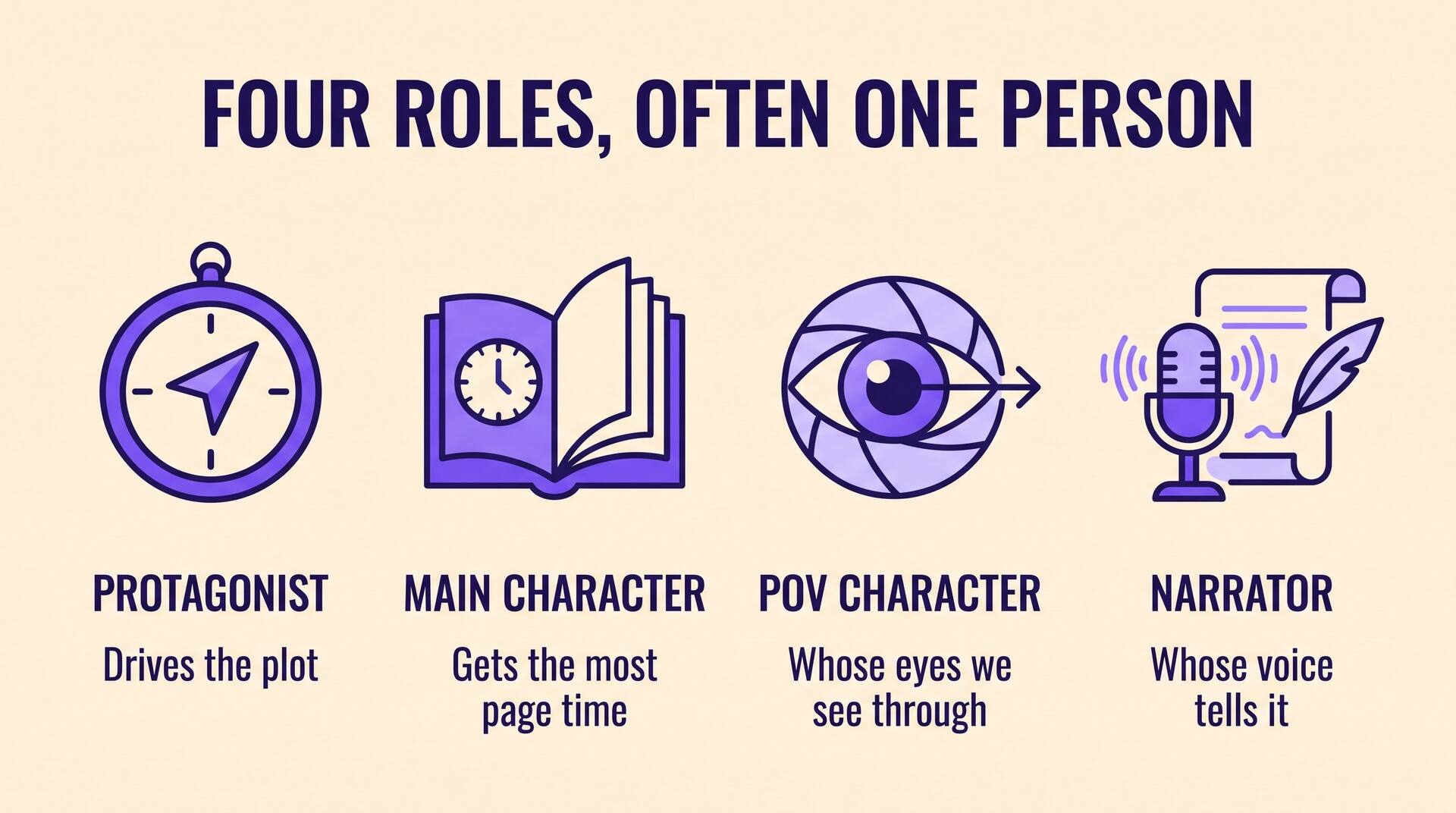
These five words get used interchangeably in workshop feedback, and the confusion has real costs: a writer told "your protagonist is passive" will often respond by giving that character more scenes, which is a fix for a main-character problem, not a protagonist problem. They are different jobs, and one person usually — but not always — holds all of them.
| Role | The question it answers | Where it comes apart |
|---|---|---|
| Protagonist | Whose want drives the plot? | Structural. Can be unlikeable, absent from scenes, or dead by the third act. |
| Main character | Who gets the most page time? | A quantity, not a function. The character we spend longest with is sometimes a witness. |
| Hero | Who has the admirable qualities? | A moral judgement the reader makes. Plenty of stories have no hero at all. |
| POV character | Through whose perceptions do we experience scenes? | A technical choice. Can rotate chapter by chapter while the protagonist stays fixed. |
| Narrator | Whose voice is telling this, and when? | Can be a character, an older version of one, or nobody in particular. |
Two books where the roles come apart
The textbook case of the split is The Great Gatsby. Nick Carraway narrates it, is the point-of-view character throughout, and is present in nearly every scene — by page count he is the main character. But almost nothing in the plot is set in motion by what Nick wants. The book's events are generated by Gatsby's pursuit of Daisy, and it is Gatsby's arc that the ending resolves. Which one is "the protagonist" is genuinely arguable, and that argument is the point: the novel is built on the gap between the man who acts and the man who watches.
Sherlock Holmes and Watson is the cleaner version, because nobody argues about it. Watson narrates every story he appears in; Holmes solves them. The reader is inside Watson's head and Holmes's plot. Conan Doyle uses the split deliberately — Watson's ordinary intelligence is what makes Holmes's look extraordinary, and Watson's ignorance is what lets the deduction be withheld until the reveal.
Use the split on purpose or not at all. A watcher-narrator buys you distance, mystery, and a protagonist who can stay partly unknowable. It costs you interiority: you can never be inside the protagonist at the moment of the decision that matters most. If you find yourself accidentally in this arrangement — a viewpoint character who reacts while somebody else drives — you usually have a diagnosis, not a design.
If you are choosing between viewpoints, our breakdown of second-person point of view covers the rarest of the options and why it occasionally earns its place.
The three tests of a functioning protagonist
These are diagnostic, not prescriptive. Run them on a draft, not on an idea — the answers are usually different, and the draft's answer is the true one.
1. Do they want something concrete?
Not "happiness" or "acceptance" — those are needs, and needs are the second layer. The want has to be nameable and losable: get the ring to the mountain, win the case, survive the winter, get her back. Katniss wants to take her sister's place in the arena, then wants to stay alive. If your answer requires a paragraph, the reader will not be able to hold it either, and every scene will feel like it could be cut.
2. Do their decisions turn the plot?
Take the three biggest reversals in your story and ask who caused each. If the answer is the antagonist, coincidence, or a helpful stranger for all three, your protagonist is a passenger. The test is not whether they win — they can fail every time — but whether the plot bends because of a choice they made rather than in spite of them.
3. Do they end changed?
Something has to be different: a belief abandoned, a loyalty broken, a self-image that no longer fits. The change can be a refusal to change, if the story makes the refusal cost something. A protagonist who ends exactly where they started, having learned nothing and paid nothing, is why readers say a book "went nowhere" even when plenty happened in it.
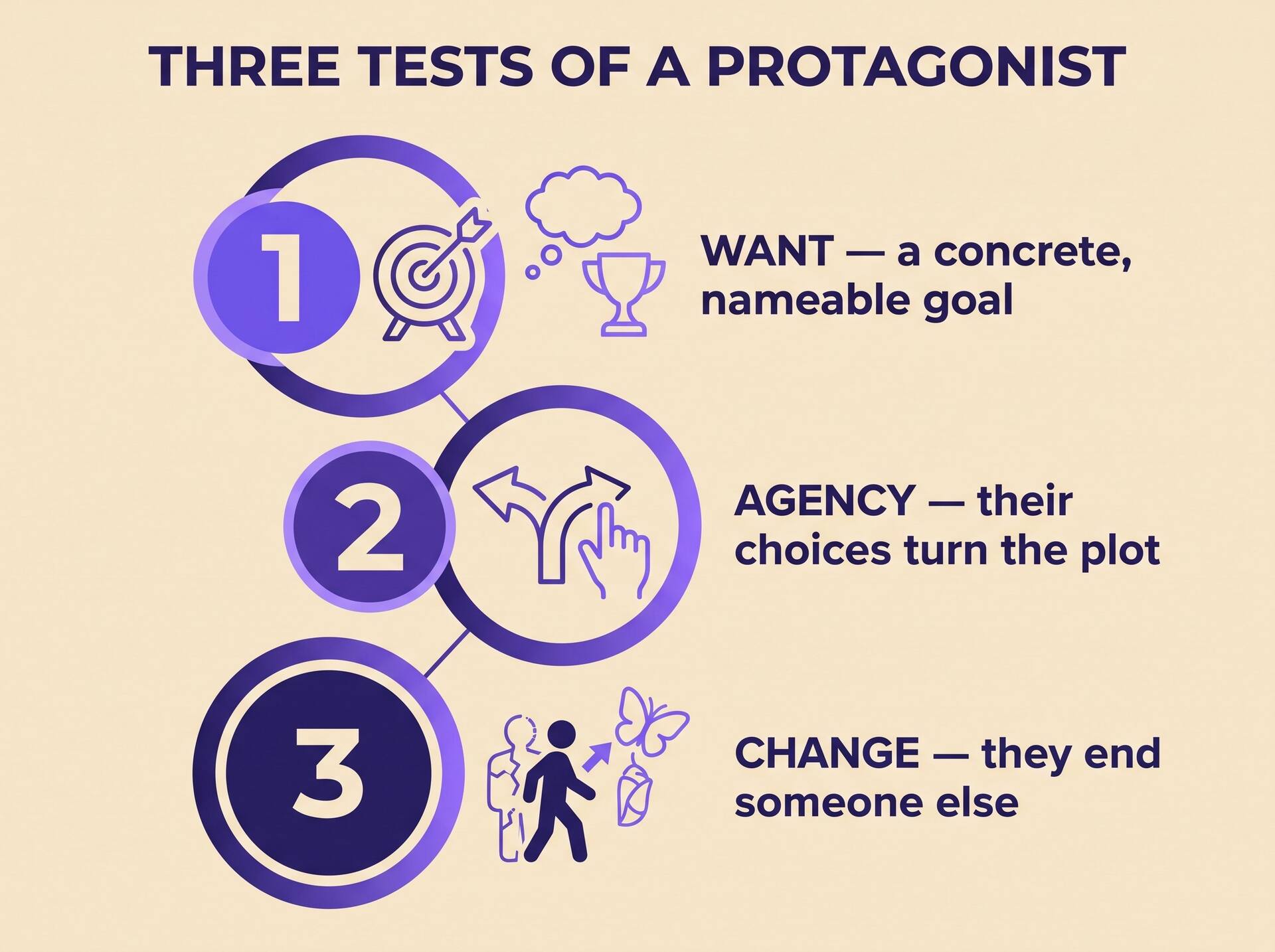
Two out of three is the most common failure state, and each pair fails in a recognisable way. Want plus agency without change gives you a competent thriller that feels hollow. Want plus change without agency gives you a character who is acted upon and then reflects — literary in ambition, inert in practice. Agency plus change without a clear want gives you a book nobody can summarise.
If you want the mirror image of this checklist, our guide to the antagonist definition runs the same diagnostic from the opposing side, including why the strongest opposition is usually the one that wants something reasonable.
Types of protagonist
These are not slots to fill. They are descriptions of the relationship between what the character wants and what the reader is asked to feel about it — and they overlap freely.
The hero
Frodo, Katniss, Jane Eyre
Wants something the reader can endorse, and the cost of pursuing it is the story. The oldest arrangement and still the most durable, because sympathy does most of the work of holding attention.
The antihero
Tom Ripley, Becky Sharp
Lacks the conventional virtues but keeps the reader's investment through competence, wit, or candour. The trick is that we are enlisted in the wanting even when we disapprove of it.
The tragic protagonist
Macbeth, Okonkwo
Their defining strength is the same trait that destroys them. Aristotle's hamartia is usually mistranslated as "flaw"; it is closer to a mistake in judgement, which is more useful — it makes the fall a decision rather than a defect.
The villain protagonist
Richard III, Humbert Humbert
The plot's engine is a want the reader actively opposes. Requires either a compelling voice or a structure that lets us watch the machinery, since sympathy is off the table.
The unlikeable protagonist
Olive Kitteridge
Not villainous, just difficult — abrasive, self-deceiving, hard to spend time with. Works when the reader's curiosity about them exceeds their irritation, which is a narrow margin to hold.
Multiple or ensemble
A Song of Ice and Fire, Middlemarch
Several characters each satisfy the three tests within their own strand. Needs an organising pressure — a war, a town, a deadline — that makes the strands one book rather than several.
The type you pick sets the reader's default posture, and you can trade it for something else. An unlikeable protagonist with an irresistible voice outperforms a likeable one with nothing to say. What you cannot do is pick a difficult type by accident: readers abandon books over an unpleasant lead they were never given a reason to follow.
If the flaw is where your character work keeps stalling, our list of character flaws is organised by the kind of trouble each one causes in a plot rather than by personality label, which is the more useful sort.
Building a protagonist in your own draft
Four decisions, in this order. Making them out of order is why revision so often turns into rewriting.
Want and need
The want is what they will chase for four hundred pages; the need is what would actually make them whole, and they are almost never the same thing. Scrooge wants to be left alone and needs to be part of something. The gap between the two is where a character arc lives — the plot delivers the want, the arc reveals the need, and the ending decides which one they get.
The flaw, and what it costs
A flaw is only a flaw if it makes them fail at something they care about. "Stubborn" is a trait; stubbornness that loses them the one ally who could have warned them is a flaw. Write the scene where it costs them before you write the scene where they overcome it, or the overcoming is unearned.
Agency, scene by scene
Go through your outline and mark each scene P if the protagonist causes what happens and R if they react to it. Runs of three or more R's are where readers put the book down. You do not need to eliminate them — reaction is half of drama — but a chapter that is entirely R needs a decision at its end.
The opposition that fits
Design the antagonist against the specific flaw, not against the character in general. If your protagonist's flaw is that they cannot ask for help, the opposition should be something that cannot be beaten alone. This is the single highest-leverage move in plotting, and it costs an afternoon.
Do this before drafting and the manuscript mostly holds. Do it after, and you are rewriting motivation across chapters that were written from a different understanding of the character.
There is a free character creator that will take a premise and return a filled-in profile — want, need, flaw, contradictions, the things they would never say aloud — which is a fast way to pressure-test whether the person you have in your head survives contact with the page. Change anything it gets wrong; the point is to have something concrete to argue with.
Naming is the other early friction point, and a bad placeholder name has a way of surviving into the final draft. The character name generator filters by genre and era, which is more useful than it sounds when your fantasy cast has drifted into three names that all start with K.
If you are writing on AIWriteBook, the character profiles you set up carry through the whole book: every chapter is generated with them in context, so the protagonist's voice, flaw, and history stay consistent across sixty thousand words instead of drifting by chapter twenty. When a chapter does come back off-key, the chapter AI chat lets you ask for a targeted rewrite — "she would not apologise here" — and shows the change as an accept-or-reject diff rather than regenerating the whole thing.
Four ways protagonists break
The passive protagonist
Things happen to them for two hundred pages. The usual cause is a writer who is protecting the character from the consequences of a real decision. Fix: find the moment they should have chosen and were rescued instead, delete the rescue.
No clear want
The character has a rich inner life and no goal, so scenes have atmosphere but no direction. Fix: give them something they can lose by Friday. A deadline converts mood into plot faster than anything else.
An ensemble with no anchor
Six viewpoints, none of them load-bearing, and the reader never settles. Fix: either promote one strand to primary, or supply the external pressure that makes the six into one story. Multi-strand books that work almost always have a clock.
The wrong character changes
The most interesting arc in the book belongs to the mentor, the rival, or the sibling. This is not always a mistake — sometimes it is a discovery. Ask honestly whether you have written the wrong protagonist, because the fix is a viewpoint change, not more scenes for the current lead.
When a story genuinely needs more than one protagonist
Multiple protagonists are a structural cost, not a richness bonus. Each additional one restarts the reader's investment, splits the page count, and multiplies the number of endings you have to land. It is worth paying when the story's actual subject is bigger than one person's experience of it — a war, an institution, a family across generations, a town.
The reliable test: could you tell this story from one of these viewpoints and lose something essential, or would you just lose material? If a strand exists because the events in it are interesting rather than because the book's argument requires that vantage point, it is a subplot dressed as a protagonist, and the book will read as diluted.
The two arrangements that hold up are the shared-pressure structure, where separate protagonists face one force that connects them without them necessarily meeting, and the convergence structure, where the strands are heading toward a collision the reader can feel coming. What does not hold up is parallel lives that meet only thematically — readers experience that as two half-books.
Series introduce a related question, since a viewpoint you open in book two has to be worth its place across the whole run. Our series planner maps arcs across multiple volumes, which is where you find out early whether a second protagonist has enough to do beyond the book they debut in.
Protagonist FAQ
The short version
A protagonist is not the nicest character, the one with the most scenes, or the one holding the camera. They are the one whose want starts the trouble, whose choices bend it, and whose self does not survive it intact. Three tests, and a draft that fails any of them is telling you something specific enough to fix.
Character decisions are structural decisions, which means they belong beside your premise and outline rather than in revision. Our guide to writing a book lays out where the protagonist work sits in the sequence, and what it is cheaper to settle before chapter one than after chapter thirty.