

The formula in one line
Title
genre signal + one specific hook
Subtitle
the words your reader searches for + the promise
Fiction usually stops at the first line. Nonfiction almost always needs both. Everything below is a way of filling in those two slots.
Why the title does so much work
A browsing reader meets your book as a small cover in a grid of search results, next to a dozen competitors. The title has to survive that size, confirm the genre in a glance, and give one reason to tap. Most weak titles fail at the first two jobs, not the third: they are clever, but nobody can tell whether the book is a thriller, a memoir or a productivity guide.
The title also lives in places the cover never goes: the Amazon search index, a friend's text message, a podcast host reading it aloud. A title that has to be spelled out, or that sounds like a different genre when spoken, leaks readers at every one of those points.
And it is hard to undo. On Amazon KDP, the title and subtitle of a paperback or hardcover lock 72 hours after first publication, so changing them later means a new edition with a new ISBN and none of your existing reviews. Choose before you upload, not after.
The five patterns
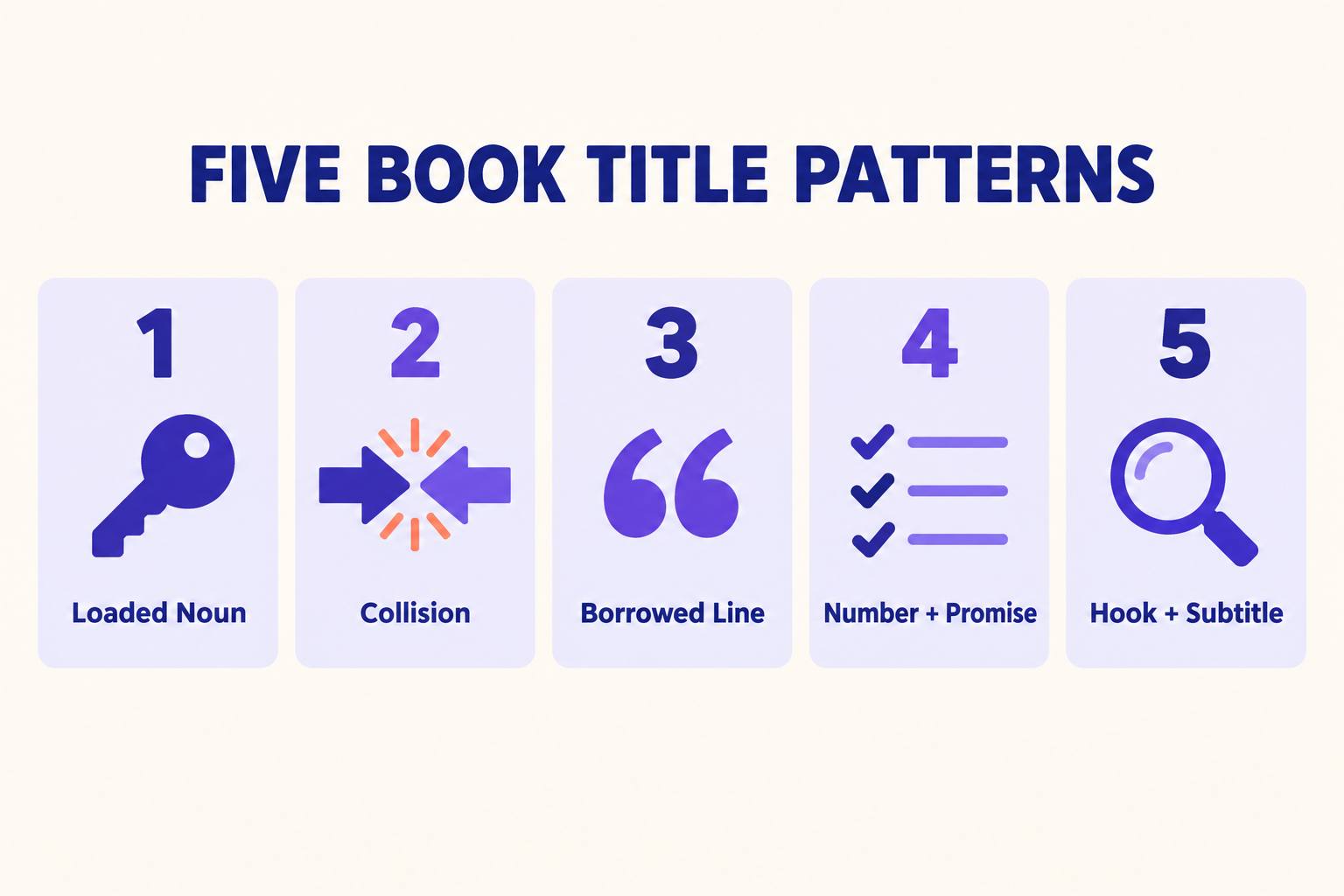
Look at any year of bestseller lists and most titles fall into one of five shapes. Knowing the shape lets you generate candidates on purpose instead of waiting for inspiration. Pick a pattern to see how it works.
Loaded Noun
Shape: The + charged modifier + concrete noun
One ordinary noun (a patient, a girl, a library) made strange by the word in front of it. The noun gives the reader something to picture; the modifier supplies the question. Why is the patient silent? What happens at midnight?
Real examples
- The Silent Patient (Alex Michaelides)
- The Girl on the Train (Paula Hawkins)
- The Midnight Library (Matt Haig)
- The Night Circus (Erin Morgenstern)
- Best for
- Thrillers, book-club fiction, magical realism.
- Watch out
- It is the most crowded pattern on the shelf. Search your exact candidate on Amazon before you fall in love with it.
What each genre expects
A pattern that sells in one genre can hide a book in another. Before you choose, look at the top 20 of your exact Amazon category and notice the shape of the titles, not only the words.
| Genre | Typical shape | Real examples | Patterns that fit |
|---|---|---|---|
| Thriller and suspense | Short, a person or place plus a threat | Gone Girl; The Woman in the Window; The Silent Patient | Loaded Noun, Collision |
| Romance and rom-com | Playful, a relationship word or a trope wink | The Love Hypothesis; The Hating Game; Beach Read | Loaded Noun, Collision |
| Fantasy and romantasy | Grand nouns, often "A ___ of ___ and ___" | A Court of Thorns and Roses; The Name of the Wind; Fourth Wing | Loaded Noun, Borrowed Line |
| Literary and book-club fiction | Lyrical, an image or a phrase | The Remains of the Day; Where the Crawdads Sing; A Little Life | Borrowed Line, Loaded Noun |
| Self-help and business | Short hook plus an outcome subtitle | Atomic Habits; Deep Work; The 7 Habits of Highly Effective People | Hook + Subtitle, Number + Promise |
| Memoir | A charged phrase, then "A Memoir" | Educated; Born a Crime; I'm Glad My Mom Died | Collision, Hook + Subtitle |
Series are the exception worth planning early: if book one is "A ___ of ___ and ___", readers expect book two to be too. If you are plotting more than one book, map the whole run of titles now with the series planner.
The subtitle's separate job
Split the work in two and both halves get easier. The title is for memory and emotion. The subtitle is for clarity and search: it names the reader, the problem and the result, using the words that reader would actually type. Amazon indexes the subtitle, so a phrase there is found by search while the title stays clean.
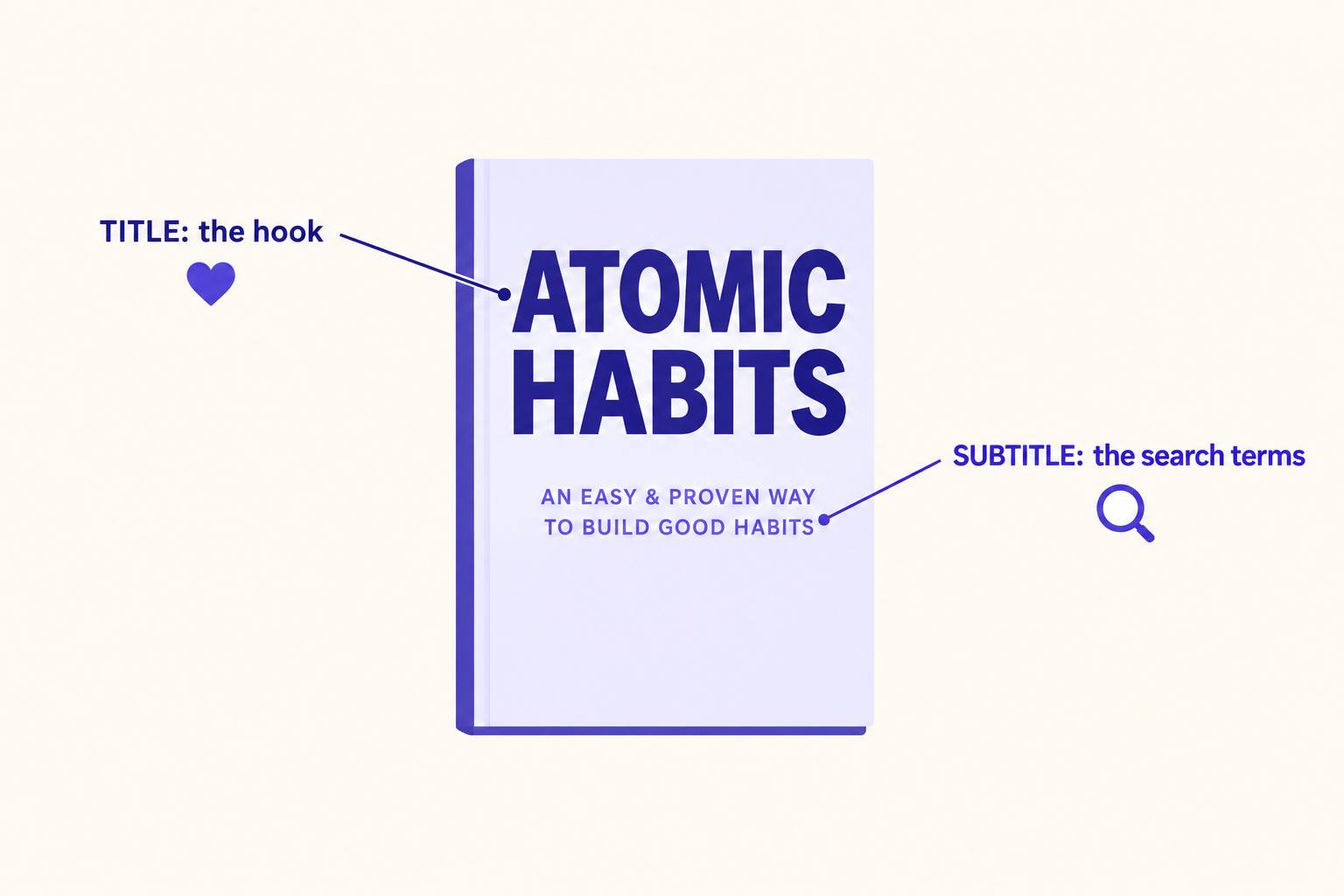
KDP allows a title and subtitle of fewer than 200 characters combined, but that is a ceiling, not a target. A subtitle of eight to fifteen words is usually enough to say who it is for and what changes. If you are unsure which phrases your readers use, work through our KDP keyword research guide first, then feed the best phrase into the subtitle generator and choose the option that still reads like a sentence a person would say.
Fiction can use the subtitle slot too, but for a different job: "A Novel", "A Cozy Mystery" or a series line such as "Book One of the Ember Crown" is a genre signal, not a keyword list.
Step by step: from blank page to shortlist
This is the process we would follow for a finished or nearly finished manuscript. Allow an afternoon, not ten minutes.
- 1
Write the one-sentence pitch
Who, what they want, what stands in the way, in one sentence. Every candidate title gets checked against this sentence. If the title could belong to a different pitch, it is too generic.
- 2
Mine your own manuscript
Skim for 20 striking words and phrases: an object that recurs, a place name, a line of dialogue someone would quote. This list feeds the Borrowed Line and Loaded Noun patterns and keeps the title tied to the book.
- 3
Choose two patterns that fit the genre
Use the genre table above. Two patterns, not five: you want enough range to compare, but a focused list is easier to judge.
- 4
Generate at least 20 candidates
Quantity first, judgement later. Write ten by hand from your word list, then describe the book in the free book title generator to get twenty more in a genre and style you pick, and vote on the ones that make you look twice.
- 5
Run the shelf check
Search Amazon for each of your top five. If a well-reviewed book in your genre already owns the exact title, move on. If your title looks nothing like the top sellers in your category, ask whether that difference helps or confuses.
- 6
Test it at thumbnail size and out loud
Put the title on a rough cover, shrink it to the size of a search result, and read it aloud to someone who has not read the book. Ask them what genre it is. Then pair the winner with a subtitle and a cover that follow our book cover design tips.
Test your title
Type your front-runner below. The counter and the wording check run as you type; tick the other boxes honestly.
Enter a title to start the test.
Checks only you can make
0 of 6 checks passed
Keep generating. A title that fails several checks rarely improves with small edits.
Common mistakes
Keyword-stuffing the subtitle
KDP's metadata rules forbid repeating generic keywords in a title or subtitle, and a stuffed subtitle reads as low quality to the human you are trying to convince. One natural search phrase beats five crammed ones.
Putting sales words in the title
"Bestselling", "free" or similar promotional wording is not allowed in KDP titles and subtitles, and neither is referencing another author or title without permission.
Fighting the genre
A cozy mystery titled like a literary novel will be shown to literary readers, who will not buy it, and hidden from cozy readers, who would. Distinctive is good; unrecognizable is not.
The inside joke
A pun on a character's name, or a phrase that only lands after chapter twenty, means nothing to a stranger in a search grid. Borrowed Lines work when the phrase is striking before you know its meaning.
Assuming you can own a title
The U.S. Copyright Office does not register titles or short phrases, so someone else can publish a book with your title, and you with theirs. That is why the shelf check matters: duplicates are legal but confusing. Series names and brands are a trademark question, which is a separate matter for a lawyer.
Choosing it after upload
Because print titles lock three days after publication on KDP, the title decision belongs before your final cover and metadata, not after the first sales report.
The AI-assisted shortcut
The slow part of titling is not judgement, it is generating enough candidates to judge. That is the part worth handing to a tool. Our book title generator takes a description of your book, an optional genre and one of six styles (literary, commercial, dramatic, mysterious, whimsical or provocative) and returns twenty titles you can vote on and save. Run it once per pattern you chose in step 3 and you have a real field to compare.
For nonfiction, give your shortlisted hook and a sentence about the reader to the subtitle generator, which weights its options toward search keywords, a benefit promise or the target reader, depending on what you pick.
If the book itself is still ahead of you, the title is also a good place to start it. In AIWriteBook a new book can begin from a title and a short description; the app drafts the outline and chapters in your own writing style, and you edit every step. When it is time to publish, the KDP Chrome extension fills KDP's title setup from the book, so the title and subtitle you tested are the ones that go live.
Fill-in templates
Copy a template, swap the brackets for words from your own manuscript list, and write five versions of each. The filled-in lines are invented examples, not real books.
Loaded Noun
The [modifier] [person or place]
Filled in: The Borrowed Winter
Loaded Noun
The [person] Who [unexpected verb]
Filled in: The Cartographer Who Forgot North
Loaded Noun
A [grand noun] of [noun] and [noun]
Filled in: A Crown of Salt and Ember
Collision
[Name] Is [calm claim that is clearly untrue]
Filled in: Margaret Is Handling It
Collision
[Soft word] [Hard word]
Filled in: Gentle Arson
Borrowed Line
[Line of dialogue from chapter one]
Filled in: Leave the Porch Light On
Number + Promise
[Number] [rules, habits or lessons] for [outcome]
Filled in: 9 Rules for Writing Before Work
Hook + Subtitle
[Hook]: How [reader] Can [result] Without [pain]
Filled in: Slow Money: How Freelancers Can Build Savings Without a Steady Paycheck
Hook + Subtitle
[Charged phrase]: A Memoir
Filled in: Salt in the Well: A Memoir
Series line
[Title]: Book [number] of the [series name]
Filled in: The Glass Tide: Book One of the Harbor Saints
Frequently asked questions
Title equals a genre signal plus one specific hook; subtitle, when you need one, equals the words your reader searches for plus the promise. The five patterns in this guide (Loaded Noun, Collision, Borrowed Line, Number plus Promise, Hook plus Subtitle) are the most common ways of filling in that formula.
Main titles on bestseller lists tend to be short, often one to five words, because they need to be readable on a small cover and easy to say. KDP allows title and subtitle together to run up to 199 characters, but use the subtitle for extra detail rather than lengthening the main title.
Yes. In the United States titles and short phrases are not protected by copyright, so duplicate titles are legal. They are still a bad idea in the same genre, because readers and search results confuse the two books. Series names used as brands can raise trademark questions, which need a lawyer.
Put them in the subtitle, and only in natural phrasing. KDP forbids repeating generic keywords in titles and subtitles, and a readable subtitle converts better than a list of search terms.
For paperbacks and hardcovers, KDP lets you edit the title, subtitle and primary author name only within 72 hours of initial publication; after that the fields lock and a new title means a new edition with a new ISBN. Check KDP's current help page before relying on any change to an eBook title, and settle the title before you publish.
Pick the pattern, then earn the title
A book title formula does not write the title for you. It narrows an infinite space to five shapes, tells you which two fit your genre, and gives you a way to test the result. The title that wins is almost always one you generated deliberately, checked against the shelf, and read aloud to a stranger.
Once the title is settled, the rest of the path from idea to finished manuscript is mapped in our complete guide to writing a book, and the first page your title promises is covered in how to start a book.