

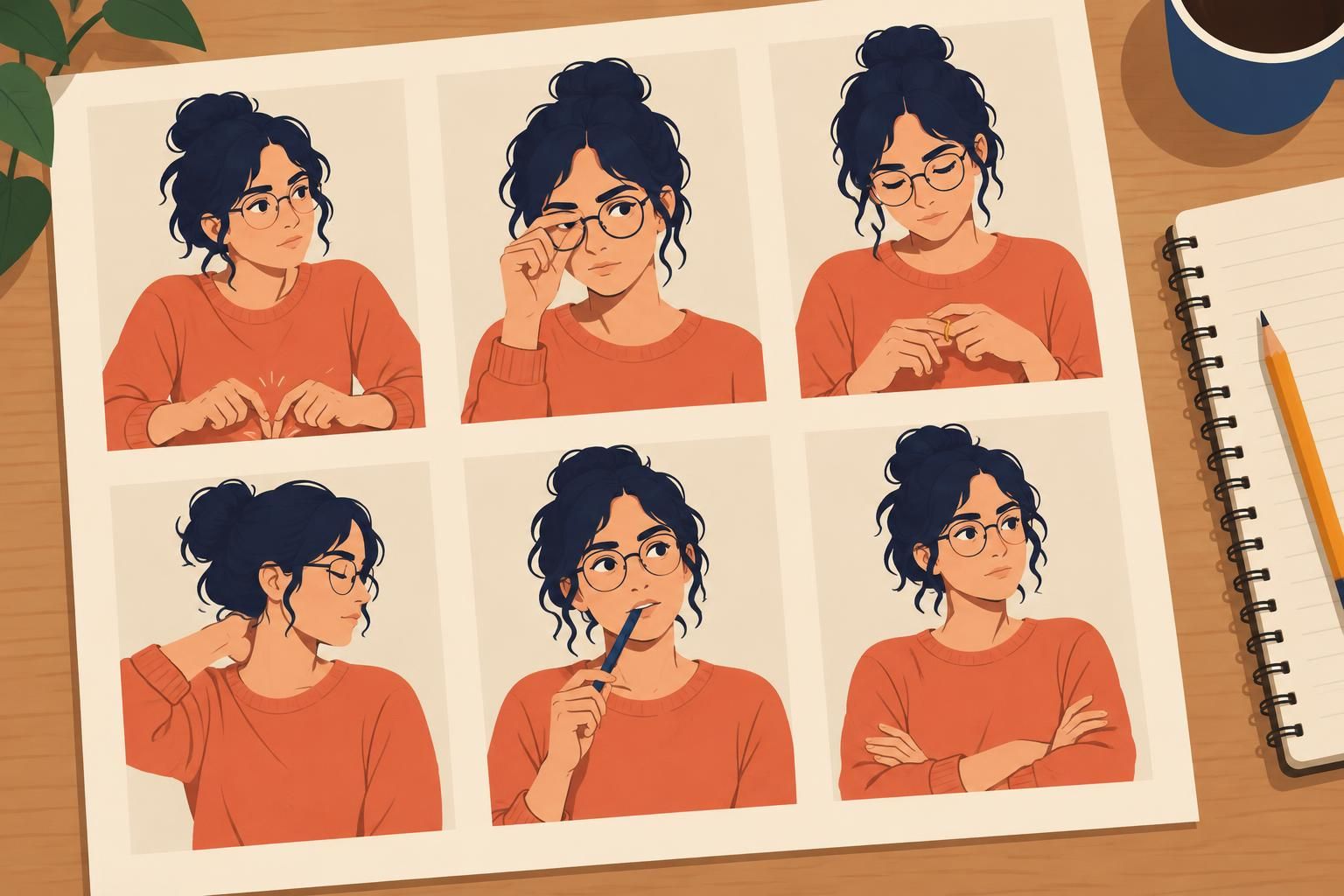
- Definition
- A mannerism is a habitual gesture, movement or way of speaking that is typical of one person, such as tapping a pen while thinking or saying "to be fair" before every disagreement. In fiction, mannerisms make a character recognisable on the page and hint at what they feel without stating it.
The word comes from "manner", the way a person does something. A mannerism is repeated, so it belongs to the character, not to the moment. A single sigh is a reaction. A sigh before every answer is a mannerism.
Five kinds of mannerisms
Most lists mix everything together. It helps to know which channel a habit uses, because a character built from five gestures of the same kind feels thin.
Gestures
Hands and arms: drumming fingers, steepling hands, pointing with a pen. The easiest to show and the easiest to overuse.
Facial habits
Biting the lip, raising one eyebrow, a smile that never reaches the eyes. Use sparingly; readers tire of faces doing things.
Posture and movement
How someone takes up space: leaning in doorways, sitting on the edge of the chair, pacing during phone calls.
Verbal tics
Catchphrases, filler words, the habit of answering a question with a question. These work in dialogue without any description at all.
Object habits
Twisting a wedding ring, clicking a pen, straightening things on a desk. An object gives the habit a history readers can ask about.
200+ character mannerisms by emotion and type
Pick a category to filter. Each list is a starting point: the best mannerism is one you adjust to fit a single person.
202 mannerisms
Nervous and anxious
- Bites the skin around a thumbnail
- Clicks a pen on and off
- Bounces one knee under the table
- Tucks hair behind an ear that is already tucked
- Checks a phone with no new messages
- Rubs the back of the neck
- Laughs a beat too early
- Pulls sleeves down over the hands
- Picks at a label on a bottle
- Clears the throat before speaking
- Counts things under the breath
- Rearranges items on a desk
- Twists a ring around a finger
- Swallows hard before answering
- Touches the collar or neckline
- Reads the same line of a menu over and over
- Pats pockets for keys that are there
- Speaks faster as the conversation goes on
- Over-apologises for small things
- Fills every silence
- Holds a cup with both hands
- Shifts weight from foot to foot
Confident and dominant
- Leans back with hands behind the head
- Holds eye contact a second longer than needed
- Takes the chair at the head of the table
- Speaks slowly and lets others wait
- Puts a hand on someone's shoulder while talking
- Stands with feet wide apart
- Interrupts and then says "go on"
- Never checks the time
- Uses people's first names often
- Walks into rooms without knocking
- Steeples the fingers
- Answers questions with a single word
- Points with the whole hand
- Smiles only when it is useful
- Finishes other people's drinks
- Taps the table to end a discussion
- Keeps hands in pockets in a tense moment
- Stretches arms along the back of the sofa
- Laughs loudly at their own jokes
- Lowers the voice instead of raising it
Angry and frustrated
- Jaw muscles tighten
- Breathes out sharply through the nose
- Grips the steering wheel at ten and two
- Repeats the other person's words back to them
- Goes very quiet
- Slams cupboard doors a little too hard
- Presses the lips into a thin line
- Taps a foot faster and faster
- Cracks knuckles one by one
- Points a finger while speaking
- Laughs without humour
- Turns away mid-sentence
- Rubs the bridge of the nose
- Speaks through the teeth
- Types with heavy keystrokes
- Picks a fight about something unrelated
- Crosses arms and stares at the floor
- Walks out and then comes back to finish the point
- Grinds the teeth at night
- Pulls at the hair at the temples
Lying and hiding something
- Gives far more detail than anyone asked for
- Answers a question with a question
- Touches the nose or mouth while speaking
- Repeats the question before answering
- Holds too steady a gaze
- Smiles with the mouth only
- Changes the subject to the other person
- Swears they are being honest
- Becomes very still
- Turns the body towards the exit
- Places an object between themselves and the listener
- Uses formal words where they usually would not
- Laughs off a direct question
- Says "to be honest" before a lie
- Keeps the phone face down
- Shrugs with one shoulder
- Has a story that is a little too smooth
- Rubs the palms on the trousers
- Avoids saying the other person's name
- Gets defensive about small details
Sad and grieving
- Stares at a fixed point in the middle distance
- Wears the same sweater for days
- Answers "fine" too quickly
- Holds an object that belonged to someone else
- Lets tea go cold
- Sleeps on top of the covers
- Walks slower than before
- Stops finishing sentences
- Hugs the knees to the chest
- Touches a photo frame when passing it
- Keeps the radio on for company
- Rubs the sternum as if it aches
- Avoids a certain chair
- Laughs and then goes quiet
- Reads old messages at night
- Cleans the house obsessively
- Forgets to eat until evening
- Sighs before standing up
- Lets the phone ring out
- Wraps the arms around the body
Happy and excited
- Hums without noticing
- Talks with the hands
- Rises up on the toes
- Claps once when an idea lands
- Grabs someone's arm while telling a story
- Laughs with the whole body
- Skips a step on the stairs
- Taps a rhythm on the steering wheel
- Speaks over others out of enthusiasm
- Grins at the phone
- Can't sit still
- Rubs hands together
- Spins around in an office chair
- Sings the wrong lyrics loudly
- Starts sentences with "Okay, so"
- Leans across the table
- Wakes before the alarm
- Texts in exclamation marks
- Hugs people who are not huggers
- Throws the head back when laughing
Thinking and focused
- Chews the end of a pen
- Pushes glasses up the nose
- Taps the temple
- Squints at nothing
- Talks to themselves under the breath
- Paces in a small loop
- Draws spirals in the margins
- Pinches the lower lip
- Tilts the head to one side
- Writes lists on the back of the hand
- Closes the eyes to remember something
- Strokes the chin or beard
- Holds up a finger to pause a conversation
- Stacks coins or sugar packets
- Stares out of windows
- Answers late because they were still thinking
- Narrows the eyes when listening
- Rubs the eyebrow with a thumb
- Lines up papers before starting
- Hums one note while reading
Attraction and flirting
- Plays with a necklace
- Mirrors the other person's posture
- Finds reasons to touch an arm
- Laughs at jokes that are not funny
- Lowers the voice to make someone lean in
- Holds eye contact and looks away first
- Adjusts clothes when the person walks in
- Says the person's name softly
- Steals food from their plate
- Points the feet towards them
- Bites the lower lip
- Tilts the head and smiles
- Lingers at the door when leaving
- Teases instead of complimenting
- Remembers small details from earlier
- Brushes hair off the face
- Sits closer than the space needs
- Blushes and rubs the cheek
- Texts and then deletes the text
- Glances at the lips mid-conversation
Verbal tics and speech habits
- Ends statements with "right?"
- Says "literally" about things that are not literal
- Calls everyone "mate", "hon" or "chief"
- Speaks in the third person when joking
- Quotes films in ordinary conversation
- Uses full names when annoyed
- Starts every answer with "Well..."
- Swears creatively but never in front of children
- Corrects other people's grammar
- Uses old-fashioned words like "golly"
- Speaks in questions when unsure
- Never uses contractions
- Hums instead of saying yes
- Names objects, like the car
- Mispronounces one word on purpose
- Laughs before the punchline
- Repeats the last word someone said
- Talks to animals in a different voice
- Uses technical jargon at dinner
- Speaks in a whisper when serious
Everyday quirks
- Eats food in colour order
- Always sits facing the door
- Counts stairs
- Smells books before reading them
- Leaves a little of every drink
- Folds receipts into tiny squares
- Keeps one earbud in during conversations
- Wears a watch that does not work
- Always takes the long way home
- Taps the roof of the car before driving
- Says goodbye to houses when moving
- Collects hotel soap
- Never sits with the back to a window
- Reads the last page of a book first
- Carries a pocket knife and never uses it
- Clicks the tongue when concentrating
- Taps the door frame twice when leaving
- Licks a thumb to turn pages
- Writes in pencil only
- Rolls coins across the knuckles
How to use mannerisms well
A list gives you raw material. These rules decide whether a habit adds character or just adds words.
- 01
Give each main character one signature habit
Readers remember one detail, not five. If your detective adjusts her cuff every time she is about to lie, that is enough. Add a second habit only if it shows a different side of her.
- 02
Let the habit change when the character does
The nervous laugh that disappears in the last act tells readers more than a paragraph of reflection. A mannerism you track across the book becomes a quiet arc of its own.
- 03
Use it to contradict the dialogue
"I'm fine," she said, folding the napkin into smaller and smaller squares. The habit tells the truth the words hide. This is the core of show, don't tell.
- 04
Space it out
Once every few scenes is plenty. If the habit appears on every page it stops reading as character and starts reading as an author's tic.
- 05
Know where it came from
A man who still eats with one arm around his plate grew up with siblings who stole food. You may never explain it, but knowing the root keeps the habit consistent. Our character questionnaire helps you find it.
Character is what you are in the dark.
A mannerism is the part of that which slips out in daylight.
Common mistakes
- Every character shrugs, nods and sighs. Generic gestures do not belong to anyone.
- Using a mannerism as the only sign of emotion, so the scene never says what is at stake.
- Giving the villain all the "bad" habits and the hero all the charming ones.
- Forgetting the habit for 100 pages and then bringing it back at random.
- Describing the same gesture with the same words every time.
Keeping mannerisms consistent across a whole novel
The hardest part is not inventing a habit. It is remembering it in chapter 27. In AIWriteBook you store each character's mannerisms in the character builder, and every chapter is drafted with those profiles in view, so the cuff-adjusting detective still adjusts her cuff late in the book.
If you are still building the cast, the free character creator suggests personality, flaws and habits from a short description, and our list of character flaws pairs well with this one.
Mannerisms FAQ
A mannerism is a habitual gesture, movement or way of speaking that is typical of one person, like tapping a pen, saying "basically" often or tilting the head when listening.
Common examples include biting nails, cracking knuckles, twirling hair, clearing the throat before speaking, pushing up glasses, humming while working and using a catchphrase.
A mannerism is usually a small physical or verbal habit. A quirk is any odd habit or preference, such as eating food in colour order. Many quirks are mannerisms, but a quirk can also be a belief or routine.
One signature mannerism for a main character is usually enough, with one or two minor ones. Side characters often need just one, which helps readers tell them apart.
Body language covers every non-verbal signal, including one-off reactions. A mannerism is a repeated habit that belongs to a particular person.
Pick one habit, tie it to a need or fear, and let it change by the last chapter. For the wider craft, our How to Write a Book guide walks through characters, plot and drafting step by step.