


Why most questionnaires waste your evening
A question earns its place in a character profile questionnaire for one of two reasons: the answer will show up on the page, or the answer will drive a decision the character makes. Questions that do both are the core. Questions that only drive decisions are the hidden engine; readers never see them stated but feel them in every choice. Questions that only show on the page give texture and voice. And questions that do neither, like a zodiac sign or a favorite ice cream flavor, are trivia unless your plot happens to hinge on them.
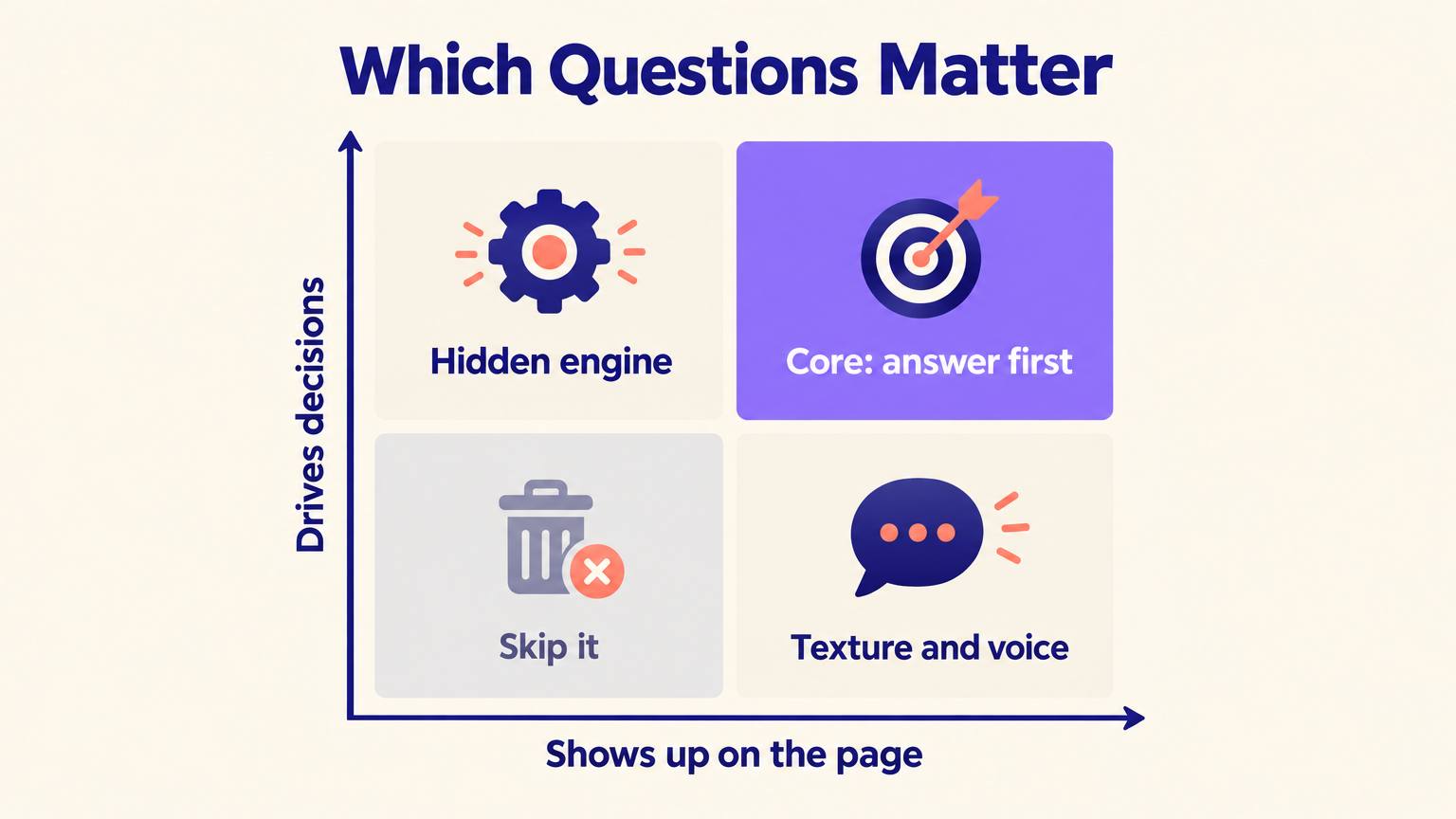
That is the sorting below. Every question carries a tag: Core, Engine or Texture. Answer the twenty core questions first. Come back to the engine questions when a character's choices start to feel arbitrary, and to texture when their dialogue starts sounding like everyone else's.
Questions you can skip (unless the plot needs them)
- Star sign, blood type, favorite color
- Middle name of their childhood best friend
- What's in their fridge right now
- Their exact height in centimeters
The character questionnaire: 50 questions in 7 groups
Filter by group, show only the core twenty, tick off what you've answered, and copy the set you need into your notes.
Want and fear
History and wounds
Relationships
Morals and contradictions
Voice and behavior
Daily life and surface
Pressure and change
Question 26 is the one most authors rush. The answer is usually both a strength and a flaw, and the character strengths and character flaws lists are built to help you find a pair that turn into each other under stress. Question 44 is not really about the character at all: whatever they are least prepared for is the plot you should be writing.
The Proust round: a five-minute voice test
The Proust questionnaire was a Victorian parlor game, a printed album of personal questions that guests answered in their own hand. Marcel Proust filled one in as a teenager and again in his twenties, and the questions have carried his name ever since. As a Proust questionnaire for characters it is less useful for facts than for voice, because its questions are short and blunt enough that the way someone answers says more than what they answer.
Here is the trick: don't summarize. Write each answer in first person, as the character, in the words they would actually use. If three different characters give answers that sound alike, their dialogue will too.
- 1Your idea of perfect happiness?
- 2Your greatest fear?
- 3The trait you most dislike in yourself?
- 4The virtue you value most in others?
- 5When do you lie?
- 6Your motto?
Same question, two characters:
Your greatest fear?
Being the one who has to explain to Mum.
I don't do fear. I do contingency plans.
Neither answer names a fear directly, and that is exactly what makes both of them useful.
From answers to a scene: a worked example
A questionnaire pays off only when an answer turns into a choice on the page. Here is how three answers became one scene for an invented thriller lead, Dana, a night-shift emergency nurse.
Q1. What do they want most?
To keep her younger brother out of prison.
Q26. Best quality, and when is it a problem?
She stays calm when everyone else panics. Under suspicion, calm reads as guilt.
Q21. Who would they lie to first?
The detective on the case, who is also her ex.
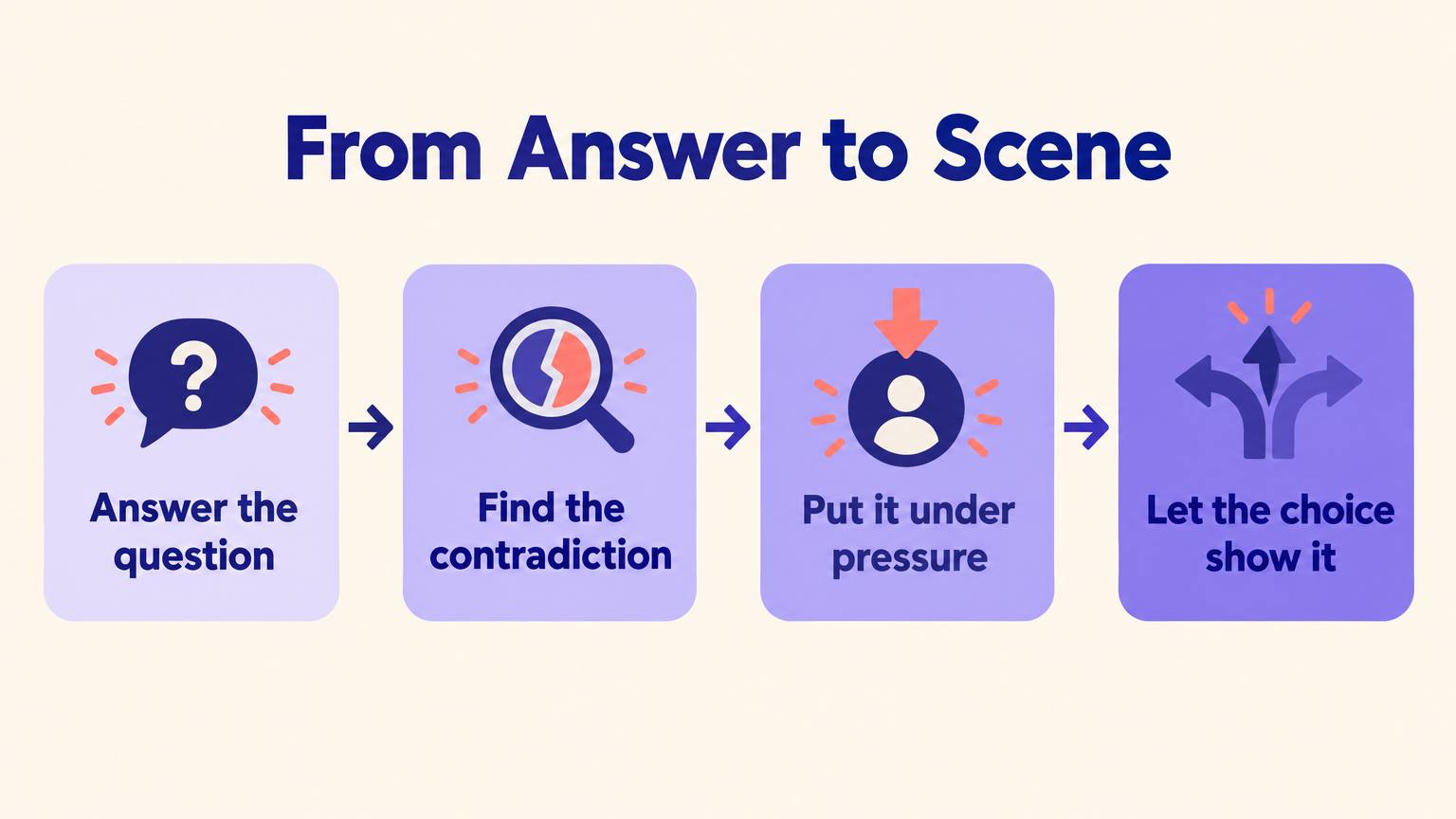
Put those three answers side by side and the contradiction jumps out: the trait that makes her good at her job is exactly what will make the police suspect her. So the scene writes itself. The ex interviews her. Tears would help her brother; she can't produce them. She tells a precise, calm lie, and he notices she never once looked away. Nothing in that scene states her backstory, yet a reader learns more about Dana from it than from a page of biography.
If dialogue scenes like this one are where you get stuck, the dialogue writing tips help you make each line do two jobs at once.
How many questions each character needs
Not every character deserves fifty answers. Spend the effort where the page time is.
| Role | Questions | Which ones |
|---|---|---|
| Protagonist / POV character | All 50, over time | Core 20 before drafting, the rest as scenes demand them |
| Antagonist | 12 to 15 | Want and fear, morals, the lie they believe, how they argue |
| Love interest or deuteragonist | 15 to 20 | Core 20, weighted toward relationships and voice |
| Recurring side character | 5 | Q1, Q17, Q31, Q39, plus what they think of the lead |
| Walk-on | 1 | Q30 or Q33: one memorable way of talking |
Villains get their own treatment in our guide on how to write a villain, because the question that matters most for them is the one that makes their logic hold up from their side.
Common character questionnaire mistakes
- Answering everything before writing a word. The draft will overturn half of it. Answer the core and start.
- Answering like a résumé. "Brave, loyal, stubborn" tells you nothing. "Ran back into the fire for a dog she didn't own" tells you plenty.
- Only flattering answers. If question 11 has a soft answer, you haven't found the character yet.
- Keeping the answers when the draft disagrees. When a scene shows you who someone really is, update the profile and let the scene win.
- Giving the whole cast the same depth. Side characters with forty answers crowd the protagonist's page time.
The faster route to a full character profile
If you'd rather react to answers than invent them from a blank page, the free character creator drafts a full profile from a one-line idea: personality, background, motivation and the conflicts that pull at them. Keep what sounds right and run the core twenty above on the rest. The character name generator helps when the only thing missing is what to call them.
Inside AIWriteBook every character in a book carries the fields this questionnaire fills: role, look, personality, voice, background, motivation, internal conflict, external conflict, stakes and arc. You can edit any of them yourself or ask the AI to revise one, and they feed every chapter the AI writes, so a voice note like "never finishes a sentence when angry" shows up in that character's dialogue in chapter twenty, not only in chapter one. Writing a series? The same characters carry into the next book, with their latest state, through book series support.
Answer less, write more
Fifty questions is a ceiling, not a target. Answer the core twenty, find the one contradiction that makes your character argue with themselves, and get them into a scene where it costs them something. That is where their voice comes from. Pair this with our character development guide for the full arc, and come back to the engine and texture questions whenever a character goes quiet on you.
More on building a novel from idea to finished draft lives in our How to Write a Book guide.