

The quick version
- One to three lines, centered, on its own right-hand page after the copyright page.
- Name one person or a small group. Specific beats grand.
- No heading needed. The white space tells the reader what the page is.
- Write it last, read it aloud once, and check every name's spelling.
What a dedication page is
A dedication is a short inscription in the front matter where the author names the person, people or idea the book is offered to. It is not a thank-you list. Thanks for editors, agents, beta readers and research help belong in the acknowledgments, which can run for pages. A dedication is a gift, and gifts are usually given to one person.
That distinction is the most useful rule on this page. If you find yourself writing a fourth name, you are drafting acknowledgments. Move the list to the back of the book with our guide to the acknowledgments page and keep the dedication for the one person the book is really for.
Format and placement
Readers barely notice a well-set dedication, which is the goal. These are the conventions that print and ebook designers follow.
- Element
- Convention
- Position
- Front matter, after the title page and copyright page, before the epigraph, table of contents and any foreword.
- Page side
- A right-hand (recto) page in print, so the back of the copyright page is left blank if needed.
- Alignment
- Centered horizontally, set about a third of the way down the page.
- Heading
- Usually none. The word Dedication is optional and most novels leave it out.
- Type
- Body font or its italic, same size as the text. No bold, no decorative fonts.
- Length
- One sentence is standard. A short paragraph works. Past half a page, it is something else.
- Ebooks
- Its own page break so it does not run into the next section. Keep it short: many readers skip straight past front matter.
The order of every front-matter page is covered in more depth in our guide to formatting a book for KDP. If you still need the page before this one, the free copyright page generator produces the text for you.
Famous dedications worth studying
The dedications people remember are short and specific. Four that show the range:
Once again to Zelda
Four words, and the phrase once again tells you there is a history between them.
To Véra
The minimal dedication, repeated across a career until it becomes a signature.
To William Godwin, Author of Political Justice, Caleb Williams, &c. These volumes are respectfully inscribed by the author.
A daughter dedicating to her father by listing his books. Formal on the surface, pointed underneath.
To Beatrice — darling, dearest, dead.
A dedication that is part of the fiction. Every book in the series has a new one to the same mysterious Beatrice.
Two more worth looking up: C. S. Lewis dedicated The Lion, the Witch and the Wardrobe to his goddaughter Lucy Barfield in a short letter, joking that she had grown too old for fairy tales by the time the book was done. J. K. Rowling's first Harry Potter book names three people, one of whom heard the story first.
30 dedication examples by tone
Pick a tone, then copy any line as a starting point. Change the names and details: a borrowed dedication reads as borrowed.
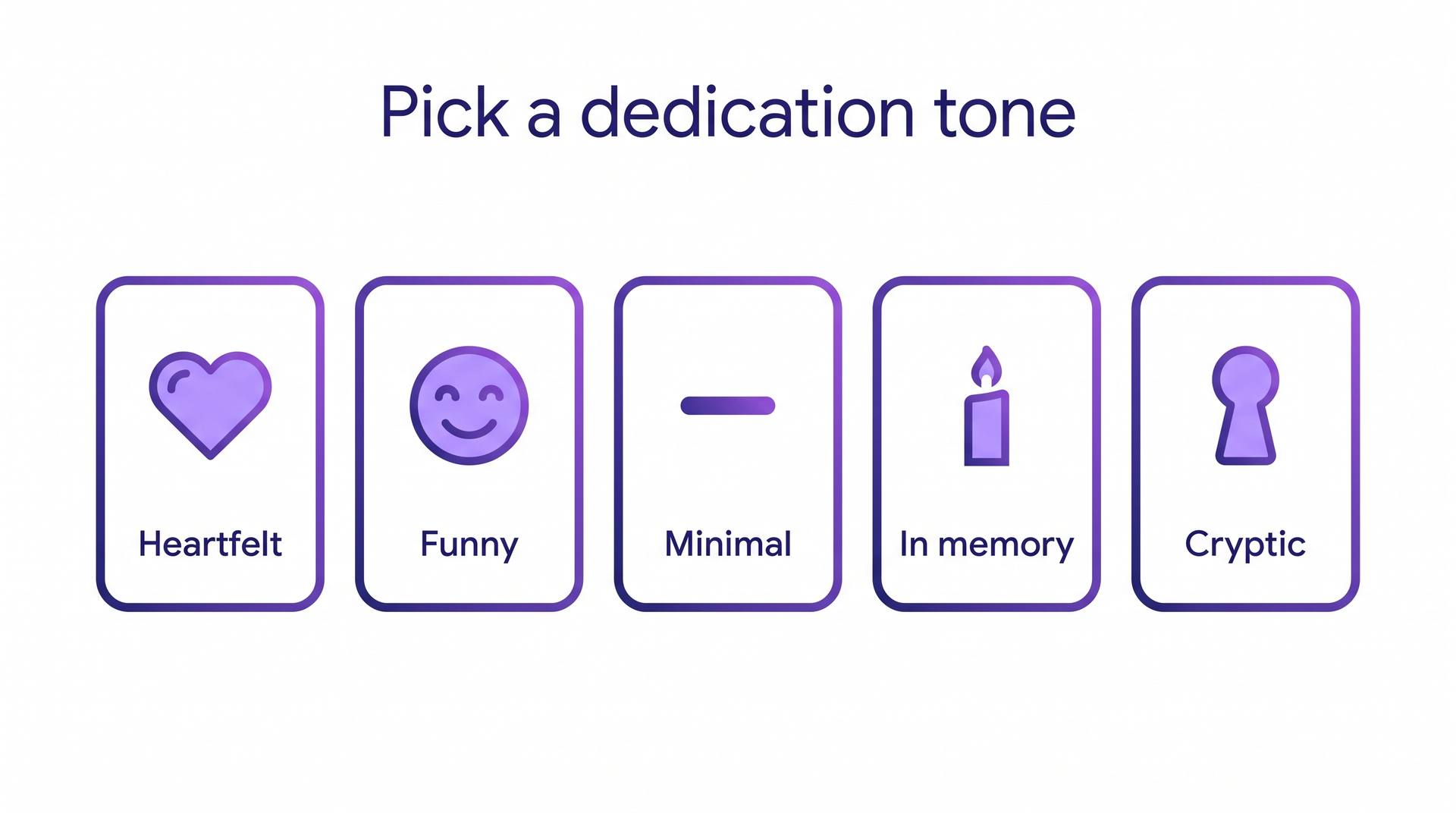
Best for first books, memoir and romance.
For Sam, who read every draft and never once asked when I would get a real job.
To my mother, who taught me that stories are how we keep people.
For Lena. You were the first reader. You are still the one that counts.
To my children: this is what I was doing at the kitchen table all those nights.
For Dad, who drove me to the library every Saturday and waited in the car.
To the girl who hid in the school library at lunch. You were right to.
Who to dedicate your book to
If you are stuck, ask one question: who would be most moved to open the book and find their name? Some common answers and how to handle each:
A partner or spouse
The most common choice. Specific details beat superlatives: what they did while you wrote says more than how wonderful they are.
A parent or grandparent
Often the person who gave you reading in the first place. Name the moment, not just the relationship.
Your children
Think about how it will read to them in twenty years, not how it sounds today.
A teacher or mentor
A dedication is a lovely surprise for a teacher. Use their name the way you actually addressed them.
Someone who has died
Dates are optional. One line about what they would have said about the book is often enough.
The reader, or an idea
Dedications to readers, to a place or to a cause work well for non-fiction and for books written for a community.
Writing a series? Give each book its own dedication. It is one of the small rewards regular readers look for, and it is a good place to thank someone new.
Common mistakes
Turning it into acknowledgments
Six names, an editor and an agent is a thank-you list. Pick one person for the front and move the rest to the back.
Dedicating to an ex, or a current flame
Books stay in print longer than a lot of relationships. If you would not want it read aloud at a future wedding, reconsider.
Misspelling a name
It happens more often than you would think, and a print run cannot be fixed. Check spelling and accents with the person themselves.
Leaving one sibling out
Naming one child or sibling and not the others is noticed. Either name all of them or dedicate to the family.
An in-joke nobody can follow
Cryptic is fine as long as the person it is meant for gets it. If even they would need an explanation, it is too obscure.
Styling it like a title page
Bold, large, decorative type makes the page shout. The dedication works because it is small.
Writing it in AIWriteBook
Every book in AIWriteBook has a Front & Back Matter section with a dedicated Dedication field next to the copyright page, acknowledgments and About the Author. Whatever you type there is placed on its own page in your PDF, EPUB and DOCX exports, in the right spot in the front matter, so you never have to fight a word processor over page breaks.
Want two dedication pages, say one for each of your parents? Type three dashes on their own line between them and the export starts a new page. Each piece of front matter can be switched on or off for export, so you can try the book with and without it.
If you are stuck on the wording, open the book's AI chapter chat and ask for five one-line dedications in the tone you want, using the details you give it about the person. Treat the results as raw material. The best dedications keep one detail only you could know.
The same screen holds the rest of the pages around it. Pair the dedication with a bio from the free author bio generator and closing pages from the back matter generator.
Frequently asked questions
Write it last, keep it short
Leave the dedication until the manuscript is done. By then you will know who the book was really for, and the line usually writes itself in a sentence or two.
It is one of the final small pages in a long process. For the rest of it, from first idea to finished draft, see our guide to writing a book.