

Why description decides whether readers stay
Readers do not skim description because they hate it. They skim it because most of it tells them nothing they could not have guessed. A 'tall, dark forest' is a forest they have already imagined. A forest where the pines grow so close that the path is carpeted in dry needles and makes no sound underfoot tells them something, and it also tells them the character is walking into a place where nobody will hear her.
That is the job: description carries mood, character and plot information at the same time. When it only decorates, it stalls the book. When it works, the reader does not notice it as description at all.
Genre fiction makes this sharper. A thriller reader wants a room described in the order a cornered person would scan it. A romance reader wants the one detail the point-of-view character cannot stop noticing about the other person. Same skill, different filter.
The method: specific, filtered, moving
Almost every strong descriptive paragraph passes three tests. Run your own paragraphs through them before you touch a thesaurus.
Specific: climb one rung higher
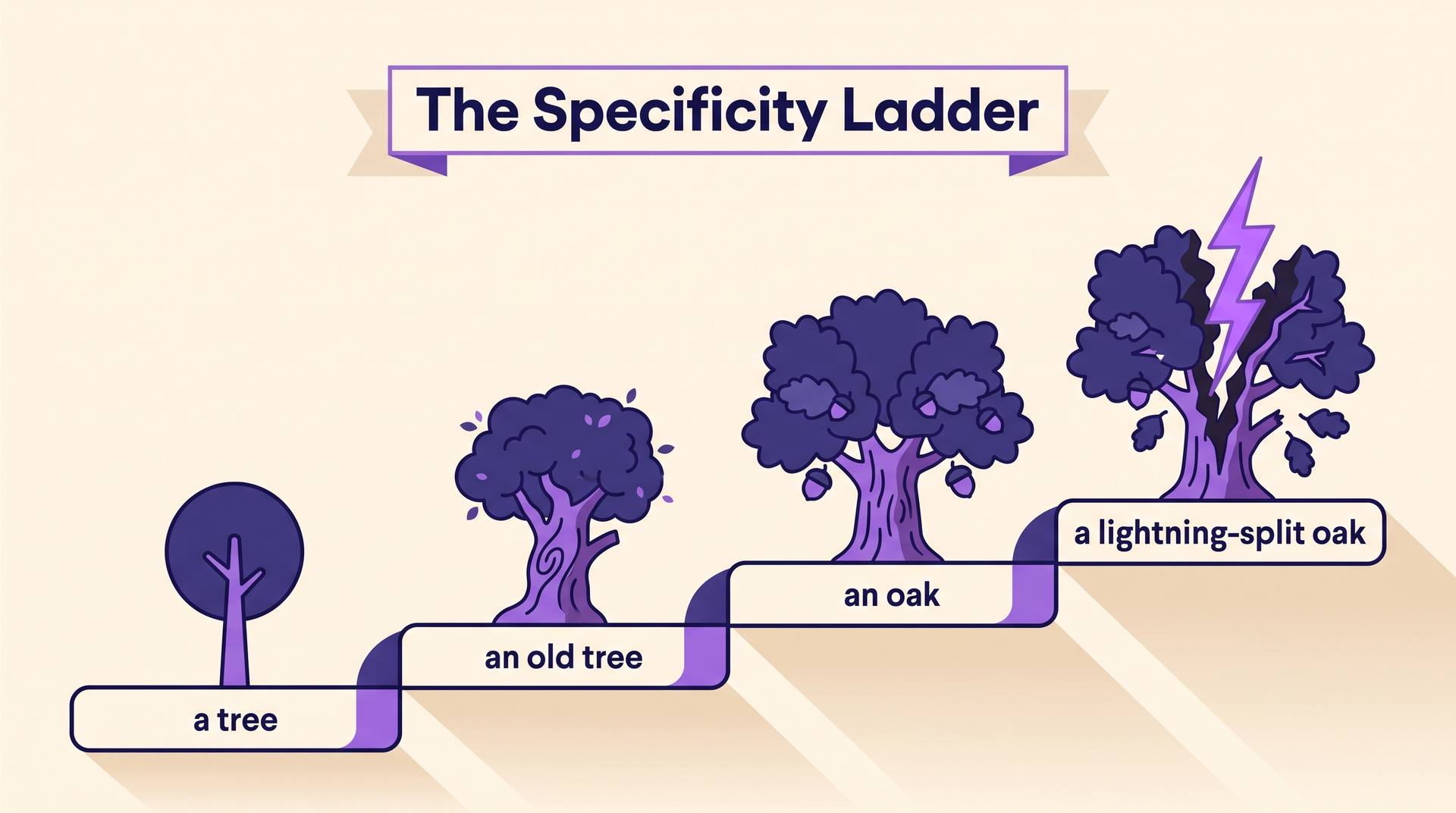
Move each noun one step up the ladder of specificity: from 'a tree' to 'an oak' to 'the lightning-split oak by the gate'. A precise noun does the work of three adjectives, and it cannot be skimmed because the reader has not seen it before.
Filtered: through someone's eyes
Describe what this character would notice, in words they would use. A carpenter sees that the banister is pine painted to look like oak. A widow sees the second coat hook that is now empty. The detail characterizes the viewer as much as the room.
Moving: attached to action
Stack description onto verbs instead of stopping the scene for it. 'She pushed through the bead curtain, which clattered and stuck to her damp arms' describes the curtain, the heat and the entrance in one sentence without a pause.
If you want the theory behind the second test, our guide to show, don't tell covers how filtering and interiority replace summary. For the sensory side, read the piece on imagery in writing.
Before and after: four rewrites
Pick a setting. Each tab shows a flat draft, the revised paragraph, and what changed. The revisions are not longer; two of them are shorter.
Before
The kitchen was old and dirty. There were dishes everywhere and it smelled bad. The light was dim and the whole place felt sad and neglected.
After
Three weeks of cereal bowls stood in the sink, each one glued to the next. The bulb over the table had gone, so Mara read the eviction notice by the fridge light.
What changed
Adjectives like 'old', 'dirty' and 'sad' became evidence: a count of weeks, a dead bulb, a letter read by the fridge. The mood is still sad, but the reader reaches that conclusion alone, and the plot arrives in the last clause.
Notice that none of the revisions uses a rarer word. Vivid comes from specific nouns and verbs, not from vocabulary.
A five-step pass for any descriptive paragraph
Use this on the revision draft, not the first one. First drafts are for getting the scene down; description gets sharp when you already know what the scene is for.
- 1
Name the paragraph's job
Write one line in the margin: what should the reader feel or learn here? 'Unease', 'she is poorer than she admits', 'the exit is behind him'. A paragraph without a job gets cut or merged.
- 2
Choose the one detail that carries it
List five details you could include, then keep the one that does the job best. Readers remember a single sharp detail and forget a list of adequate ones.
- 3
Pick the sense that is least expected
Sight is the default. If the scene already has plenty of it, reach for sound, smell, temperature or texture. One non-visual detail makes a place feel physically real.
- 4
Delete filter verbs
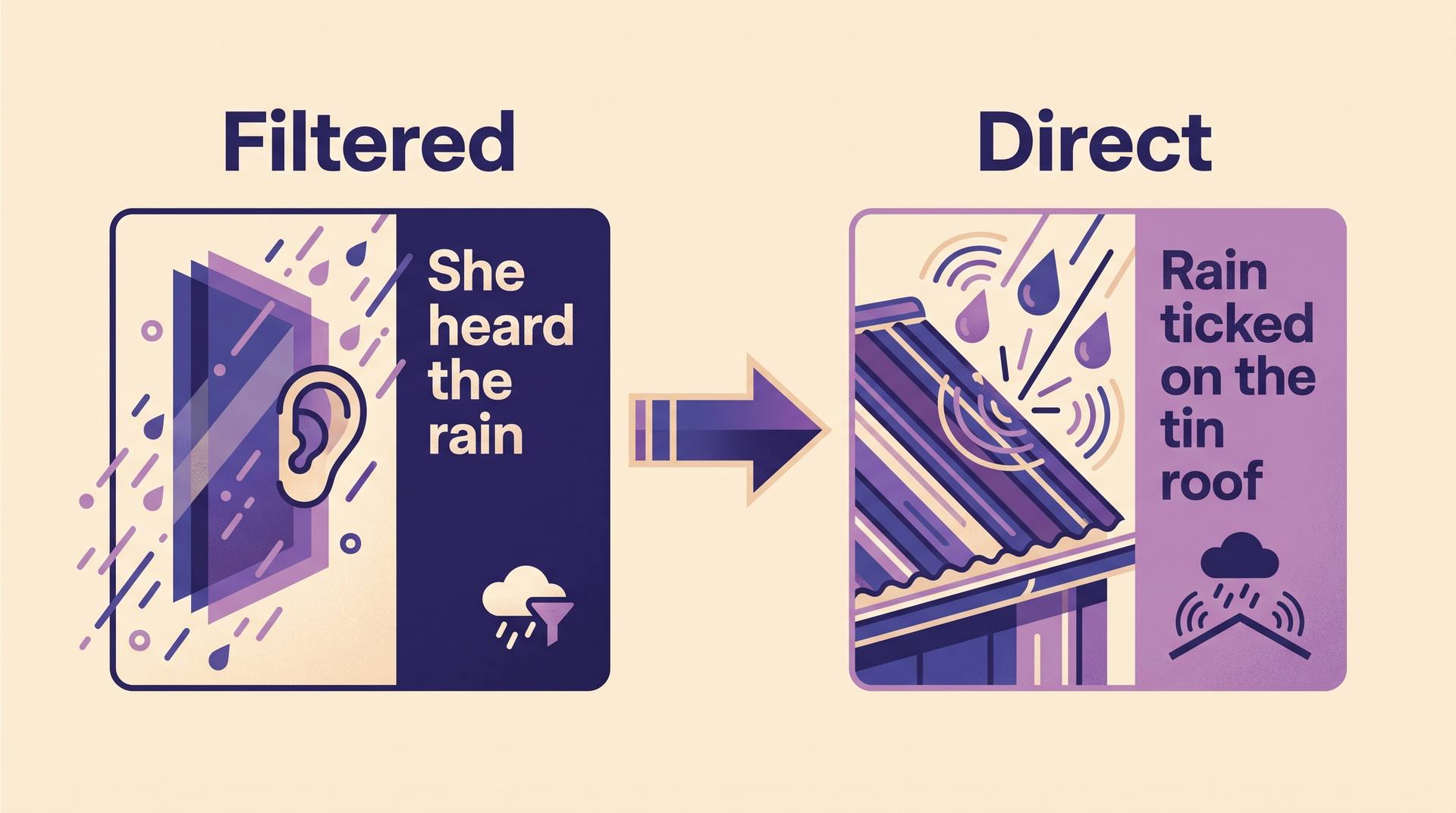
Cut 'she saw', 'he heard', 'she felt', 'he noticed' and give the thing directly. The point of view already tells the reader whose senses these are.
- 5
Read it at the story's speed
In a chase, cut description to clauses. In an arrival or a quiet aftermath, let it breathe. The same detail can be right in chapter two and wrong in the climax.
Stuck on what a location actually contains? Our free scene builder sketches a setting, the sensory details and the conflict in it, which gives you raw material to choose from in step two. For a whole invented place, the world builder lays out geography, culture and history first.
Mistakes that tip into purple prose
Purple prose is description that draws attention to the writer instead of the world. These are the six patterns that cause it most often.
Adjective stacks
'The ancient, crumbling, ivy-covered stone wall.' Three of those four words are guesses at the same image. Keep the one the reader could not supply.
Adverbs propping up weak verbs
'Walked slowly and heavily' is 'trudged'. 'Said angrily' is usually a line of dialogue that should carry the anger itself.
Metaphors that fight each other
One comparison per image. A sea that is 'a sheet of glass' and 'a restless beast' in the same paragraph asks the reader to picture two things and believe neither.
Describing on arrival, every time
Opening every scene with a paragraph of setting trains readers to skip your first paragraph. Drop the place in through the character's actions instead.
Cataloguing the whole room
Nobody walks into a room and inventories it clockwise. Give two or three details and let the reader furnish the rest.
Describing what the reader already knows
The hero's eye color in chapter nine, again. Repeat a detail only when it has changed, or when the change is the point.
If a friend has told you your writing is 'overwritten', our breakdown of purple prose and how to fix it shows how to find the worst paragraphs quickly. And if you like a rich style on purpose, read the guide to a lyrical writing style that stays readable: lush and purple are not the same thing.
Where AI actually helps
AI is weak at choosing the one right detail on its own, and strong at giving you twenty candidates to choose from, or at tightening a paragraph you have already written. Use it for the second half of the job, not the first.
Generate options, then choose
Ask for ten concrete details about a location as seen by one specific character, then keep one. The choosing is the craft, and it stays yours.
Tighten in place, with a diff
In AIWriteBook, the chapter AI chat can rewrite a single selected paragraph, for example 'cut the adjective stacks and filter verbs', and shows every change as a diff you accept or reject one by one. You keep the details that matter and refuse the rest.
Keep it in your voice
When you import a manuscript or paste a sample of your prose, AIWriteBook learns your writing style and uses it for every generated chapter, so new description reads like the rest of your book instead of like generic AI.
Read more about how the AI chapter generator uses your outline and style, or open the AI book editor to revise an existing draft.
Templates you can copy
Two tools for your revision pass: a checklist for any descriptive paragraph, and a prompt for generating detail options with an AI model.
Description checklist
0 of 8 checkedDetail-options prompt
Here is the scene so far: [paste scene] The viewpoint character is [name], a [job, age, mood right now]. List 10 concrete, specific details about [the place or person] that this character would notice in this moment. Use at least four senses besides sight. One short phrase each, no adjectives stacked on the same noun, no metaphors.
The short version
Swap the adjective for a precise noun, filter the detail through someone who cares about it, and hang it on an action. Do that consistently and you will not need a single rare word to be called vivid.
Description is one skill among many that a finished book needs. For the full path from idea to published manuscript, see our complete guide to writing a book.