

The short version
Five acts divide a story into five movements. Act 1 lights the fuse. Act 2 escalates. Act 3 delivers the turn everything pivots on. Act 4 deals with the wreckage that turn creates. Act 5 settles the account. Exposition, rising action, climax, falling action, resolution are labels for those movements, not extra machinery on top of them.
The distinguishing feature is not the count. It is the weight of Act 4. A three-act story compresses everything after the climax into a few closing pages; a five-act story treats the aftermath as a full movement with reversals of its own. If your book's real subject is consequence, that fourth act is the reason to reach for this shape.
Where the five acts came from
The convention is Roman before it is English. In Ars Poetica, written around 19 BC, Horace laid down a rule that outlived its author by two thousand years.
Let no play be either shorter or longer than five acts.
Horace was prescribing, not describing — Greek tragedy had no fixed act count. Seneca followed the rule, Renaissance schoolmasters taught Seneca, and the five-act play reached Elizabethan England as received wisdom rather than discovery.
Shakespeare is a complicated witness for the 5 act structure: most quartos printed in his lifetime carry no act divisions, and the tidy five-act layout in a modern paperback of Hamlet was largely supplied by later editors, Nicholas Rowe's 1709 edition being the one that made it standard. The convention was in the air when he wrote; the numbered acts came afterwards. It became a diagram in 1863, when Gustav Freytag published Die Technik des Dramas and drew five-act tragedy as a pyramid — a rise to a central peak and a symmetrical fall away from it. Freytag's last stage was the catastrophe, not a gentle winding-down; the softer word resolution is a later classroom substitution. His pyramid gets its own guide here.
The shape on paper
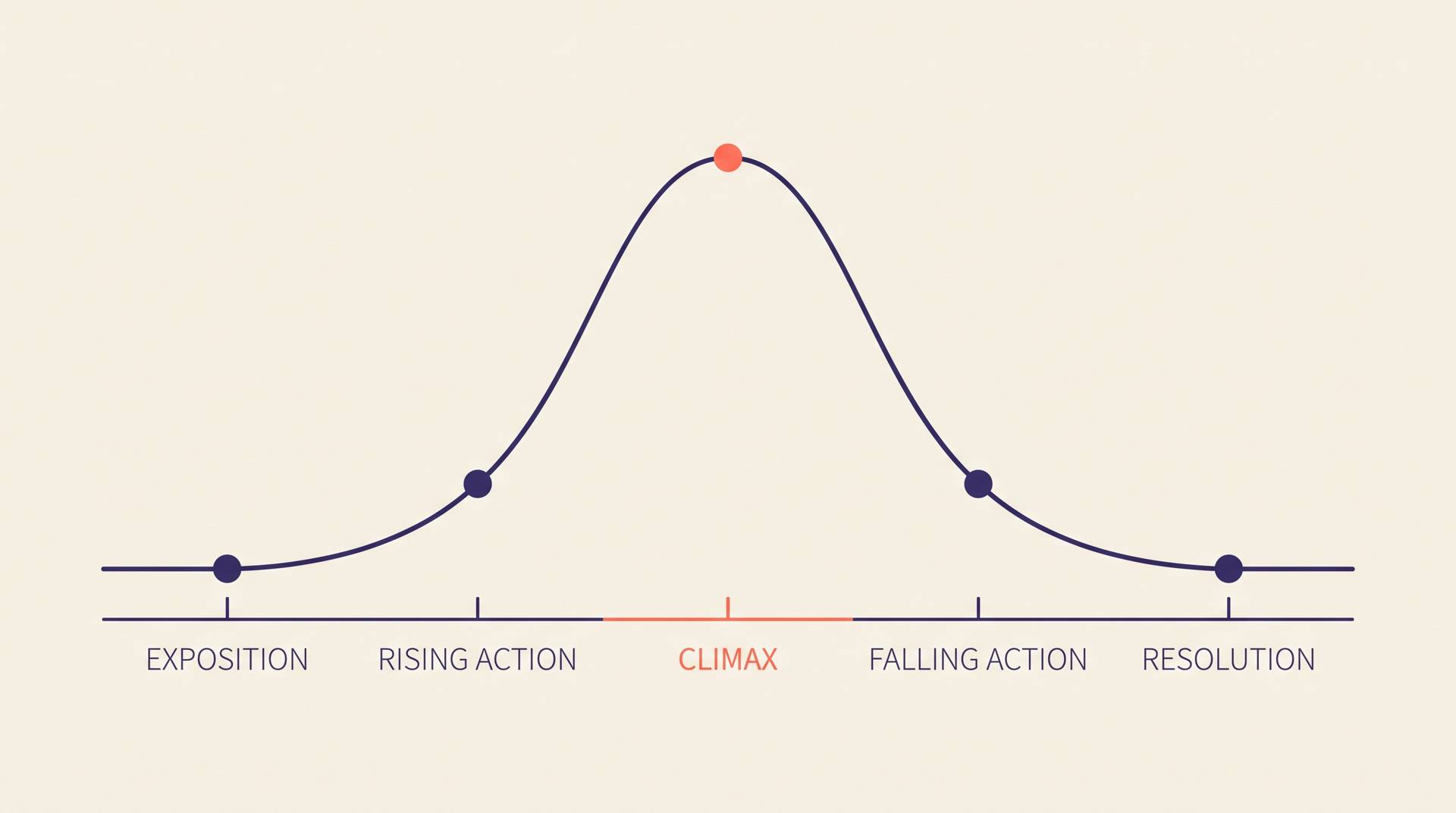
Two things about that curve are worth arguing with. The symmetry is a stage convention: an audience sits through forty minutes of falling action because they are already in the theatre, while a novel reader past the climax can feel how many pages are left in their hand. And a smooth line misrepresents Act 2, which is a staircase of setbacks rather than a ramp. Our plot diagram guide puts this curve beside the other common story shapes.
The five acts, one at a time
Open an act for its job, roughly how much of the book it takes, the question it must answer, and what Shakespeare does with it in Romeo and Juliet — the cleanest five-act example in English, because the play changes genre at the exact centre.
What the act does
Establishes the world, the people, and the pressure already on them, then introduces the disturbance that makes the book necessary. Freytag called it the exciting force, and it belongs near the end of the act, not the start.
Typical share of the book
Roughly 15 to 20 percent
The question it must answer
Why does this story begin today and not on any other day?
Romeo and Juliet
Verona's feud is staged as a street brawl before a single lover appears. Romeo, sulking over Rosaline, is talked into crashing the Capulet feast, meets Juliet there, and each learns afterwards that the other belongs to the enemy house.
Five acts vs three acts, honestly
The two shapes are less rivals than different resolutions of one picture. Three acts is five acts with the middle three fused into a single confrontation, and the percentage beat map in our three-act structure guide will serve most commercial novels perfectly well.
What changes is where the pressure sits. Three acts hands you one long second act, around half the book, and a short tail after the climax. Five acts splits that middle into escalation and consequence with the turn between them. A writer in three acts asks how to keep the middle from sagging; a writer in five asks what the victory costs.
Five acts also gives subplots cleaner joints: a thread planted in Act 1 can run beneath the main line, collide with it at the climax, and pay off during the falling action. If that scheduling is what you find hardest, these subplot examples go deeper.
Choose five acts when
- Your ending is a consequence rather than a victory — tragedy, crime, political fiction, a fall from grace.
- The aftermath of the central turn is the part you most want to write.
- You are working long: a saga, a multi-POV epic, anything past about 100,000 words.
- Your midpoint genuinely reverses the story's direction instead of just raising the stakes.
Choose three acts when
- The climax is the payoff and readers want to leave soon after it — most thrillers, romance and middle grade.
- It is your first novel and you want the fewest moving parts you can get away with.
- The book is short, under roughly 70,000 words, and a full fourth act would stretch it thin.
- You are pitching to agents or producers who think and speak in three acts.
A worked example: one thriller across five acts
Structure arguments stay abstract until someone runs a premise through them, so here is an original one. Ines Varga audits supply ledgers for a chain of regional clinics. Her sister is a patient at one of them.
Act 1 gives us the job before the crime: reconciliation spreadsheets, a boss who prizes clean quarters, the unglamorous competence Ines has built a life on. The exciting force lands on page forty, when a clinic bills for four thousand doses of a cardiac drug its own cold-storage log says never arrived. She files a query. It is closed that afternoon by someone outside her department.
Act 2 is a staircase of closing doors. The original manifests were migrated; a nervous pharmacist confirms the shortfall, then stops answering; a glowing review arrives with a transfer six hours away. Every move Ines makes to stay legitimate removes a legitimate move, and by the end of the act she is copying files she has no authority to copy.
Act 3 is the turn, and it is not the confrontation she planned. She brings her evidence to the board and finds her own electronic signature on eighteen months of falsified approvals. In four minutes she goes from auditor to suspect, and nothing afterwards can put her back — the only real test of a climax worth building toward.
Act 4 is where a three-act version would already be sprinting for the exit, and where this story lives. The pharmacist recants under legal pressure. Her sister's treatment goes under review at the same chain Ines is accusing. Prosecutors move first because the company hands them a defendant. Her last lever is a courier's delivery log, destroyed nine months ago — except that one driver photographed his route sheets nightly, for reasons that have nothing to do with fraud.
Act 5 settles the account rather than winning the argument. The driver testifies, a chief financial officer takes the fall, the parent company settles without admitting anything, and the four thousand doses are never located. Ines is cleared and unemployable. The last scene puts her behind a smaller desk, auditing a smaller thing, checking the numbers twice.
Plan your novel in five acts
This is the order that works when you are staring at a blank outline. It starts at the end on purpose: the five-act shape is defined by its consequences, and you cannot weigh consequences you have not chosen.
- 1
Write the ending in one sentence
Name who pays and what it costs, in plain language. “The auditor is cleared and unemployable” is a usable ending. “She wins” is not. Every later decision gets measured against this sentence.
- 2
Place the turn
Choose the single irreversible event of Act 3 — the one that makes your ending inevitable rather than merely possible. Write it as a before-and-after: what is true entering the scene, and what is permanently true leaving it.
- 3
Build Act 1 backwards from the turn
Ask what the reader must already understand for the turn to land: which relationships, which rules, which weakness. Put only that in the first act, and place the exciting force near its end so the act closes in motion.
- 4
Chain Act 2 as a list of closing doors
List five to eight complications and test each one: does it remove an option the protagonist had a scene ago? Anything that only adds incident gets cut or merged. This is what keeps escalation from becoming a sequence.
- 5
Give Act 4 its own reversal
Write the plan the characters make to undo Act 3, then break it in a way they could not have predicted from inside it. A fourth act with no reversal is a mop-up, and a mop-up is the failure five acts exist to prevent.
- 6
Break the five acts into chapters
Convert each act into chapters with a target word count, then check the shares: if Act 4 is two chapters long you have written three acts with extra headings. Give every chapter its own brief — events, reveal, who is in the room.
For step six you can draw the grid yourself or start from a draft: the free outline generator turns a premise into a chapter list in a couple of minutes, which is enough of a skeleton to start moving acts around and arguing with.
Four ways the five-act plan goes wrong
Treating act breaks as chapter breaks
Acts are structural, not typographical. Nothing on the page has to announce them, and printing “ACT THREE” on a divider has not thereby earned a third act. Delete the headings — would a reader still feel the turn?
Putting the climax dead centre because Freytag drew it there
A stage audience is captive for the falling action; a reader can feel how many pages are left. In a novel the turn usually wants to sit around the 55 to 65 percent mark, with Act 4 compressed accordingly.
Letting Act 4 become housekeeping
Falling action should not feel calmer than rising action, only differently frightening. Its tension comes from consequence rather than opposition, which means someone has to be losing something in every scene.
Using Act 5 to explain the book
A resolution shows the new order; it does not summarise the argument. When a fifth act turns into one character explaining the story to another, the real problem is back in Act 4, where the meaning was supposed to be dramatised.
Turning a five-act plan into an actual outline
The tedious part of five-act planning is not the theory, it is the conversion: five movements have to become twenty-eight chapters with word targets, each carrying enough of a brief that you can write it months later without rereading your notes.
That is what the Outline step does inside the AIWriteBook book-creation flow. Once the premise, details and cast are set, it writes a story synopsis and a card for every chapter — plot events, hooks and twists, locations, the characters in the scene, a target word count — and you can set the chapter count, regenerate one card, reorder, insert a chapter between two others, or edit any field by hand before a word of prose is drafted. That is what lets you push a climax later or give a thin fourth act two more chapters.
Because the outline feeds every chapter that gets written, the structure you settle on is what the draft actually follows. The outline builder feature page walks through a chapter card, and the free outline generator is the quickest way to see the shape of your own premise.
Use the fourth act or use three
Five acts are not a more sophisticated version of three. They are a different bet about where a story's meaning lives. If it lives in the climax, three acts will serve you better and spend less of the reader's patience. If it lives in what the climax costs — the letter that arrives too late, the settlement that admits nothing — then the fourth act is not padding, it is the book.
Pick the shape that matches the ending you already wrote in one sentence, and resist switching halfway. For the rest of the process around it, see our complete guide to writing a book.