


What is a subplot?
A subplot is a secondary story line that runs alongside the main plot and changes either its meaning or its outcome. That second clause is the part most definitions leave out, and it is the whole job. A story line that merely runs alongside is a digression. It becomes a subplot the moment the book would be damaged by cutting it.
Structurally it is a miniature of the main plot: somebody wants something, something blocks them, the question gets answered. What keeps it from feeling like a second book stapled to the first is shared material — the same characters, the same setting, or the same argument about the world.
Scale is worth getting right early. A subplot usually surfaces in six to ten scenes and occupies a minority of the page count. Thinner than that and it reads as a loose thread the author forgot; much fatter and you no longer have a subplot, you have a dual narrative, which is a different structural animal with its own rules.
The one-sentence version
A subplot is a second story that the main story cannot finish without.
Five types of subplot, with examples
Almost every subplot in commercial fiction is doing one of five jobs. Pick a tab to see the job, a famous book that does it well, and the one move worth stealing. The mirror type overlaps heavily with the foil character technique, and the two stack well when you want contrast doing double duty.
Romantic
Harry Potter — J.K. Rowling
The example
Ron and Hermione argue their way through seven books. Rowling plants it with the troll in the bathroom in the first year, strains it at the Yule Ball in Goblet of Fire, breaks it open in Half-Blood Prince, and settles it in the middle of the Battle of Hogwarts.
What it does for the main plot
It gives an abstract war a private stake. A reader who feels nothing about the fate of wizarding Britain still feels two friends who might not live long enough to admit anything. It also measures time — the romance ages as the characters do, which is why the series reads as a childhood rather than seven missions.
Steal this
Attach the romance to the main plot's clock. If the couple can only arrive at each other once the central problem is solved, every plot beat quietly doubles as a romance beat.
Even the very wise cannot see all ends.
Tolkien puts the thesis of the complication subplot in Gandalf's mouth in chapter two and then spends a thousand pages proving it. Gollum is the end nobody could see.
The braid, not the parallel line
Picture two threads rather than two lanes. The main plot runs straight through the book; the subplot weaves over and under it, and the places where they touch are the only places it does structural work. Everything between crossings is maintenance — keeping the thread warm so the next crossing is believable.
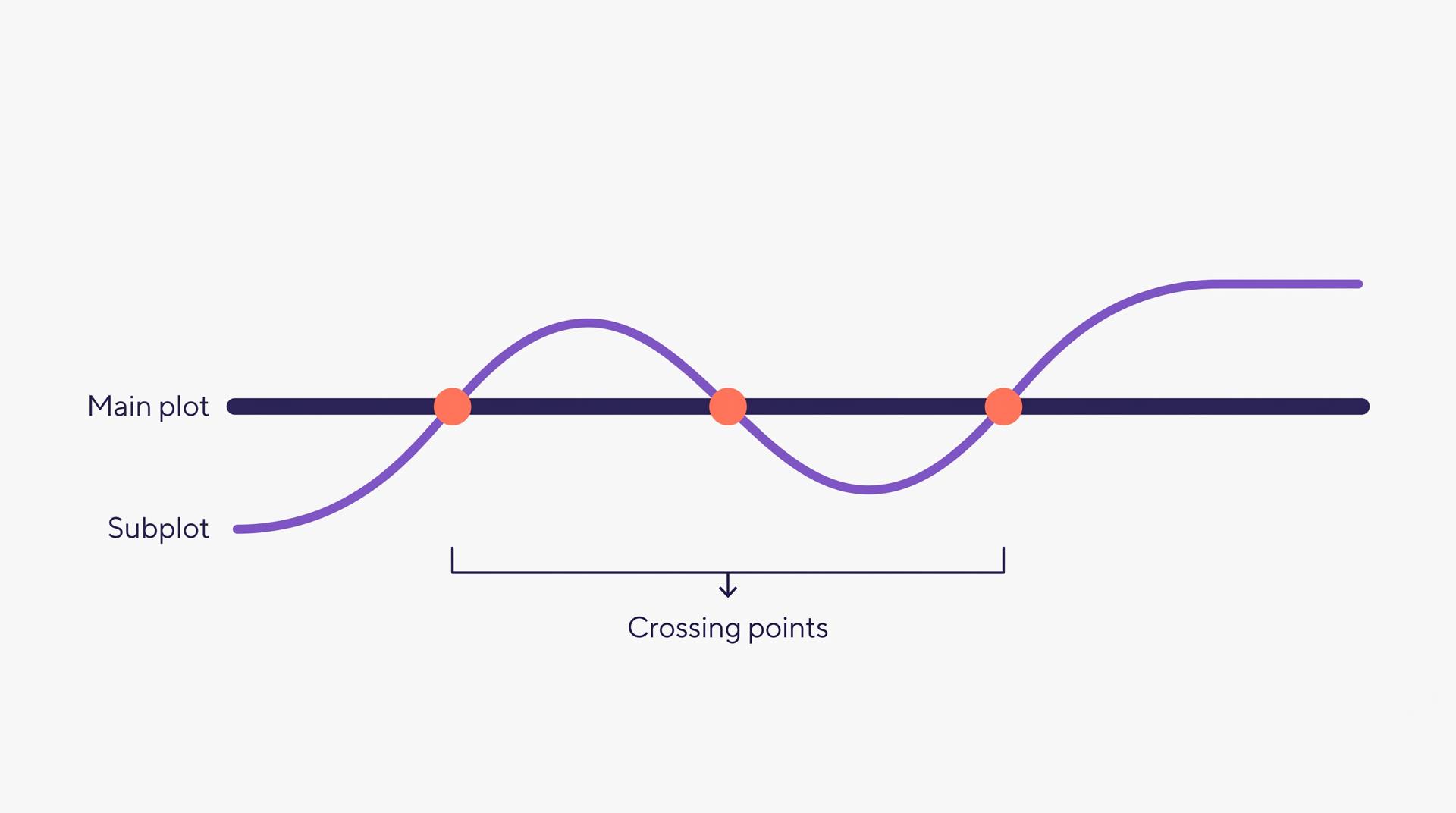
How to weave a subplot, act by act
The timing is not arbitrary. A subplot introduced too late reads as an emergency; one resolved too late reads as an afterthought. Three anchors do most of the work, and they map onto any beat sheet you already use.
- 1
Introduce it by the end of act one
The reader should know the second story exists before the main plot commits to its course — ideally while they are still forming expectations. Whether you are working from a three-act map or a longer five-act shape, the subplot's opening image belongs in the same stretch of pages as the main plot's inciting incident, not after it.
- 2
Cross the main plot at the midpoint
The midpoint crossing is the one most drafts miss. The subplot has to cost the protagonist something here, or hand them something they will go on to misuse. If you know the two threads must collide but not what the collision should produce, running the setup through a plot twist generator is a quick way to break the block before you draft into a dead end.
- 3
Resolve it just before or during the climax
The subplot's answer should arrive close enough to the climax that it is still in the reader's hands when the main question is settled. Resolve it early and the last act sags; resolve it after and you have written an epilogue where a structure should be.
A worked example: the heist and the daughter
Abstract advice about braiding is easy to nod at and hard to apply, so here is a small original one, spelled out crossing by crossing.
Main plot
A five-person crew plans to take a case of bearer bonds out of a private vault during a scheduled overnight power cut in a downtown tower.
Subplot
Mara, who leads the crew, has a nineteen-year-old daughter, Ivy, who has not spoken to her in six years.
Crossing one — end of act one
The only workable route into the vault runs through the building's security contractor, and Ivy took a job there last spring. Taking the score means using her. Mara says yes, and the subplot stops being backstory.
Crossing two — midpoint
Mara makes contact under a pretext, gets the shift rotation, and lies about why she came. Ivy is glad to see her. The crew now has the schedule it needs, and Mara has acquired something she can lose — which is the only kind of midpoint gain worth writing.
Crossing three — climax
The power cut starts forty minutes early and Ivy is still on the floor. Mara has the case in her hands and a stairwell in front of her. The whole subplot exists so that the reader knows exactly what this choice costs her either way.
Delete the daughter and the climax is a timing puzzle: does the crew get out. Keep her and the same forty minutes deliver a verdict on who Mara is. That is the difference a subplot makes, and it costs perhaps eight scenes.
The test: delete it and see
One question sorts real subplots from padding. If you delete the subplot entirely, does the climax still work? If the answer is yes, you have either an ornament to cut or a thread to wire in — and wiring in takes only one of two moves.
Make it supply something
The climax needs a piece of information, a person in the wrong place, a debt, a key. Let the subplot be where that thing was produced, and the main plot cannot finish without it.
Make it change the price
Leave the outcome identical but let the subplot decide what winning costs. Same result, different meaning — and this is usually where a character arc is actually measured, since the reader learns who the protagonist is from what they are willing to pay.
Four ways subplots go wrong
It never touches the main plot
The most common failure and the easiest to diagnose: the subplot has its own scenes, its own cast, and no crossings. Readers describe these chapters as the ones they skimmed. Either give it a crossing or give it to a different book.
Too many for the length
Subplot count scales with page count, not with ambition. A rough working rule: about one subplot per 30,000 words of finished manuscript, which means a novella carries one and most novels carry two or three. Four threads in 60,000 words leaves none of them room to resolve properly.
It is better than the main plot
You will hear this from beta readers as a compliment — the book really picks up whenever that character shows up. The fix is almost never to shrink the good thread. Promote it, or raise the main plot's stakes until it can hold its own.
It resolves in the epilogue
If the subplot's ending can wait until after the climax, it was decoration. Move the resolution forward into the last act and check whether anything in the climax changes. If nothing does, apply the deletion test above.
Keeping threads straight while you draft
Tracking a subplot across a full manuscript is mostly a memory problem. In AIWriteBook the outline step comes before any drafting, so you can plan which chapters carry which storyline and see the crossings laid out as chapter beats instead of holding them in your head — the outline builder is where that map lives.
Then, while drafting, the chapter AI chat reads the book you have actually written. Asking it where a thread was last mentioned, or whether a subplot character has appeared since chapter nine, is faster than scrolling, and changes come back as a diff you accept or reject line by line rather than a wholesale rewrite.
If you are still deciding whether the second thread is worth carrying at all, the free outline generator will rough out a chapter map from a premise in a couple of minutes, no account required.
Apply it to your book
Plan the storylines first, then draft chapter by chapter with the outline in front of you.
Frequently asked questions
A subplot is a smaller story running inside the book alongside the main one. It has its own goal and its own ending, but it shares characters, setting or theme with the main plot and it changes how the main story turns out or what it means.
The short version
A subplot is not a second thing happening. It is a second thing that the first thing needs. Choose the job it is doing — romance, mirror, complication, thematic argument, buried history — plant it before the first act closes, cross the main plot at the midpoint, and land it inside the climax. Then run the deletion test honestly, because a subplot that survives it is the difference between a story a reader follows and one they argue about afterward.
For the wider picture of how structure, character and drafting fit together, our full how to write a book guide covers the rest of the process.