


What a foil character is
A foil is a character placed beside another so that the contrast between them exposes something about the second character. The word comes from jewellery: a thin sheet of bright metal set under a gemstone so the stone throws more light. The foil is not the point. The stone is.
That is the whole mechanic, and it is more precise than most definitions admit. A foil does not need to be an enemy, a rival, or even a major character. It needs to be similar enough to the protagonist that a reader instinctively compares them, and different on one axis that matters to the story's argument. Similarity is what makes the comparison feel fair; difference is what makes it mean something.
Two brothers raised in the same house who respond to the same father's death in opposite ways is a foil relationship. Two strangers who share nothing are just two characters in a book.
The two-part test
If you cannot finish both sentences, you do not have a foil yet: "These two are alike in ___" and "which is why it matters that one of them ___."
Foil vs antagonist vs rival
This is where most writing advice goes fuzzy, so here is the clean separation. An antagonist is defined by function: they stand between the protagonist and the goal. A foil is defined by effect: they make a trait visible. A rival competes for the same prize. A single character can be all three, or any one alone.
Draco Malfoy is an antagonist and a foil. Samwise Gamgee is a foil and nothing like an antagonist — he carries Frodo up the mountain, and the contrast between his plain endurance and Frodo's slow erosion is exactly what lets you measure the Ring's cost. Sauron is a pure antagonist and no foil at all, because nobody compares themselves to him.
The practical consequence: if you cut a foil, the plot still works but the protagonist goes flat. If you cut an antagonist, the plot stops. That is the clearest diagnostic you can run on your own manuscript. For the function side of that split, our guide to what an antagonist actually does takes it further.
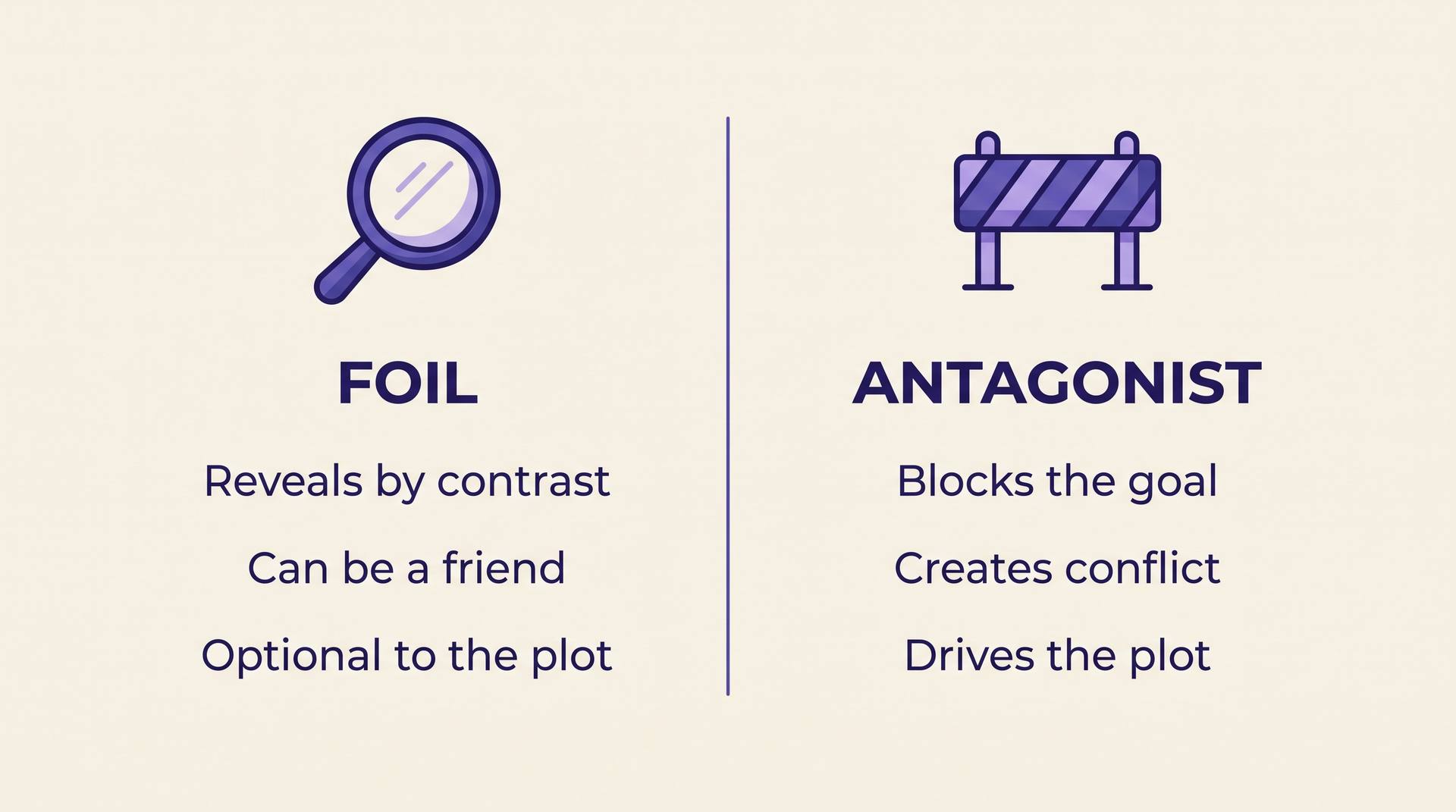
Three roles, three jobs
| Foil | Reveals a trait by contrast | Cut them and the protagonist reads flatter, but the plot still runs |
|---|---|---|
| Antagonist | Opposes the goal | Cut them and the story has no engine |
| Rival | Wants the same thing | Cut them and the stakes lose their scoreboard |
Five foil pairs, dimension by dimension
Pick a pair to see what is held constant, what is varied, and what the contrast actually buys the book. The held-constant column is the part beginners skip.
Hamlet and Laertes
Hamlet, William Shakespeare
Held constant
Both are young noblemen at Elsinore whose fathers are murdered and who are expected to avenge them.
Varied
Laertes acts within hours of learning the news and storms the castle. Hamlet spends four acts testing, staging, rehearsing and postponing.
What it buys
Because Laertes proves that instant revenge was available, Hamlet's delay stops being a plot hole and becomes a character. Shakespeare doubles down with a third case, Fortinbras, who converts his grievance into a military campaign. Three sons, three answers, one question.
By the image of my cause I see the portraiture of his.
Shakespeare puts the technique in the character's own mouth. Hamlet looks at Laertes and sees his own situation drawn more clearly than he can draw it himself — which is exactly what a foil is for.
14 foil character examples
Each entry names the pair, the held-constant similarity, and the axis of contrast, because a foil without a stated axis is just a second character. Several of these characters are also dynamic characters — the two ideas are independent, and a foil can change as much as the protagonist does.
Dr. Watson and Sherlock Holmes
The Sherlock Holmes stories, Arthur Conan Doyle
Both are educated professional men in the same rooms looking at the same evidence. Watson sees a muddy boot; Holmes sees three days in Hampshire. Watson's competence is the floor that makes Holmes's ceiling measurable — a less capable narrator would have made Holmes look merely lucky.
Mercutio and Romeo
Romeo and Juliet, William Shakespeare
Two young men of the same circle with the same appetite for danger. Romeo speaks of love as sacrament; Mercutio treats it as a joke with a punchline. Mercutio's cynicism keeps the reader from mistaking Romeo's intensity for the ordinary way people talk.
Draco Malfoy and Harry Potter
Harry Potter, J. K. Rowling
Same year, same school, both boys of famous wizarding families arriving at eleven with a name that precedes them. Draco takes the house and the friends his family expects; Harry, offered the same shortcut on the first train, refuses it. The refusal is the character, and it only reads as a choice because Draco shows the alternative.
Mr. Collins and Mr. Darcy
Pride and Prejudice, Jane Austen
Both propose to Elizabeth Bennet and both are insufferable while doing it. Collins is a fawning man who cannot imagine being refused; Darcy is a proud one who cannot imagine his pride is showing. Austen uses the first proposal to teach the reader how to hear the second.
Boromir and Aragorn
The Lord of the Rings, J. R. R. Tolkien
Two men of Gondor's line at the same council with the same claim that the Ring could save their people. Boromir reaches for it. Aragorn, who has the better claim to the throne and the older bloodline, does not. The refusal is the whole measure of the man.
Lennie and George
Of Mice and Men, John Steinbeck
Two migrant workers with one shared dream and one shared plan. Lennie is enormous and cannot hold a thought; George is small and holds every thought, including the ones he wishes he could put down. Each makes the other's burden visible.
How to build a foil in four steps
Foils fail when writers start from difference. Start from sameness instead — the contrast only means something if the comparison was fair to begin with.
Name the trait you cannot show directly
Write the one sentence about your protagonist that you keep having the narrator assert: she is reckless, he cannot forgive, she trusts too fast. That assertion is the thing a foil will convert into evidence. If you have more than one, pick the one the ending depends on.
Build the sameness deliberately
Give the foil the same situation, pressure, or claim as your protagonist — same loss, same offer, same deadline, same starting disadvantage. Laertes and Hamlet share a murdered father. Aragorn and Boromir share a council and a temptation. Without the shared setup, readers attribute the difference to circumstance rather than to character.
Vary exactly one axis, and let the foil be right about it
Change the response, not the whole person. And resist making the foil obviously wrong: Jane Bennet's generosity is a virtue, Sam's plainness is a strength, Gale's anger is justified. A foil who is simply worse teaches the reader nothing, because nobody had to choose.
Put them in the same scene at the decision point
Contrast that lives in separate chapters is a note in your outline, not a technique on the page. Stage at least one scene where both face the identical choice in front of the reader, close enough together that comparison is involuntary. That scene is where the foil pays for its word count.
If you are inventing the second half of a pair from scratch, our free character creator is built for exactly this: give it your protagonist's situation and the trait you want thrown into relief, and it drafts a counterpart with a matched background and an opposed response, which you then bend to fit.
Three ways foils go wrong
All three are visible in a first draft if you know what you are looking for.
The opposite-day character
Every trait is inverted: he is tall and gloomy, so she is short and cheerful. Total inversion reads as a gimmick because nothing is held constant, so no comparison is actually being made. One axis of difference, on a bed of similarity, is the whole design.
The foil who exists to be wrong
If the foil's position collapses the moment anyone examines it, the protagonist has not been tested, only flattered. Give the foil the strongest honest version of their choice — a well-chosen entry from a list of real character flaws beats a manufactured stupidity. Readers forgive a protagonist who wins narrowly; they resent one who wins against a strawman.
The foil with nothing to do
A character who only exists to be contrasted becomes dead weight by chapter nine. Give the foil their own want, their own scenes, and their own stake in the outcome. Sam wants to go home and open a garden. Laertes wants his sister's honour back. The contrast should be a byproduct of two people pursuing real goals, not the character's job description.
When not to use a foil
Foils cost pages. In a tight thriller or a short story, the space a properly built foil demands — shared setup, parallel scenes, an independent want — may be better spent elsewhere, and the trait can be shown through a single decisive action instead.
They are also the wrong tool for a character whose defining quality is internal and unshared: grief, faith, a private obsession. Contrast needs a comparable situation, and some situations have no comparison. First-person narration can carry that work more cheaply.
And if your protagonist changes substantially across the book, be careful which version of them the foil is calibrated against. A foil built to expose a flaw in chapter three can start reading as a redundant echo once that flaw is gone. Either let the foil change too, or let them exit.
Building foils with AIWriteBook
Contrast is a bookkeeping problem as much as a creative one. You have to remember, across eighty thousand words, which sameness you established and which axis you promised to vary. Two parts of AIWriteBook are genuinely useful here.
- Define both halves of the pair in the character step before drafting, with the shared setup written down explicitly, so every chapter the AI drafts keeps the comparison fair rather than drifting into two unrelated people.
- Use the chapter AI chat on a finished scene and ask it to sharpen one character's response against the other's — it proposes edits as a diff you accept or reject line by line, so the prose stays yours.
- Run the free scene builder on the single confrontation where both characters face the same choice, which is the scene the whole foil relationship depends on.
- In a series, carry the pair forward from book one so the foil's own arc keeps developing instead of resetting to their introduction.
One honest limit: a model will happily generate a character who is the mechanical opposite of your protagonist, which is mistake one above. Give it the sameness you want held constant and the single axis you want varied, and check the draft against the two-part test yourself.
Frequently asked questions
A character placed beside another so the difference between them reveals something about the second character. They are usually similar in background or situation and different in one important response, and the contrast is what makes the main character's trait visible instead of merely stated.
The takeaway
Every strong foil in this guide is built the same way: two people close enough to compare, one difference that matters, and a scene where the reader has to hold both in mind at once. Get the sameness right and the contrast does the work for free. Get it wrong and you have written a character who is merely different, which no reader has ever found interesting.
Pick the trait in your protagonist you keep asserting rather than showing, and build the person who makes it undeniable. Our complete guide to writing a book covers where that cast work fits in the rest of the process.